
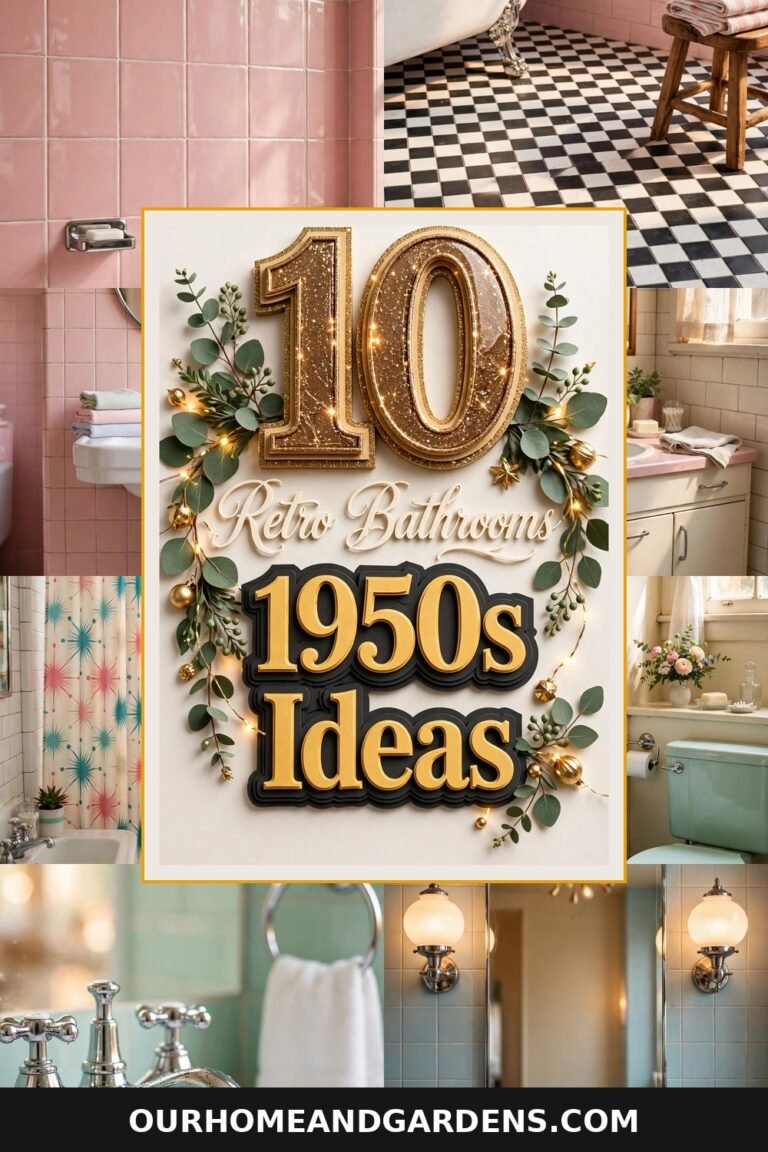
If you have ever walked into a pastel-tiled bathroom and felt instantly happier, you already understand the magic of retro bathrooms 1950s style. The 1950s were optimistic, colorful, and wonderfully playful — and the bathroom was where that spirit showed up in tile, chrome, and clever little details. Think soft pink walls, shiny chrome taps, and floors that make you want to dance in your slippers. The best part? You do not need a full gut renovation to get the look. A few well-chosen changes can bring all that mid-century charm into a modern bathroom, while keeping the plumbing, storage, and easy cleaning you rely on today.
In this guide, you will find 10 distinct ideas for retro bathrooms 1950s style, each with realistic costs, simple how-to guidance, and a practical tip you can use right away. Mix and match them: one pastel accent can be enough, or you can go all in with matching fixtures, patterned tile, and vintage accessories. Either way, the goal is a bathroom that feels cheerful, polished, and personal — never like a museum you are afraid to use.
1. Mamie Pink Tile Walls for Retro Bathrooms 1950s Charm
Nothing says 1950s quite like soft pink tile. Famously nicknamed “Mamie Pink” after First Lady Mamie Eisenhower, this rosy pastel covered countless post-war bathrooms from floor to halfway up the wall, and it still looks fresh today when you balance it with plenty of white. Pink tile works because it warms up a small room instantly, flatters skin tones in the mirror, and pairs beautifully with chrome. It feels nostalgic without feeling childish, especially in a muted, dusty shade rather than a bubblegum bright one.
Materials and realistic cost: glossy 4×4 ceramic wall tiles in soft pink ($8–$15 per square foot for tile), white grout, tile adhesive, and a matching bullnose trim. A single accent wall in a small bathroom typically runs $300–$800 if you hire a tiler, or $120–$300 in materials if you do it yourself.
Start by choosing your pink carefully — order samples and view them in your bathroom’s actual light, morning and evening. Tile one wall, or tile to chair-rail height around the room, and keep the upper walls crisp white. Use white grout for a clean look, or a very pale grey grout if you want the grid to read a little more. Seal the grout once it cures, and you are done.
Practical tip: If full pink tile feels like a lot, tile just the wall behind the sink or the shower surround — you get the full retro hit for a fraction of the cost.
Variation idea: Swap pink for pale turquoise or baby blue tile if pink is not your color; the 1950s pastel formula works exactly the same way.

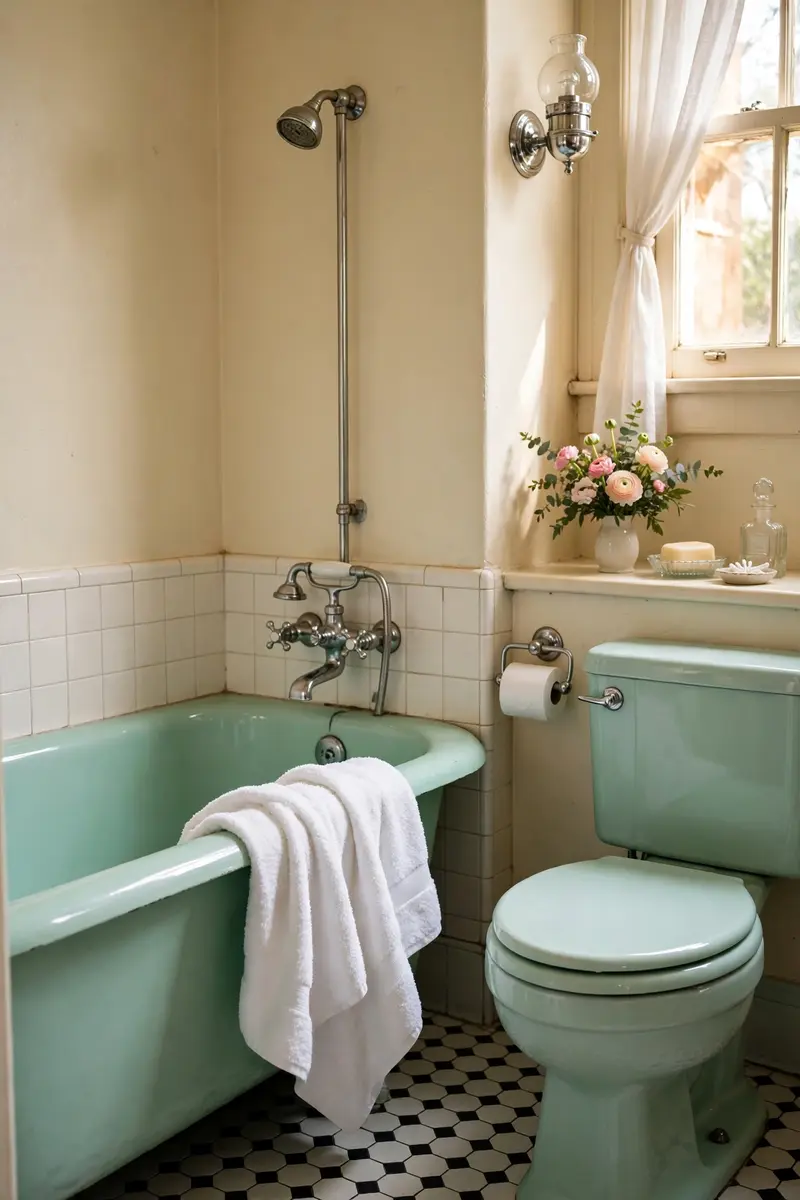
2. A Mint Green Matching Bathroom Suite
In the 1950s, the tub, toilet, and sink often matched in one signature pastel color, and mint green was one of the most beloved. A matching mint suite works because it makes a small bathroom feel intentional and pulled together, like a set designed in one happy moment. The soft green is calming, it hides water spots better than white, and it looks wonderful against cream walls and chrome fittings.
Materials and realistic cost: a reproduction mint pedestal sink ($250–$600), a matching toilet ($300–$700), and either a mint freestanding or alcove tub ($700–$2,000). If your budget is tight, paint-grade or refinished vintage pieces from salvage yards can cost far less — often $100–$400 per piece.
You do not have to replace everything at once. Start with the sink, which is the piece your eye lands on first, then add the matching toilet when your budget allows. Keep the walls warm white and the floor simple so the mint stays the star. If you find an original mint suite in good condition, have a plumber check the seals and fittings before you install it; modern internals can make an old toilet far more water-efficient.
Practical tip: Match the shade, not just the color family — hold paint and tile samples against the actual fixture before you buy anything else.
Variation idea: Try a soft butter yellow suite for a sunnier take, or pair a mint sink with a white tub for a lighter, more modern balance.
3. Black-and-White Checkerboard Floors
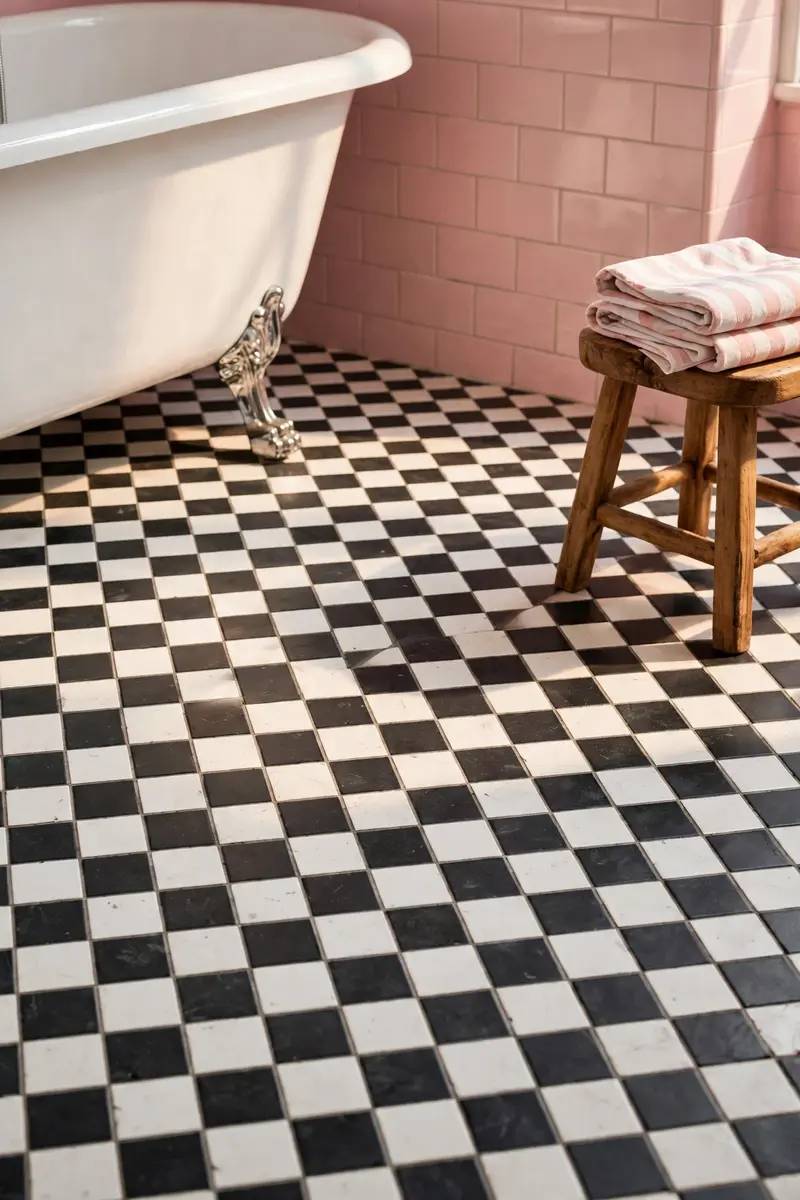
If pink tile is the heart of retro bathrooms 1950s style, the checkerboard floor is its dance floor. Black-and-white checkerboard tiles are bold, graphic, and instantly recognizable, and they ground all those pastels with a confident pattern. The pattern works in tiny bathrooms because the regular grid actually makes the floor feel orderly and larger, and it hides dirt far better than a plain light floor.
Materials and realistic cost: porcelain or ceramic checkerboard tiles ($5–$12 per square foot), black and white grout or a single neutral grout, and underlayment if your subfloor needs leveling. A small bathroom floor usually costs $400–$1,000 installed, or $150–$400 in materials for a confident DIYer.
Lay the tiles on the diagonal if you want a more dynamic feel, or straight for a classic diner look. Use tile spacers for even joints, and choose a grout color that matches one of the tiles so the pattern stays crisp. A matte finish is more forgiving underfoot than high gloss, and it is less slippery when wet. Finish with a white or black baseboard to frame the pattern cleanly.
Practical tip: In a very small bathroom, use smaller checkerboard squares — 4-inch tiles keep the pattern in proportion instead of overwhelming the room.
Variation idea: Try a pink-and-white or mint-and-white checkerboard for a softer version that still reads unmistakably 1950s.
4. Gleaming Chrome Cross-Handle Fixtures
Chrome was the metal of the 1950s bathroom, and cross-handle faucets are its signature. Those little star-shaped or cross-shaped handles, paired with curved spouts and polished chrome towel bars, add sparkle the moment light hits them. Chrome works because it is bright without being fussy, it suits every pastel in the 1950s palette, and it is still one of the easiest finishes to clean and maintain.
Materials and realistic cost: a reproduction cross-handle widespread faucet ($120–$350), matching chrome towel bar and toilet-paper holder ($20–$60 each), and chrome shower fittings ($80–$250). A full faucet-and-hardware swap for one bathroom usually lands between $250 and $700.
Swap the faucet first — it is the single fastest retro upgrade in this list. Turn off the water, photograph the existing connections before you disconnect anything, and check that your new faucet matches your sink’s hole spacing (4-inch centerset or 8-inch widespread). Polish chrome with a soft cloth and a drop of dish soap; avoid abrasive cleaners that dull the shine. Add the matching towel bar and robe hooks last so the whole room reads as one set.
Practical tip: Keep all your metals chrome in a 1950s bathroom — mixing in brushed nickel or matte black breaks the period spell.
Variation idea: If you love a little extra warmth, use chrome for the faucet and add one brass accent, like a small soap dish, rather than switching all the hardware.

5. A Classic Pedestal or Wall-Mounted Sink
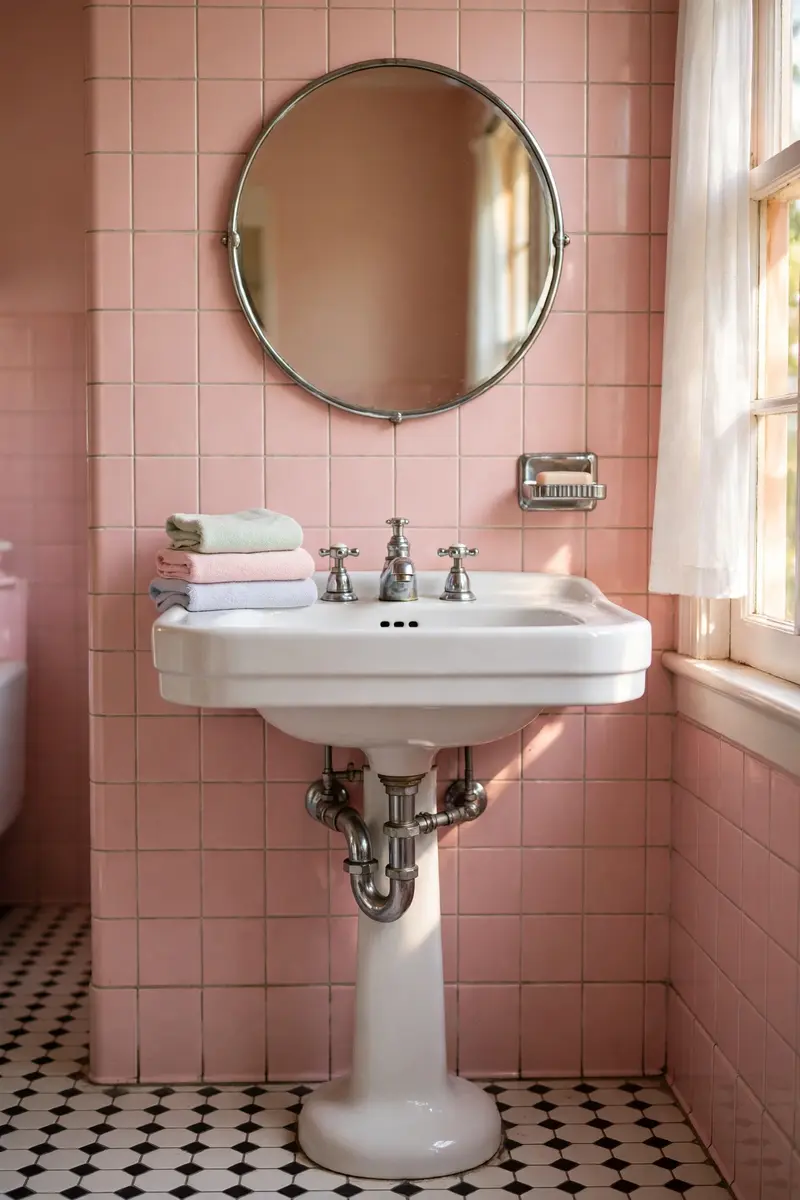
Before big vanity cabinets took over, the 1950s bathroom often featured a pedestal sink or a wall-mounted basin on chrome legs, and both still look wonderful today. A pedestal sink works because it frees up visual space in a small bathroom, shows off more of your pretty tile or floor, and puts the focus on the porcelain shape itself. It is the perfect choice if your bathroom is short on square footage but long on style ambitions.
Materials and realistic cost: a porcelain pedestal sink ($180–$500), a chrome P-trap ($25–$60), and a matching faucet. Installation by a plumber typically adds $200–$400, especially if the drain or supply lines need moving.
Measure carefully before you buy: pedestal sinks vary in width and projection, and you need clearance for the door swing and for comfortable use. A wall-mounted sink with chrome legs is a great alternative if you want a little shelf space underneath for a basket. Pair either style with a simple round or rectangular mirror and a chrome soap dish mounted on the wall beside it, just like the originals had.
Practical tip: Add a small stool or basket beside a pedestal sink for the storage you lose — you keep the airy look without losing a place for towels.
Variation idea: For a family bathroom, choose a wider pedestal basin with a flat back ledge, so there is room for a soap dispenser and a small plant.
6. Penny Tile and Mosaic Shower Accents
Tiny penny-round tiles and colorful mosaics were 1950s favorites for shower floors, niches, and accent strips, and they are one of the easiest ways to add authentic detail today. Penny tile works because the small scale feels handmade and playful, it grips better underfoot than large tiles, and a little goes a long way — a single niche or border can carry the whole retro story. Designers are bringing back retro tile patterns in exactly this spirit, mixing pastel squares with mosaics for a fresh take on the era.
Materials and realistic cost: penny tile sheets ($10–$20 per square foot), mosaic accent tile ($12–$25 per square foot), and waterproof grout. A shower niche or accent strip usually costs $100–$350 in materials; a full shower floor runs $400–$900 installed.
Use penny tile on the shower floor, where its many grout lines add grip, and add a mosaic stripe at eye level on the shower wall. Keep the rest of the shower tile simple — white subway or 4×4 squares — so the mosaic reads as jewelry, not clutter. Seal the grout well, and squeegee after showers to keep those little tiles looking crisp for years.
Practical tip: Carry the same penny tile into a small border around the bathroom mirror or along the top of the wall tile to tie the room together.
Variation idea: Try a floral or starburst mosaic medallion on the shower wall for a bolder, more decorative 1950s moment.

7. A Formica Vanity with Sliding Doors
By the mid-1950s, the Formica-topped vanity with sliding cabinet doors was the modern, practical upgrade from the pedestal sink — and it is still a smart choice. A Formica vanity works because it gives you closed storage for cleaning supplies and toiletries, a durable wipe-clean surface, and a shot of period color or pattern, all without the cost of stone. Boomerang and crackle patterns in pastel or cream are the most authentically 1950s options.
Materials and realistic cost: a ready-made retro-style vanity ($400–$1,200), or a DIY build with a laminate top ($150–$400) over a simple cabinet. Chrome cup pulls or slim bar handles ($3–$8 each) complete the look.
If you are building your own, choose a laminate in a soft pastel or a subtle boomerang pattern and pair it with flat-front cabinet doors. Sliding doors are a lovely period touch and they are practical in a tight bathroom, since nothing swings into your knees. Keep the faucet chrome and the mirror simple, and let the vanity top be the color accent in an otherwise calm room.
Practical tip: Seal the laminate edges carefully around the sink cutout — water creeping into the edge is the one thing that shortens a Formica top’s life.
Variation idea: For a renter-friendly version, wrap an existing vanity top in a pastel laminate-look contact film and swap just the handles for chrome.

8. Globe and Sputnik Lighting
Lighting is where a 1950s bathroom really glows — literally. Milk-glass globe sconces beside the mirror, a sputnik-style ceiling fixture, or a simple chrome pendant were the era’s go-to choices, and they still flatter a bathroom beautifully. Globe lighting works because it spreads soft, even light with no harsh shadows, which is exactly what you want at the mirror, and the round shapes echo the curves of the tub and sink.
Materials and realistic cost: a pair of globe sconces ($60–$200), a sputnik or globe ceiling fixture ($80–$250), and warm-white LED globe bulbs ($10–$25 for a pack). An electrician typically charges $100–$250 to install a new fixture safely.
Place one sconce on each side of the mirror at eye level for the most flattering light — overhead-only lighting casts shadows on your face. If you have only one junction box, a two-light globe bar above the mirror is a good compromise. Choose warm-white bulbs (2700K) so the light feels cozy rather than clinical, and dimmers are worth every penny in a bathroom you also use for relaxing baths.
Practical tip: Frosted or milk-glass globes hide the bulb and soften the light — clear globes look great but can glare at mirror height.
Variation idea: Add a small pink or mint glass shade as a single accent light over the tub for a playful pop of color.

9. Atomic and Floral Pattern Accents
The 1950s loved pattern — atomic starbursts, boomerangs, and cheerful florals showed up on shower curtains, wallpaper, and towels, and one bold pattern is all you need to make a bathroom feel era-perfect. Pattern works because it breaks up all that tile and porcelain with personality, and it is the cheapest, most reversible way to commit to the theme. If you tire of it, you can change a shower curtain in five minutes.
Materials and realistic cost: a patterned shower curtain ($25–$70), a roll of moisture-resistant wallpaper for one accent wall ($40–$120), and matching hand towels ($15–$40 for a set). A full pattern refresh for a bathroom usually costs under $200.
Pick one pattern hero: either the shower curtain or one wallpapered accent wall, not both in competing prints. Keep the pattern’s colors tied to your tile — for example, a starburst print that picks up your pink or mint — and keep everything else calm. In a rental, peel-and-stick wallpaper on a single wall gives you the same effect with no damage. A real-life example shows how keeping original pink tile and adding wallpaper transformed a 1950s bathroom makeover for just $750.
Practical tip: Test a pattern at full size before you commit — a print that looks cute in a thumbnail can feel loud across a whole shower curtain.
Variation idea: If bold wallpaper feels like too much, use the pattern on towels and a bath mat only, and keep the walls plain.

10. Vintage Accessories and a Lighted Medicine Cabinet
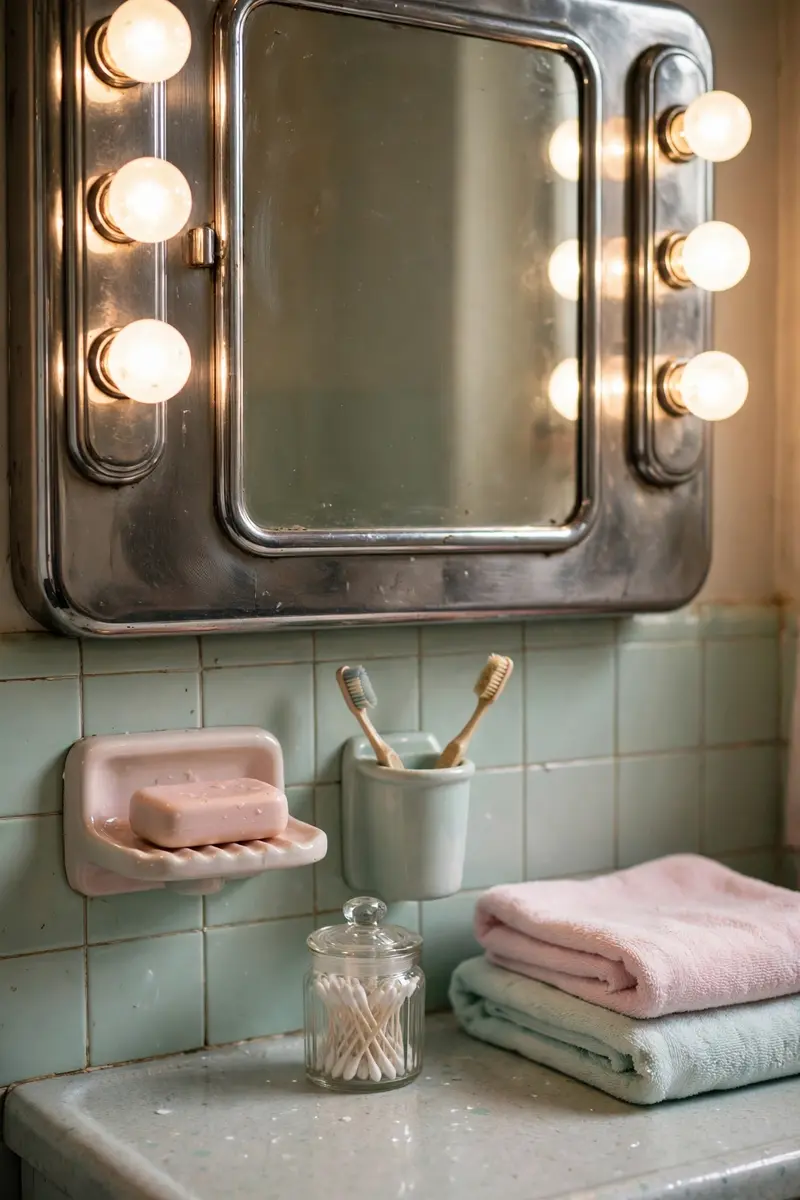
The finishing layer of a 1950s bathroom is all in the accessories: ceramic soap dishes and toothbrush holders mounted on the wall, chrome towel rings, a lighted medicine cabinet, and a small stool or chair for the vanity area. These details work because they are exactly what made original 1950s bathrooms feel complete and considered — every little thing had its own pretty, purpose-built spot. They also make the room more functional, which is the real secret of good retro design.
Materials and realistic cost: a ceramic soap dish and tumbler set ($20–$60), chrome towel rings and robe hooks ($15–$40 each), a lighted medicine cabinet ($150–$450), and a small vintage-style stool ($40–$120). A full accessory refresh usually runs $200–$600.
Mount the soap dish and toothbrush holder at a comfortable height beside the sink, and choose a medicine cabinet with lights on both sides if you can — that side lighting is wonderfully flattering and very period-correct. Add a small framed print in 1950s colors, a glass apothecary jar for cotton balls, and a folded stack of pastel towels. Keep surfaces tidy: the 1950s look is cheerful, not cluttered, so give every accessory a home and edit ruthlessly.
Practical tip: Buy the medicine cabinet first and build the mirror lighting around it — retrofitting lights around an existing cabinet is far harder than the other way around.
Variation idea: For a guest bathroom, swap the stool for a small teak bench with a folded towel and a tiny vase of fresh flowers — instant 1950s hospitality.
Frequently Asked Questions About Retro Bathrooms 1950s Style
How do you decorate a 1950s bathroom?
Start with one anchor — pastel tile, a checkerboard floor, or chrome fixtures — then layer in matching accessories. Keep the palette to one pastel plus white and chrome, add one pattern, and finish with vintage-style lighting. You do not need to change everything at once; even a new faucet, shower curtain, and towels can shift the whole mood.
What colors were popular in 1950s bathrooms?
Mamie Pink, mint green, baby blue, turquoise, and pale yellow were the signature pastels, often used for matching tubs, toilets, and sinks. Black-and-white checkerboard floors and crisp white walls balanced the color. If you want a calmer version today, use the pastel on tile or accessories and keep the big fixtures white.
How can I make my bathroom look retro on a budget?
Focus on the cheapest high-impact swaps: a patterned shower curtain, chrome hardware, a globe light fixture, and vintage-style accessories. Keeping original tile and simply regrouting it can transform a bathroom for very little money, and peel-and-stick wallpaper or floor tile gives renters the same look without permanent changes.
Should I keep original pink tile in a 1950s bathroom?
In most cases, yes — original pink or mint tile in good condition is a prized feature that is expensive to reproduce, and it gives your bathroom genuine period character. Clean and regrout it, update the grout color if needed, and build the rest of the room around it with white walls, chrome, and simple accessories. Replace it only if it is cracked, loose, or damaged beyond repair.
What fixtures define a 1950s bathroom?
The hallmarks are a pedestal or wall-mounted sink, a matching pastel three-piece suite, chrome cross-handle faucets, a built-in alcove tub with a patterned shower curtain, and a lighted medicine cabinet. Globe or sputnik lighting and ceramic wall-mounted accessories complete the picture. You can mix in modern plumbing inside these classic shapes for the best of both eras.
Conclusion: Bring Home the Happy 1950s Spirit
Retro bathrooms 1950s style prove that a bathroom can be practical and joyful at the same time. Whether you start with a single pink tile accent, a checkerboard floor, or a full mint suite with chrome cross-handles, each of these 10 ideas brings a little of that post-war optimism into your daily routine. Start with the change that makes you smile every morning, live with it for a while, and add the next layer when you are ready — the best retro bathrooms grow one charming detail at a time.
If you loved these ideas, save this post to Pinterest so you can find it again when you are ready to renovate, and explore more of our vintage bathroom inspiration — including our vintage bathroom ideas, retro bathroom ideas, and moody vintage bathroom ideas — for even more ways to make your bathroom feel beautifully, cheerfully old-school.
Leave a Reply