
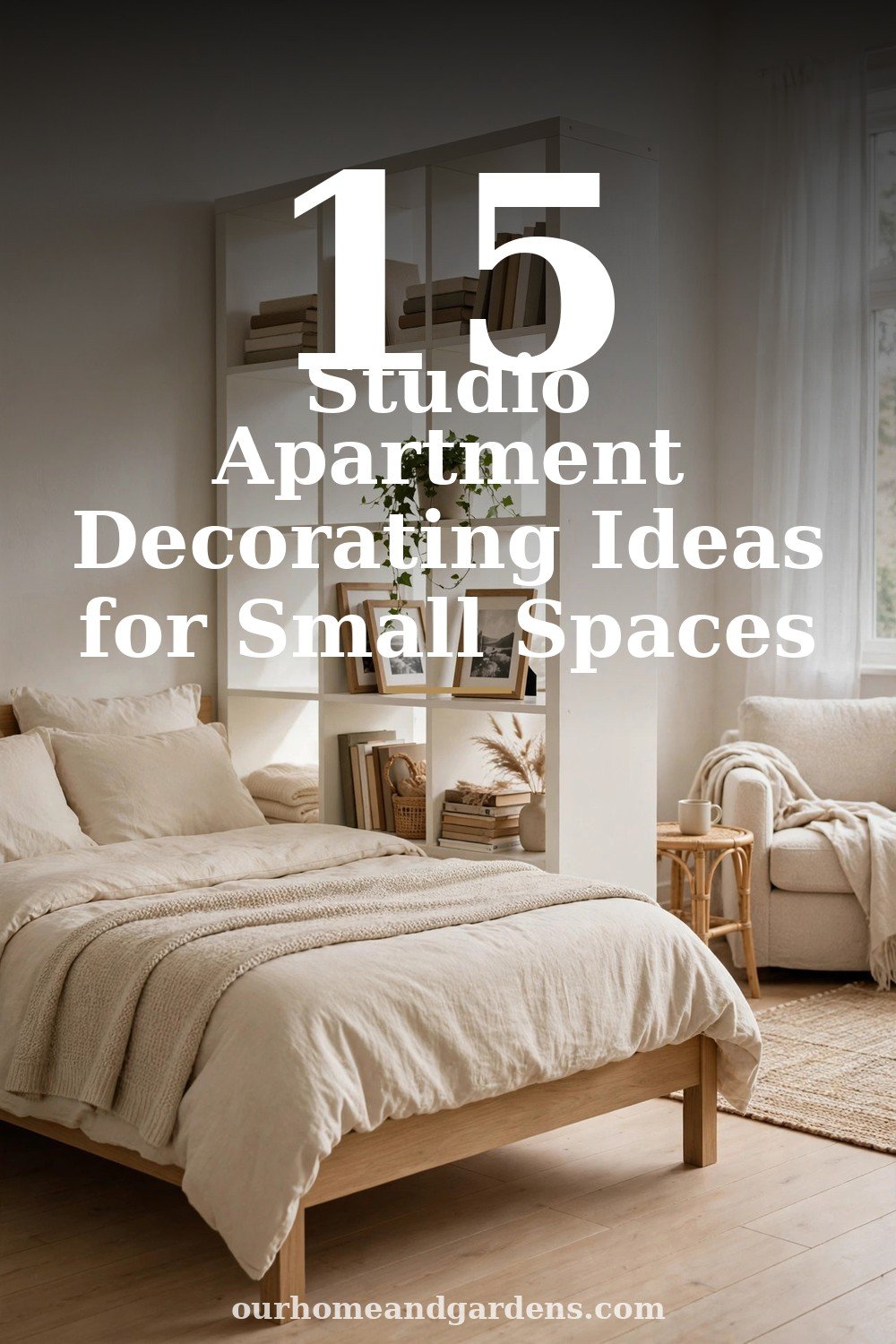
15 Studio Apartment Decorating Ideas for Small Spaces
A studio apartment is one room that has to do the job of four — bedroom, living room, dining room, and office — and decorating it can feel like solving a puzzle with half the pieces missing. But studio apartment decorating ideas don’t have to mean compromise. In fact, some of the most stylish homes you’ll ever see are studios, because a small space forces you to make every choice intentional.
Most of the ideas in this guide cost under $200 each, and several cost nothing but an afternoon. Whether you’re in a 300-square-foot shoebox or a generous 600-square-foot open plan, these 15 studio apartment decorating ideas will help you carve out distinct zones, double your storage, and make your space feel bigger and more beautiful than the floor plan suggests.
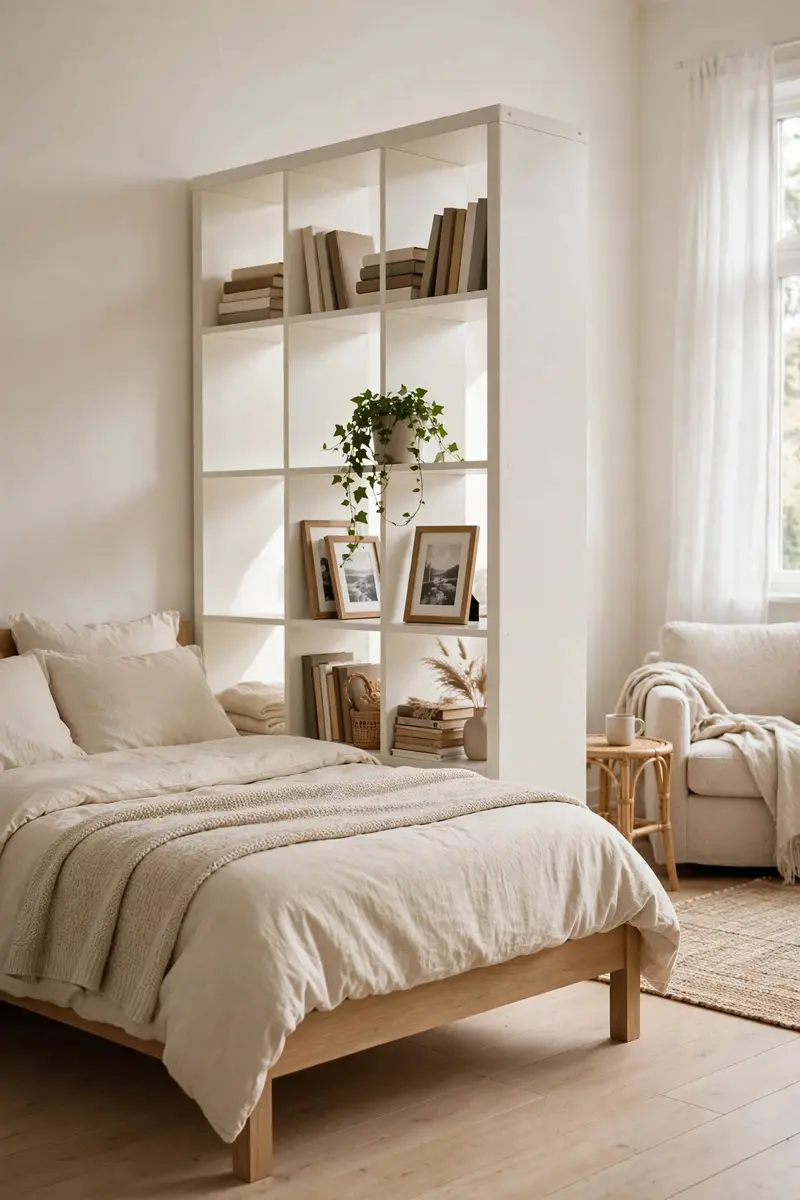
1. Carve Out a Sleeping Zone with an Open Bookcase Divider
A studio’s biggest challenge is that you sleep where you live. Instead of fighting it, define a “bedroom” with an open-backed bookcase placed perpendicular to the wall behind your bed. It separates the sleeping zone from the living zone while letting light flow straight through, so the room still feels open. This room-divider trick is one of the most effective studio apartment decorating ideas for creating privacy. For layout inspiration, see these studio apartment layouts from The Spruce, featuring more studio apartment decorating ideas for small spaces.
Materials and realistic cost: A sturdy 4×4 cube shelf (like IKEA’s KALLAX) runs $70-$130; a slimmer tall bookcase costs $40-$90. Cubes or bins to corral clutter: $15-$30. Total: $55-$160.
How to do it: Position the bookcase at the foot of your bed or along its side, perpendicular to the wall, to create a partial wall. Anchor it to the wall or floor with anti-tip hardware — a loaded bookcase is top-heavy. Style it from both sides: facing the bed, keep it practical (books, chargers, a small lamp); facing the living area, style it like decor (framed photos, a trailing plant, ceramics). Leave some cubes open for airiness; overfilling kills the light-through effect.
Practical tip: Never place a solid-backed tall bookcase as your first divider — it blocks light and makes the studio feel sliced in half. Open-backed or open-front shelving keeps the eye moving through.
Variation: Renting and want zero commitment? Use two matching low bookcases back-to-back at knee height — they define the boundary without blocking sightlines at all.
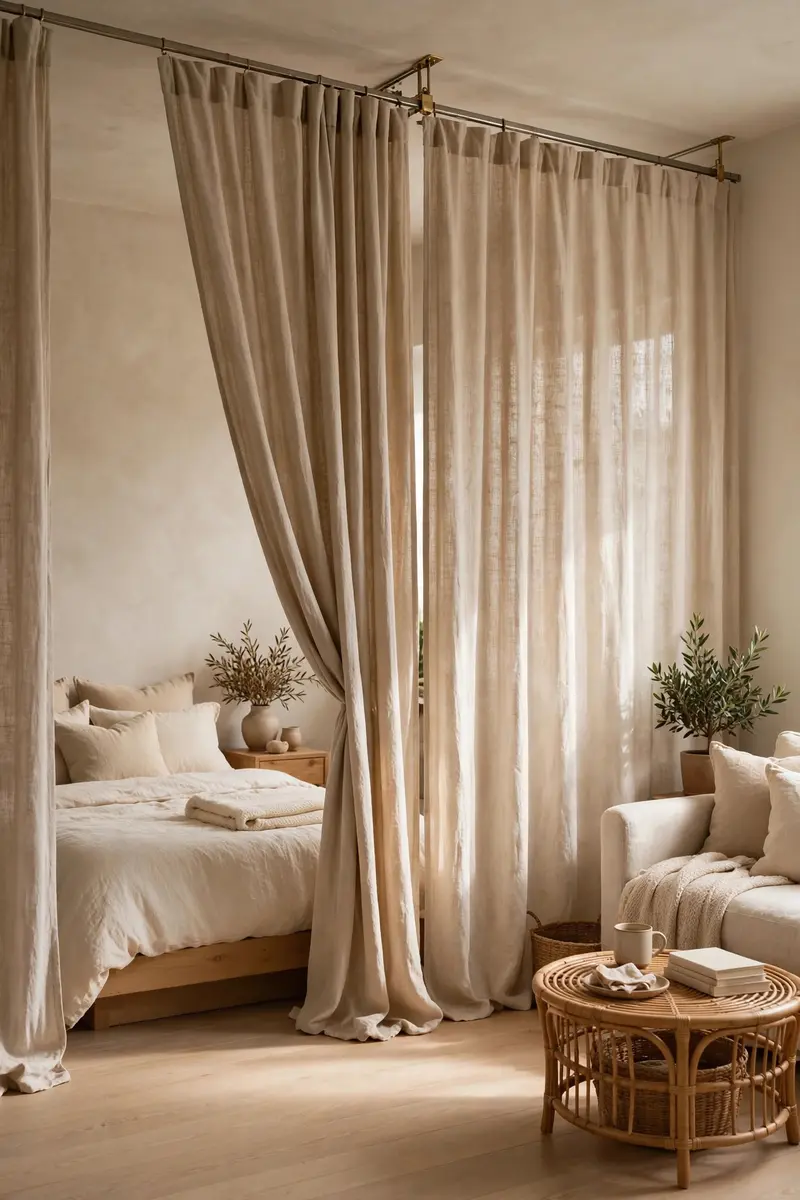
2. Hang Linen Curtains to Build a Real “Bedroom”
If a bookcase divider feels too bulky, curtains do the same job with half the footprint and twice the softness. A ceiling-mounted curtain track lets you close off your sleeping area at night and sweep it open in the morning — instant studio apartment room dividers without walls. Curtain dividers are among the most flexible studio apartment decorating ideas for renters.
Materials and realistic cost: A ceiling-mounted curtain track kit costs $20-$45; linen-look curtain panels run $18-$35 per pair at IKEA or Amazon. Total: $40-$80.
How to do it: Mount the track on the ceiling where you want the “wall” to be — typically across the room where the bed zone meets the living zone. Hang floor-length panels so they just kiss the floor. When open, pull them fully to one side so they don’t eat walkway space. Choose a fabric close to your wall color for a seamless look, or a natural linen texture for warmth.
Practical tip: Add a blackout liner behind the bedroom-side curtain if you sleep while your partner watches TV. You’ll thank yourself the first night.
Variation: For a 2026-trending touch, swap fabric curtains for bamboo or rattan beaded curtains — they divide the space while keeping light and airflow, and they nail the warm natural-fiber aesthetic that’s huge on Pinterest this year.
3. Float Your Bed Away from the Wall
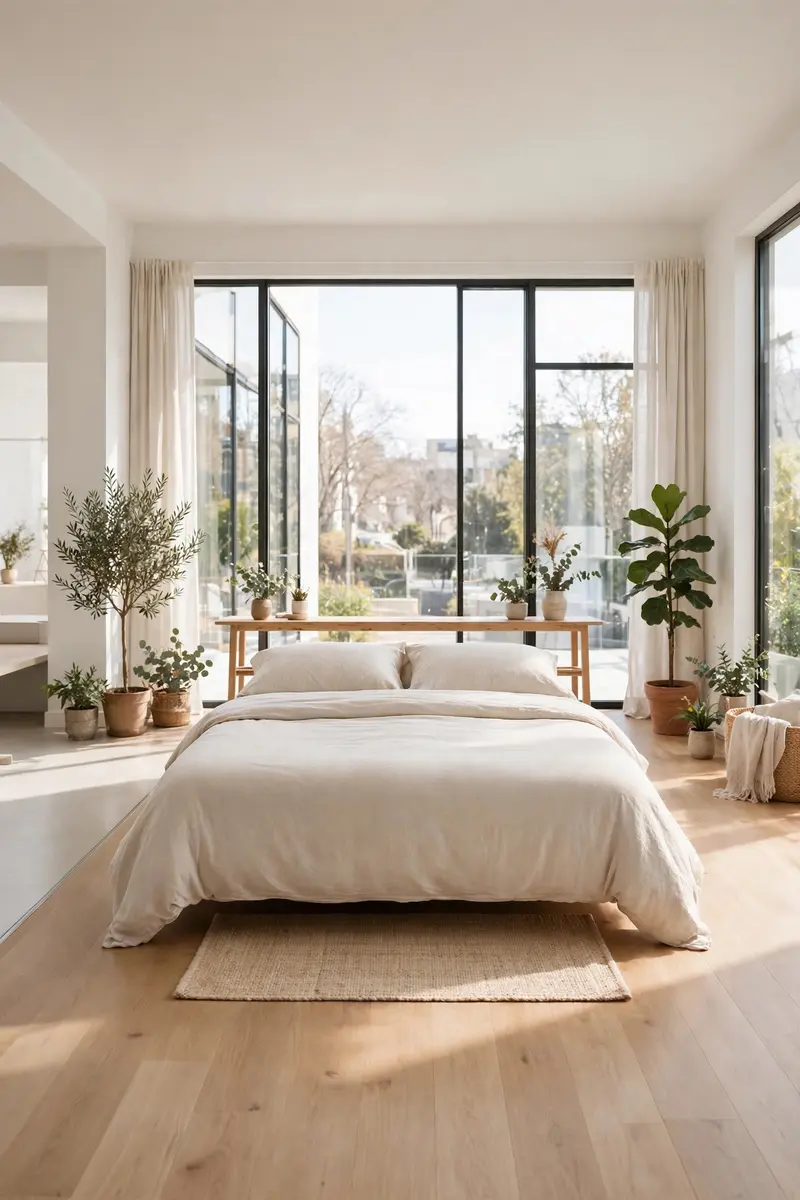
Pushing the bed into the corner feels efficient, but floating it — pulling it a few feet out into the room — can actually make a studio feel bigger. A floating bed lets you create a defined sleeping zone in the middle of the floor plan, with walkways around it that make the space feel generous instead of cramped. Floating the bed is one of the simplest studio apartment decorating ideas for better flow.
Materials and realistic cost: Nothing to buy — this is a free rearrangement. If you need it to look intentional, add a slim console table or storage bench behind the headboard ($40-$90).
How to do it: Pull the bed 2-3 feet off the wall so there’s a walkway behind it. Place a slim bench, console, or even a narrow bookcase behind the headboard to finish the back — this becomes your “headboard wall” and gives the bedroom zone a deliberate anchor. Keep the bedding streamlined and neutral so the floating bed reads as a design choice, not a mistake.
Practical tip: Float the bed so the foot faces the room’s best light or view. You want the first thing you see when you wake up to feel intentional and calm.
Variation: In a very narrow studio, float the bed widthwise across the room instead of lengthwise — it visually shortens a long tunnel-like layout and creates a natural boundary between zones.
4. Choose Furniture That Does Double Duty
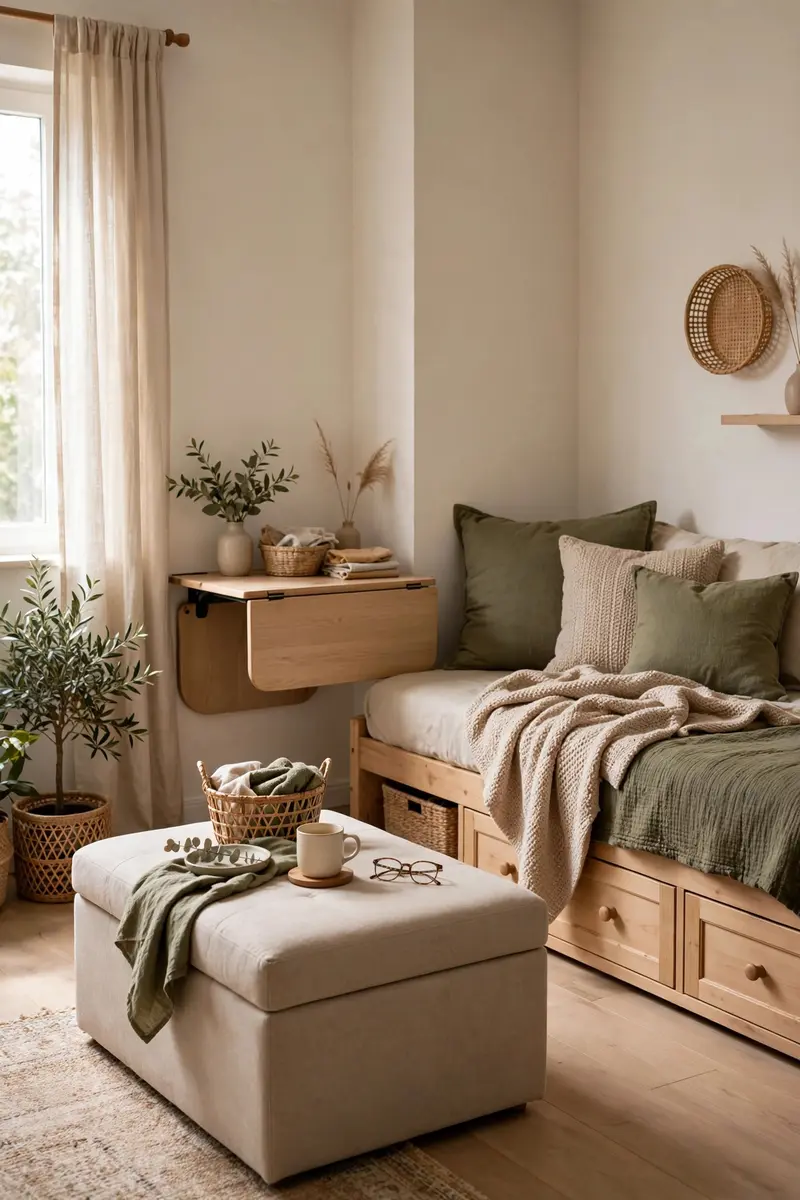
In a studio, every piece of furniture needs to earn its footprint. If it only does one job, it has to leave. A storage ottoman that works as a coffee table, extra seating, and a blanket trunk is worth three “cute but useless” side tables. Dual-purpose furniture is one of the smartest studio apartment decorating ideas for maximizing function.
Materials and realistic cost: A quality storage ottoman runs $50-$120; a daybed with drawers $250-$450; a drop-leaf dining table $80-$180. Start with the ottoman — biggest impact per dollar.
How to do it: Audit every piece of furniture you own and ask: “What does this do besides look good?” Replace single-job pieces one at a time, starting with the biggest footprint. Prioritize the “big three” of studio apartment decorating ideas: a bed with storage drawers underneath, a coffee table or ottoman with storage inside, and seating that converts (daybed, sleeper sofa, or futon).
Practical tip: Before buying any multifunctional piece, measure your doorways and the walkways around it. The most beautiful storage bed in the world is a disaster if you can’t get it around the hallway corner.
Variation: Budget-strapped? Stack two matching storage cubes under your existing bed skirt — instant under-bed storage for the cost of a pizza night.
5. Define Zones with Layered Area Rugs
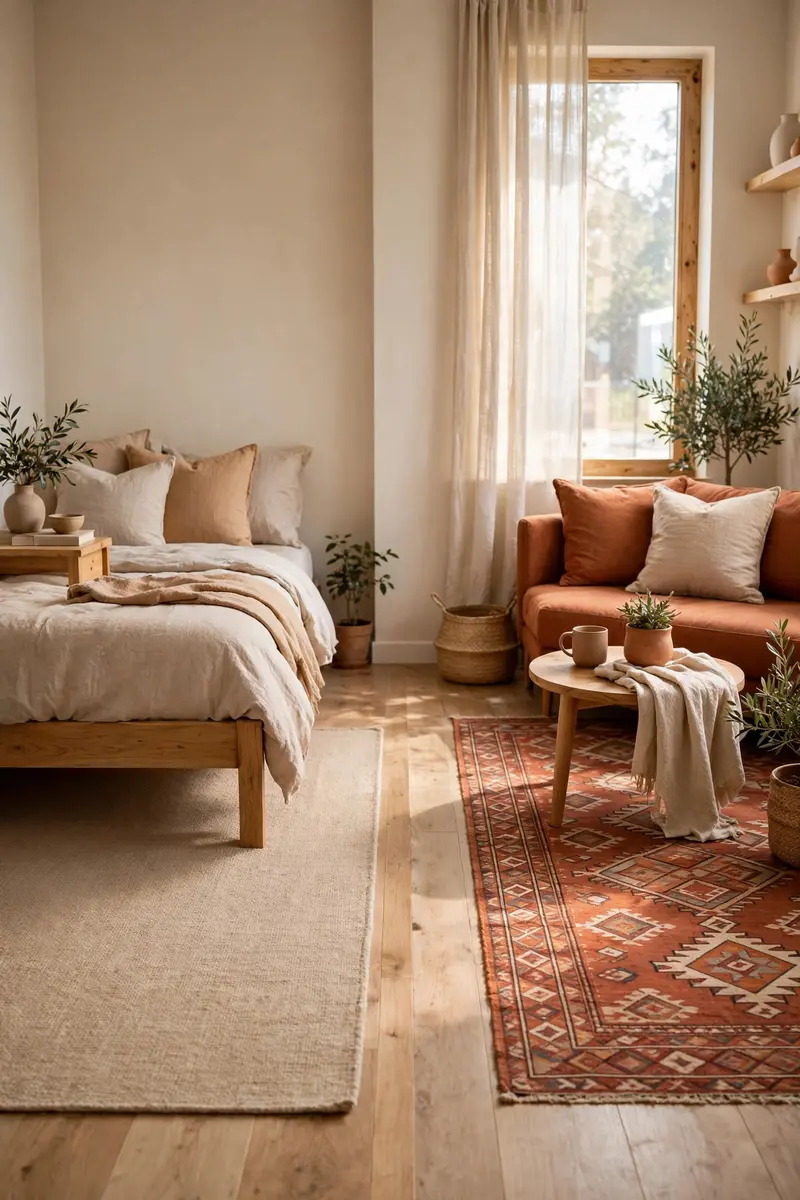
Rugs are the invisible walls of a studio. A rug under the bed defines the sleeping zone; a different rug under the sofa defines the living zone. Without a single wall, your brain reads the two areas as separate rooms. Zoning with rugs is one of the easiest studio apartment decorating ideas for defining spaces.
Materials and realistic cost: Flatweave rugs are the studio’s best friend — light, stackable, easy to clean. A 5×7 flatweave runs $40-$90 at IKEA or Target. Two coordinating rugs: $80-$180 total.
How to do it: Place the bed-zone rug so it extends at least 18 inches beyond each side of the bed. In the living zone, the rug should sit under the front legs of the sofa and coffee table. The two rugs don’t need to match — in fact, coordinating rather than matching (same palette, different patterns) looks more designer. Keep both low-pile so the room’s floor reads as one continuous surface.
Practical tip: Leave a 12-18 inch gap of bare floor between the two rugs. That breathing room is what makes each zone feel distinct instead of like one big patchwork.
Variation: Layer a small textured rug (jute, shag, or faux fur) over a larger flatweave in the living zone — instant boutique-hotel depth for under $40.
6. Go Vertical: Floor-to-Ceiling Storage Walls
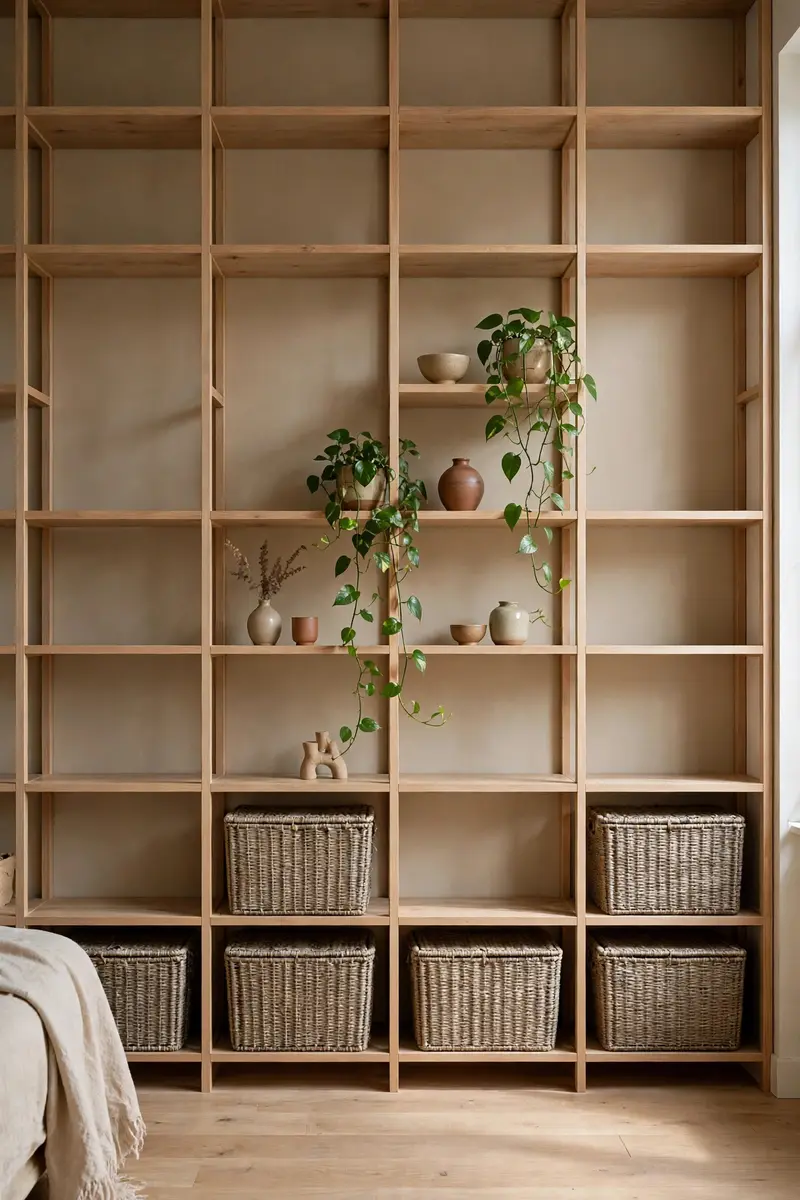
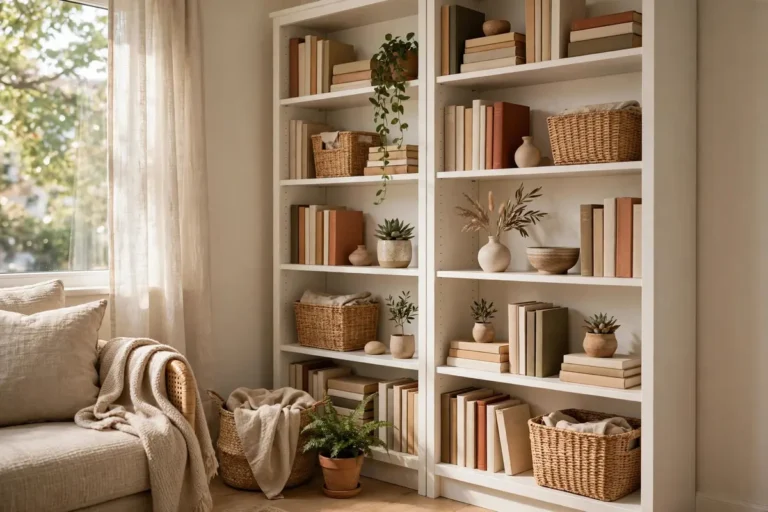
When the floor is full, the walls are your only way out. Floor-to-ceiling shelving turns dead air into your hardest-working square footage — books, bins, plants, and decor all live up where they’d otherwise collect dust on every surface. Vertical storage is one of the most practical studio apartment decorating ideas for small footprints.
Materials and realistic cost: Modular shelving systems (IKEA LACK or KALLAX stacked units) run $60-$150 per wall section. Decorative bins and baskets: $20-$50. Total: $80-$200 per wall.
How to do it: Pick one wall — ideally in the living zone — and build upward with matching modular units from floor to ceiling. The trick to making it look like design rather than storage: follow the 60/30/10 rule — 60% practical storage (in closed bins), 30% display (books, plants, ceramics), 10% negative space. Paint or wallpaper the wall behind open shelves a slightly deeper tone than the room for depth.
Practical tip: Anchor every tall unit to the wall with the included anti-tip hardware. A fully loaded shelving unit can weigh hundreds of pounds — this is non-negotiable, especially with kids or pets.
Variation: Above the kitchen cabinets is wasted gold in a studio. Add matching baskets or closed bins up there for seasonal items, appliances you rarely use, and bulk pantry overflow.
7. Bounce Light with a Big Mirror Opposite the Window
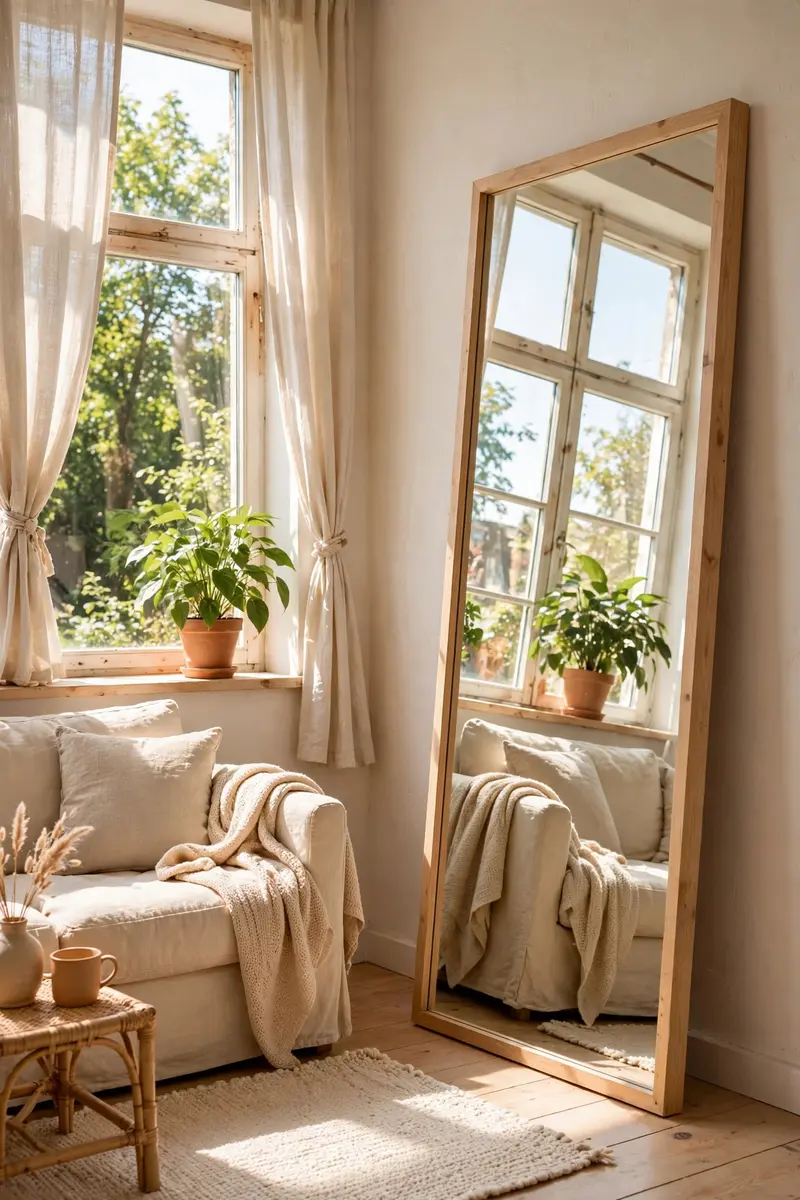
Studios often have just one or two windows, so every lumen of natural light has to work twice as hard. A large mirror placed opposite the window doubles your light — literally reflecting it back into the room — and makes the studio feel like it has windows on both sides. Strategic mirrors are among the brightest studio apartment decorating ideas for dark studios.
Materials and realistic cost: A full-length leaning mirror runs $40-$100 at IKEA, Target, or HomeGoods. Oversized 24×36 mirrors: $25-$60. The bigger you can go, the better the effect.
How to do it: Lean (don’t hang) the mirror on the wall directly opposite your largest window for maximum light bounce. Slightly angle it so it catches the window at the best angle — you’ll see the difference the moment it lands. Keep the frame slim and light-toned; chunky dark frames eat the visual space you’re trying to create.
Practical tip: What the mirror reflects is what your room “becomes,” so make sure it shows something worth doubling — a window, a plant, your nicest art — never the messy corner by the door.
Variation: No wall space for a big mirror? Lean a medium mirror on top of a dresser or console opposite the window — you get the light bounce without using any wall at all.
8. Add One Statement Furniture Piece (and Keep Everything Else Quiet)
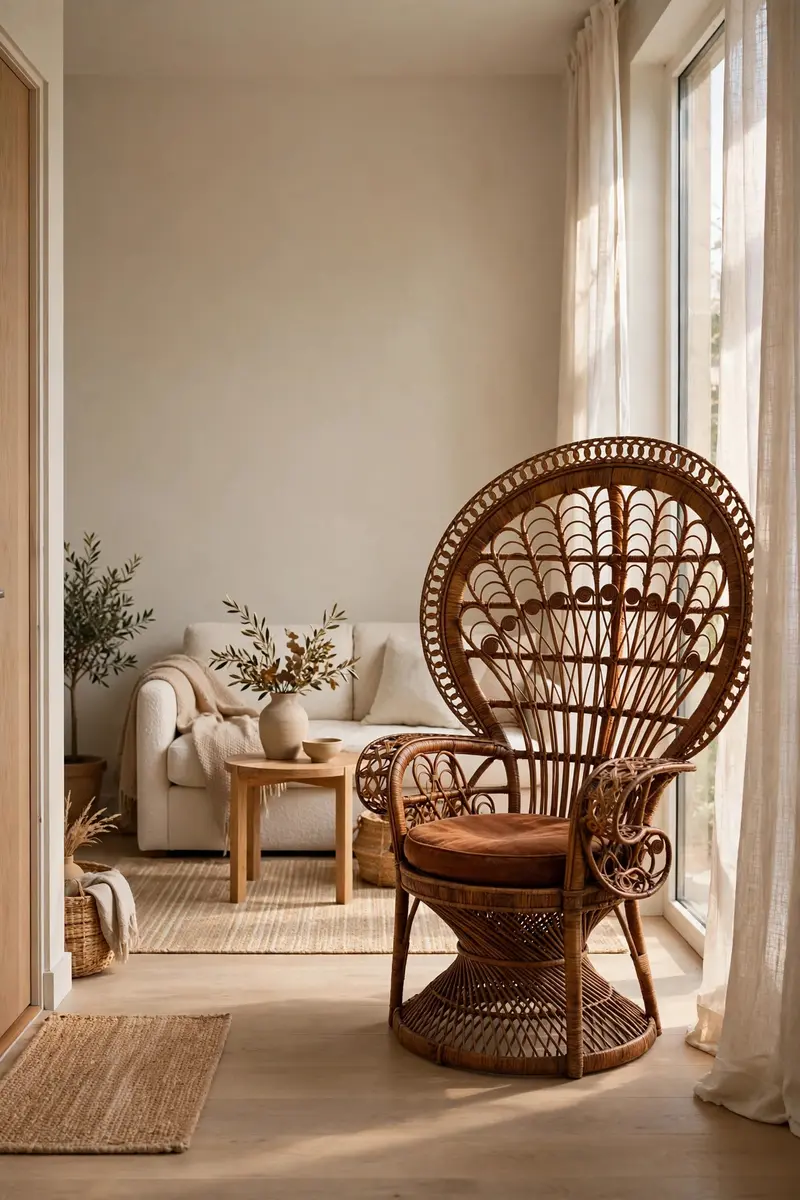
Tiny doesn’t have to mean timid. One bold piece — a sculptural rattan armchair, a velvet loveseat in deep rust, a patterned vintage rug — gives a studio personality and a focal point, while the rest of the furniture stays neutral and quiet to let it shine. A statement piece is one of the boldest studio apartment decorating ideas for adding personality.
Materials and realistic cost: Thrift stores and Facebook Marketplace are gold mines: a vintage rattan chair $30-$80, a velvet loveseat $100-$250, a hand-knotted patterned rug $50-$150. New statement pieces run $150-$400.
How to do it: Choose ONE piece with real presence and place it where your eye lands first when you walk in — that’s your focal point. Then edit everything else down: neutral sofa, simple side tables, quiet bedding. The formula is simple: one loud piece + quiet surroundings = a studio that feels curated, not cramped. Rattan and natural-fiber pieces are especially on-trend right now (Afrohemian and warm-neutral looks are surging on Pinterest for 2026) and they add texture without visual weight.
Practical tip: The statement piece should be the right scale — oversized art or furniture makes a small room feel grand, but an oversized piece that’s too bulky for the walkways just makes it feel crowded. Leave 30 inches of walking space around it.
Variation: If new furniture isn’t in the budget, make your statement with paint: one bold accent wall or a painted vintage dresser delivers the same focal-point punch for the cost of a gallon of paint.
9. Create a Folding-Screen Reading Nook
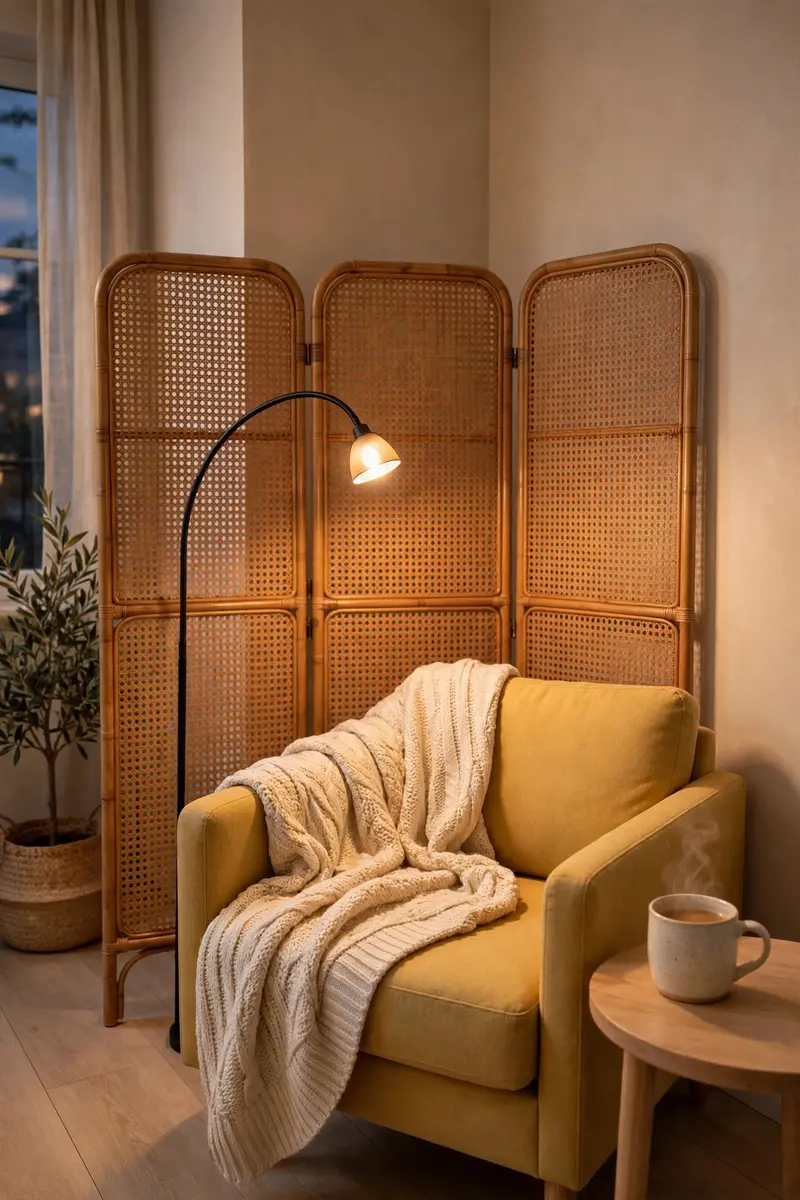
A corner is just wasted space until you give it a job. A folding screen plus an armchair, a small side table, and a floor lamp turns 12 square feet of dead corner into the coziest spot in the house — a reading nook that also doubles as a visual “wall” between zones. A reading nook is one of the coziest studio apartment decorating ideas for unused corners.
Materials and realistic cost: A three-panel rattan or fabric folding screen runs $50-$120; a compact armchair $80-$180; a small floor lamp $25-$50. Budget build: $150-$350 total, or thrift the chair and do it for under $100.
How to do it: Tuck the chair into the corner at a slight angle, place the folding screen behind it to create a backdrop, and add the lamp beside the chair at reading height. The screen should relate to your palette — natural rattan for warm schemes, matte black frames for modern ones. Add a small side table for tea and a throw for texture. When you don’t need the screen as a divider, fold it flat behind the chair.
Practical tip: Angle the chair toward the room, not into the corner — you want the nook to invite you in and face the light, not stare at two walls.
Variation: No room for a full armchair? A floor cushion or pouf with a tall plant behind it creates the same “destination corner” feeling for under $50.
10. Use One Cohesive Color Palette Throughout
In a one-room home, color is the thread that holds everything together. When every zone shares the same 3-4 colors, the studio reads as one calm, intentional space instead of a jumble of mismatched corners. This is one of the highest-impact studio apartment decorating ideas — and it costs nothing if you just edit what you have.
Materials and realistic cost: Zero if you shop your own home first. To fill gaps: throw pillows $10-$25 each, a throw blanket $20-$40, curtain panels $18-$35. Palette refresh total: $50-$100.
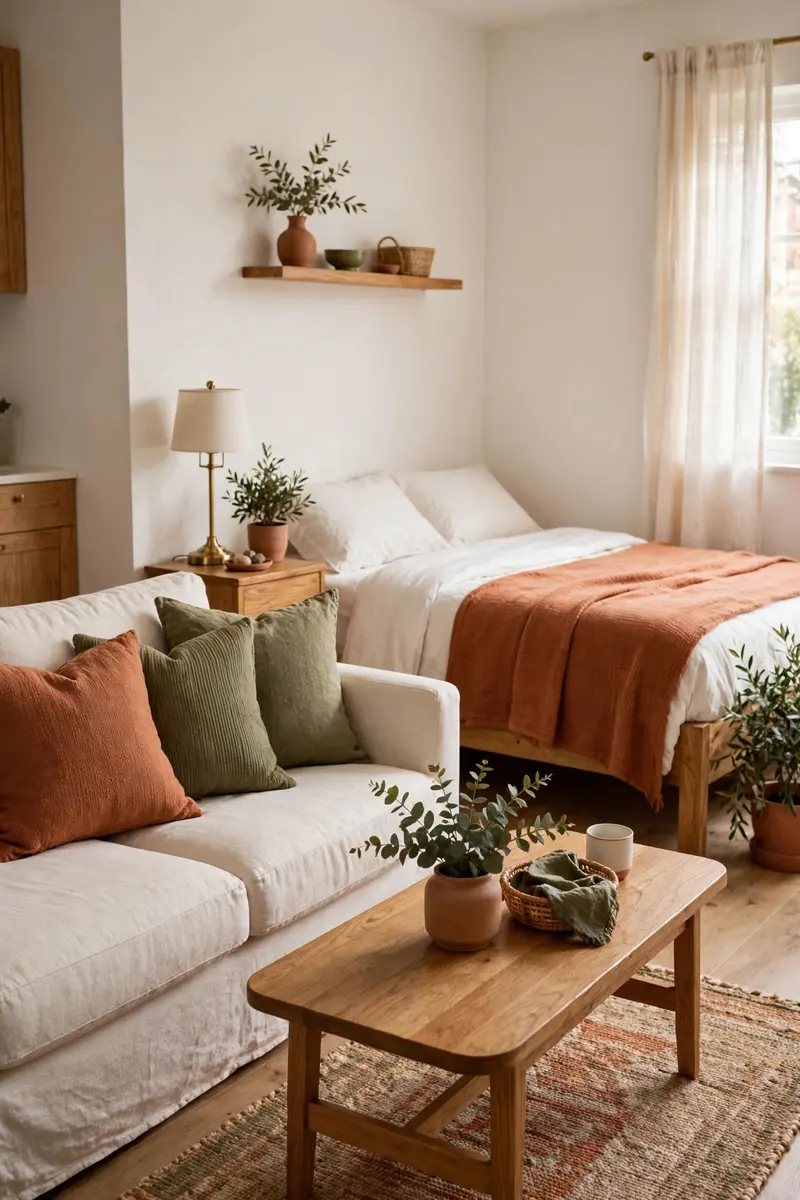
How to do it: Pick one neutral base (warm white, greige, or soft beige), one deeper anchor color (olive, navy, charcoal, or terracotta), and one accent that repeats in small doses (brass, rust, sage). Walk through your studio and remove anything that doesn’t fit the palette — store it, donate it, or move it to another room. Then re-place the survivors so each color appears in every zone: the rust pillow on the bed echoes the rust vase in the living zone, tying the two “rooms” together.
Practical tip: Photograph your studio from the doorway with your phone. The camera reveals color clashes your eye has learned to ignore — anything that jumps out of the photo in a bad way is your first edit target.
Variation: Nervous about committing? Start with textiles only — pillows, throws, one rug. They’re the cheapest way to test a palette, and you can swap them seasonally.
11. Build a Wall-Mounted Drop-Leaf Desk Office
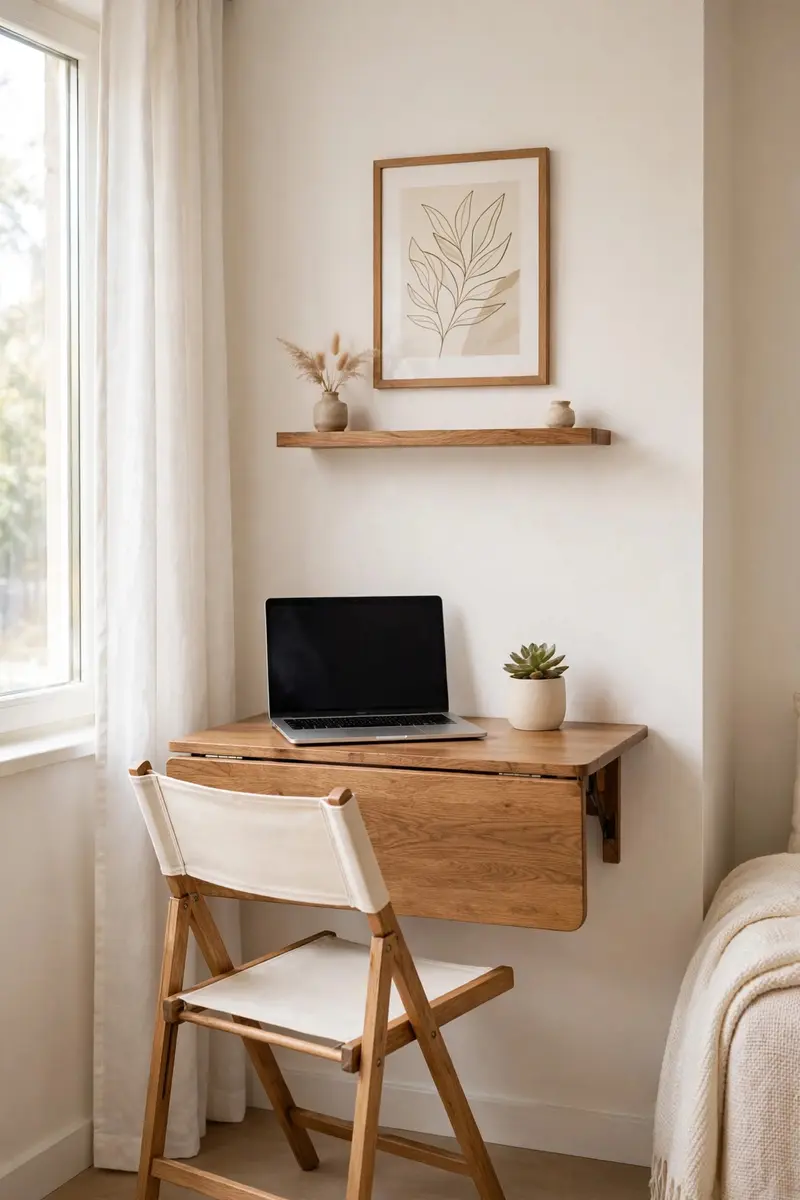
Working from the kitchen table is fine until the laptop crumbs start ruining your dinner. A wall-mounted drop-leaf desk gives you a real office that folds flat against the wall when the workday ends — your studio goes from home office to living room in ten seconds. A drop-leaf desk is one of the smartest studio apartment decorating ideas for remote workers.
Materials and realistic cost: Wall-mounted drop-leaf tables run $40-$80 at IKEA or Amazon; add a folding chair ($25-$45) that hooks on the wall beside it. Total: $65-$125.
How to do it: Mount the desk at standard desk height (29-30 inches) on a wall in the living zone — ideally near a window for natural light. Pair it with a chair that folds flat or tucks completely under the desk. When folded up, style the wall above the desk with a small shelf and art so it reads as decor, not a closed office. Keep a cable basket underneath so cords don’t dangle when the desk is down.
Practical tip: Mount a small pegboard or floating shelf directly above the folded desk for office supplies — vertical storage means nothing has to live on the desk surface itself.
Variation: Already have a console table? Raise it to desk height with risers, add a stool that tucks underneath, and you’ve got a workspace that moonlights as an entryway console.
12. Light in Layers, Not from the Ceiling
One overhead light makes a studio feel like an interrogation room — flat, shadowless, and somehow smaller. Layered lighting — a floor lamp in the living zone, a table lamp by the bed, a small lamp at the desk — creates pools of warm light that define each zone and make the space feel like several rooms after dark. Layered lighting is one of the most atmospheric studio apartment decorating ideas for evenings.
Materials and realistic cost: A floor lamp $30-$60, two table lamps $20-$40 each, warm-white LED bulbs $10-$15 for the set. Total: $80-$155 for a full lighting overhaul.
How to do it: Turn off the overhead light permanently (or replace its bulb with the dimmest warm option). Place one lamp per zone at different heights: tall floor lamp by the sofa, mid-height table lamp on the nightstand, small desk lamp at the workspace. Use warm-white bulbs (2700K) everywhere — daylight bulbs (5000K) make a studio feel like an office. Add a string of warm fairy lights along a shelf for instant coziness after dark.
Practical tip: Every lamp should be reachable without crossing the room — if you have to walk to a wall switch for each zone, you’ll never use them. Smart plugs ($8-$12 each) let you control all lamps from your phone or voice.
Variation: String lights aren’t just for college dorms: drape warm-white fairy lights inside a glass vase or along the top of your bookcase divider for soft ambient light that costs almost nothing.
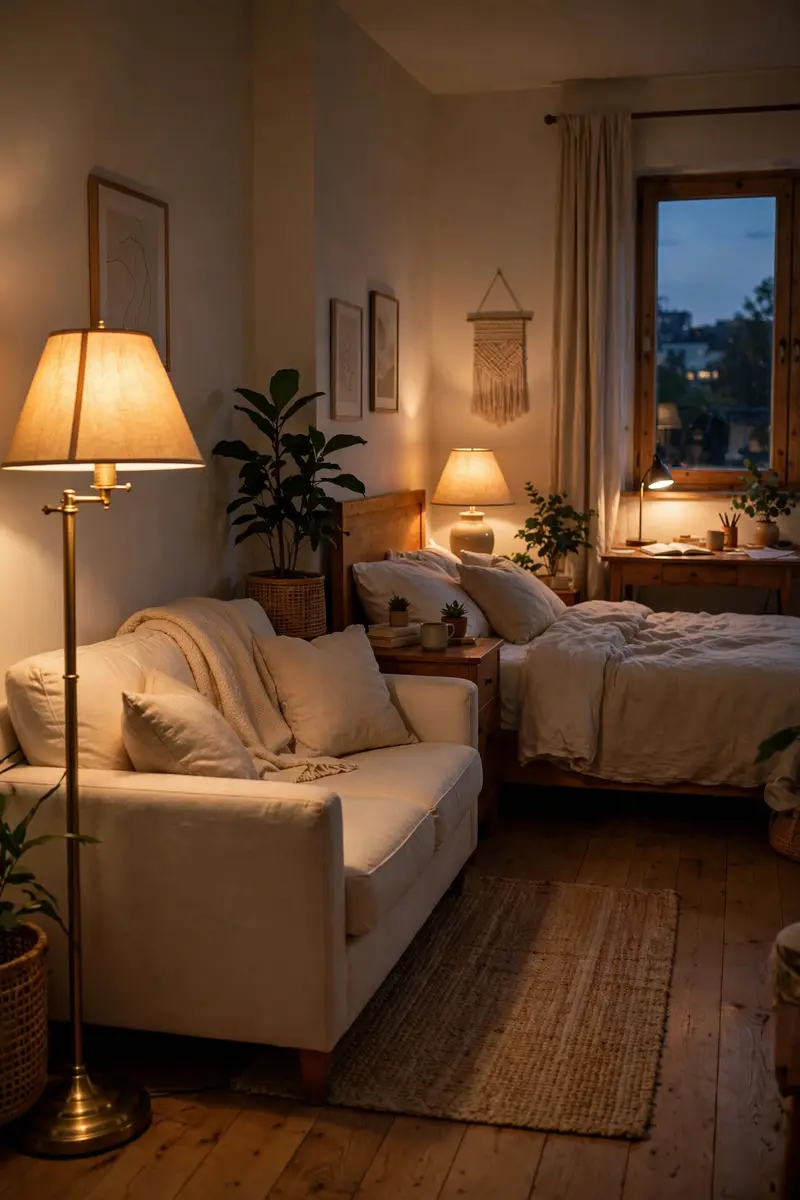
13. Hide Storage in Plain Sight with Baskets and Trunks
Studios have no closets to hide the ugly stuff, so the stuff itself has to look good. Woven baskets, lidded boxes, and a vintage trunk that doubles as a coffee table turn clutter into decor — the mess is there, but nobody can see it. Hidden storage is one of the most practical studio apartment decorating ideas for clutter-free living.
Materials and realistic cost: Large woven seagrass baskets $15-$30 each; a vintage-look trunk $60-$120; matching lidded fabric boxes $8-$15 each. Total: $40-$150 depending on the combo.
How to do it: Place one large basket in each zone for that zone’s clutter: throws and remotes by the sofa, laundry by the bed, chargers and mail by the desk. Use the trunk as your coffee table — the interior swallows board games, guest bedding, and anything else that doesn’t have a home. Keep the baskets matching in material (all seagrass, all felt, all canvas) so they read as a deliberate collection rather than random clutter.
Practical tip: The one-in-one-out rule is mandatory in a studio: every time something new comes in, something leaves. Baskets hide clutter, but they don’t create square footage.
Variation: Slide low flat bins under the sofa or under the bed skirt — they’re invisible and hold a shocking amount of stuff, from shoes to seasonal clothes.
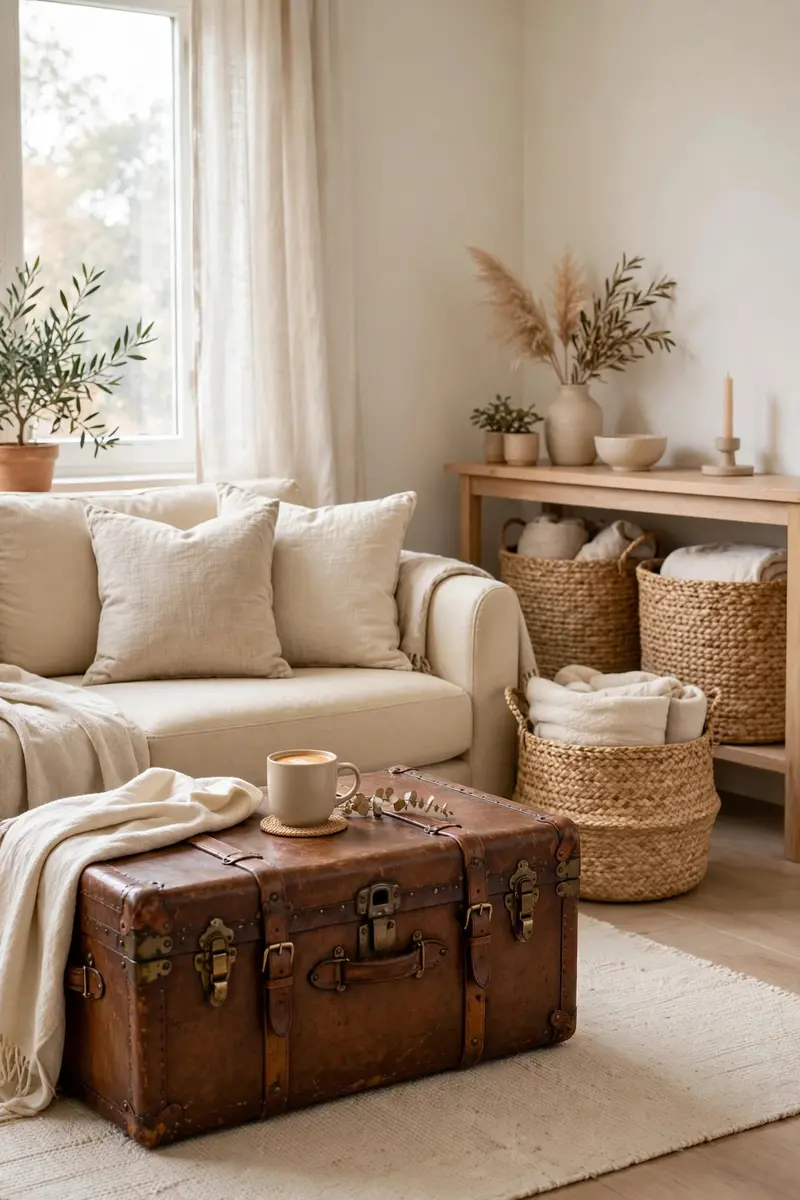
14. Bring in Plants as Living Dividers
A tall plant — or a cluster of them — is the prettiest room divider you’ll ever own. A large fiddle-leaf fig or a row of snake plants on a bench creates a soft, breathing boundary between the sleeping and living zones, and unlike furniture, plants make the air feel fresher and the room feel larger. Plant dividers are among the most beautiful studio apartment decorating ideas for natural boundaries.
Materials and realistic cost: A tall snake plant or fiddle-leaf fig in a 10-inch pot runs $25-$60; three medium plants in matching pots $40-$80. Hanging planters $8-$15 each.
How to do it: Place your tallest plant (or a plant stand with a large plant) at the boundary between zones — the foot of the bed is the classic spot. Group plants in odd numbers (3 or 5) for a natural look, and keep the pots in one material or palette so they read as a unit. If floor space is zero, go vertical: hanging planters from the ceiling or a wall-mounted plant shelf at the zone boundary.
Practical tip: Low-light studios are not a death sentence for plants — snake plants, pothos, and ZZ plants thrive in dim corners. Match the plant to your light, not your wishful thinking, and you’ll stop killing them.
Variation: A trailing pothos on top of your bookcase divider (idea 1) softens the whole thing — green spilling over both sides makes the “wall” feel alive instead of structural.
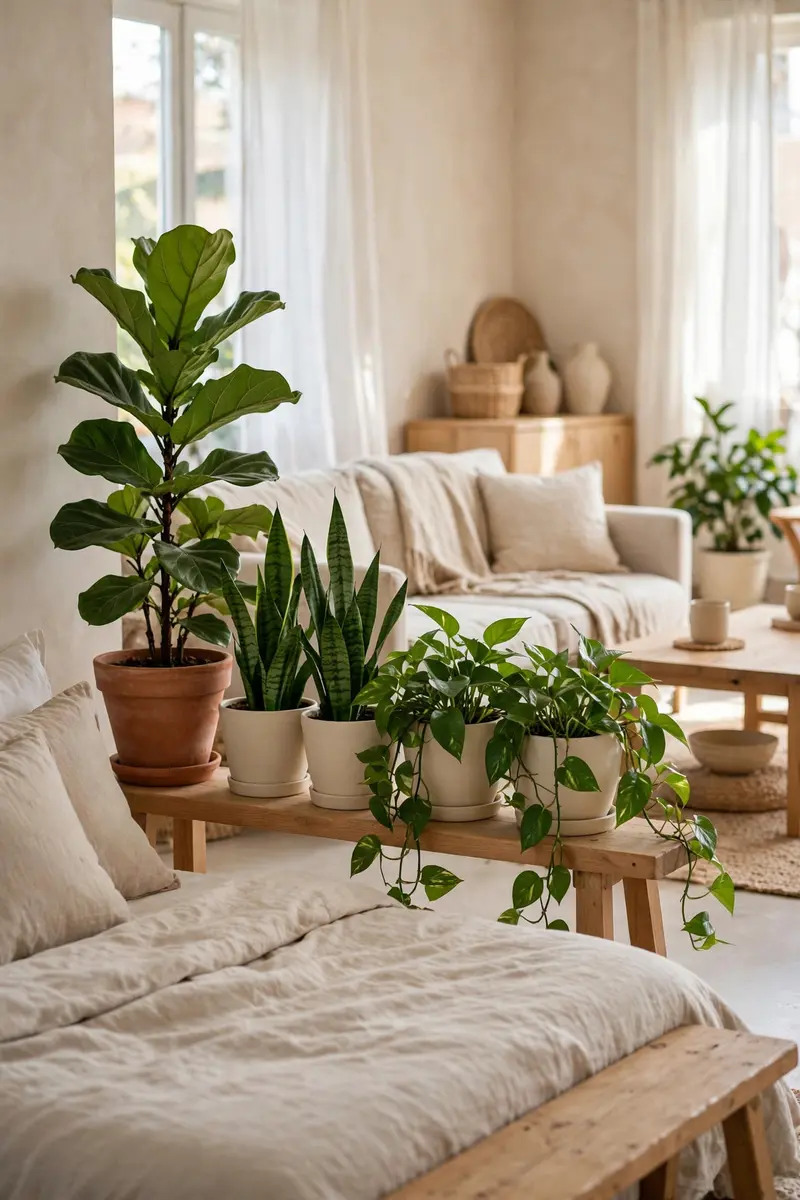
15. Style One “Hero Corner” and Let It Set the Tone
You don’t need to decorate every square inch. Pick the corner your eye lands on when you walk in — usually near the window — and make it beautiful: a framed print, a plant, a textured throw, a small lamp. That one styled vignette sets the tone for the whole studio and makes everything else feel intentional by association. A hero corner is one of the most impactful studio apartment decorating ideas for first impressions.
Materials and realistic cost: A framed art print $15-$40, a medium plant $15-$30, a textured throw $20-$40, a small lamp $20-$35. Total: $70-$145 — or $0 if you rearrange what you already own.
How to do it: Stand in your doorway and find the first spot your eye lands. Clear it completely, then rebuild it in layers: something tall in back (plant or art), something mid-height (lamp or stack of books), something soft in front (throw or cushion). Photograph it and check the photo — if it looks styled in the photo, it’ll look styled in person. Let this corner’s palette guide the rest of the room.
Practical tip: A hero corner is also your “Pinterest corner” — the spot you’ll photograph, the spot guests see first, the spot that makes you smile when you come home. Invest your best pieces here and let the rest of the studio be simpler.
Variation: Change your hero corner seasonally — swap the throw, rotate in a new print, add a seasonal stem. It’s the cheapest refresh in your home and it keeps the studio feeling new.
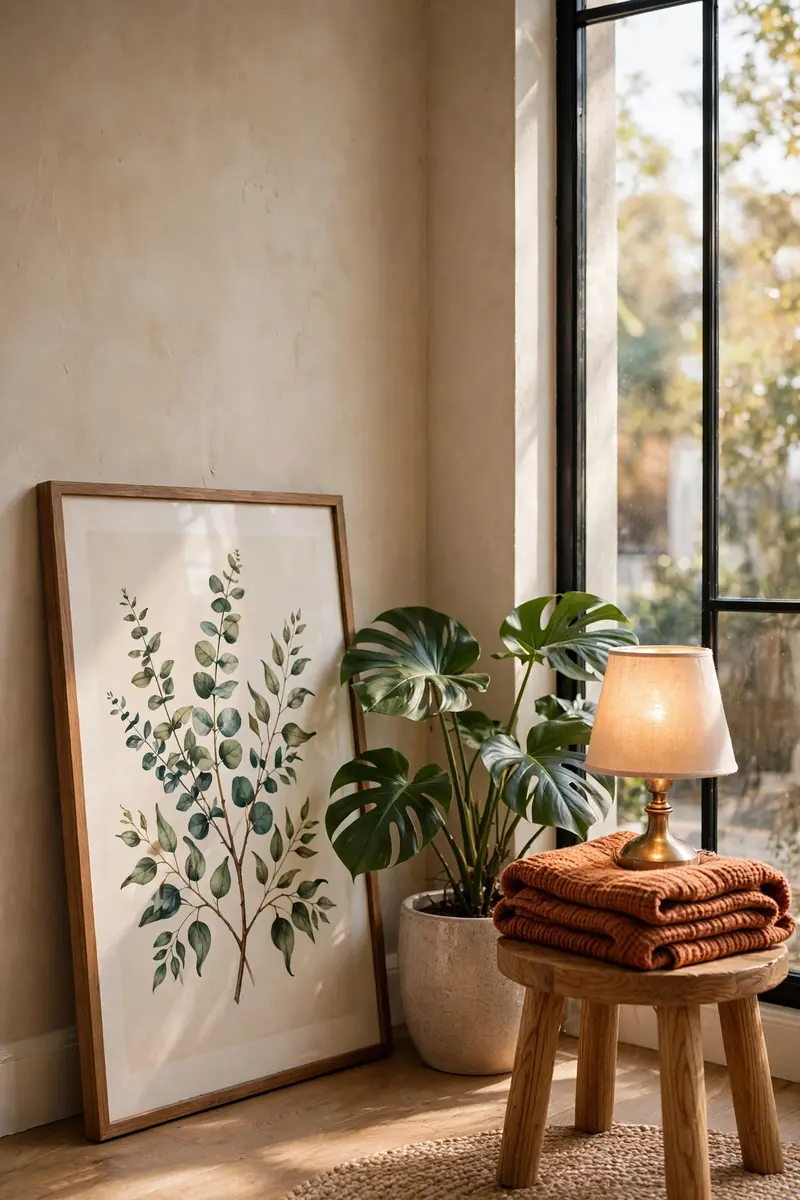
For more small-space wins, browse our small apartment decor ideas that maximize every inch, and these small living room decor ideas on a budget for a living area that feels twice its size.
Frequently Asked Questions
How do I make my studio apartment look bigger?
Start with light: hang a large mirror opposite your biggest window and keep your palette light and cohesive. Choose fewer, appropriately scaled furniture pieces instead of many small ones — one right-sized sofa looks bigger than three tiny chairs. Keep walkways clear and let the floor show as much as possible, because visible floor equals visible space.
How can I create a separate sleeping area in a studio apartment?
The three most effective methods are an open bookcase used as a divider, ceiling-mounted curtains you can close at night, and layered rugs that visually separate the sleeping zone from the living zone. Combining two of these — say, curtains plus a rug — creates a “bedroom” that genuinely feels separate.
What are the best colors for a studio apartment?
Light neutrals — warm white, greige, soft beige — make the walls recede and the space feel larger. Then add one deeper anchor color (olive, navy, terracotta) and repeat it in every zone to tie the room together. A single cohesive palette across the whole studio matters more than any individual color choice.
How do I maximize storage in a studio apartment?
Think in three dimensions: use under-bed storage, wall-mounted shelves that go to the ceiling, and furniture with hidden compartments (storage ottomans, trunk coffee tables). Keep like with like in matching baskets so clutter looks intentional. And remember — the fastest storage upgrade in a studio is decluttering first.
What furniture is essential for a studio apartment?
The essentials are a bed with storage underneath (or a daybed that doubles as seating), seating for the living zone, a storage ottoman or coffee table, one surface to eat and work at, and vertical shelving. Everything else is optional — in a studio, every piece must earn its footprint by doing at least two jobs.
Final Thoughts: Studio Apartment Decorating Ideas to Try
A studio apartment isn’t a small version of a big home — it’s its own kind of home, and it rewards a different way of decorating. Define your zones with rugs, curtains, and shelving instead of walls. Let every piece of furniture pull double duty. Light the room in layers and keep your palette cohesive. Do that, and your studio stops feeling like a compromise and starts feeling like exactly what it is: a space designed entirely around you.
Start with the one idea that solves your biggest frustration — the sleeping zone, the storage, the light — and build from there. And if one of these ideas made your space feel bigger and better, save this post to Pinterest so it’s there the next time your studio needs a refresh. For more inspiration, see these small apartment decor ideas — many are perfect studio apartment decorating ideas too.
One Comment