Step into a 1920s bathroom and you step into the Jazz Age itself: bold geometry, gleaming chrome, black-and-white tile, and just enough glamour to make an ordinary morning feel like a scene from a Gatsby party. The good news is you do not need a mansion or a huge budget to get the look. These 1920s bathroom ideas mix authentic period details with modern comfort, so you can go all-in on Art Deco drama or borrow just one or two touches. Pick the ideas that fit your space and budget — then let the jazz play.
1. Black-and-White Checkerboard Floors for a 1920s Bathroom
Nothing says 1920s bathroom faster than a black-and-white checkerboard floor. It is graphic, timeless, and it grounds even the plainest white fixtures with instant period drama. The high contrast also makes small bathrooms feel sharper and more intentional, not just old.
Materials and realistic cost: porcelain or ceramic checkerboard tiles, $3–$12 per square foot, plus grout and adhesive; a small bathroom floor often runs $200–$600 in materials. Lay tiles in a straight grid, keep grout lines even, and seal the grout so it stays crisp. If a full re-tile feels too big, try peel-and-stick checkerboard tiles over a sound existing floor for a weekend test run.
Tip: Use large 12-inch squares in a big bathroom and smaller 6-inch squares in a tiny one, so the pattern stays in proportion.
Variation: Swap the black for deep navy or charcoal for a softer take that still reads unmistakably vintage.

2. Classic White Subway Tile Walls
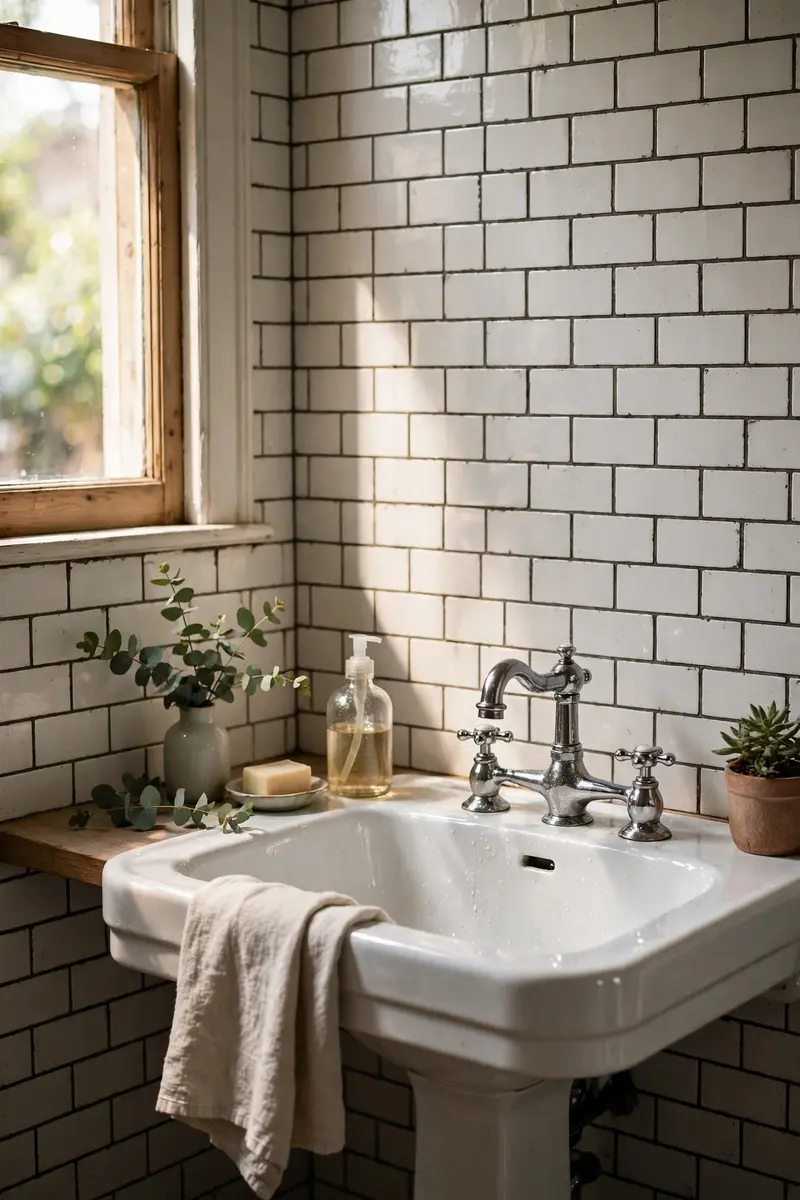
White subway tile was the workhorse of 1920s bathrooms, and it still works because it is clean, bright, and endlessly adaptable. Run it floor to ceiling in a shower, or stop at chair-rail height with paint above.
Materials and realistic cost: classic 3×6 subway tiles, $2–$8 per square foot; a shower surround in materials often costs $300–$900. Install in a running-bond brick pattern, use spacers for even joints, and choose a grout color deliberately — white grout disappears, grey grout defines each tile. Keep edges tidy with bullnose or metal trim pieces.
Tip: Dark grey grout gives plain white subway tile an instant Art Deco edge without adding a single new color.
Variation: Lay the same tile vertically or in a herringbone pattern on one accent wall for a modern twist on the classic.
3. A Clawfoot Tub as the Centerpiece
A freestanding clawfoot tub is the undisputed star of the 1920s bathroom. Its rolled rim and sculpted feet turn bathing into an occasion, and it anchors the whole room the way a sofa anchors a living room. Modern reproductions are lighter and easier to care for than originals.
Materials and realistic cost: reproduction clawfoot tubs, $800–$3,500; freestanding filler faucet, $200–$600; professional plumbing if you move drains, $500–$1,500. Center the tub under a window or on the longest wall, with breathing room on all sides.
Tip: Paint the tub exterior emerald green, navy, or black and leave the feet in chrome or brass for a custom look at paint cost only.
Variation: If space is tight, choose a smaller slipper tub with one raised end — all the glamour, less footprint.

4. An Art Deco Sunburst Mirror
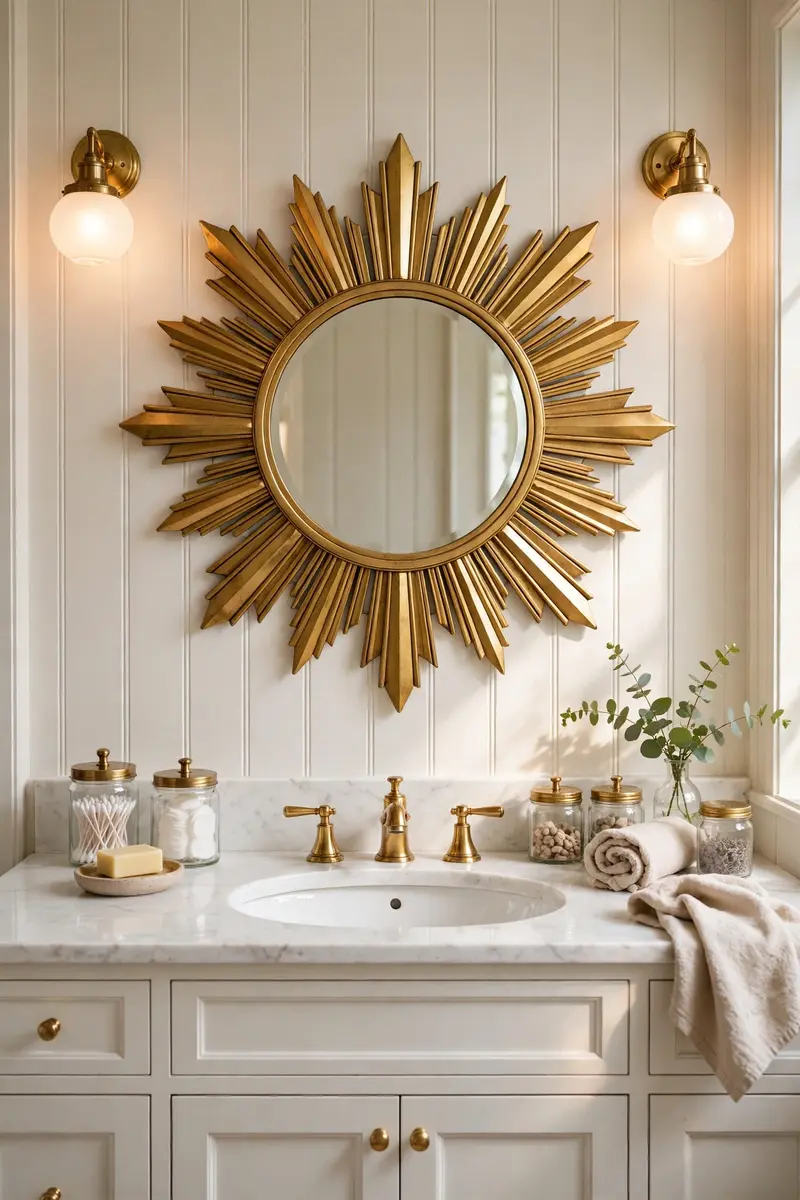
A sunburst mirror above the vanity is pure 1920s theatre: radiating rays, a round or octagonal center, and a metallic finish that catches light from every angle. It replaces a plain mirror and a piece of wall art in one move.
Materials and realistic cost: reproduction sunburst mirrors, $60–$300; hanging hardware included in most cases. Hang it centered over the sink at eye level, with a calm wall around it. Brass reads warm and Gatsby-like; chrome reads crisper and more modern.
Tip: In a small bathroom, a sunburst mirror doubles the sense of light because its rays scatter reflections across the wall.
Variation: Try a fan-shaped mirror instead — the same Deco geometry, in a shape that echoes a scallop shell.
5. Brass Cross-Handle Faucets
Cross-handle faucets are a tiny detail with an outsized period payoff. Their simple X shape and warm brass or polished chrome finish instantly date a sink to the 1920s in the best possible way, even when the sink itself is brand new.
Materials and realistic cost: cross-handle widespread or wall-mount faucets, $120–$400 per set. Match the finish to your mirror and lighting, and replace towel bars in the same finish too. Most swaps are a straightforward DIY job if your existing fittings share the same hole spacing.
Tip: Unlacquered brass will patina beautifully over time; lacquered brass stays shiny if you prefer a polished look.
Variation: Go for porcelain cross handles with a brass base for a softer, more cottage-meets-Deco feel.

6. An Emerald Green Feature Wall
Emerald green was a jewel tone the 1920s loved, and one green wall — tile, paint, or wallpaper — gives a bathroom instant depth and drama. It pairs beautifully with brass, marble, and white porcelain, so the rest of the room can stay simple.
Materials and realistic cost: glossy emerald subway or square tiles, $8–$25 per square foot; or emerald paint, $40–$70 per gallon. Tile the wall behind the vanity or in the shower, keeping other walls white or cream. Add brass sconces to warm the green up.
Tip: Test your green in both daylight and evening light before committing — emerald can swing teal or nearly black depending on the bulb.
Variation: Use emerald only as a tile border or a painted vanity, with white walls everywhere else, for a gentler dose.

7. Hexagon Mosaic Shower Floors
Tiny hexagon tiles are a hallmark 1920s bathroom floor, especially in white with a black dot or a contrasting border. They are also practical: the many grout lines give bare feet grip in a wet shower.
Materials and realistic cost: hexagon mosaic sheets, $12–$28 per square foot; a standard shower floor in materials runs $150–$400. Lay sheets carefully so the pattern flows across joints, press evenly into thinset, and seal well. A black-and-white hex pattern is the most authentic; an all-white hex floor with dark grout is the easiest to live with.
Tip: Choose a grout color you will enjoy cleaning — mid-grey hides wear far better than bright white.
Variation: Run the same hexagon tile up a shower curb or onto a vanity backsplash to tie the room together.

8. A Pedestal Sink with Chrome Details
Pedestal sinks were made for 1920s bathrooms: slim, symmetrical, and elegant, they free up floor space and show off beautiful tile behind them. They suit small bathrooms especially well, where a bulky vanity would swallow the room.
Materials and realistic cost: pedestal sinks, $200–$800; chrome P-trap and supply lines, $40–$100. Check plumbing first, since pedestals hide less pipework, and add a small shelf nearby for lost storage. Pair with a chrome faucet and a round or rectangular mirror.
Tip: Exposed chrome plumbing is part of the look here, so spend the small extra on polished traps and valves rather than hiding them.
Variation: Choose a pedestal sink with a square basin for a more Deco feel, or a round basin for a softer vintage look.

9. Geometric Fan Wallpaper on One Wall
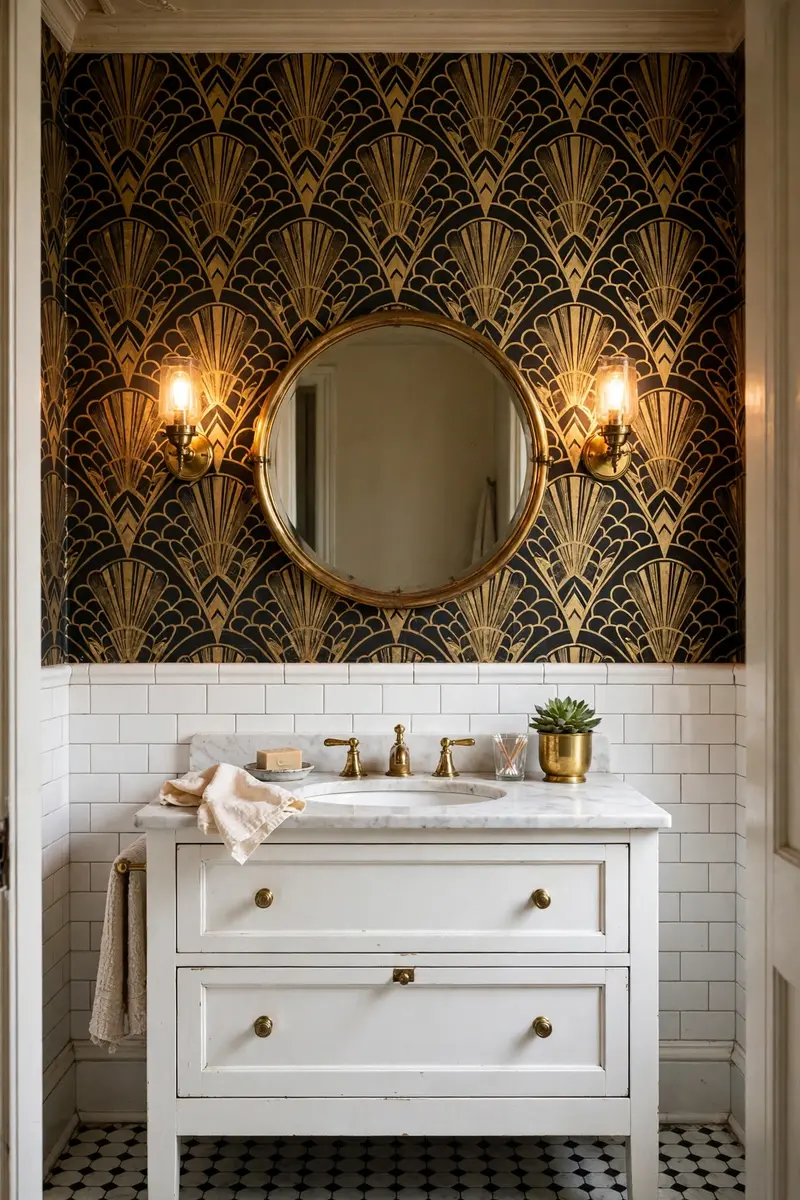
Fan, scallop, and chevron wallpapers are the fastest way to get Art Deco pattern without touching a tile. One feature wall — behind the vanity or on the wall you see from the door — is plenty; the rest of the room stays calm.
Materials and realistic cost: peel-and-stick Deco wallpaper, $50–$200 per roll; paste wallpaper slightly more with adhesive. Measure carefully, match the pattern at seams, and start in the least visible corner. In a steamy bathroom, choose vinyl or washable wallpaper and ventilate well after showers.
Tip: Metallic gold or silver ink in the wallpaper catches light and makes the pattern glow in the evening.
Variation: Use the same pattern in a smaller dose — inside a medicine cabinet door or as a framed panel — if full-wall pattern feels brave.
10. Stepped Art Deco Sconces
Stepped, fan-shaped, or tiered sconces flanking the mirror are the lighting signature of the era. Their frosted glass shades soften the light at face level, which is also the most flattering light for getting ready in the morning.
Materials and realistic cost: Deco-style sconce pairs, $80–$400. Mount them at eye level, one on each side of the mirror. If rewiring feels daunting, plug-in or battery sconces with a cord cover give a similar silhouette with no electrician.
Tip: Warm-white bulbs (2700K) keep frosted Deco glass glowing amber rather than clinical.
Variation: A single stepped pendant over a freestanding tub gives the same Deco line in a room without vanity wall space.

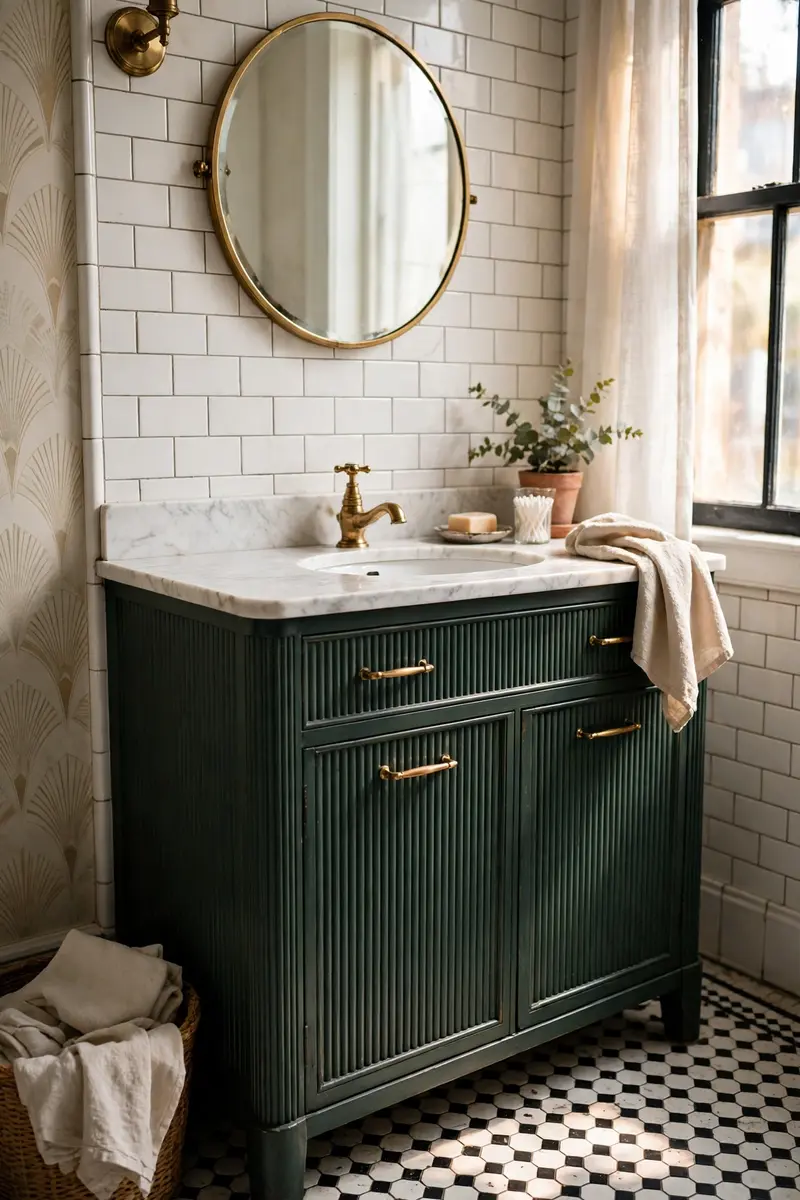
11. A Fluted Vanity Cabinet
Fluting — those vertical ribs carved or moulded into wood — is a Deco detail that makes a plain vanity look custom and expensive. A fluted front catches light and shadow all day, so the cabinet never looks flat.
Materials and realistic cost: fluted vanity cabinets, $1,200–$4,500; DIY fluted panels applied to an existing vanity, $100–$300 in materials. Keep the countertop simple and use brass pulls to complete the look. If you DIY, use half-round trim pieces glued in even rows and painted in one coat.
Tip: Paint a fluted vanity deep green or black and the ribs read like architectural moulding rather than furniture.
Variation: Fluted drawer fronts only, with flat cabinet doors, give you the texture for less money and less visual weight.
12. A Black Marble Vanity Top
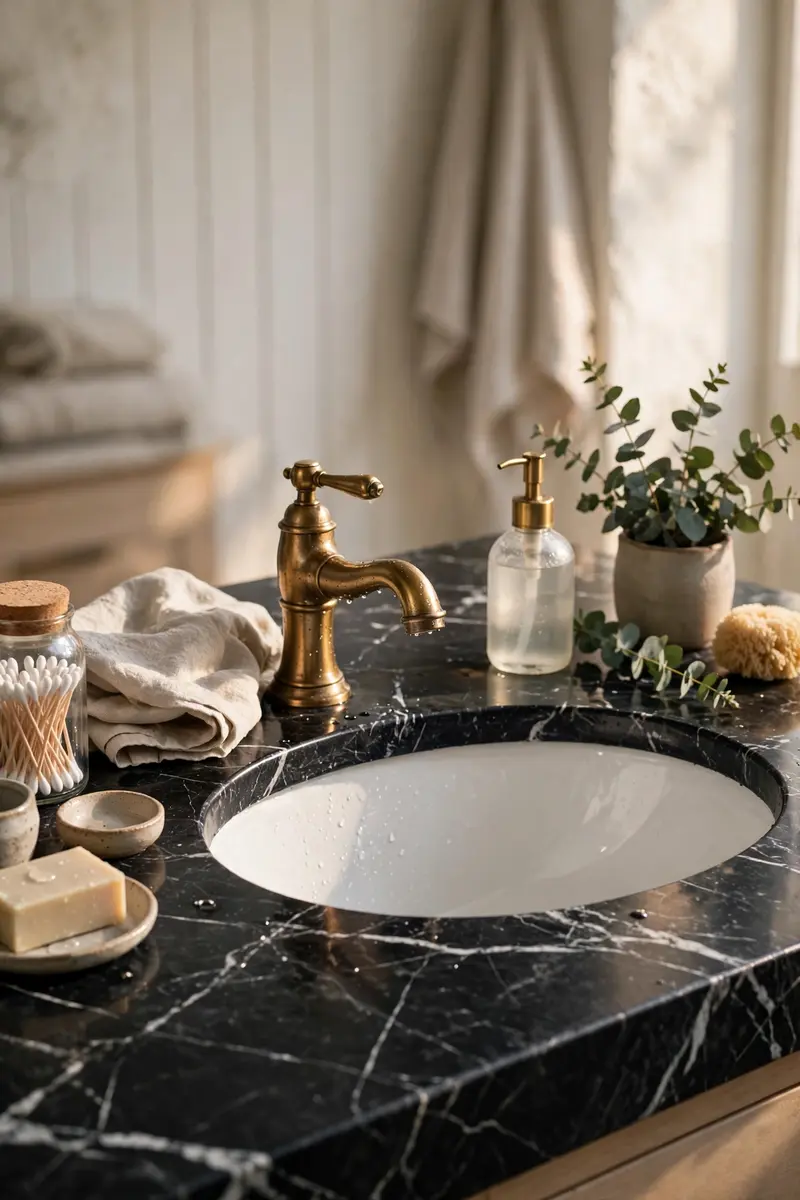
Black marble with white or gold veining is Gatsby-level luxury in a single slab. It turns an ordinary vanity into a statement, hides water spots better than white marble, and pairs with both brass and chrome.
Materials and realistic cost: black marble vanity tops, $400–$1,200 depending on size; remnant pieces from stone yards can halve that. Seal on installation and yearly after, and pair with a white undermount sink.
Tip: Ask stone yards for offcuts first — a small bathroom vanity often fits a remnant that a kitchen never could.
Variation: Black quartz with marble-like veining gives the same drama with far less sealing and staining worry.
13. Gatsby Gold Accents Throughout
Gold is the thread that ties a 1920s bathroom together: mirror frame, faucet finish, light fittings, tray edges, even the grout-adjacent trim. Used sparingly and consistently, it reads as luxury rather than bling.
Materials and realistic cost: gold-finish accessories, $15–$80 each; a gold tray, soap dish, and tumbler set often totals under $150. Pick one gold tone and stick to it across every accessory. Too many gold tones at once is what tips a room from glamorous into chaotic.
Tip: Limit gold to three or four visible items per sightline, and let white tile and marble do the rest of the work.
Variation: Mix gold with black rather than white for a moodier, evening-ready Gatsby bathroom.

14. A Pastel Pink Tile Nod
Not every 1920s bathroom was black and white — soft pink, mint, and pale blue tiles were hugely popular too, and they bring a gentler, more romantic version of the decade. Pink tile with chrome fixtures feels like a vintage hotel bathroom in the best way.
Materials and realistic cost: pastel subway or square tiles, $4–$15 per square foot. Use pink on the lower half of walls with white above, or as a shower surround. Chrome, not brass, is the classic partner for pastel tile.
Tip: A single row of black pencil tile as a border stops pastel tile from feeling sugary and anchors it in the period.
Variation: Blush pink towels, a pink soap dish, and pink flowers give the same nod with zero tiling at all.

15. A Navy and Gold Color Scheme
Navy and gold is the evening-gown version of the 1920s bathroom: deep, dramatic, and endlessly elegant. Navy walls or tile with gold fixtures and a white tub create a room that feels expensive even when most of it is paint.
Materials and realistic cost: navy paint, $40–$70 per gallon; navy tiles, $6–$20 per square foot; gold accessories as in idea 13. Paint upper walls navy with white tile and tub, or tile one navy wall. Good lighting matters more in a dark room, so add sconces and a bright ceiling light.
Tip: A large mirror opposite the window bounces daylight around a navy room and stops it feeling small.
Variation: Swap navy for deep teal if you want the same drama with a slightly greener, more jewel-like cast.

16. A Crystal or Frosted-Glass Chandelier
A small chandelier in a bathroom feels delightfully over the top — which is exactly the point of 1920s glamour. A tiered crystal piece or a frosted-glass geometric pendant over a tub or in a high-ceilinged bathroom becomes the room’s jewelry.
Materials and realistic cost: damp-rated small chandeliers, $250–$2,000; simpler frosted-glass pendants, $80–$250. Check the damp rating, hang clear of splashing water, and put it on a dimmer. Keep the rest of the lighting simple so the chandelier owns the ceiling.
Tip: In a bathroom with a standard 8-foot ceiling, choose a flush or semi-flush Deco fixture rather than a long drop chandelier.
Variation: A beaded or frosted-glass flush mount gives chandelier sparkle without the drop or the price.

17. An Arched Medicine Cabinet
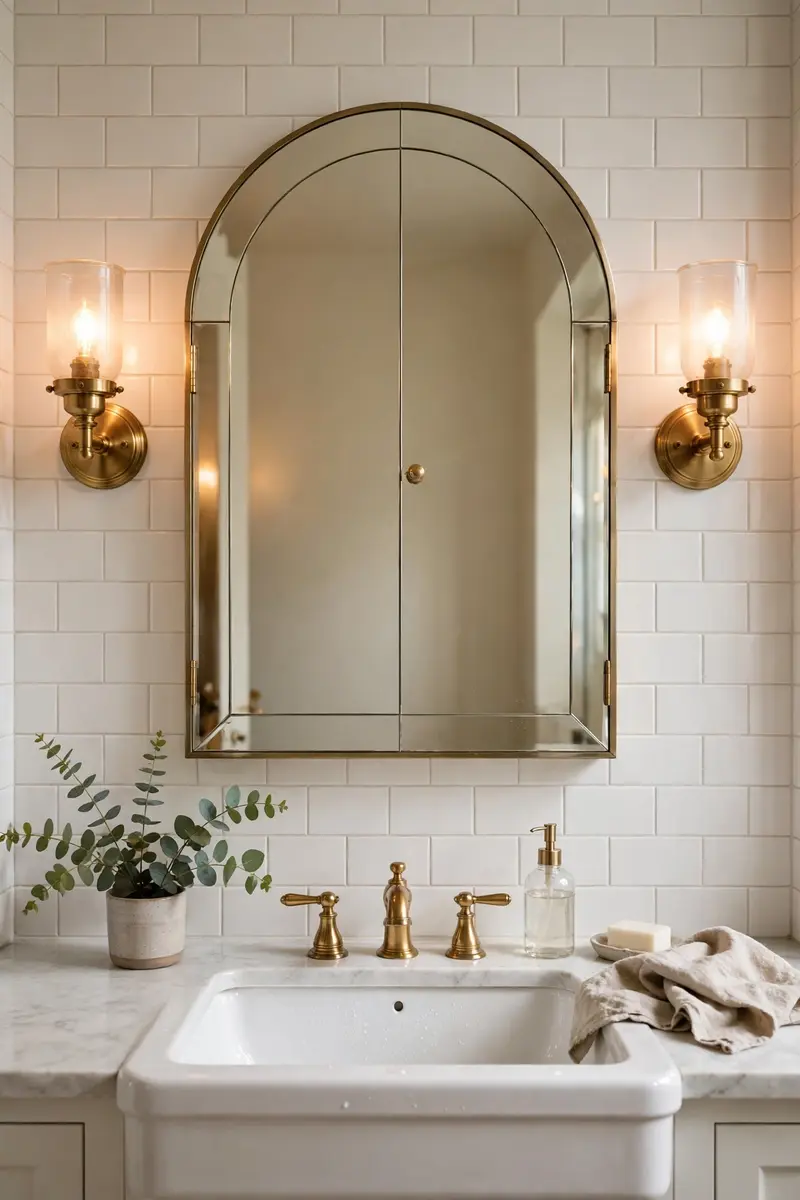
Arched tops soften all that Deco geometry and echo the doorways and windows of 1920s homes. A mirrored arched medicine cabinet adds storage and a period silhouette in one, and it suits both traditional and modern bathrooms.
Materials and realistic cost: arched mirrored medicine cabinets, $150–$600; surface-mount versions are an easy DIY install. Center it over the sink, checking for studs and pipes before recessing. Pair it with sconces on either side and the arch becomes the room’s focal point.
Tip: An arched cabinet with interior shelving and a magnifying mirror insert is the rare vintage look that is also genuinely practical.
Variation: A plain arched mirror with a separate wall-mounted cabinet nearby gives the same shape with more flexible storage.
18. Glass Shelves with Chrome Brackets
Open glass shelves on chrome brackets are textbook 1920s bathroom storage: light, hygienic, and honest about what they hold. They keep daily items visible and easy to reach, and they make a small bathroom feel larger than a closed cabinet would.
Materials and realistic cost: tempered glass shelves with chrome brackets, $40–$150 per shelf. Install into studs, keep styling edited, and wipe weekly so glass stays invisible. Two shelves over a toilet or beside a vanity are usually plenty.
Tip: Decant shampoo and soap into matching glass bottles and the shelf instantly looks curated rather than cluttered.
Variation: A single glass shelf above the sink, paired with a tall closed cabinet elsewhere, balances display and hidden storage.

19. A High-Tank Toilet, Reproduction Style
The high-tank toilet with a pull chain is the most recognizable silhouette of the early 20th-century bathroom. Modern reproductions keep the look — elevated cistern, long pipe, classic bowl — with modern flushing that actually works.
Materials and realistic cost: reproduction high-tank toilets, $600–$1,500; professional installation, $300–$700. Mount the tank high with solid fixings, check ceiling height, and pair with a wooden or black seat. It is a statement piece, so give it a wall to itself rather than crowding it.
Tip: If a full high-tank model is too much, a close-coupled toilet with a wooden seat and chrome flush lever gives a quieter period nod.
Variation: Paint the tank to match your vanity color for a coordinated, custom-built look.

20. Chevron Floor Tile in a 1920s Bathroom
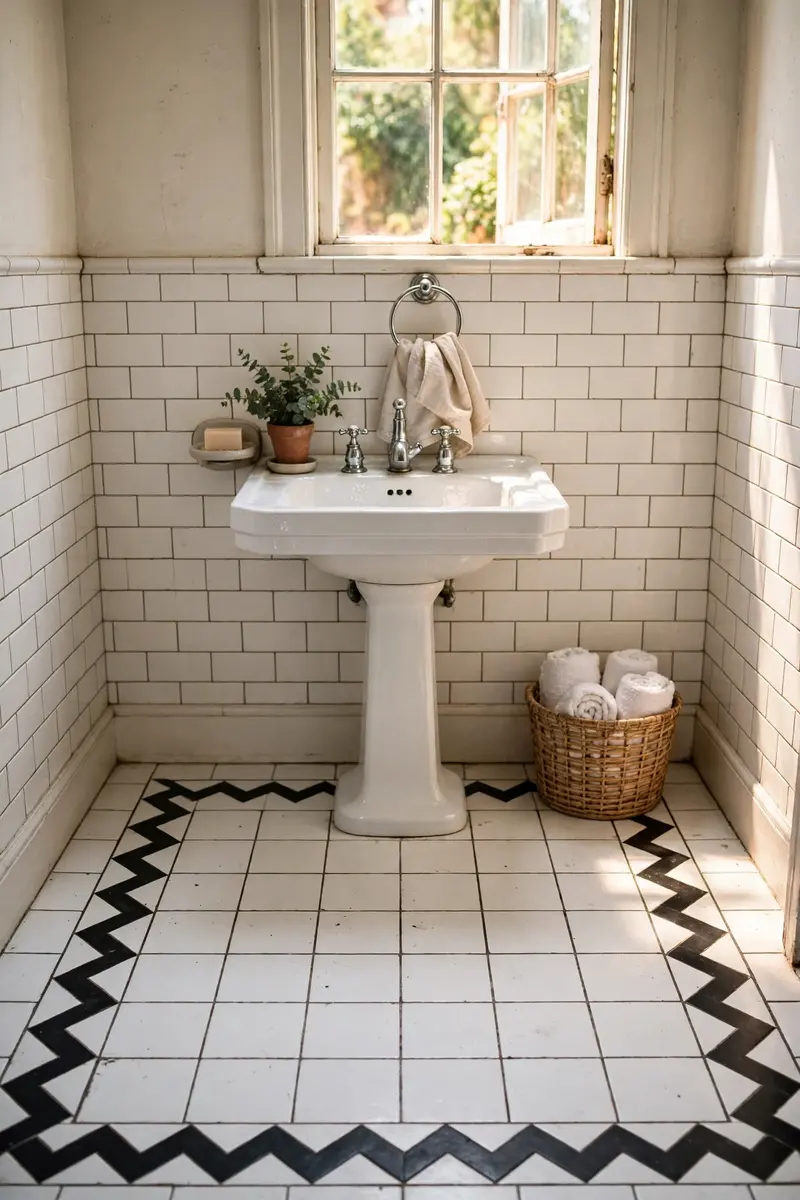
Chevron tile brings movement to a 1920s bathroom floor or shower wall without adding a new color. The zigzag V pattern is pure Deco energy, and it makes even a plain white tile feel designed rather than default.
Materials and realistic cost: chevron mosaic sheets or individual chevron tiles, $8–$25 per square foot. Use a chalk line to keep Vs aligned, expecting more cuts at edges. Black-and-white chevron is the boldest choice; tone-on-tone white chevron is subtler.
Tip: Keep the chevron to the floor only and the walls simple, so the pattern reads as a rug rather than a riot.
Variation: A chevron border strip around a plain tile floor gives the zigzag thrill for a fraction of the tiling.

21. A Zigzag Border Around Plain Tile
If a full patterned floor feels like too much, a zigzag or Greek-key border around plain tile delivers the same Deco message in miniature. Borders were a classic 1920s device for making simple tile feel finished and expensive.
Materials and realistic cost: border tile strips, $5–$15 per linear foot; or paint a border with tile paint for under $50. Run it around the floor edge, at chair-rail height, or as a mirror frame. Keep the border color in the room’s palette — black on white is the classic.
Tip: A border only works if it is straight, so use a laser level or a long straightedge and do not rush the first row.
Variation: A painted zigzag border on a wooden vanity or a mirror frame echoes the tile border without any tiling at all.
22. An Octagonal Mirror with a Brass Frame
Octagonal mirrors are Deco geometry at its purest: eight clean sides, a brass or chrome frame, and a shape that feels both vintage and current. They suit square rooms and square sinks particularly well.
Materials and realistic cost: octagonal mirrors, $50–$250. Hang centered over the sink, letting its angles contrast with round accessories. Brass frames warm up white tile; black frames sharpen a black-and-white scheme.
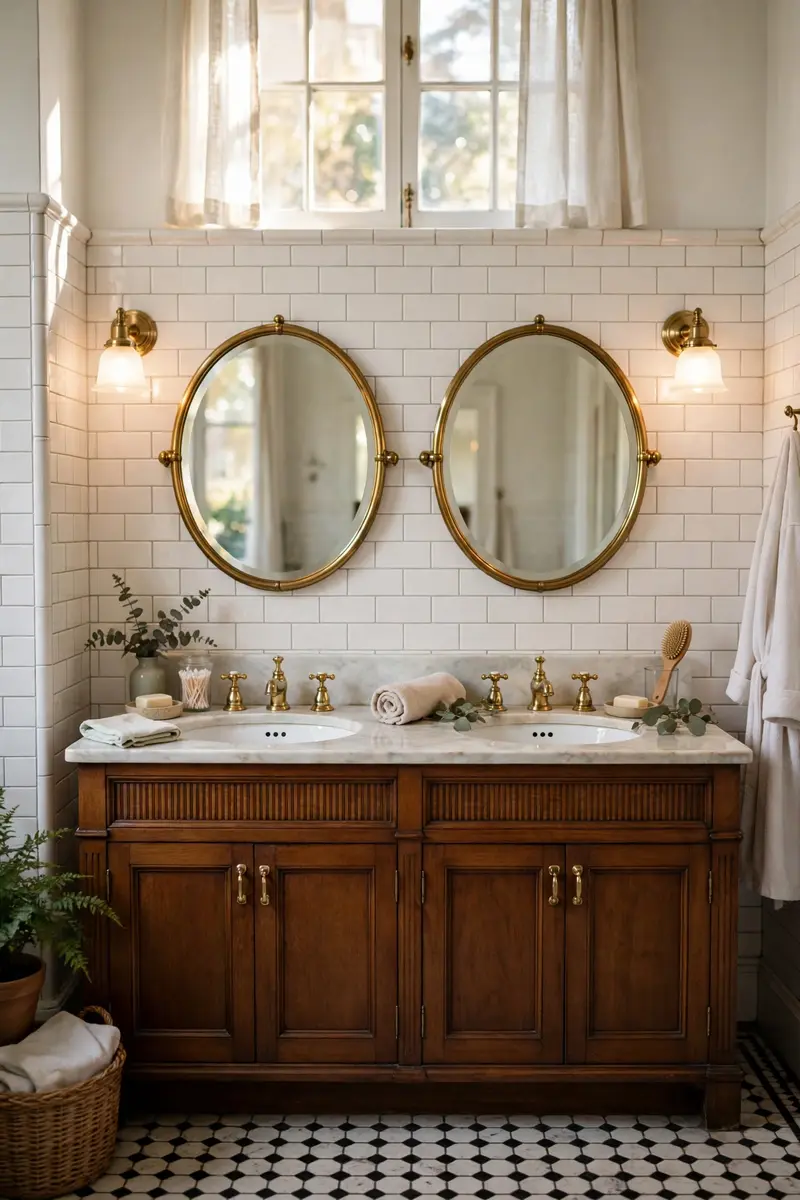
Tip: An octagonal mirror over a double vanity, repeated twice, creates the symmetry the 1920s loved.
Variation: A beveled-edge octagonal mirror with no frame at all reads lighter and more modern while keeping the period shape.

23. A Stained-Glass Window Accent
A stained-glass window — real, reproduction, or even a film applied to existing glass — pours colored light into a 1920s bathroom and gives privacy without curtains. Geometric Deco patterns in amber, green, and gold suit the era best.
Materials and realistic cost: stained-glass window film, $20–$60; custom stained-glass panels, $300–$1,500. Apply film inside the glass, or hang a real panel in front of a window. Keep the pattern geometric rather than floral to stay in the Deco lane.
Tip: Amber and gold glass warms morning light beautifully, while blue and green glass cools a sunny south-facing bathroom.
Variation: A small stained-glass transom above a plain window gives the colored-light effect without replacing the whole window.

24. Monochrome Walls with Jade Green Accessories
If you love the 1920s bathroom look but not a full remodel, start monochrome and add jade. White walls, black floors, chrome fixtures — then jade towels, a jade soap dish, and a jade glass tray. The green pops against the black and white like jewelry.
Materials and realistic cost: jade accessories, $10–$50 each; a full accessory swap often totals under $150. Keep the base truly monochrome so the jade reads as a deliberate accent, and repeat it at least three times around the room — towel, tray, and soap dish, for example — so it feels intentional.
Tip: Real jade-green glass, rather than plastic, catches light the way period glass did and elevates the whole shelf.
Variation: Swap jade for ruby red or sapphire blue if you prefer a warmer or cooler jewel tone.

25. A Vanity Tray with Perfume Bottles
A mirrored or brass vanity tray dressed with perfume bottles, a small vase, and a candle turns a bathroom counter into a 1920s dressing table. It is pure styling, costs almost nothing, and instantly photographs beautifully.
Materials and realistic cost: brass or mirrored trays, $20–$60; vintage-style perfume bottles, $10–$40 each, often found at thrift stores. Group items in odd numbers with varied heights, leaving room around the tray. Keep everyday items — toothbrush, cleanser — off the tray and in a cabinet.
Tip: A tray corrals clutter visually, so even a busy counter reads as styled rather than messy.
Variation: Use a tray on the back of the toilet or on open shelving if counter space is too precious to spare.

26. Framed 1920s Prints and Posters
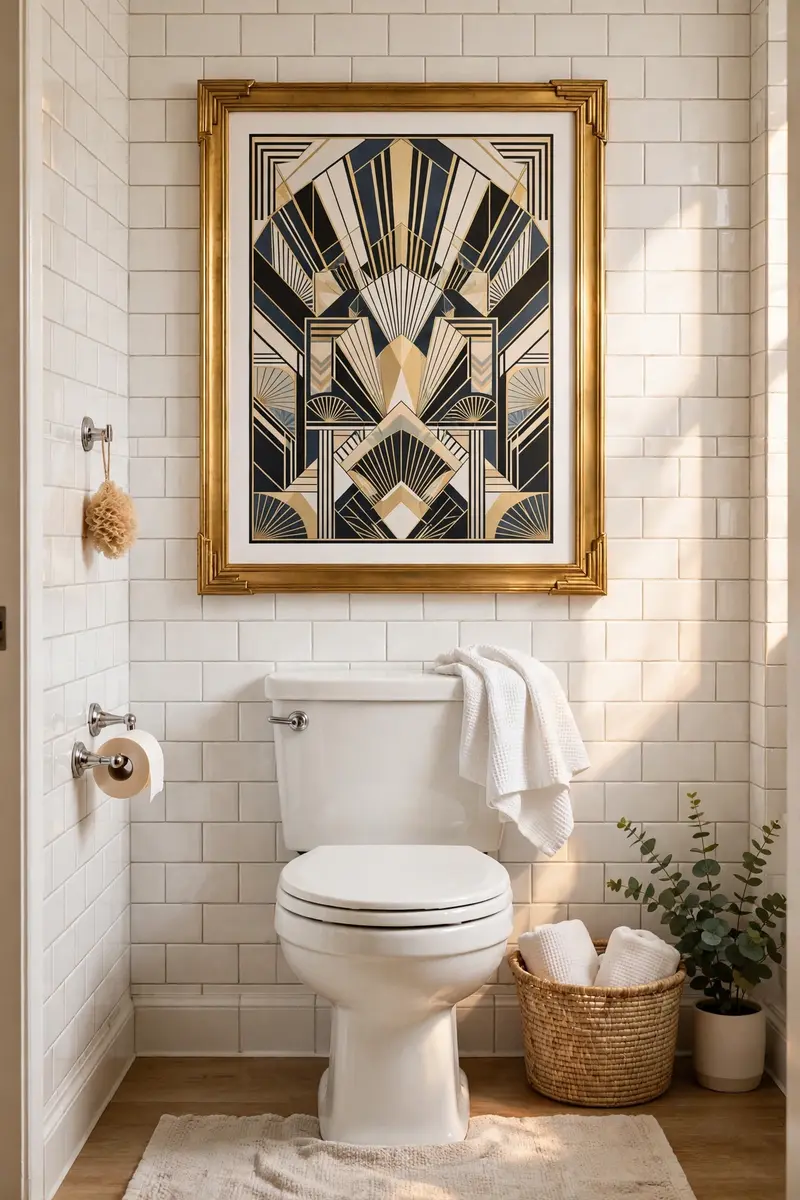
Framed Deco posters, jazz-age advertisements, or geometric art prints are the cheapest way to declare the era. One large framed print over the toilet or beside the mirror sets the theme for the whole room.
Materials and realistic cost: reproduction Deco prints, $15–$60; frames, $20–$50 each. Choose gold or black frames, hang at eye level, and keep out of splash zones. A single bold print beats a gallery wall here; Deco loved symmetry and restraint.
Tip: A print in the room’s accent color — emerald, navy, or gold — ties the wall art to the towels and accessories.
Variation: Frame a page from a vintage magazine or a reproduction travel poster for a one-of-a-kind piece nobody else has.
27. Beveled Subway Tile with Dark Grout
Beveled subway tile adds a subtle three-dimensional ripple to walls that flat tile cannot match. Each tile’s angled edge catches light differently, so the wall shimmers gently as you move around the room.
Materials and realistic cost: beveled subway tiles, $5–$15 per square foot. Install like flat tile, taking extra care since bevels exaggerate uneven joints. Dark grey or black grout outlines each bevel dramatically; white grout keeps the effect soft and luminous.
Tip: Beveled tile on the shower walls only, with flat tile elsewhere, concentrates the shimmer where the light hits it most.
Variation: Beveled tile in a soft sage or blush color gives the same texture with a pastel period palette.

28. A Freestanding Tub Painted a Bold Color
Painting a freestanding tub is the single most transformative trick in the 1920s bathroom playbook. A white tub becomes a emerald, navy, or black sculpture, and the cost is a can of paint and a weekend.
Materials and realistic cost: tub paint or exterior enamel suitable for the tub material, $40–$100; painter’s tape and primer, $20–$40. Clean, sand lightly, prime, and paint in thin coats, letting each cure. Keep the interior white porcelain and the feet chrome or brass for contrast.
Tip: Test the color on a hidden patch of the tub exterior first — dark colors show every brush mark, so use a foam roller for a smooth finish.
Variation: Paint only the feet gold or copper and leave the tub white for a subtler custom touch.

29. Double Vanity Symmetry
The 1920s loved symmetry, and nothing expresses it better than a double vanity: two sinks, two mirrors, two sconces, perfectly mirrored. Even in a modest bathroom, a symmetrical arrangement around a single sink — matching sconces and matching shelves — gives the same calm, balanced feeling.
Materials and realistic cost: double vanity units, $800–$3,000; matching mirror and sconce pairs, $150–$600 total. Allow at least 30 inches per person, keeping countertop and hardware identical. Symmetry only works when it is exact, so match everything down to the towel rings.
Tip: If a true double vanity will not fit, fake the symmetry with one sink centered between two identical sconces and two identical shelves.
Variation: A single long trough sink with two faucets gives double-vanity function with a more contemporary silhouette.
30. Black-Framed Shower Glass
Black-framed shower glass — thin steel-look frames in a grid pattern — is the modern descendant of the 1920s steel window. It adds graphic structure to a shower, keeps the room open, and pairs with both black-and-white tile and brass fixtures.
Materials and realistic cost: black-framed shower enclosures, $600–$2,000; grid-pattern film on existing glass, $30–$80 as a trial. Keep the glass clean with a daily squeegee, since black frames show water spots more than chrome, and match the frame to your mirror frame or faucet finish family.
Tip: A grid pattern with larger panes reads more 1920s than a fine grid, which can feel industrial rather than Deco.
Variation: Black-framed glass as a room divider between a tub and a vanity gives the same graphic line without a full enclosure.

31. Terrazzo Flooring with a Vintage Palette
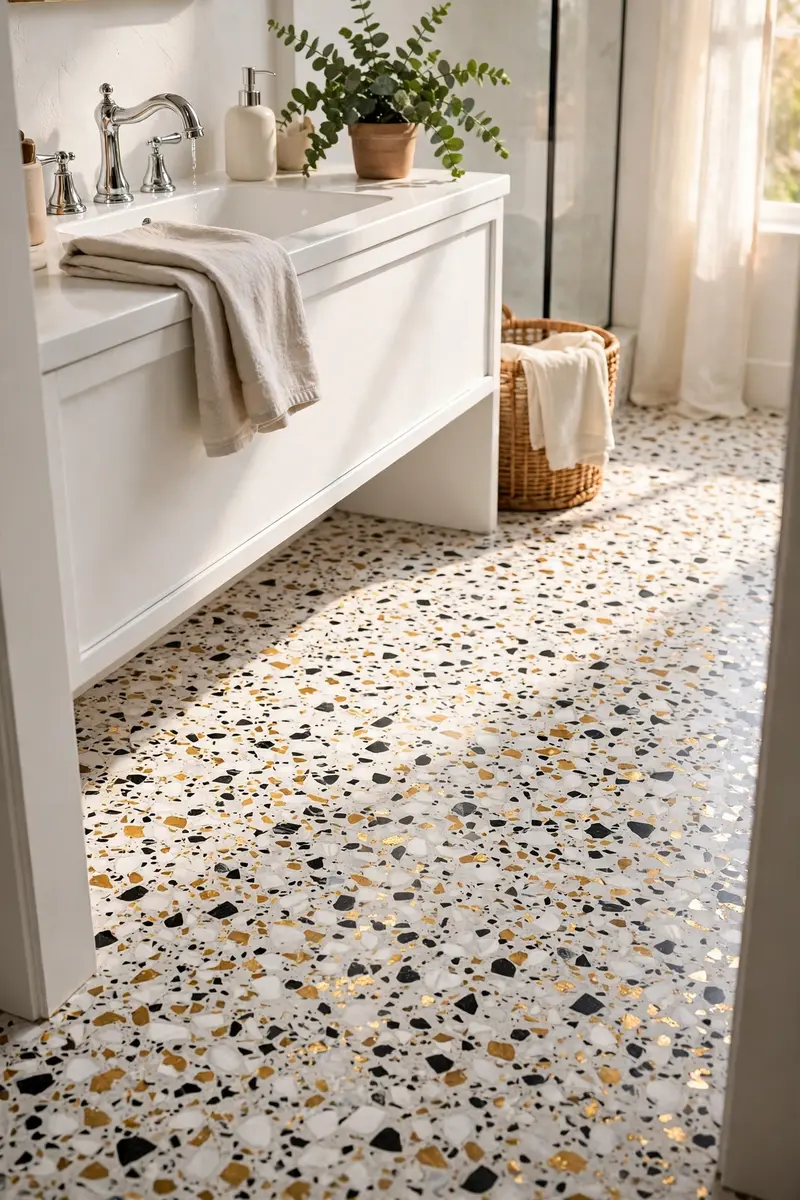
Terrazzo — chips of marble and stone set in cement — was a glamorous 1920s flooring choice, and it is back in a big way. A terrazzo floor in white, black, and gold chips ties together every other Deco element in the room.
Materials and realistic cost: terrazzo-look porcelain tiles, $6–$20 per square foot; poured terrazzo, $15–$30 per square foot installed. Tiles are the practical choice for most bathrooms: they install like ordinary tile and need no special sealing beyond grout sealer. Choose chips that repeat your wall and accessory colors.
Tip: Large-format terrazzo-look tiles with big chips read more period-authentic than tiny speckled patterns.
Variation: A terrazzo vanity top or a terrazzo tray gives the material’s sparkle without re-flooring the room.
32. Wainscoting Below, Wallpaper Above
The classic 1920s bathroom wall treatment is two-part: beadboard or panel wainscoting on the lower half, patterned wallpaper or paint above. It protects the lower wall from splashes, adds architectural detail, and frames the wallpaper beautifully.
Materials and realistic cost: beadboard panels, $2–$6 per square foot; chair rail and cap trim, $30–$100; wallpaper as in idea 9. Paint wainscoting white or cream and caulk the top edge against steam. The split should sit around 36–42 inches from the floor.
Tip: Paint wainscoting in a satin or semi-gloss finish so it wipes clean and resists bathroom humidity.
Variation: Tile wainscoting — subway tile below, paint above — is the more waterproof version of the same classic split.

33. A Round Brass Mirror over the Vanity
A round brass mirror is the softer cousin of the sunburst and octagonal mirrors: one clean circle, one warm frame, endless versatility. It works with every other idea on this list, which makes it the safest first purchase for a 1920s bathroom.
Materials and realistic cost: round brass mirrors, $40–$200. Hang centered over the sink at eye level, paired with a brass faucet. A thin frame reads modern; a thick, rope-textured frame reads more vintage.
Tip: A round mirror over a rectangular vanity softens all the straight lines in the room and makes the space feel less boxy.
Variation: Two small round brass mirrors over a double vanity keep the circle motif while delivering the symmetry of idea 29.

34. A Vintage Radiator as a Towel Warmer
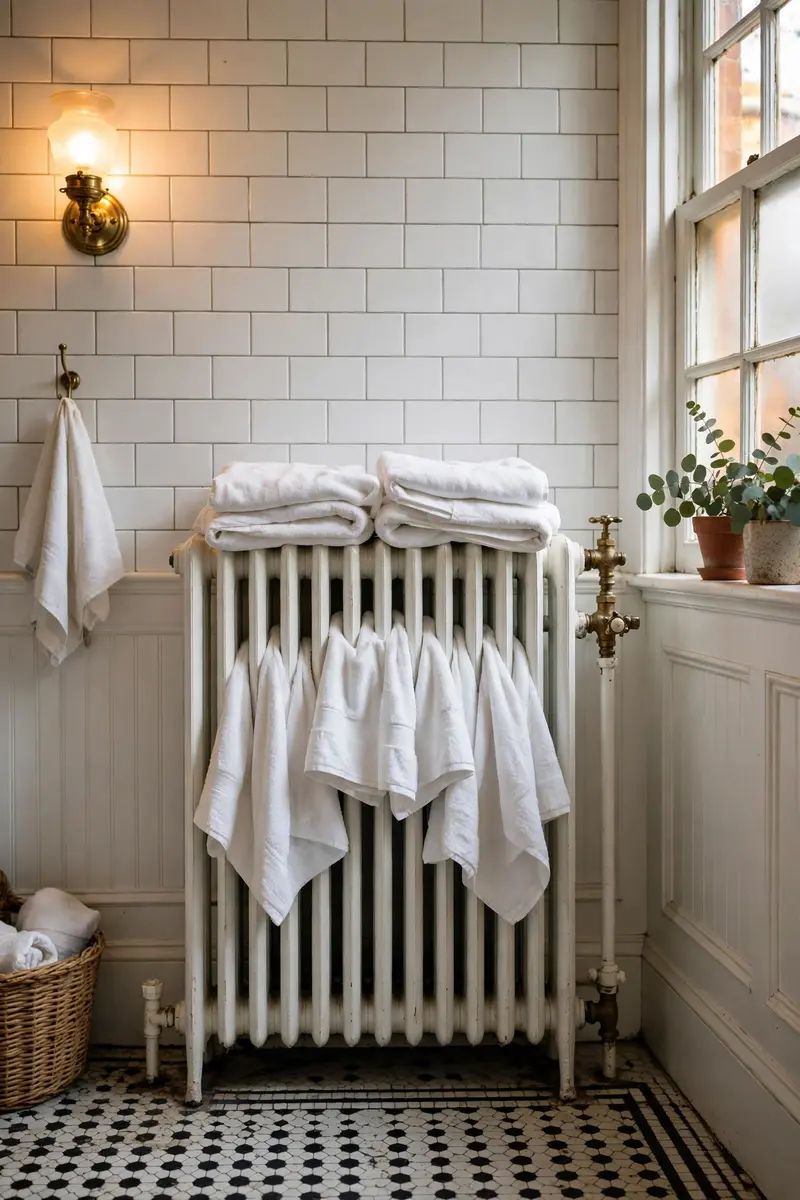
A cast-iron radiator — restored, or a modern column radiator in a period style — warms a 1920s bathroom and dries towels the way no modern panel heater can match visually. It is functional sculpture, especially in a cold-climate home.
Materials and realistic cost: column radiators, $300–$900; heated towel rails in a vintage style, $200–$600; professional plumbing, $300–$800. Place it on the wall opposite the tub or beside the vanity, check that your heating system can support it, and add a wooden shelf above it for folded towels that warm while they wait.
Tip: A radiator in the same color as your vanity — black, cream, or emerald — turns a utility into a design feature.
Variation: An electric heated towel rail in brass gives the same warm-towel luxury with simpler installation in a bathroom without central heating.
35. Marble Hexagon Floor with a Border
Combine two period favorites — hexagon tile and a border — for a floor that looks like it was laid by a 1920s craftsman. A white marble hexagon field with a black hexagon border, or the reverse, is intricate without being busy.
Materials and realistic cost: marble hexagon mosaic, $15–$35 per square foot; border strips, $8–$20 per linear foot. The result rewards the effort every single day.
Tip: Seal marble hexagon floors before grouting as well as after, to keep grout pigment out of the stone.
Variation: Porcelain hexagon tile that mimics marble gives nearly the same look with far less sealing and staining worry.

36. A Deco Fan Tile Backsplash
Fan or scallop tile — overlapping semicircles like fish scales — is the most romantic Deco pattern, and a vanity backsplash is the perfect small canvas for it. One strip of fan tile behind the sink becomes the room’s jewelry.
Materials and realistic cost: fan mosaic tiles, $10–$25 per square foot; a vanity backsplash in materials often costs $80–$250. Choose a color echoing the room and keep the rest of the wall plain. Grout color matters: matching grout softens the fans, contrasting grout defines each scallop.
Tip: Fan tile looks best when the pattern is complete at the edges, so plan your layout from the center outward.
Variation: Fan tile inside a shower niche or as a single accent stripe gives the same scalloped charm in an even smaller dose.

37. A Soft Cream and Blush Palette
If black-and-white Deco feels too stark, try cream and blush: warm cream walls, blush towels and accessories, brass fixtures, and white porcelain. It is the same era, seen through a softer, more romantic lens, and it flatters every skin tone in the mirror.
Materials and realistic cost: cream paint, $40–$70 per gallon; blush accessories, $10–$50 each. The palette works especially well in bathrooms with warm natural light.
Tip: A blush shower curtain or a blush Roman blind is the fastest way to test the palette before repainting anything.
Variation: Cream and sage is the cooler, greener cousin of this palette, and it pairs beautifully with chrome instead of brass.
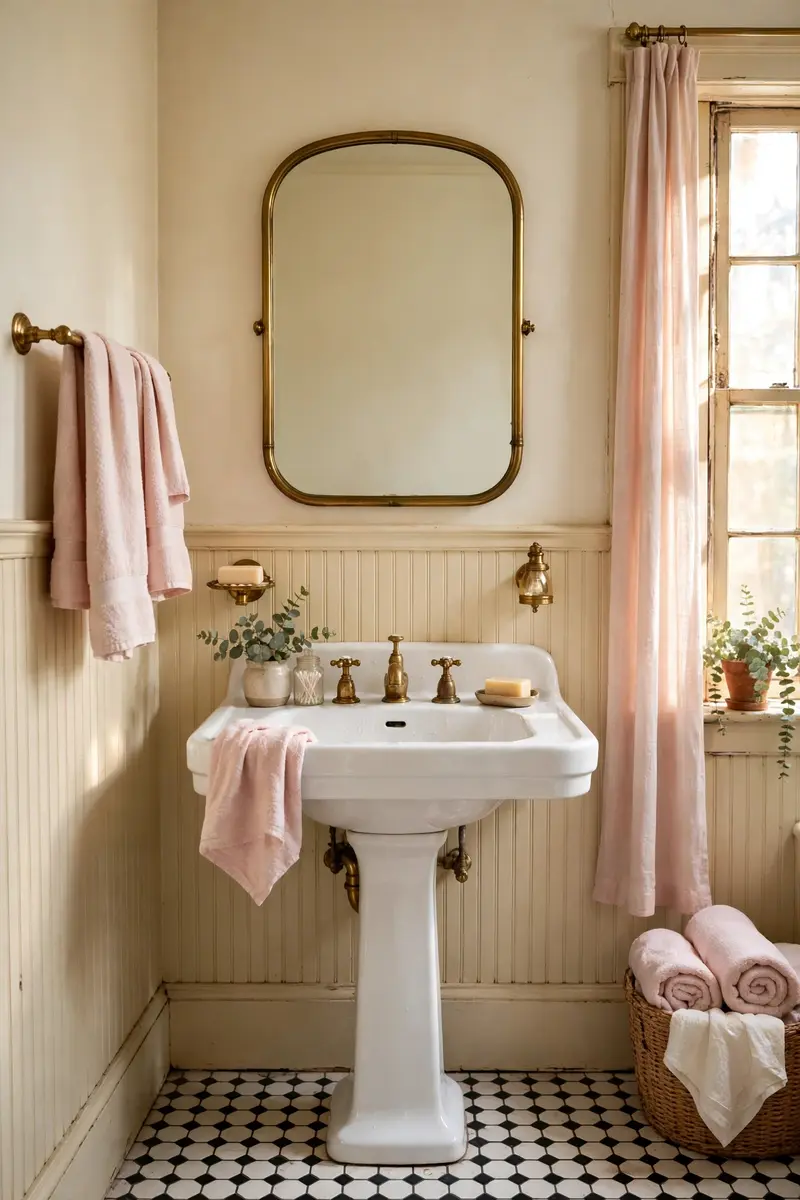
38. A Chrome Telephone Shower Handset
The telephone-style handset — a shower head on a cradle with a flexible hose, mounted beside a clawfoot tub — is a delightful period detail that is also genuinely useful for rinsing the tub, washing hair, and bathing children or pets.
Materials and realistic cost: telephone shower sets, $150–$400; wall-mount cradle included. Mount within reach of the tub, checking filler compatibility, in chrome or brass. Keep the hose looped neatly on its cradle when not in use.
Tip: A handset with an adjustable spray setting is far more useful day to day than a fixed-flow vintage reproduction.
Variation: A modern rainfall shower head paired with a separate vintage-style handset gives you both period charm and modern showering.

39. Patterned Cement-Look Floor Tiles
Patterned cement-look tiles — encaustic-style designs in black, white, and grey — bring Deco geometry to the floor in a single, bold move. They suit bathrooms that want pattern without the fuss of tiny mosaics.
Materials and realistic cost: patterned porcelain tiles mimicking cement tile, $5–$18 per square foot; real cement tiles, $10–$25 per square foot but heavier and more porous. Lay in a straight grid, seal real cement tile well, and keep walls simple.
Tip: Order 10 percent extra tile for cuts and breakage, especially with a bold pattern where a mismatched replacement would show.
Variation: Patterned tile on the floor of a small powder room only gives maximum impact for minimum square footage and cost.
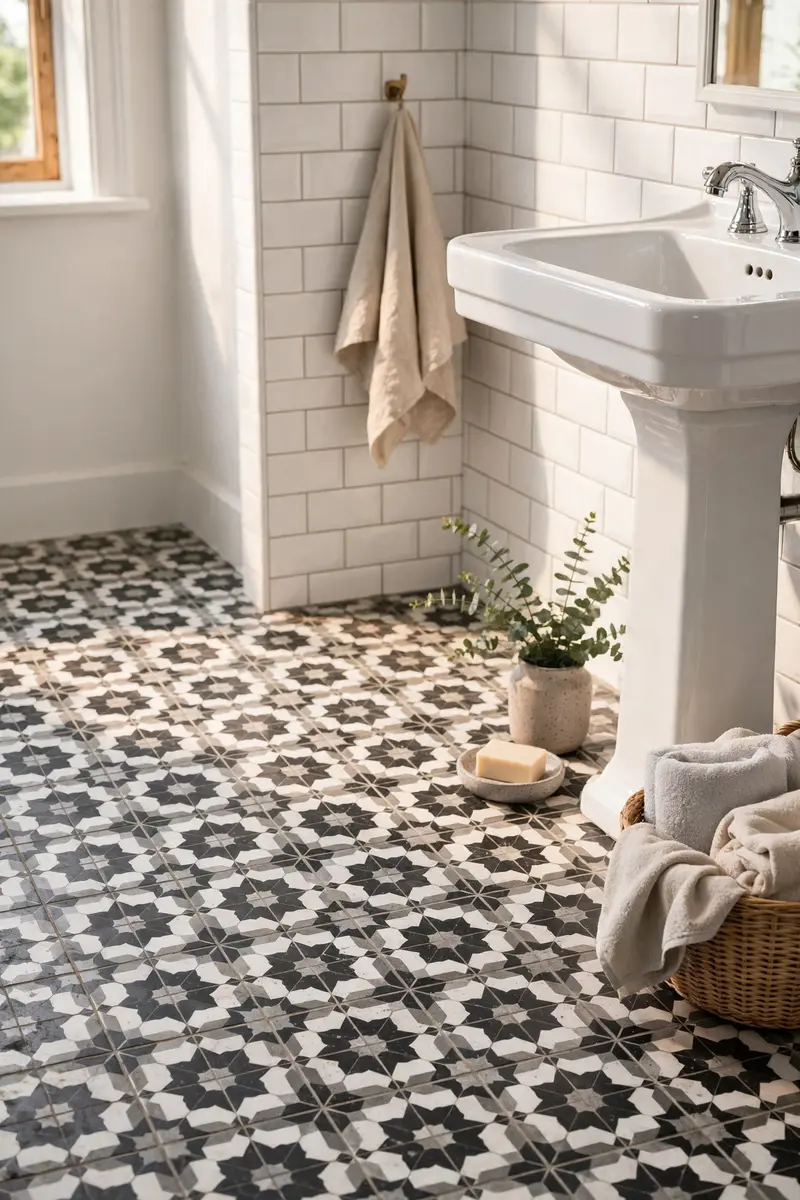
40. A Jewel-Box Gatsby Powder Room
If you only have a tiny powder room, make it a jewel box: dark walls, a gold mirror, a patterned floor, and one dramatic light. Small rooms can carry more drama per square foot than large ones, because every surface is close at hand and the effect is immersive.
Materials and realistic cost: a powder-room transformation with paint, mirror, lighting, and accessories often totals $300–$900 without tiling. Paint walls deep green or navy, add a gold mirror, swap in brass fixtures, and finish with a patterned towel. Keep the floor pattern bold — it is the room’s rug.
Tip: In a powder room, go one shade darker than you think you dare — small dark rooms feel intentional and cocooning, not cramped.
Variation: If dark walls feel too brave, keep the walls cream and make the floor and mirror the drama instead. For more vintage inspiration, see our vintage bathroom ideas and our retro bathroom ideas, and if you are working with a tight budget, our small bathroom decor ideas on a budget will help you stretch every dollar.

Frequently Asked Questions About 1920s Bathrooms
How do I make my bathroom look 1920s without remodeling?
Start with swaps that signal the era instantly: a sunburst, octagonal, or round brass mirror, brass or chrome cross-handle hardware, and Art Deco lighting. One wall of peel-and-stick geometric wallpaper, glass jars for storage, and framed vintage prints will sell the look while your layout stays as it is.
What tile styles feel most authentic for a 1920s bathroom?
Subway tile is the classic choice, especially white with matching or darker grout for contrast. Black-and-white floors — checkerboard, chevron, and herringbone patterns — also feel very true to the era. For more decoration, look for geometric Art Deco patterns, hexagon mosaic floors, or small accent areas of fan or scallop tile that reflect light and add vintage glamour.
What colors were used in 1920s bathrooms?
1920s bathrooms favored creams, whites, soft pastels, and muted greens, with black-and-white combinations especially common in tilework. Jewel tones like emerald green and navy appeared as accents, while brass and chrome provided the metallic warmth. For more on period color, see these vintage bathroom ideas from Apartment Therapy and this guide to Art Deco wallpaper from The Spruce.
Can I mix modern fixtures with 1920s style?
Absolutely — the best 1920s bathrooms today hide modern comfort behind period looks. Choose fixtures with vintage silhouettes in modern materials, like a reproduction clawfoot tub in acrylic or a rainfall shower paired with a telephone handset. Keep finishes consistent and the room will read as vintage while performing like new.
Conclusion
A 1920s bathroom is not about recreating a museum — it is about borrowing the decade’s confidence: bold geometry, honest materials, and a little glamour in an everyday room. Start with one idea, whether a checkerboard floor, a sunburst mirror, or a brass tray, and let the room grow from there. Even three or four well-chosen touches will make your bathroom feel like a small, sparkling piece of the Jazz Age. Save this post to Pinterest so you can return to it for your next vintage update.



Leave a Reply