There is a reason your feed suddenly feels warmer, richer, and more soulful. Pinterest named Afrohemian its number one home prediction for 2026, and searches for afrobohemian living room ideas have climbed about 220% in a single year. After a long run of pale minimalism, people want rooms that feel collected, storied, and alive — and this style delivers exactly that.
Afrohemian blends African craftsmanship with relaxed bohemian ease. Think mudcloth from Mali, indigo adire from Nigeria, kente from Ghana, handwoven baskets, carved wood, and terracotta made by real hands. The palette runs warm and sunbaked: terracotta, ochre, clay, deep browns, and sand, balanced with black and deep indigo for contrast.
This guide walks you through 34 afrobohemian living room ideas, from one-afternoon swaps to full-room transformations. Each idea explains what creates the look, what it costs, and how to pull it off in your own space. Pick three or four favorites to start, then layer more over time — that slow, collected feeling is the whole point.
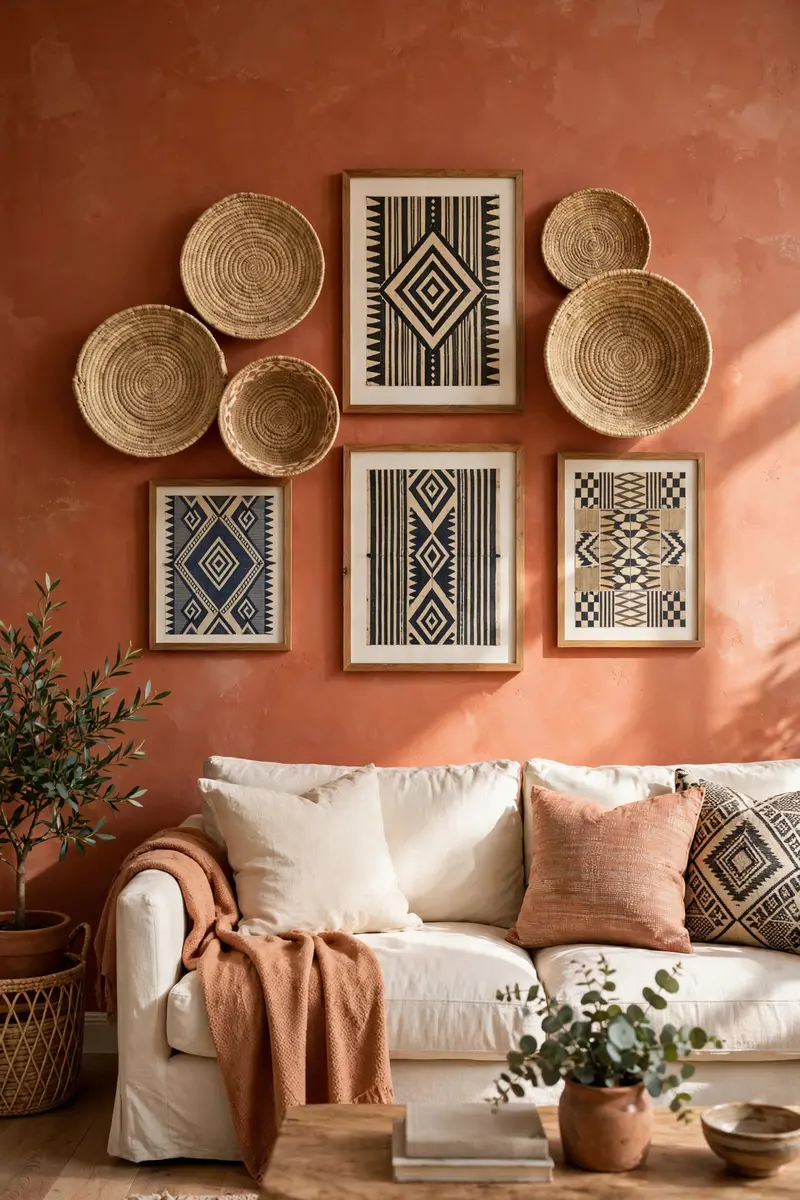
1. Terracotta Gallery Wall with Woven Baskets
A terracotta-painted gallery wall is one of the most powerful moves in afrobohemian living room ideas, because it gives every object behind it a warm glow. Layering framed African textile prints alongside handwoven wicker baskets creates depth that no single art piece can achieve on its own.
Materials + cost: one gallon of terracotta paint ($30–$45), 5–7 woven baskets in varied sizes ($8–$20 each), 2–3 framed textile prints ($15–$40 each). Total: roughly $120–$250 for a full wall.
Paint the wall first and let it dry completely. Arrange the baskets on the floor before hanging, mixing sizes dramatically. Hang the largest basket slightly off-center, then fill around it with smaller baskets and framed prints.
Tip: Photograph your floor arrangement before you start hammering nails — it saves a wall full of extra holes.
Variation: Swap the terracotta paint for a warm clay limewash if you want a softer, chalky finish.
2. Low Linen Sofa with Mudcloth Throw Pillows
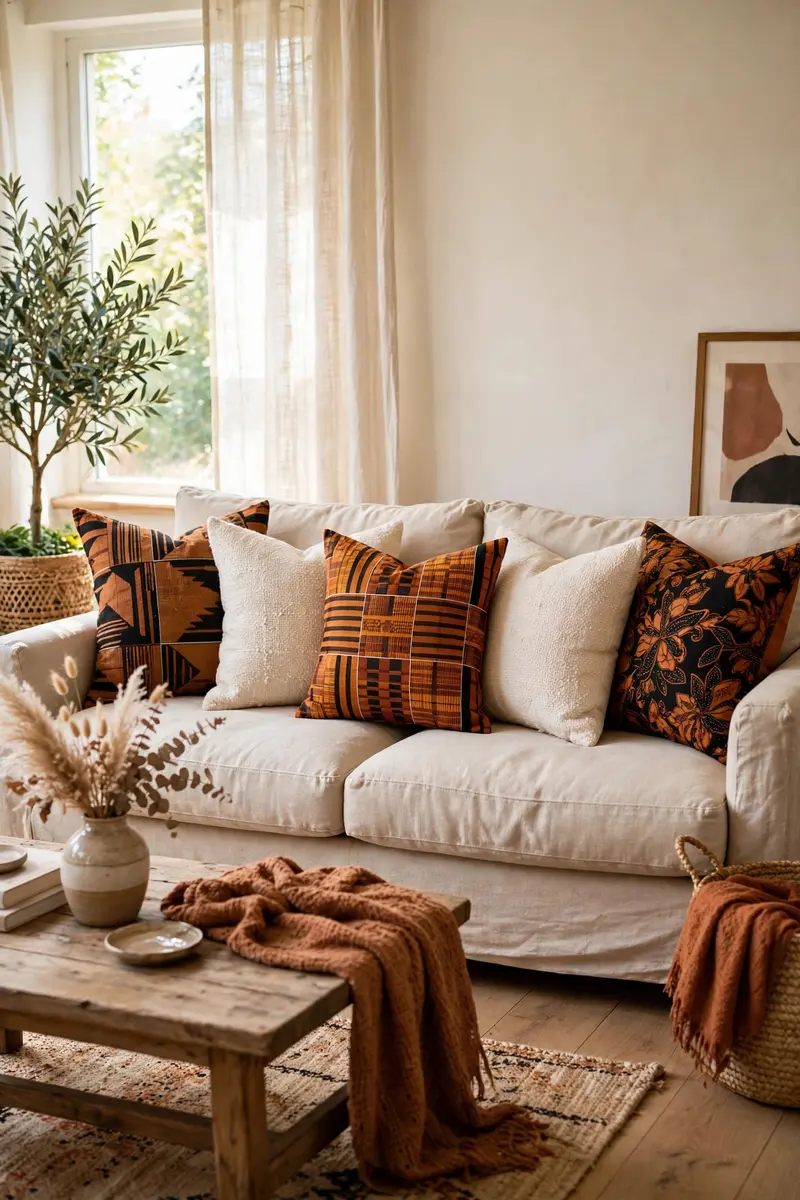
Start with a comfortable sofa in a warm neutral shade like cream, oatmeal, or soft beige. These lighter colors create a beautiful foundation for the richer textures and patterns that give afrobohemian living room ideas their personality, and mudcloth pillows are the fastest way to add that layer.
Materials + cost: 3–5 mudcloth pillow covers ($25–$45 each), one rust or ochre throw ($30–$60). If your sofa needs replacing, a low linen sofa runs $600–$1,200.
Style the pillows in odd numbers and mix two mudcloth patterns with one solid rust or black pillow to keep the arrangement calm. Drape the throw over one arm rather than folding it neatly — the slightly undone look is what makes the room feel lived in.
Tip: Buy authentic mudcloth covers from an African artisan or Black-owned maker when you can — the real hand-dyed cloth has a depth that printed copies never match.
Variation: Use mudcloth lumbar pillows on a leather sofa for a moodier, more masculine take.

3. Layered Jute and Kilim Rugs
Layering rugs is the oldest trick in afrobohemian living room ideas, and it works because it builds depth from the floor up. A jute base topped with a geometric African-pattern kilim creates a richness that a single rug never achieves, and it anchors the whole seating area.
Materials + cost: a large jute rug ($45–$90), a smaller patterned kilim or flatweave ($60–$150), rug pad ($20–$35). Total: under $250 for most living rooms.
Lay the jute rug first, centered under the coffee table with at least the front legs of the sofa resting on it. Place the kilim on top at a slight angle so a border of jute shows on two sides.
Tip: A rug pad under both layers stops the kilim from sliding and adds softness underfoot.
Variation: Swap the kilim for a vintage Moroccan-style rug in the same warm palette for a softer pattern.

4. Adire Indigo Throw Blanket
Adire is indigo-dyed cloth from the Yoruba people of Nigeria, made with resist-dye techniques that leave white swirls and dots on deep blue. A single adire throw brings the cool, saturated counterpoint that keeps afrobohemian living room ideas from feeling all warm and no contrast.
Materials + cost: an authentic adire throw ($40–$90), or an adire-style cotton throw ($25–$45). Look for hand-dyed pieces at artisan markets and fair-trade shops.
Drape the throw over the back of the sofa or fold it over one arm so the pattern reads clearly from across the room. Pair it with a rust or ochre pillow to let the blue pop — indigo and terracotta are one of the great color partnerships in this style.
Tip: Keep adire away from direct, all-day sun if you can; natural indigo fades gracefully, but harsh sun speeds it up.
Variation: Hang a large adire cloth as a wall hanging behind the sofa for the same color story at a bigger scale.

5. Kente Cloth Pillows
Kente is the cloth of kings from Ghana, woven in silk and cotton strips with vibrant interlocking geometric patterns that carry specific symbolic meanings. Kente pillows bring the brightest color moment in afrobohemian living room ideas, so a little goes a long way.
Materials + cost: 2–3 kente pillow covers ($30–$55 each). Choose one dominant color family — gold and red, or green and black — and repeat it elsewhere in the room.
Place kente pillows at the corners of the sofa rather than the center, where they frame the seating instead of competing with it. Balance them with solid linen pillows in cream or chocolate so the eye has somewhere to rest.
Tip: Limit bold prints to two or three pieces per room and balance them with solid, textural neutrals — that is how you keep the energy high without visual chaos.
Variation: Use a single long kente lumbar pillow on a bench or window seat for a smaller dose of the same color.

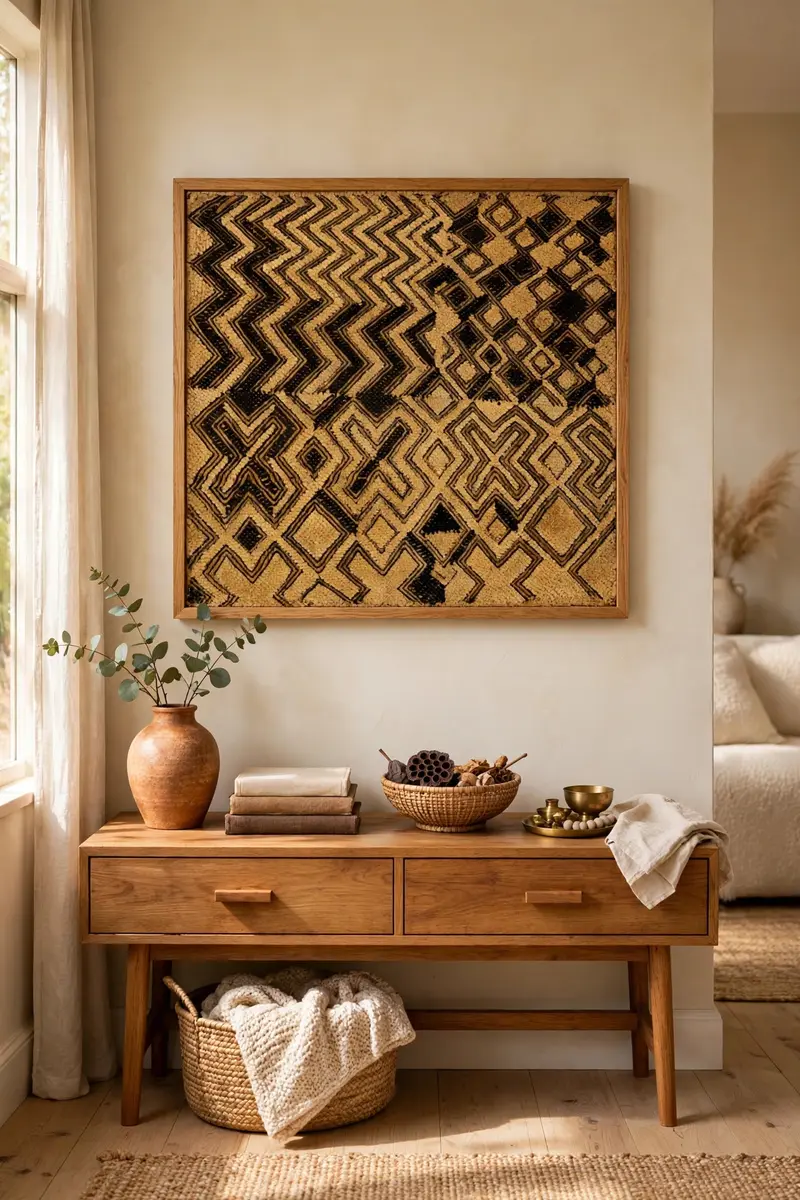
6. Framed Kuba Cloth Wall Art
Kuba cloth is handwoven from raffia palm fibers by artisans in the Congo, and its bold geometric patterns in ochre, cream, and black make it one of the most graphic textiles in afrobohemian living room ideas. Framed as art, it reads like a museum piece — because in a sense, it is one.
Materials + cost: one kuba cloth panel ($50–$120), a simple black or natural wood frame ($25–$60), or a floating frame ($40–$80). Total: roughly $90–$200.
Choose a panel with strong geometry and let it hang alone on a narrow wall, or pair two smaller panels side by side above a console. Keep the frame simple — the cloth is the art, and a fussy frame fights it.
Tip: Float-mount the cloth with a linen mat so the raffia texture stays visible at the edges.
Variation: Drape an unframed kuba cloth over a bench or the back of a chair for a softer, more casual display.
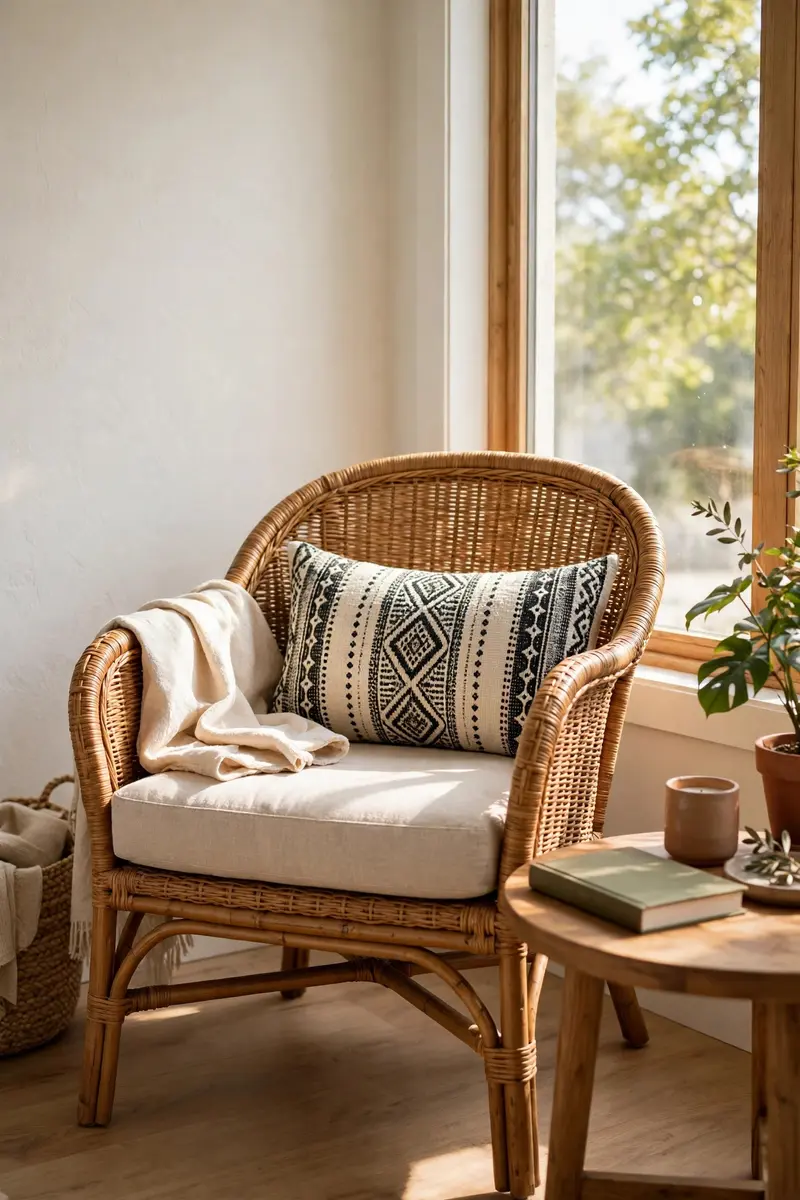
7. Rattan Accent Chair in the Sunny Corner
Searches for rattan accent chairs are up about 50% this year, and in afrobohemian living room ideas the chair is the anchor piece. It adds sculptural shape, natural texture, and a sunny-corner seat that everyone in the house will fight over.
Materials + cost: a rattan or cane accent chair ($120–$350), one mudcloth or kente lumbar pillow ($25–$45), a small sheepskin or woven throw ($30–$60).
Place the chair where the light lands — near a window or angled toward the sofa at about 45 degrees. Add the pillow and throw, plus a small side table with a book.
Tip: Check the chair’s weight and wobble before you buy; a good rattan chair feels solid, not springy.
Variation: A rattan peacock chair makes the same corner dramatically taller and more sculptural.
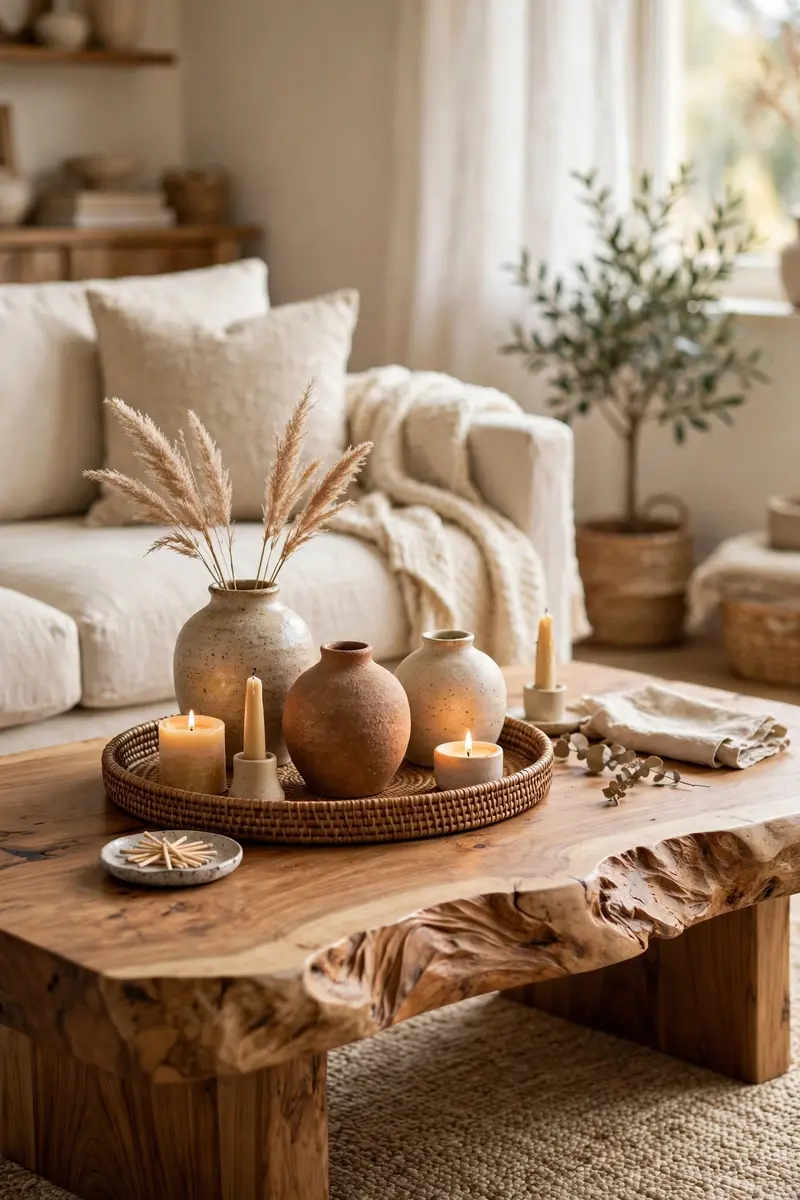
8. Carved Wood Coffee Table: Afrobohemian Living Room Ideas with Soul
A substantial wooden coffee table with visible grain, a slightly weathered finish, or an interesting sculptural shape is the heartbeat of afrobohemian living room ideas. Carved wood brings three-dimensionality that keeps a textile-heavy room from feeling flat.
Materials + cost: a carved or live-edge wood coffee table ($200–$600 new, $60–$200 thrifted), a woven tray ($20–$40), 2–3 handmade ceramic pieces ($15–$35 each).
Center the table on the rug with about 18 inches between it and the sofa. Style the top in thirds: a tray with candles on one side, a small stack of books in the middle, and a ceramic vase with branches on the other. Leave some empty wood showing — a crowded table looks like a shop shelf.
Tip: Oil a dry-looking thrifted wood table with a food-safe mineral oil before styling it; the grain wakes up instantly.
Variation: Use a carved wooden trunk as the coffee table for hidden storage inside.
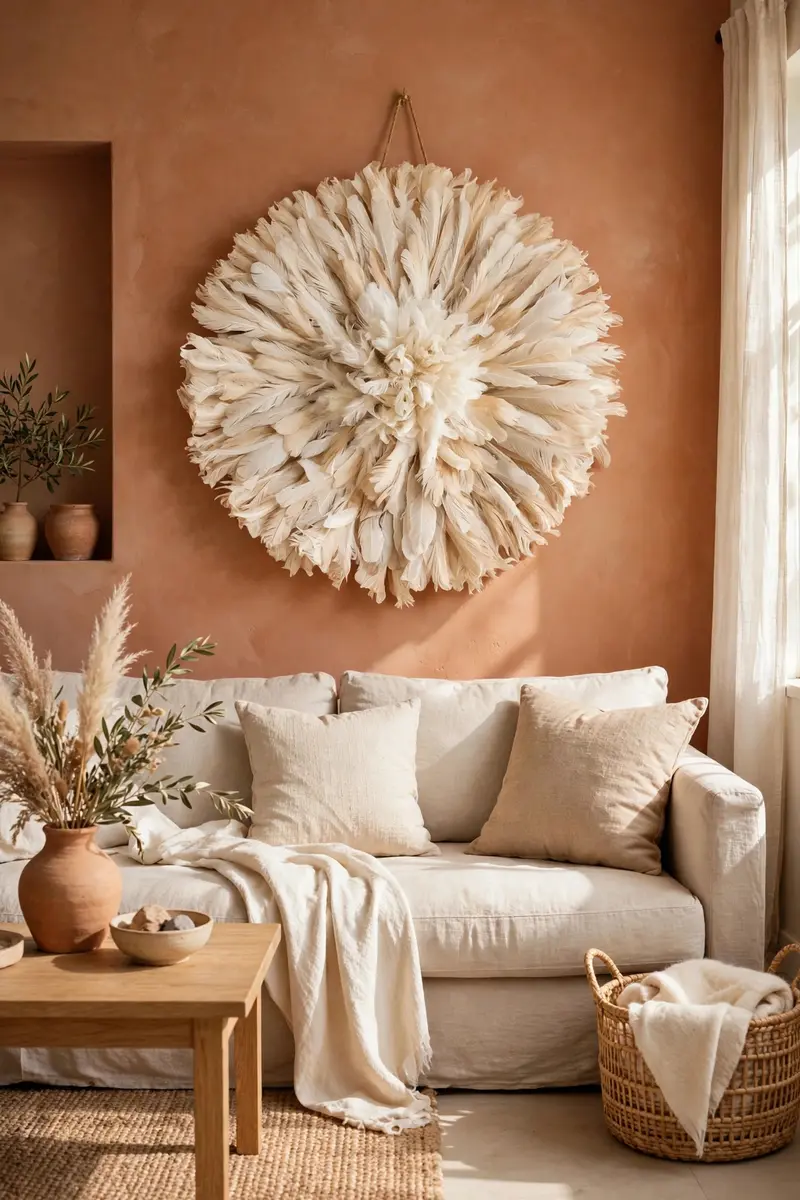
9. Oversized Juju Hat Above the Sofa
The juju hat — a circle of soft feathers hand-sewn onto a woven base — is the single most dramatic wall piece in afrobohemian living room ideas. One oversized hat in cream, rust, or black above the sofa does the work of an entire gallery wall, and it softens the room in a way flat art never can.
Materials + cost: one large juju hat, 24–32 inches ($80–$200), a sturdy picture hook rated for its weight ($5–$10).
Hang it centered above the sofa, about 8–10 inches above the back cushions. Because the feathers add visual weight, keep the wall around it mostly bare — a pair of small sconces or nothing at all is the right amount of company.
Tip: Dust a juju hat gently with a hair dryer on cool, low speed rather than a duster, which snags feathers.
Variation: Cluster three small juju hats in graduating sizes down a narrow hallway wall.
10. Woven Basket Wall Over the Console
A collection of woven baskets in different sizes, shapes, and weave patterns turns a blank console wall into the most photographed corner of afrobohemian living room ideas. The trick is dramatic size contrast — a few large baskets and several small ones, never a row of identical pieces.
Materials + cost: 7–11 baskets in mixed sizes ($6–$25 each), removable hanging strips or small nails ($5–$10). Total: roughly $60–$180.
Lay the arrangement on the floor first, starting with the largest basket slightly off-center. Build outward with medium baskets, then fill the gaps with small ones. Step back often — the composition should feel like a constellation, not a grid.
Tip: Mix one or two painted or blackened baskets into a natural seagrass group for contrast that makes the whole wall pop.
Variation: Carry the same idea above a sideboard in the dining area with deeper, bowl-shaped baskets.

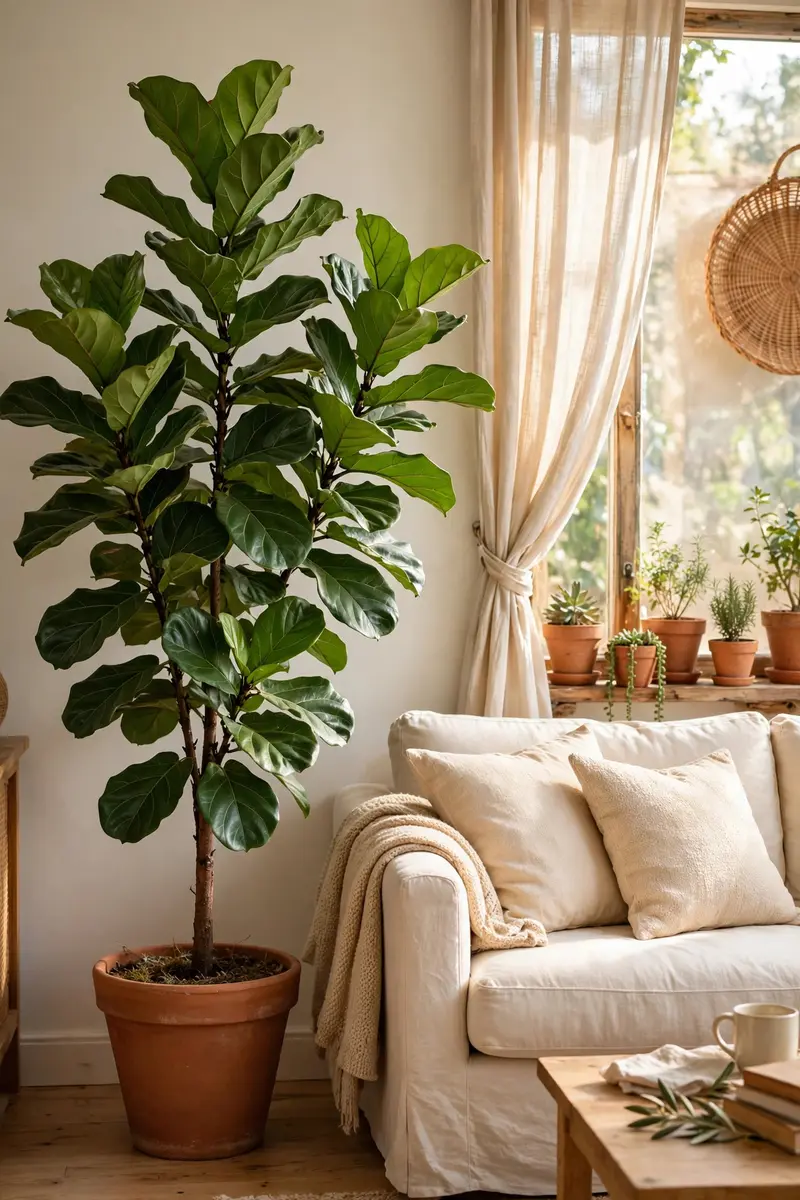
11. Terracotta Pots and Tall Leafy Plants
Nothing makes afrobohemian living room ideas feel alive faster than plants, and terracotta pots are their natural home. A tall leafy plant in a clay pot beside the sofa, plus a cluster of smaller pots on the windowsill, brings the green that balances all that warm earth tone.
Materials + cost: one large terracotta pot ($20–$45), a fiddle-leaf fig or olive tree ($40–$90), 3–5 small pots ($5–$15 each), potting soil and a saucer ($10–$15).
Place the tallest plant in the corner where the sofa meets the wall, so it frames the seating rather than blocking it. Group smaller pots in odd numbers on a sill or plant stand.
Tip: Terracotta dries out faster than plastic or glazed pots, so check the soil with your finger twice a week at first.
Variation: Add a generous arrangement of dried branches in an earthy ceramic vase for height without the watering.
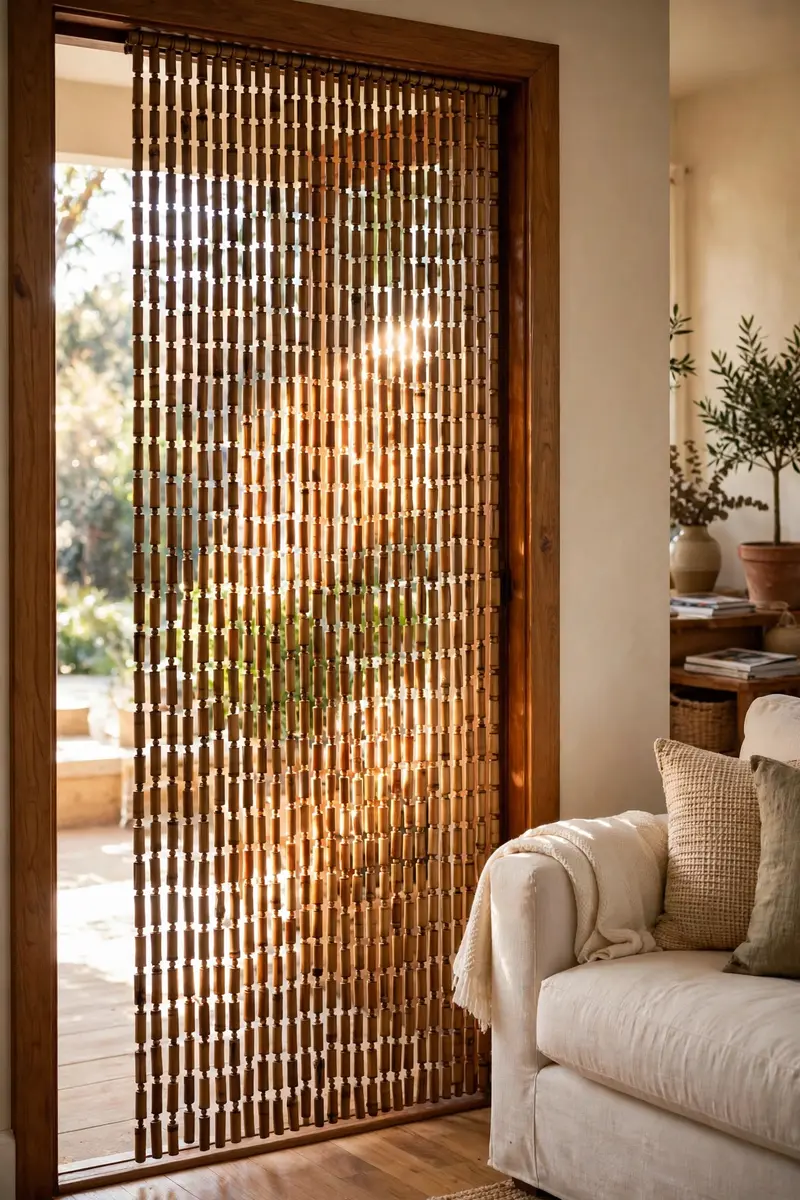
12. Beaded Curtain Room Divider
Bamboo beaded curtains are having a real moment — searches on Pinterest are up about 60% — and they are one of the most fun afrobohemian living room ideas for dividing space without building anything. They add movement, sound, and a wash of warm wood tone to a doorway or open-plan edge.
Materials + cost: one bamboo beaded curtain panel ($30–$60), a tension rod or curtain rod ($10–$25). Two panels for a wide opening: $70–$140 total.
Hang the curtain in a doorway between the living room and a hallway, or use it to soften the edge of an open-plan living area. Let it hang straight and full — trimming strands makes it look sparse and cheap.
Tip: If the clicking sound bothers you, tie the bottom third of the strands loosely together with twine for a quieter, draped effect.
Variation: Use a beaded curtain as a closet door in a small living room to save swing space and add texture.
13. Limewash Terracotta Accent Wall
A limewash accent wall in terracotta gives afrobohemian living room ideas their sunbaked, old-plaster soul. The chalky, cloudy finish catches light differently across the day, so the wall itself becomes a piece of art — no frames required.
Materials + cost: limewash paint in terracotta ($50–$90 per gallon), a limewash brush ($15–$25), painter’s tape and drop cloths ($15–$20). One gallon covers a single accent wall.
Apply the limewash in loose, crisscross strokes rather than neat vertical passes — the cloudiness is the finish. Two thin coats beat one thick coat, and the color deepens as it dries, so judge the shade the next morning, not while it is wet.
Tip: Test a small patch first; limewash looks lighter wet and much richer once cured.
Variation: Limewash the fireplace surround in the same terracotta for a monolithic, sculptural focal point.

14. Floor Cushions and Low Seating Nook
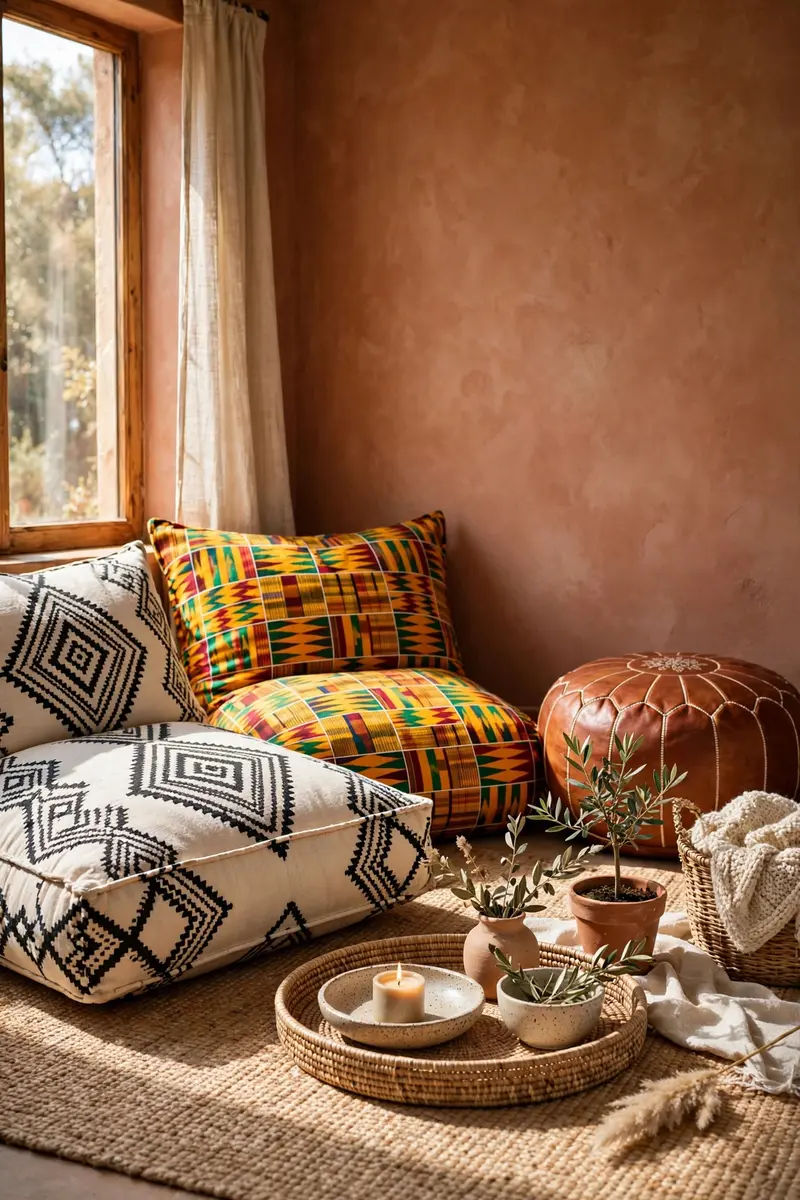
Low seating is where afrobohemian living room ideas get their relaxed, gather-around energy. A nook of oversized floor cushions in mudcloth, kente, and solid linen turns an empty corner into the spot where everyone ends up during movie night.
Materials + cost: 3–5 large floor cushions ($30–$70 each), a low woven tray for drinks ($20–$35), a small pouf ($40–$80). Total: roughly $150–$350. For more small living room decor ideas on a budget, floor seating is one of the cheapest ways to add seats without buying another sofa.
Layer the cushions against the wall with the largest at the back, then add a pouf in front as a footrest or extra seat.
Tip: Choose cushion covers with zippers so you can wash them; floor cushions collect dust faster than sofa pillows.
Variation: Build the nook around a low round coffee table for a Moroccan-inspired tea corner.
15. Antique Brass and Copper Accents
Antique brass and copper are the metallics that close the loop in afrobohemian living room ideas, reflecting the glow of the warm palette like late African sun. A few metallic touches — never a matched set — keep the room from feeling too matte and earthy.
Materials + cost: a brass floor lamp or table lamp ($60–$150), a copper bowl or tray ($20–$45), brass candle holders ($15–$35 each). Total: roughly $100–$250.
Scatter the metals rather than grouping them: a brass lamp on one side of the room, a copper tray on the coffee table, candle holders on the mantel. The pieces should feel found over time, not bought as a set in one afternoon.
Tip: Let brass develop a soft patina instead of polishing it weekly — the aged finish suits this style better than a mirror shine.
Variation: Swap in blackened iron for a moodier, more modern edge while keeping the same warm textiles.

16. Ethiopian Art Gallery Wall
Ethiopian wall art — bold religious icons, hand-painted processional crosses, and contemporary portraits — brings a storytelling depth to afrobohemian living room ideas that generic prints cannot touch. This is the wall where the style’s cultural roots show most clearly.
Materials + cost: 3–5 framed Ethiopian art prints or small originals ($20–$80 each), simple black or wood frames ($15–$30 each). Total: roughly $100–$300.
Mix one larger anchor piece with smaller works, and include at least one hand-painted or artisan-made piece rather than all mass-produced prints.
Tip: Buy from Ethiopian artists and fair-trade sellers when possible, and keep the artist’s name on the back of the frame — provenance is part of the story.
Variation: Pair one Ethiopian textile, like a handwoven cotton throw, with the framed art for a mixed-media wall.

17. Natural Fiber Rug with Leather Pouf
A chunky natural-fiber rug underfoot and a rich brown leather pouf beside the sofa give afrobohemian living room ideas their grounding contrast: rough weave against smooth leather, matte against shine. It is a small pairing with an outsized effect on how expensive the room feels.
Materials + cost: a natural-fiber rug, sisal or wool ($80–$200), one leather pouf ($60–$140). Faux leather poufs run $35–$70 and age surprisingly well.
Center the rug under the coffee table with the front sofa legs on it. Place the pouf at the sofa’s end as a footrest, extra seat, or impromptu side table with a tray on top. The leather will darken and soften with use, which only improves it.
Tip: A pouf with a removable cover is worth the extra $20 — leather conditioner keeps the real thing supple, but washable covers survive kids and pets.
Variation: Use two smaller poufs in different leathers — cognac and dark chocolate — for a collected pair.

18. Mudcloth Ottoman
A mudcloth-upholstered ottoman is the workhorse of afrobohemian living room ideas: footrest, extra seat, coffee table with a tray, and the room’s boldest textile all in one piece. It brings the mudcloth pattern down to floor level, where it balances the pillows up on the sofa.
Materials + cost: a mudcloth ottoman ($90–$200), or reupholster a thrifted ottoman with mudcloth fabric ($30–$60 for fabric plus $20 in supplies). A wooden tray ($20–$35) turns it into a table.
Place the ottoman where a coffee table would go in a smaller room, or in front of the rattan chair as its footrest. If you reupholster, choose a pattern with strong black-and-white geometry — it reads clearly even at floor level, where patterns usually get lost.
Tip: Scotchgard the fabric before first use; ottomans collect feet, drinks, and everything in between.
Variation: Use a long mudcloth bench ottoman at the foot of a window seat instead of a round one.

19. Sculptural Wooden Stools: Small Afrobohemian Living Room Ideas
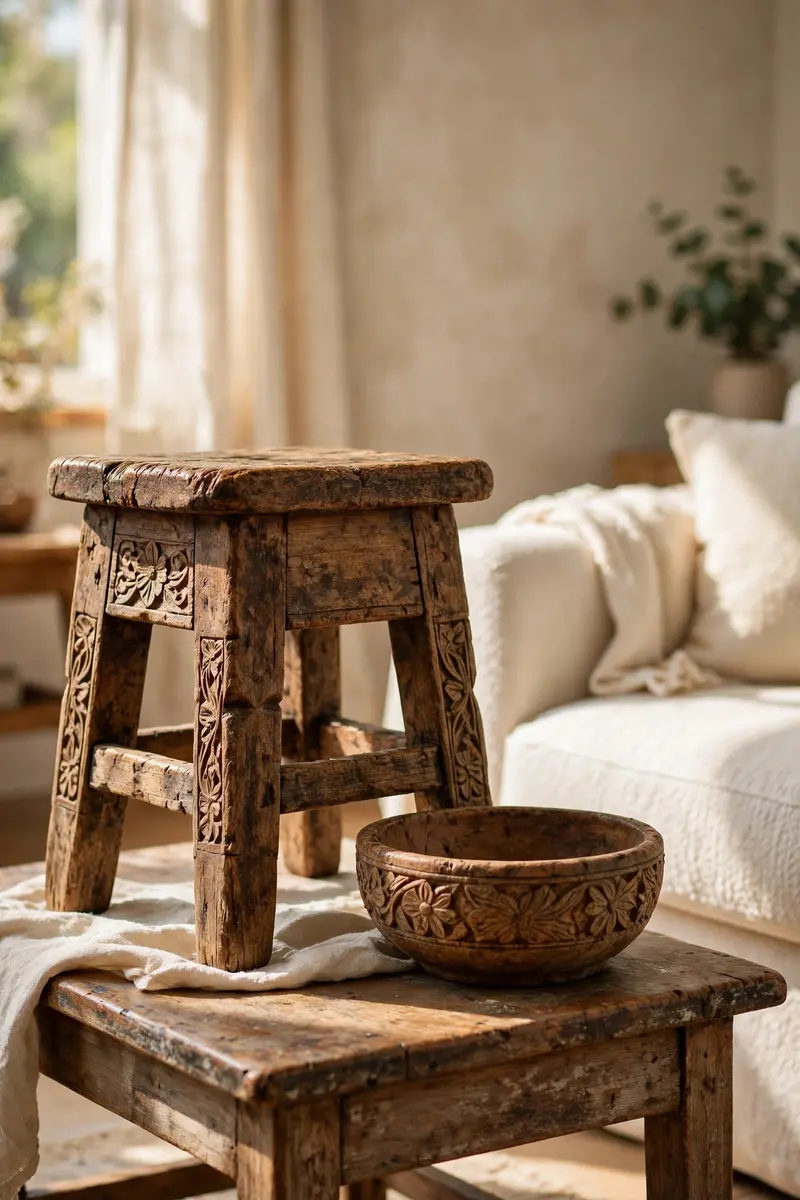
Carved wooden stools — the kind with a single sculpted seat and three splayed legs — are the most versatile small pieces in afrobohemian living room ideas. They work as side tables, plant stands, extra seats, and sculpture, and they slide away when you need floor space.
Materials + cost: 2–3 carved wooden stools ($40–$90 each), or one statement stool ($80–$150). Vintage African stools at flea markets often run $30–$70.
Place one beside the sofa as a side table with a candle and a book, and one near the plant corner as a stand that lifts a pot to eye level. Vary the heights — a tall stool and a short stool together look collected, while matching pairs look bought.
Tip: Feel the stool’s balance before you buy; a sculptural piece that wobbles is a sculpture, not furniture.
Variation: Stack two stools in a corner as a tiered plant display when guests are not using them as seats.

20. Indigo Adire Curtains
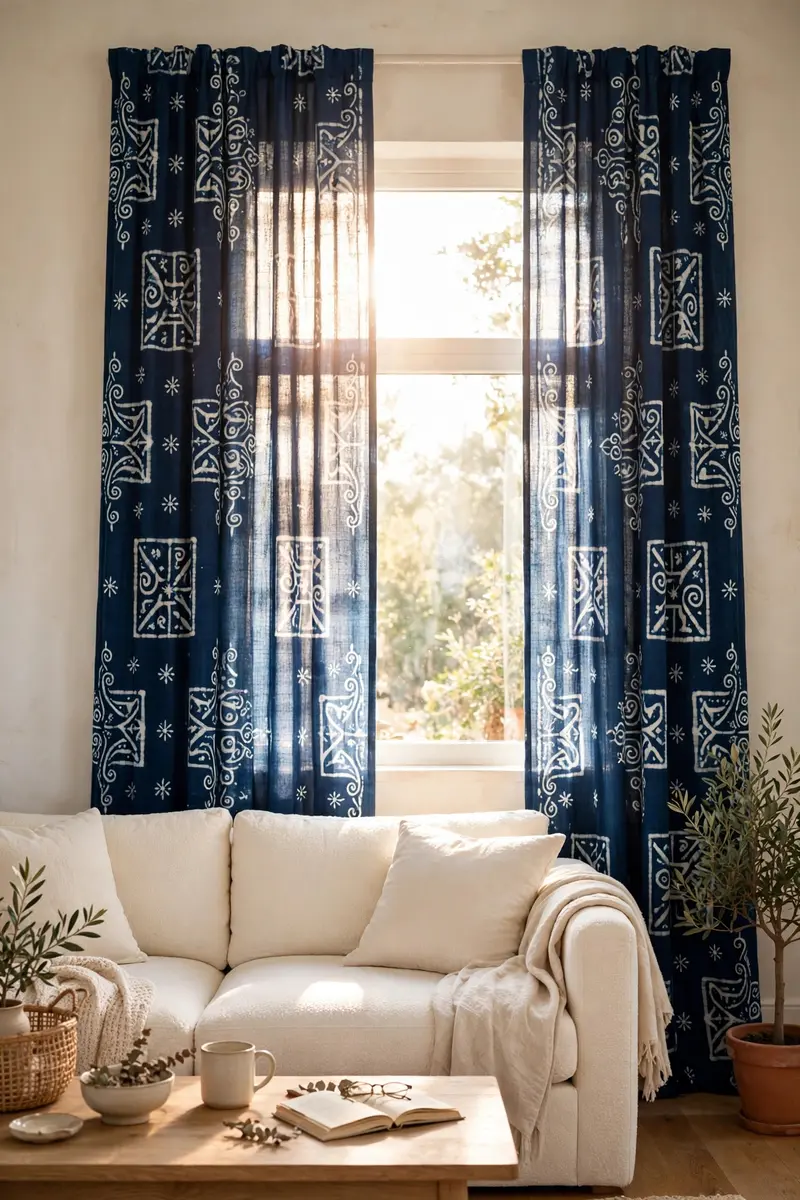
Floor-length adire curtains turn a plain window into the cool, deep-blue moment that afrobohemian living room ideas need to balance all their warmth. The white resist patterns glow when backlit by daylight, so the window becomes a light filter and a piece of art at once.
Materials + cost: two adire curtain panels ($60–$120 each), a black or dark wood rod ($25–$50). Total: roughly $145–$290.
Hang the rod 4–6 inches above the window frame and 3–4 inches wider on each side so the panels stack off the glass when open. Let the fabric puddle slightly on the floor for a relaxed, bohemian drape, or hem it to just kiss the floor for a cleaner line.
Tip: Line adire curtains with a lightweight cotton voile if the room gets harsh afternoon sun — it protects the dye and softens the light.
Variation: Use a single adire panel as a doorway curtain to a reading nook for the same indigo glow in a smaller dose.
21. Woven Pendant Light Cluster
A cluster of woven pendant lights — rattan, seagrass, or bamboo shades hung at different heights — is the lighting move that makes afrobohemian living room ideas glow at night. The woven shades throw patterned shadows on the ceiling, so the light itself becomes decoration.
Materials + cost: 3 woven pendant shades ($30–$70 each), pendant cord kits ($15–$25 each), or one plug-in swag kit ($40–$60) if you rent. Total: roughly $135–$285.
Hang the cluster over the coffee table or in a corner reading spot, staggering the heights by 6–10 inches. Use warm-white bulbs (2700K) — cool white light kills the cozy glow this style depends on.
Tip: If you rent, use plug-in swag pendants with ceiling hooks and command strips; no electrician needed, and they come down cleanly.
Variation: A single oversized woven pendant over the dining table carries the same texture into the next room.

22. Kente Throw on the Sofa Arm
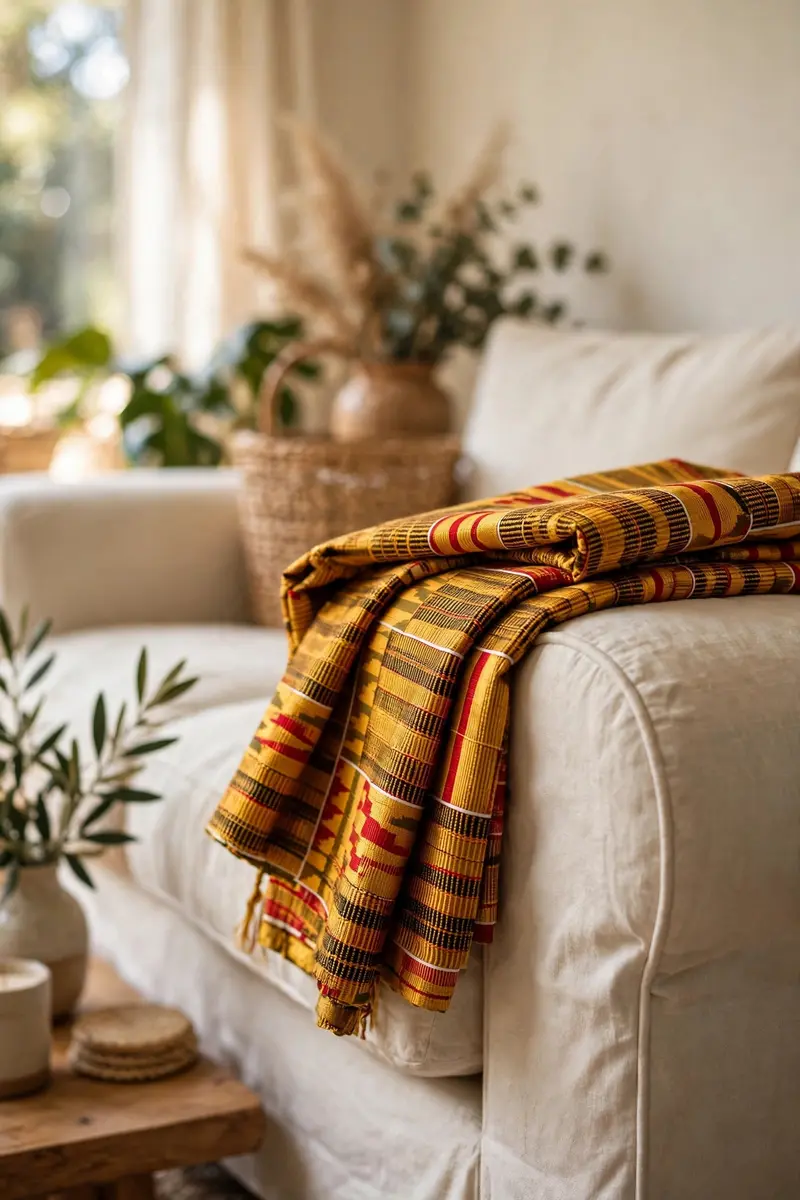
A kente throw folded over the sofa arm is the quickest color injection in afrobohemian living room ideas — five seconds of styling, and the whole sofa reads differently. It is also the easiest piece to move around the room when you want a change.
Materials + cost: one kente throw ($50–$110), or a kente-pattern cotton throw ($30–$60). Authentic handwoven kente costs more and is worth it for a piece you will keep for years.
Fold the throw in thirds lengthwise and drape it over one sofa arm so the pattern faces outward. Let one end hang a little longer than the other — the slight asymmetry is what makes it look styled rather than stored.
Tip: Rotate the throw to a different arm or chair every few weeks; it refreshes the room for free and evens out wear.
Variation: Drape the same throw over the back of the rattan chair for a coordinated-but-not-matching look.
23. Handmade Terracotta Ceramics Vignette
A small vignette of handmade terracotta ceramics — vases, bowls, and pitchers with visible throwing lines and uneven rims — is the quiet detail that makes afrobohemian living room ideas feel honest. Machine-perfect ceramics look like a store display; handmade ones look like a home.
Materials + cost: 3–5 handmade terracotta pieces ($15–$40 each), a woven tray or linen runner to ground them ($20–$35). Total: roughly $65–$235.
Group the ceramics on the coffee table or console in odd numbers, mixing tall and short shapes. Leave breathing room between pieces — a vignette needs air to read as a collection rather than clutter. Add one sprig of dried grass or a single stem for life.
Tip: Buy ceramics directly from potters at markets when you can; the maker’s story is half the charm, and prices are often lower than shops.
Variation: Use the same ceramics as planters for small succulents on a windowsill.

24. Pattern-Mixing: Mudcloth, Kente, and Batik
The signature skill of afrobohemian living room ideas is mixing three distinct African patterns — mudcloth, kente, and batik — in the same color family. Done right, the room buzzes with energy; done wrong, it looks like a fabric store exploded. The rule is simple: one color family, three patterns, plenty of solid neutrals between them.
Materials + cost: one mudcloth pillow ($25–$45), one kente pillow ($30–$55), one batik throw or cushion ($25–$50). Total: roughly $80–$150 for the whole experiment.
Start with the largest pattern on the largest surface — mudcloth on the sofa pillows — then add kente as the accent and batik as the smallest dose, like a lumbar pillow or a throw. Keep the shared color family tight: all warm rusts and blacks, or all indigos and creams, never both at once.
Tip: If two patterns fight, separate them with a solid pillow; neutrals are the peacekeepers of pattern-mixing.
Variation: Try the same three-pattern mix in a single color story of black, cream, and natural linen for a calmer, graphic version. For a deeper look at how bohemian layering works, The Spruce’s guide to interior design styles explains the free-spirited bohemian approach these ideas build on.
25. Indoor Olive Tree Statement
A tall olive tree in a terracotta or woven basket planter is the living sculpture of afrobohemian living room ideas. Its silvery-green leaves cool down the warm palette, and its height draws the eye up to the ceiling, making the whole room feel taller.
Materials + cost: an olive tree, 4–6 feet ($60–$120), a large terracotta pot or basket planter ($30–$60), a plant stand with wheels ($25–$45).
Place the tree in the brightest corner, ideally near a south or west window, and give it room — olive branches need air to keep their shape.
Tip: Olive trees drop leaves when they are unhappy about watering; water deeply, then let the top two inches of soil dry before watering again.
Variation: A fiddle-leaf fig gives the same height with broader, glossier leaves if your light is less intense.

26. Dark Wood Shelves with Collected Objects
Dark wood shelving — espresso-stained or raw-edge acacia — is the display backbone of afrobohemian living room ideas. It holds the collected objects that make the style personal: small sculptures, woven boxes, books, and ceramics, arranged like a story rather than a store.
Materials + cost: two floating dark wood shelves ($40–$90 each) or a leaning ladder shelf ($80–$180), plus the objects you already own. Total: roughly $80–$270 before objects.
Hang the shelves at eye level on the wall beside the sofa, and style them in layers: tall objects at the back, medium pieces in the middle, small objects in front.
Tip: Style shelves by threes and vary the heights; three objects of the same height look like a lineup, not a collection.
Variation: Use a single long shelf above the sofa as a picture ledge for leaning framed textiles and small art.
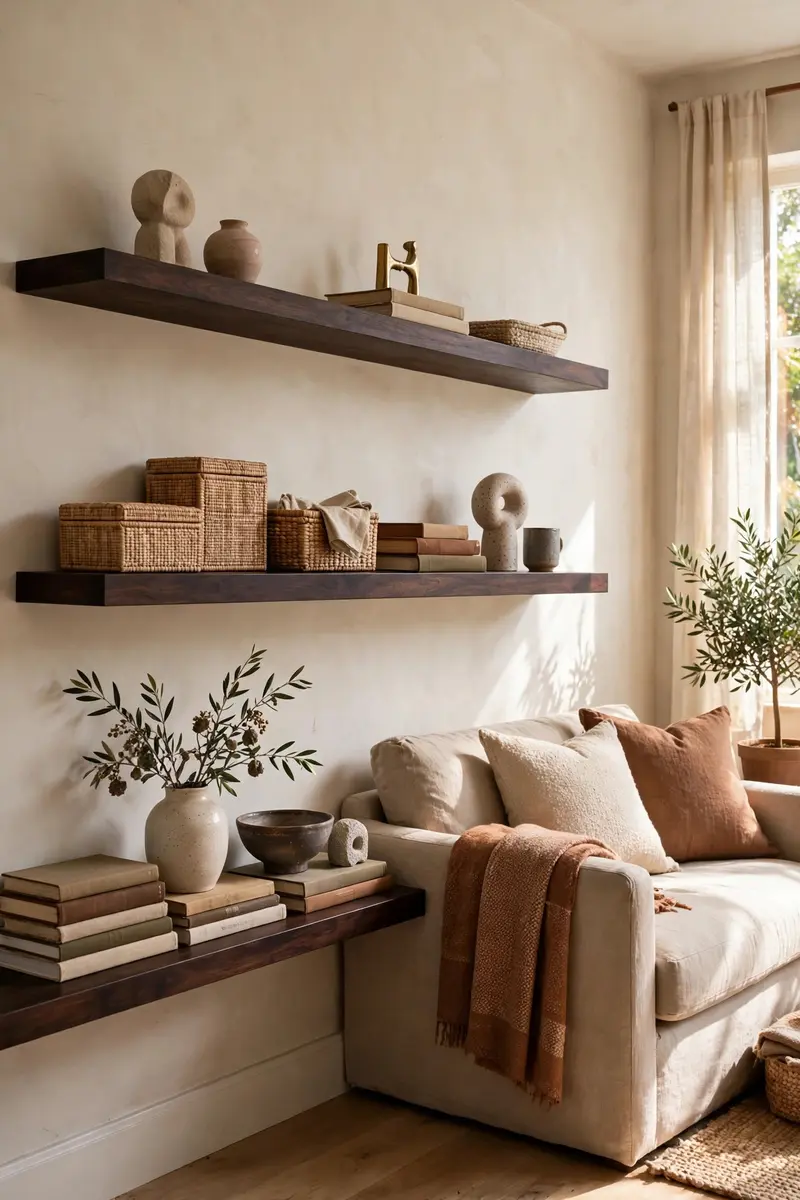
27. Sunset-Hued Throw Blankets
A throw blanket in sunset hues — rust, ochre, burnt orange fading into cream — is the color story of afrobohemian living room ideas in a single piece. Draped over the sofa, it warms up a neutral room in seconds and invites people to curl up in it.
Materials + cost: one woven sunset-hued throw ($35–$75), or a handwoven cotton throw ($50–$95). Look for gradient or striped weaves rather than flat solid colors.
Drape the throw across the back of the sofa with one corner folded over, so the color gradient shows. In winter, keep a second throw in a basket beside the sofa — a basket of throws is itself a decor piece in this style.
Tip: Wash throws in cold water and line-dry them when you can; heat fades the sunset dyes fastest.
Variation: Layer two thin throws — one rust, one ochre — for a deeper, more complex color than any single blanket gives.

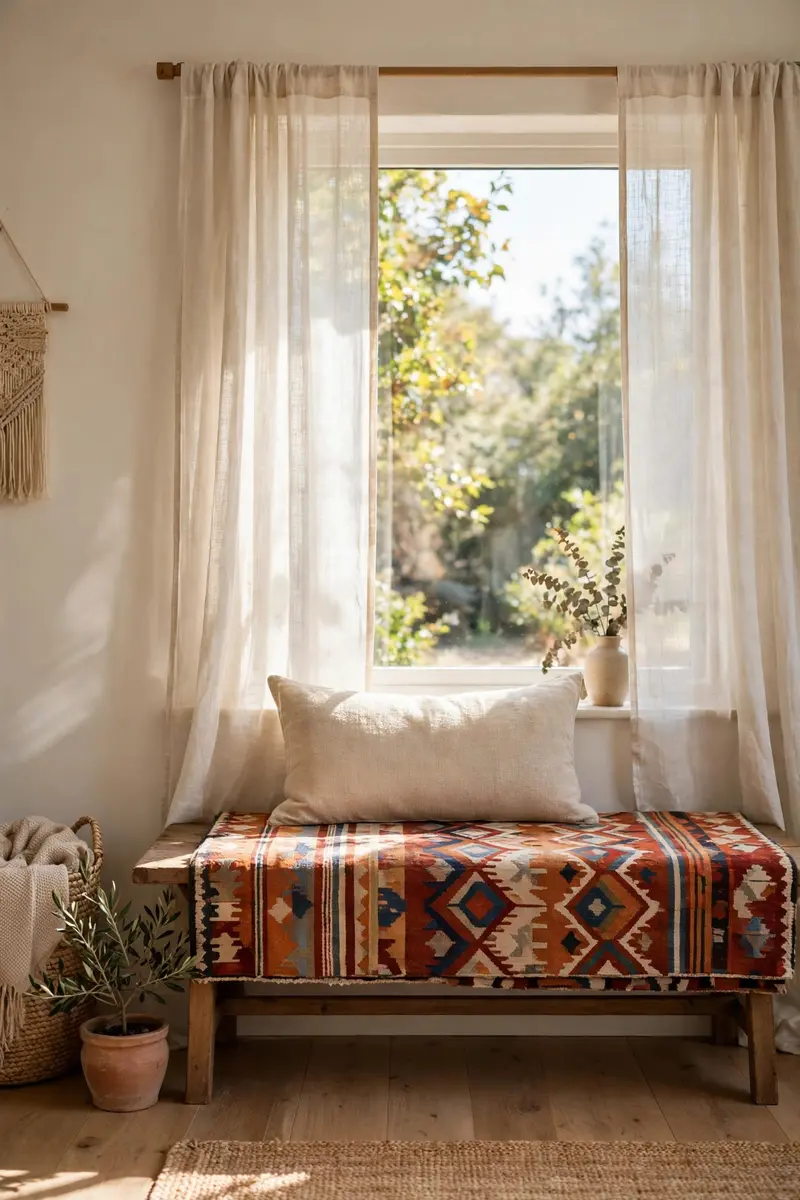
28. Patterned Kilim Bench by the Window
A low bench dressed with a patterned kilim — or upholstered in kilim fabric — turns a sunny window into the best seat in afrobohemian living room ideas. It is a reading perch, a plant stand, and a pattern moment all at once.
Materials + cost: a low wooden bench ($80–$180), a kilim rug or kilim fabric piece to drape ($40–$90), one lumbar pillow ($25–$45). Total: roughly $145–$315.
Place the bench under the largest window with the kilim draped over the top and the pillow at one end.
Tip: A bench with a lower shelf doubles as shoe or basket storage in an entryway-adjacent living room.
Variation: Use the bench at the foot of the sofa as a coffee-table alternative in a narrow room.
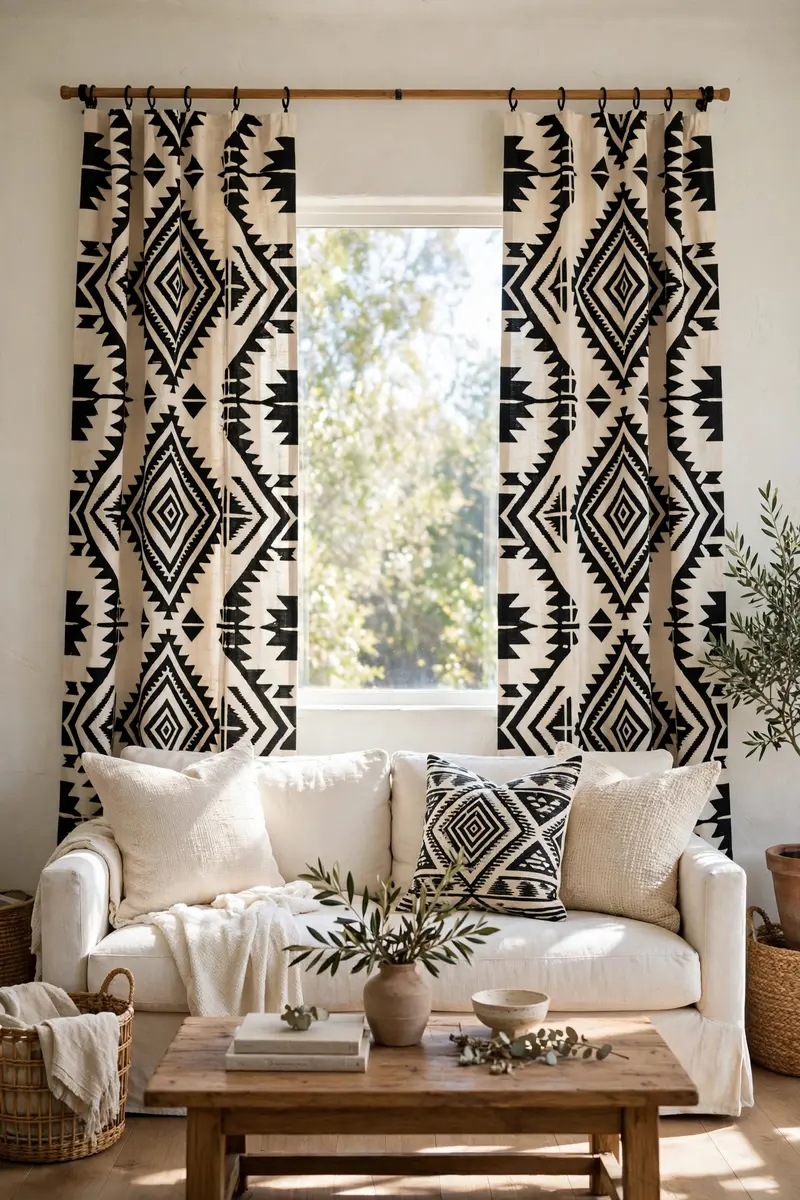
29. Black-and-White Mudcloth Curtain Panels
Black-and-white mudcloth curtain panels are the graphic, high-contrast window treatment in afrobohemian living room ideas. They frame the view like a bold print, and their geometry echoes the mudcloth pillows across the room without repeating the exact pattern.
Materials + cost: two mudcloth curtain panels ($50–$100 each), a matte black rod ($20–$40). Total: roughly $120–$240.
Hang the panels high and wide, as with the adire curtains, and let them stack mostly off the glass so the pattern frames rather than blocks the light. Pair them with a solid linen sheer underneath if you need privacy without losing daylight.
Tip: Steam mudcloth panels before hanging; the cotton wrinkles in shipping, and wrinkles hide the geometry.
Variation: Use the same black-and-white mudcloth as a table runner on the console for a smaller echo of the window pattern.
30. Seagrass Storage Baskets: Practical Afrobohemian Living Room Ideas
Seagrass storage baskets are the hardest-working pieces in afrobohemian living room ideas, hiding throws, toys, magazines, and remote controls inside beautiful woven texture. They prove that storage can be the decor, not just something you hide.
Materials + cost: 2–4 seagrass baskets in mixed sizes ($15–$40 each), lids included if possible. Total: roughly $30–$160 for a useful set.
Place the largest basket beside the sofa for throws, a medium one by the media unit for remotes and chargers, and a small one on a shelf for odds and ends. Label nothing — the baskets’ job is to look good closed, so keep the clutter inside invisible.
Tip: Baskets with lids look tidier and stack better; open baskets are for throws and plants only.
Variation: Use a tall seagrass basket as a planter cover for a large floor plant.

31. Carved African Mask Display
A small display of carved wooden masks brings the sculptural, storytelling heart of afrobohemian living room ideas to the wall. Masks carry deep cultural meaning in the traditions they come from, so choose authentic, artisan-made pieces and display them with respect, not as generic decoration.
Materials + cost: 1–3 carved masks ($40–$120 each), picture ledges or small hooks ($10–$20). Total: roughly $50–$380 depending on how many you collect.
Hang masks in a tight group on a narrow wall, or place a single large mask as the anchor of a shelf display. Learn the story of each piece — where it was made, what it represents — and keep that note with it; the story is part of why it belongs in your home.
Tip: Buy masks from the artists or fair-trade cooperatives that made them, and avoid mass-produced resin copies, which flatten the craft.
Variation: Mix one mask with woven baskets on the same wall for a mixed-media display with varied textures.

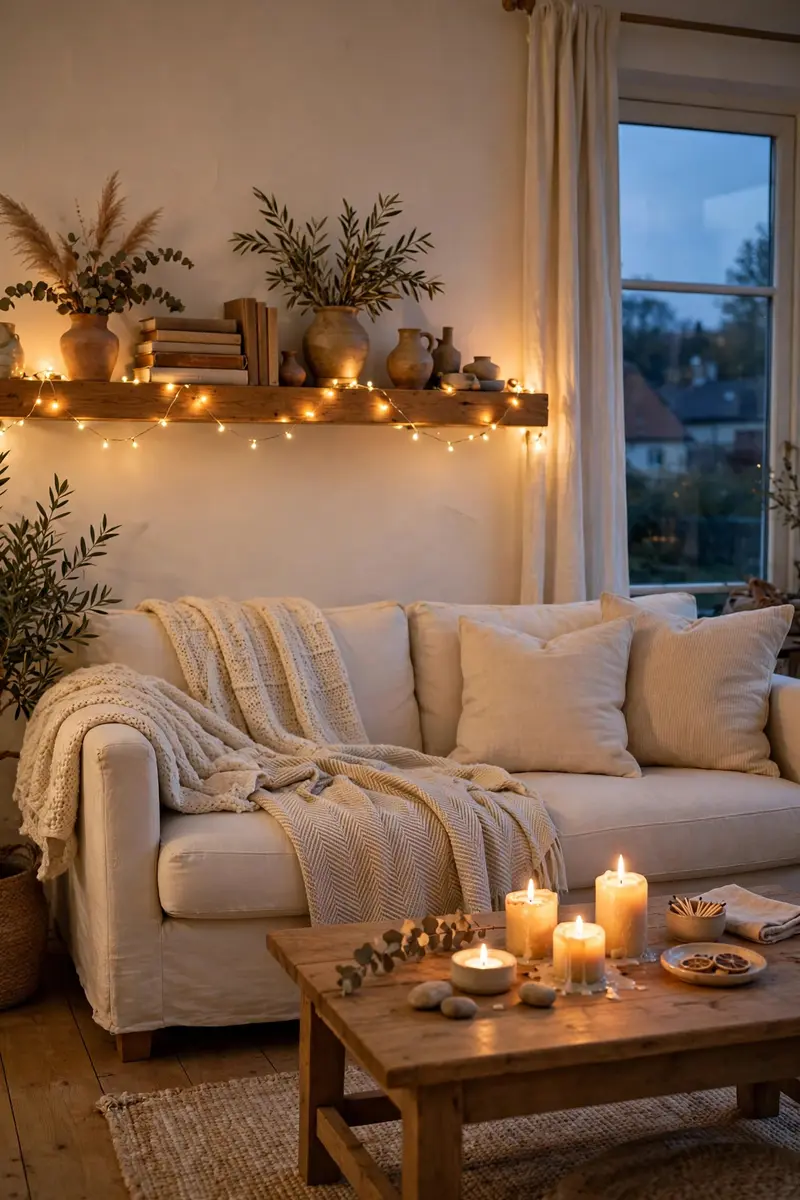
32. Warm Fairy Lights and Candle Glow
Fairy lights and candles are the evening layer of afrobohemian living room ideas — the warm glow that turns a beautiful daytime room into a magical nighttime one. The light should feel like firelight: low, warm, and a little flickering.
Materials + cost: two strands of warm-white fairy lights ($8–$15 each), 3–5 candles in brass or terracotta holders ($5–$20 each), a tray to group them ($15–$30). Total: under $100.
Drape fairy lights along a shelf edge, inside a glass cloche, or around a large plant — never across the ceiling in straight lines, which reads as a dorm room.
Tip: Use LED candles with timers inside enclosed lanterns or near fabric, and save real flames for open, supervised spots.
Variation: A string of Moroccan-style metal lanterns on the mantel gives the same glow with more daytime presence.
33. Thrifted Carved Wood Finds
The most soulful afrobohemian living room ideas are also the cheapest, because the style is built on pieces with a past. Thrifted carved wood — a stool, a bowl, a small side table, a wall panel — brings patina and history that new furniture cannot fake, often for a few dollars.
Materials + cost: thrifted carved pieces ($5–$40 each), wood oil or beeswax ($10–$15), a soft cloth. Total: under $100 for a full set of finds. For more budget-first thinking, our diy home decor ideas on a budget guide covers the thrifting and styling habits that make cheap pieces look collected rather than cheap.
Visit thrift stores, flea markets, and estate sales with a short list — stool, bowl, side table — and buy only pieces with good bones and solid joints. Clean them, oil the wood, and style one piece at a time so each find gets its moment instead of crowding the room.
Tip: Check the underside and joints of any thrifted wood piece; wobbly joints and woodworm holes are the two deal-breakers, and everything else is fixable.
Variation: Paint one thrifted piece in matte black for a modern counterpoint among the natural wood.
34. Terracotta Velvet Sofa as the Anchor
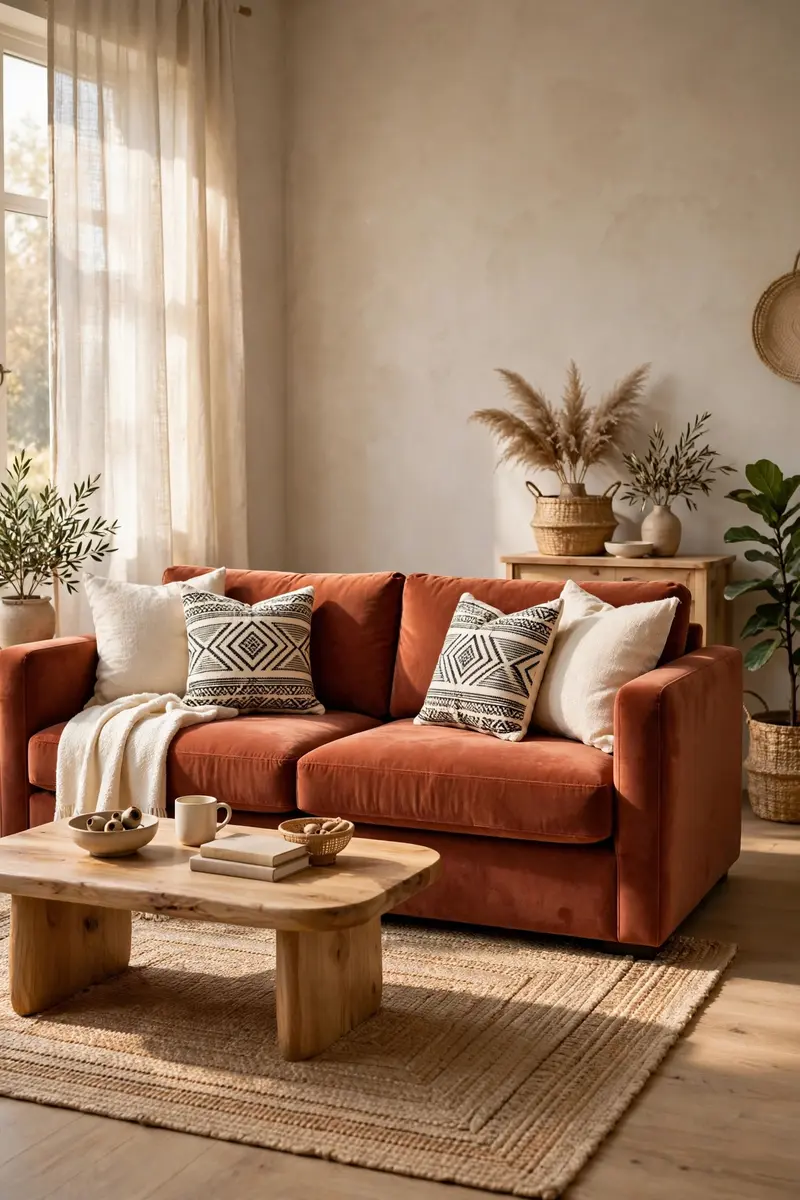
If you are ready for one bold move, make it a terracotta velvet sofa. It is the ultimate anchor in afrobohemian living room ideas — the whole room can be built around it, and every textile, basket, and plant in this guide looks better against it.
Materials + cost: a terracotta velvet sofa ($700–$1,500), cream and mudcloth pillows ($25–$45 each), a cream throw ($30–$60). Keep the rug neutral so the sofa stays the star.
Let the sofa carry the color and keep everything else calmer: cream pillows, a jute rug, natural wood, and one indigo accent for contrast. The velvet catches light beautifully, so place the sofa where daylight hits it at least part of the day.
Tip: Velvet shows every crumb, so keep a lint roller in the side table drawer — five seconds a day keeps it looking new.
Variation: If a full sofa feels like too much, a terracotta velvet armchair gives you the same bold anchor at a third of the price.
Frequently Asked Questions
What is afrobohemian decor?
Afrobohemian decor — also written afrohemian — is a style that fuses African design heritage with relaxed bohemian warmth. It centers mudcloth, adire, kente, and kuba textiles, handwoven baskets, carved wood, and terracotta, arranged so a room feels collected over years rather than bought in one afternoon. Pinterest named it its number one home prediction for 2026.
What colors define an afrobohemian living room?
The palette is warm and sunbaked: terracotta, ochre, clay, burnt sienna, deep browns, olive, and sand as the base, balanced with black for contrast and deep indigo as the cool accent. Designers like DuVäl Reynolds note that afrohemian leans into these warm hues instead of the pastel tones of generic boho — the difference is visible the moment you walk in. Apartment Therapy’s experts round up the look in their 10 afrohemian decor ideas.
How do I decorate afrobohemian on a budget?
Start with the highest-impact cheap moves: two mudcloth pillow covers ($25–$45 each), a basket wall ($60–$180), a jute rug under $50, and one thrifted carved wood piece. Buy textiles first, because they change the room fastest, and add one artisan piece at a time. Many of the ideas in this guide cost under $100, and several cost under $50.
Can afrobohemian work in a small living room?
Yes — it may work better in a small room, because the layering reads as cozy rather than cluttered when the scale is right. Choose one anchor textile, keep bold prints to two or three pieces, use low seating and floor cushions instead of bulky furniture, and let one basket wall carry the pattern so the rest of the room can stay calm.
How do I mix African patterns without the room looking cluttered?
Keep every pattern inside one color family, limit bold prints to two or three pieces, and separate competing patterns with solid, textural neutrals. Start with the largest pattern on the largest surface, add the second pattern as an accent, and use the third pattern in the smallest dose. If two patterns fight, a solid pillow between them fixes it instantly.
Conclusion
Afrobohemian style is not about buying a look in one weekend — it is about collecting pieces that mean something, one mudcloth pillow and one carved stool at a time. Start with the three moves that change a room fastest: an anchor textile, a basket wall, and a warm terracotta accent.
Which of these 34 afrobohemian living room ideas will you try first? Save this guide to Pinterest so you can find it when you are ready to start, and pin your favorite idea to your living room board — your future self will thank you when the thrifting begins.



Leave a Reply