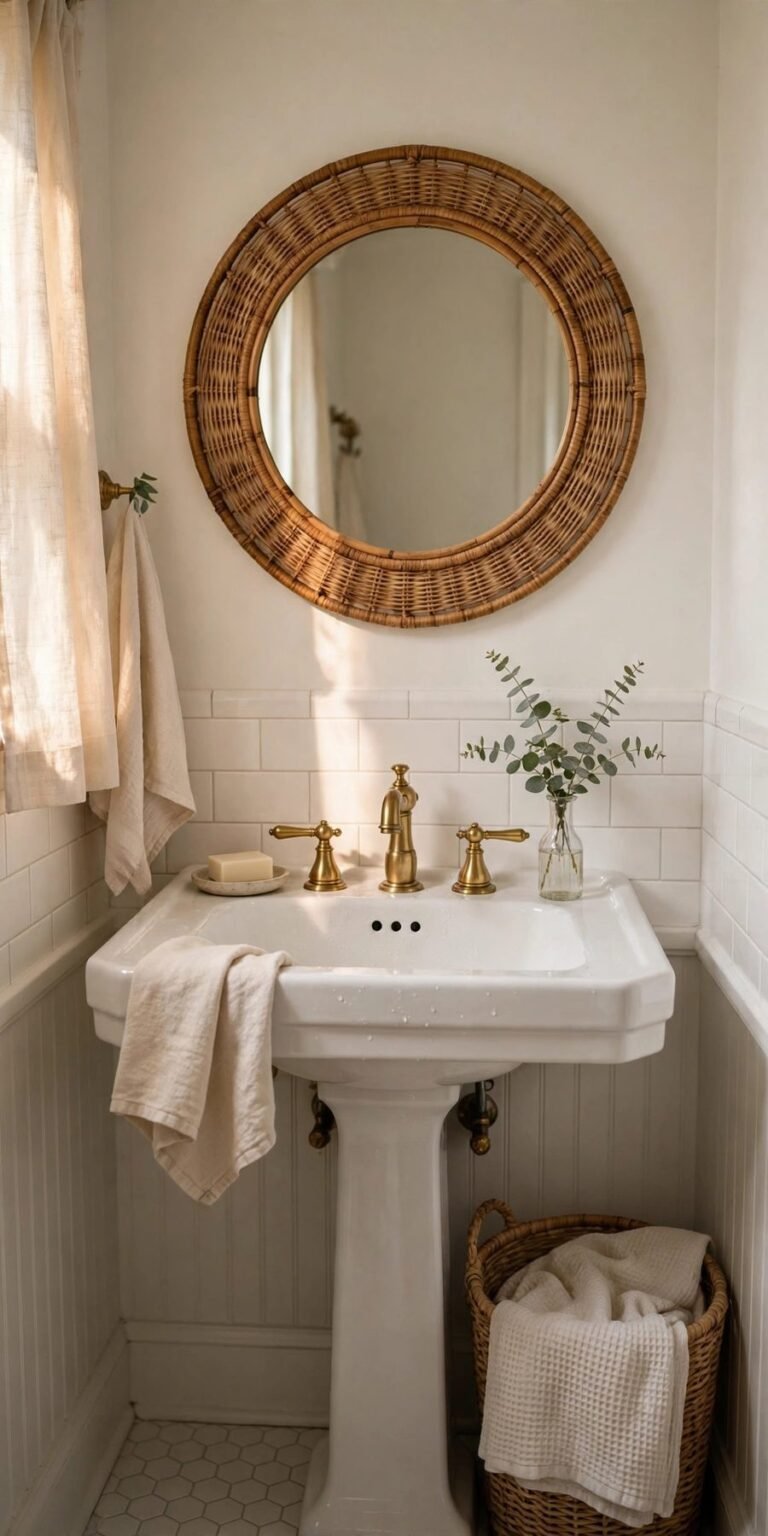

16 Farmhouse Bathroom Decor Ideas That Wow
There’s a reason farmhouse bathroom decor ideas keep topping Pinterest boards in 2026: they turn the coldest room in the house into the warmest one. Farmhouse style is a masterclass in cozy — reclaimed wood against crisp white tile, matte-black iron against warm linen, a vintage mirror catching morning light over an apron-front sink. It’s rustic without being rough, charming without being kitsch, and it only gets better-looking as it ages.
The best part? The farmhouse look forgives imperfection. Distressed finishes, thrifted finds, and DIY shiplap all read more authentic when they’re a little imperfect — and most of these ideas work on a real-world budget. Many come in under $100, and a few cost almost nothing.
Below you’ll find 16 farmhouse bathroom decor ideas, each with realistic costs, simple how-to guidance, one practical tip, and a variation to make it yours. Whether you’re doing a full remodel or a weekend refresh, there’s something here for your bath.
1. Clad an Accent Wall in White Shiplap — the Signature of Farmhouse Bathroom Decor Ideas
Nothing says farmhouse like shiplap — those long, horizontal wood planks that add texture, brightness, and instant character to flat drywall. On a bathroom wall, white shiplap reflects light, makes the space feel bigger, and gives you that unmistakable rustic-modern backdrop behind your vanity, mirror, and lighting.
Materials and cost: Primed MDF or pine shiplap boards, $2–$6 per square foot; construction adhesive or a nail gun; white satin or semi-gloss paint for moisture resistance; caulk and filler. A single 8×8-foot accent wall runs $100–$300 (DIY) or $50–$100 with peel-and-stick shiplap panels.
Measure your wall and start from the bottom up, leaving a 1/8-inch gap between boards for that classic shadow line. Use a level for the first board — every row follows it, so getting it straight matters. Fill nail holes, caulk the edges where the shiplap meets the ceiling and trim, then seal with two coats of bathroom-grade satin paint (standard flat paint will not survive the steam). For a full guide to DIY wall projects like this, see our DIY bathroom decor ideas roundup.
Tip: Paint your shiplap a warm white (not stark white) — shades like creamy “linen white” keep the room cozy instead of clinical, especially under warm lighting.
Variation: Try beadboard wainscoting on the lower half of the wall instead — it leans toward the “new traditional” farmhouse look that’s trending on Pinterest right now, and it takes paint color beautifully if you want a muted sage or dusty blue base.
2. Bring Home a Reclaimed Wood Vanity
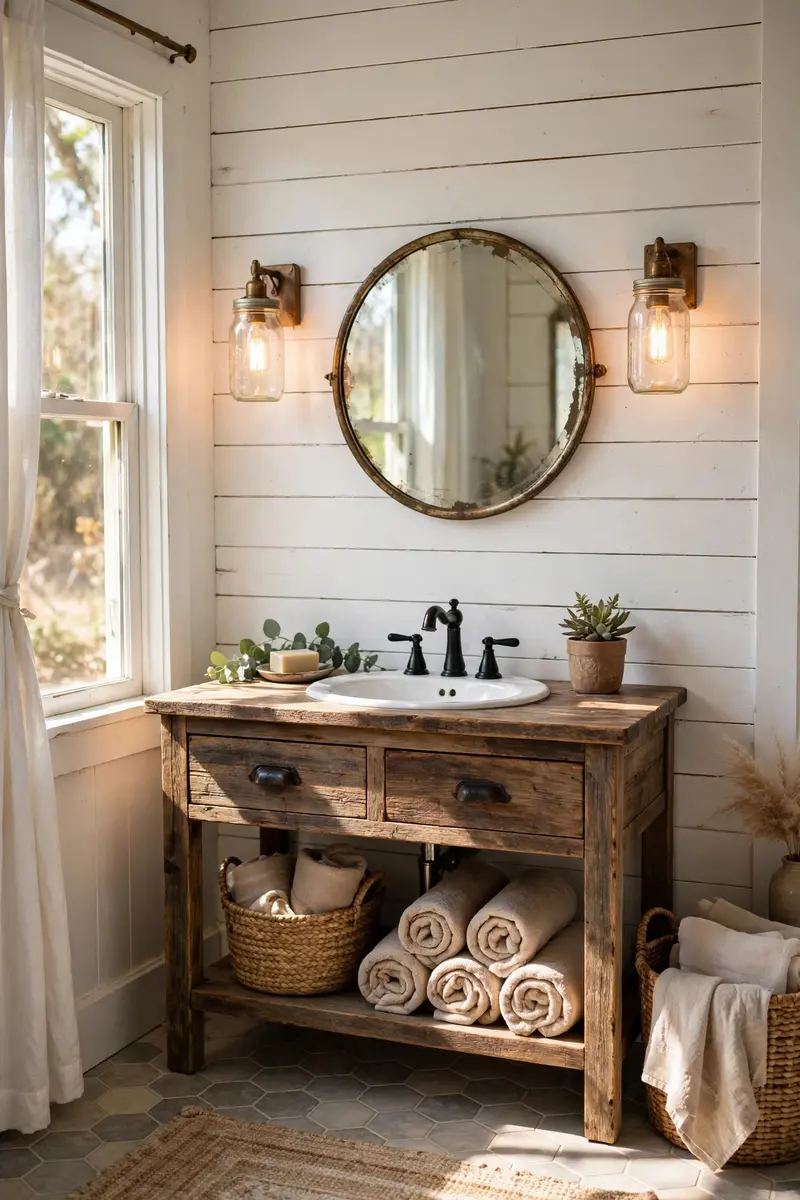
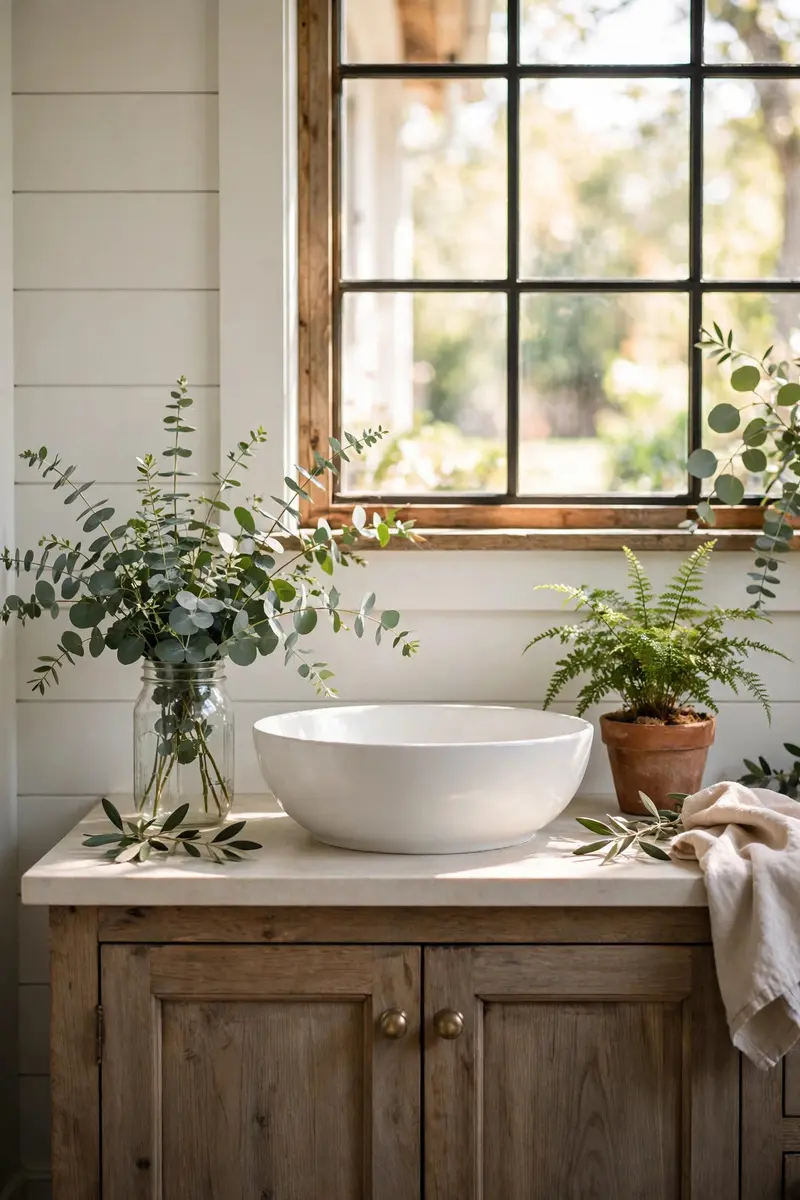
A reclaimed wood vanity is the beating heart of a farmhouse bathroom. Whether it’s an antique dresser converted into a sink base or a brand-new vanity with a distressed, weathered finish, the wood’s knots, grain, and history do more for the room’s character than any tile ever could. It grounds the space and instantly balances all that white porcelain and chrome.
Materials and cost: A secondhand wooden dresser or sideboard, $50–$200 (thrift store, Facebook Marketplace, or a garage sale); a vessel or drop-in sink, $80–$250; a plumber for the drain hookup, $150–$300 if you’re not DIY-inclined. Total for a conversion: $280–$750. New “distressed wood” farmhouse vanities start around $400–$900.
For a conversion, cut openings in the dresser top for the sink and plumbing, seal every surface with marine-grade polyurethane or spar urethane (bathroom moisture is relentless), and swap the hardware for bin pulls or cup pulls in aged brass or matte black. Vessel sinks are the easiest conversion — they sit on top and need only a small drain hole. Check that the dresser’s height lands near 32–36 inches with the sink, or you’ll be stooping every morning.
Tip: Line the drawers with cedar or cedar-scented liners before you store towels in them — the wood smell is lovely, and it naturally repels moisture and moths.
Variation: Can’t plumb a dresser? Get the same warmth with a new vanity in a wire-brushed oak or weathered-gray finish, then style the countertop with a wooden tray and vintage soap dispenser.
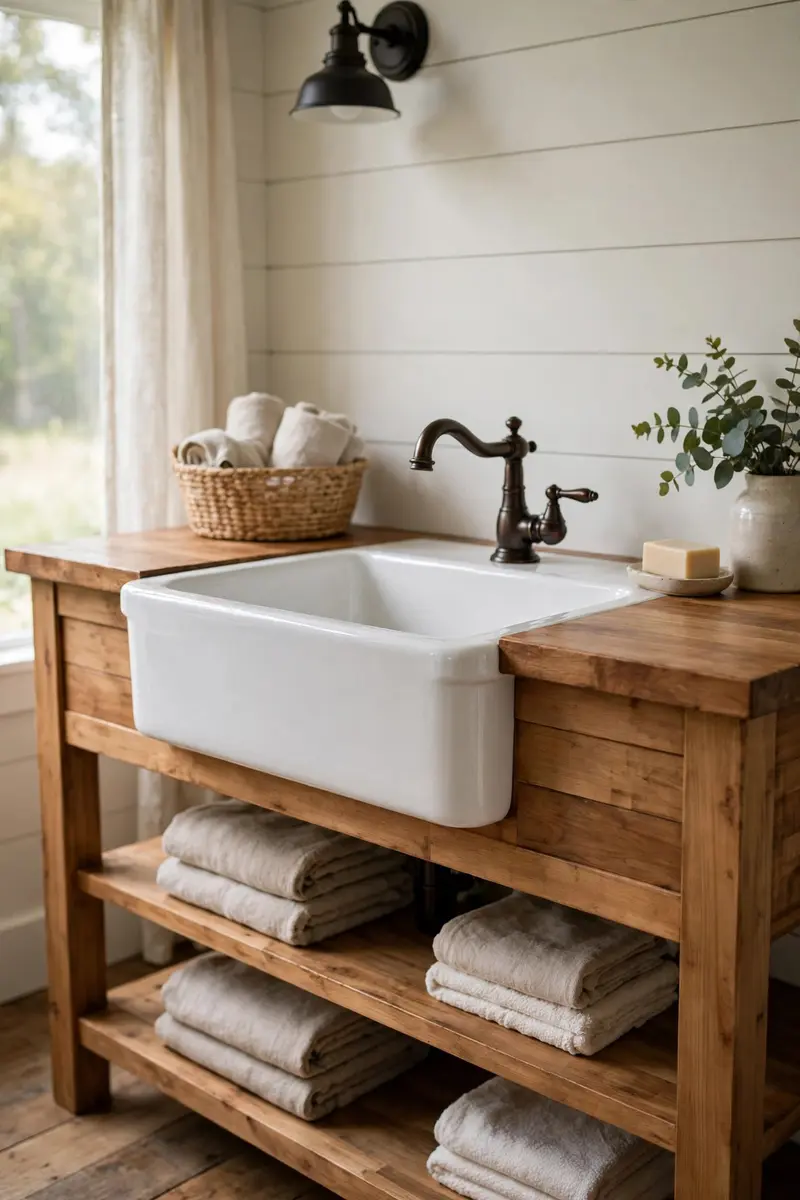
3. Install an Apron-Front Farmhouse Sink
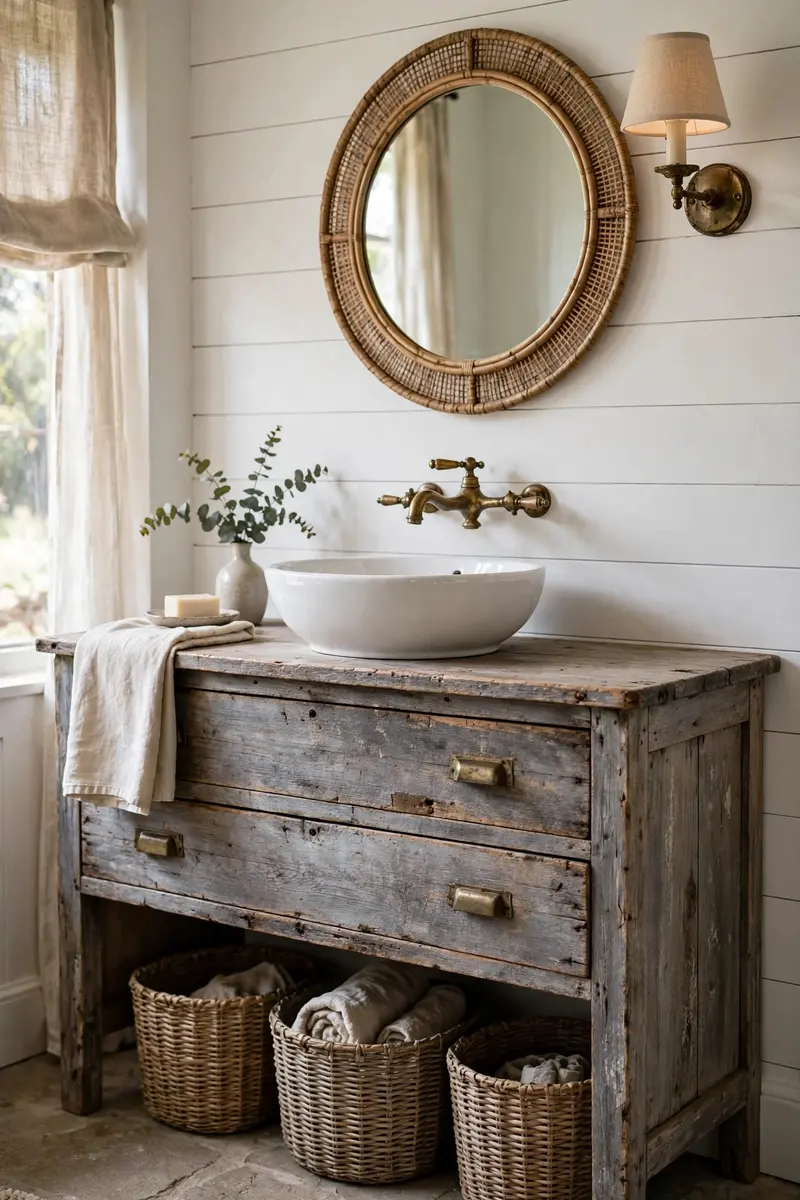
The apron-front sink — that deep, wide basin with the exposed front panel — is the one fixture that literally carries the farmhouse name. In a bathroom, it becomes a sculptural focal point: practical (you can actually soak a shirt in it), durable, and visually striking against a wood vanity or butcher-block counter.
Materials and cost: Fireclay or porcelain apron-front sinks, $200–$500; a farmhouse-style faucet in oil-rubbed bronze or brushed brass, $80–$200; installation (a pro is wise here — these sinks are heavy), $200–$400. Total: $480–$1,100.
Apron-front sinks need a vanity built or modified to cradle them — the front panel sits proud of the cabinet, so the cabinet’s top front rail is typically cut away or the sink rests in a custom opening. Confirm your plumbing rough-in lines up before you buy, and order the faucet with enough reach: vessel-style apron sinks pair best with taller, wall-mounted or deck-mounted faucets that clear the deep bowl.
Tip: Fireclay resists chips and stains better than standard porcelain, and its glossy finish is easier to wipe down — worth the small premium if you have kids or hard water.
Variation: Love the look but not the remodel? A standard undermount sink with a fabric sink skirt in ticking stripe or gingham gives you that old-fashioned farmhouse feel for under $50.
4. Hang a Sliding Barn Door
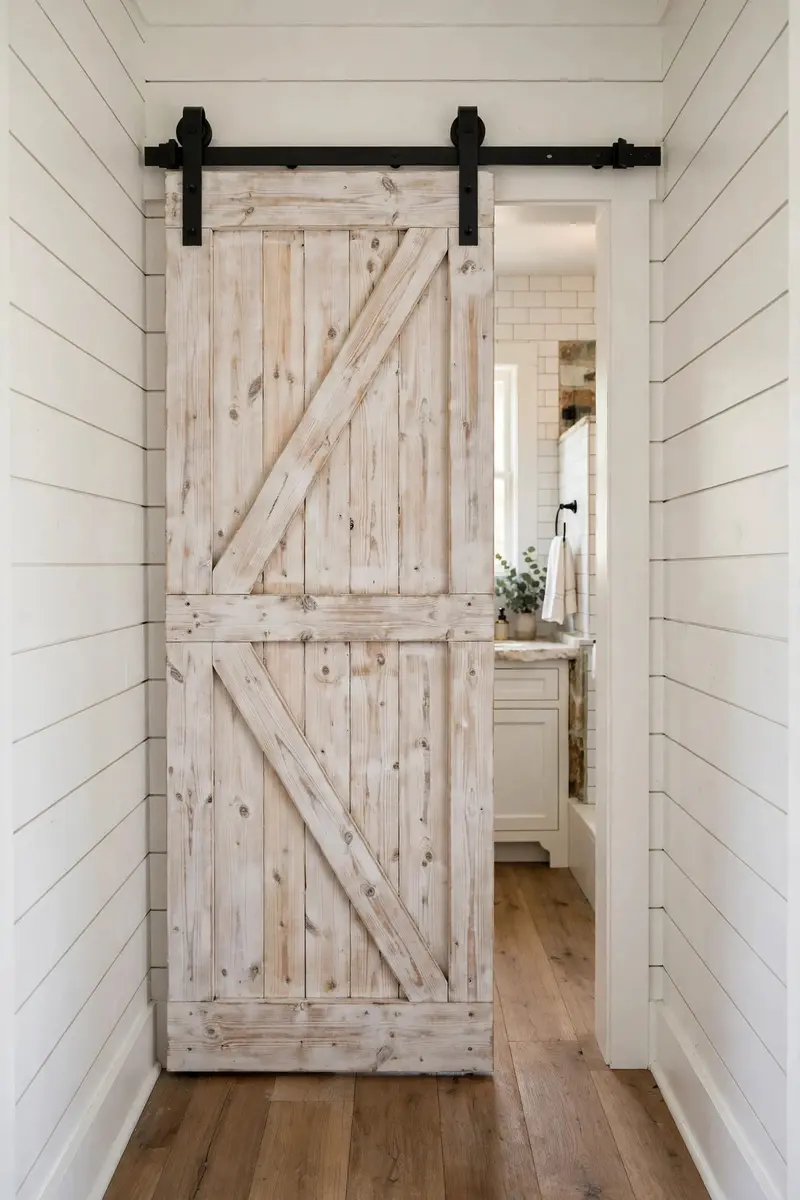
Few upgrades shout “farmhouse” as fast as swapping a standard swing door for a sliding barn door. Beyond the looks, it’s genuinely practical: no swing clearance means more usable space in tight bathrooms, and the exposed black iron track and hardware add that industrial-rustic edge the style is known for.
Materials and cost: A solid-core wood barn door slab, $150–$400; sliding hardware kit with track, $50–$120; handles, $20–$50. Total: $220–$570 (a DIY weekend project) or add $150–$250 for professional installation.
Mount the track into wall studs — a 150-pound door ripping out of drywall is nobody’s idea of decor. Level the track carefully, hang the door, and add a floor guide so it doesn’t swing. One caveat: barn doors don’t seal as tightly as regular doors, so they’re best for powder rooms and main bathrooms rather than the only bathroom in a house where privacy and sound matter most. A simple cane or latch hook on the inside handles privacy just fine.
Tip: Leave a 1-inch gap between the door bottom and the floor so the door glides over rugs and tile without dragging.
Variation: Try a half-X or Z-brace design in whitewashed pine for a lighter, airier feel — or go bold with a matte-black door against white shiplap for modern farmhouse contrast.
5. Soak in a Clawfoot Tub, the Crown Jewel of Farmhouse Bathroom Decor Ideas
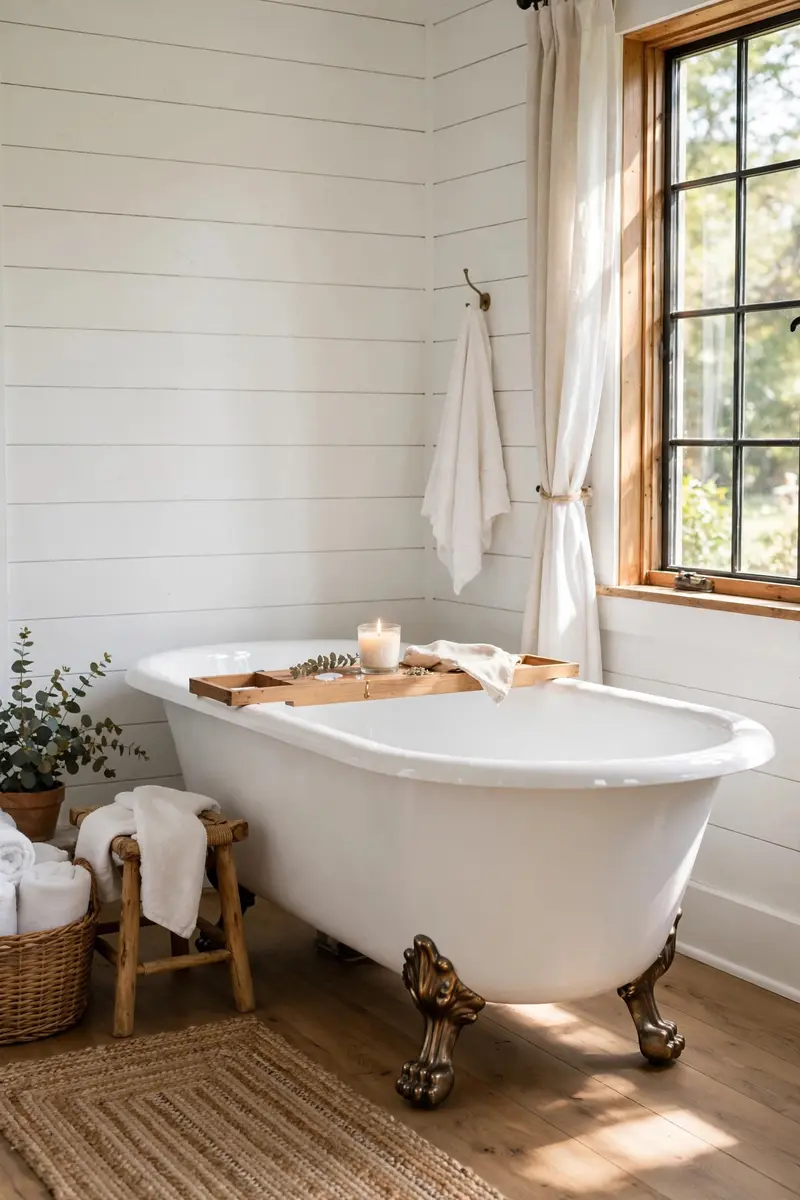
If your space allows it, a freestanding clawfoot tub is the single most romantic farmhouse bathroom statement you can make. It turns an ordinary bath into a destination — the deep soak, the sculptural silhouette, the vintage ball-and-claw feet — and it anchors the entire room so every other detail plays supporting role. For more farmhouse bathroom inspiration from the style’s biggest outlets, the editors at Better Homes & Gardens round up farmhouse bathroom ideas that show just how versatile this look can be.
Materials and cost: Acrylic clawfoot-style tubs, $700–$1,500 (much lighter than cast iron — a real blessing on upper floors); authentic cast-iron clawfoots, $1,200–$3,000+; a freestanding tub filler in aged brass or chrome, $150–$500; professional installation, $500–$1,200. Total: $1,350–$3,200+.
Plan the plumbing before you fall in love: freestanding tubs need floor-mounted or wall-mounted fillers, and the drain location must match your existing rough-in (or budget for moving it). Measure twice — you need at least 4 inches of clearance on all sides for cleaning, and the tub plus water plus you can top 500 pounds, so confirm your floor can take the load. Pair it with a wooden bath caddy across the rim for candles, a book, and a glass of something cold.
Tip: Acrylic tubs keep water warmer longer than cast iron and are a fraction of the weight — unless authenticity matters more to you than practicality, acrylic is the smarter buy.
Variation: No room for a full tub? A deep, farmhouse-style soaking sink at the vanity, styled with folded linens and a wooden stool beside it, hints at the same spa-farmhouse feeling.
6. Hang a Vintage Mirror in a Distressed Wood Frame
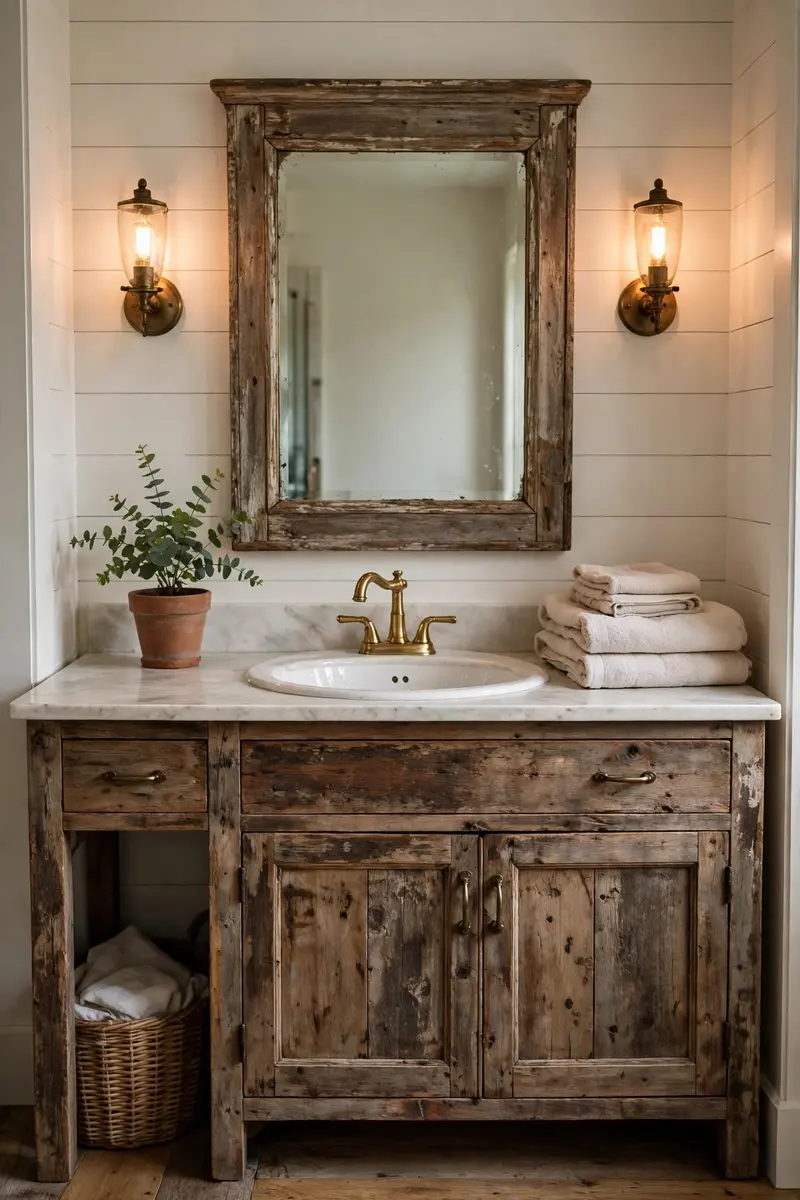
A mirror is the one thing every bathroom needs, so make it the thing everyone remembers. A vintage mirror — thrifted, flea-marketed, or simply new with a distressed wood frame — adds history, warmth, and reflected light all at once. The worn frame does the storytelling; you don’t need anything else on that wall.
Materials and cost: Thrifted or antique mirror, $10–$50; new distressed-wood-framed mirrors, $50–$150; DIY option: frame a plain mirror with reclaimed fence pickets or barn wood, $15–$40 in lumber plus an afternoon. Total: $10–$150.
When thrifting, look past the frame and check the glass: light “desilvering” spots around the edges actually add to the vintage charm, but large black patches in the center mean the mirror is failing. For a DIY frame, miter (or simply butt-joint) four pieces of weathered wood around a standard mirror, attach with wood glue and corner brackets, and seal the back with a moisture-resistant finish. Hang with proper anchors — mirrors are heavier than they look, and bathroom walls hide surprises.
Tip: Go bigger than you think. An oversized mirror over a farmhouse vanity bounces light around the room and makes even a small bathroom feel twice as large.
Variation: Hang two matching vintage mirrors over a double vanity for symmetry, or cluster three small round mirrors in different wood frames for a collected-over-time gallery look.
7. Add Open Shelving in Reclaimed Wood
Open shelves are farmhouse multitaskers: they store your towels, display your pretty things, and add that warm wood layering the style depends on — all while making a small bathroom feel more open than a closed cabinet ever could. They shine above the toilet, over the vanity, or along a bare stretch of wall. For more ways to style that tricky above-toilet zone, our over-toilet bathroom shelf decor ideas pair beautifully with this look.
Materials and cost: Reclaimed wood planks, $0–$30 (salvage yards, pallets, or old fence boards); black iron shelf brackets, $8–$15 each; wood screws and anchors. Two shelves: $20–$80 total.
Sand reclaimed boards smooth enough that they won’t snag towels (but leave the character — the saw marks and nail holes are the point). Cut to length, stain or leave raw, and seal with polyurethane. Mount brackets into studs wherever possible; on tile, use masonry anchors. Style in threes: a stack of folded white towels, a small plant, and a jar of cotton balls or bath salts. Leave breathing room — farmhouse shelves look collected, not crowded.
Tip: Mix one “pretty” shelf with one “practical” shelf. The top shelf holds decor (plants, jars, a small framed print); the lower one holds the everyday towels and baskets you actually reach for.
Variation: Try a single long floating shelf with hidden brackets for a cleaner, more modern-farmhouse line — or hang shelves with rope instead of brackets for a playful rustic twist.

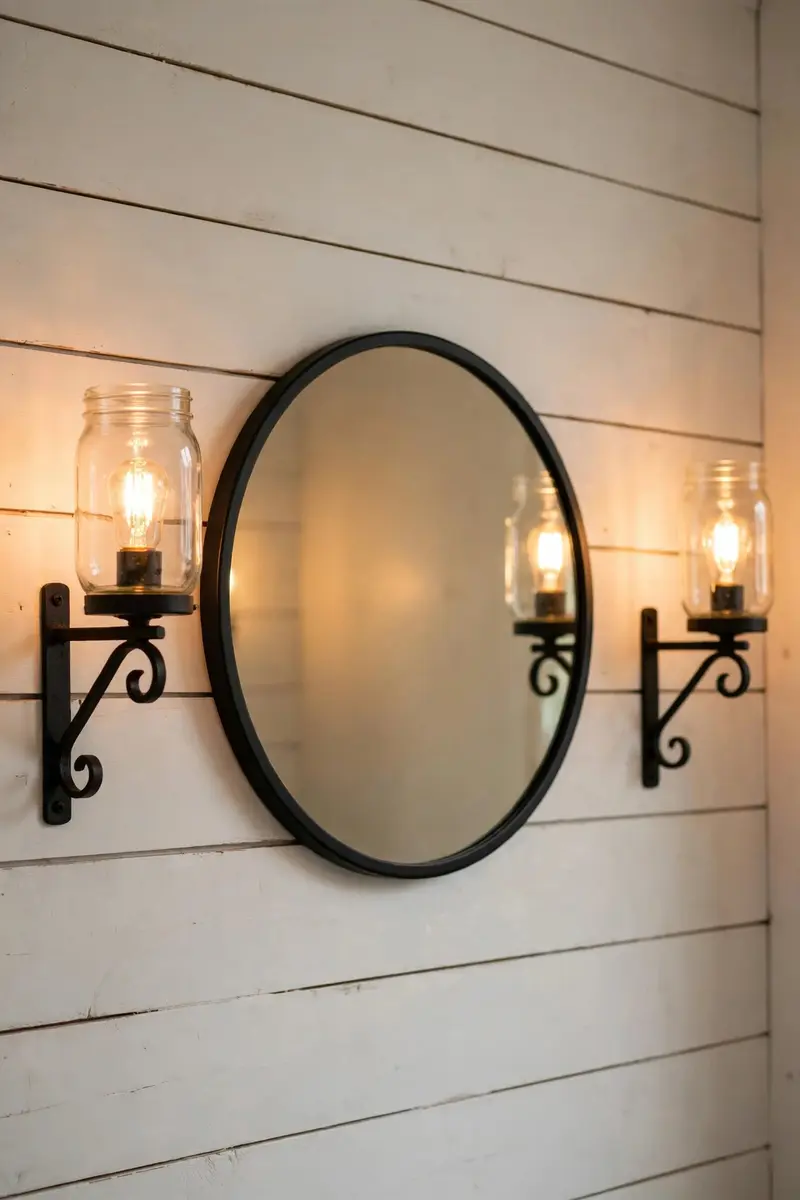
8. Light It With Mason Jar Sconces
Mason jar sconces are the farmhouse lighting move: warm, glowy, a little nostalgic, and endlessly customizable. Mounted as a pair flanking the mirror, they replace harsh overhead vanity bars with a soft, flattering light that makes the whole room feel like golden hour.
Materials and cost: Mason jar sconce kits (bracket + jar + socket), $20–$50 each; hardwired versions from farmhouse lighting brands, $60–$120 each; LED Edison bulbs, $5–$12 each. A pair: $50–$150.
Plug-in versions are the renter-friendly pick — they mount with a couple of screws and trail a cord to the outlet (run it through a slim cord cover painted to match the wall). For hardwired sconces, kill the breaker, remove the old vanity bar, and wire the new sconces to the existing box — it’s a straightforward swap if the boxes are already there, or a quick electrician visit ($100–$200) if they’re not. Always use LED bulbs: they run cool, and mason jars trap heat.
Tip: Choose 2700K “warm white” bulbs. Cooler daylight bulbs kill the cozy farmhouse mood instantly — lighting temperature matters more than the fixture itself.
Variation: Swap the jars seasonally — clear jars with fairy lights for summer, amber jars for fall, frosted jars with eucalyptus sprigs tucked inside for a spa-like twist.
9. Finish With Aged Brass or Matte Black Fixtures
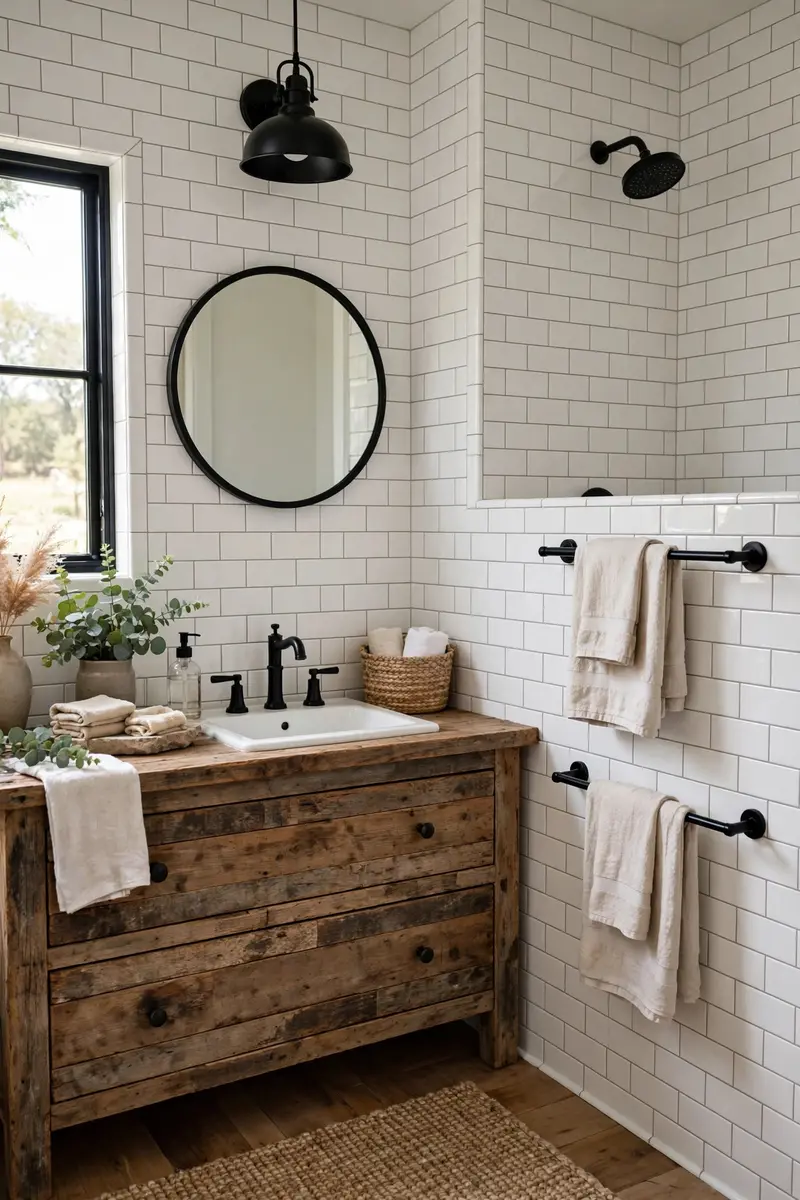
Fixtures are the jewelry of the bathroom — and in a farmhouse bathroom, the right finish pulls the whole look together. Aged brass (warm, softly patinaed) leans traditional and cozy; matte black (bold, graphic) leans modern-farmhouse and pairs beautifully with white shiplap and subway tile. Pick one finish and commit — mixed metals are a look, but a single finish reads far more intentional. For a deep dive into the modern end of the spectrum, The Spruce’s collection of modern farmhouse bathroom ideas is a great place to study how designers mix these finishes.
Materials and cost: Bathroom faucet, $80–$250; shower head and trim kit, $120–$350; towel bars, hooks, and cabinet pulls, $10–$40 each. A full fixture refresh: $300–$800.
Swapping a faucet is one of the highest-impact DIY upgrades in the house: shut off the water, disconnect the supply lines, lift out the old faucet, and drop in the new one (most standard faucets fit standard 4-inch or 8-inch spreads). Shower trim kits are similarly straightforward if you’re keeping the existing valve. Keep your old finish nowhere — every visible fixture, down to the toilet handle and the robe hook, should match your chosen finish, or the odd one out will shout.
Tip: Order finish samples before committing. “Aged brass” varies wildly between brands — some read gold, some read brown — and you’ll live with it for years.
Variation: Oil-rubbed bronze is the dark horse of farmhouse finishes: darker than brass, softer than black, with coppery highlights that show as it ages. It hides water spots better than anything else on this list.
10. Corral Clutter in Woven Jute Baskets
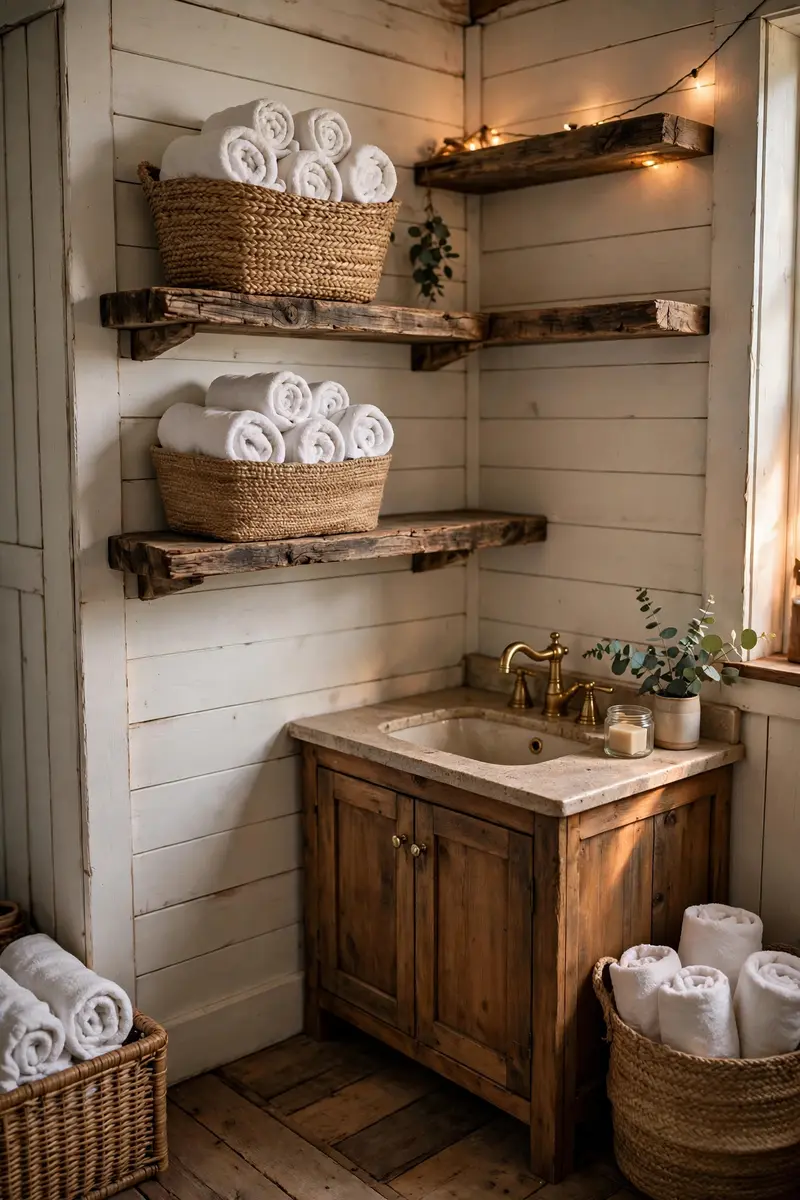
Farmhouse style loves texture, and nothing delivers it like woven baskets. Jute, seagrass, and wicker baskets turn bathroom clutter — extra toilet paper, cleaning supplies, hair tools — into something that looks intentional. They’re the difference between a messy bathroom and a “collected” one.
Materials and cost: Large seagrass or jute baskets, $15–$40 each; small woven bins, $8–$20 each; thrift-store baskets, $2–$8 each. A full bathroom set: $25–$100.
Use a big basket under a floating vanity for the hair dryer and styling tools, medium ones on open shelves for rolled towels and toilet paper, and small ones in drawers to corral bottles and brushes. Roll hand towels instead of folding them — they fit better and look like a spa. If a basket feels too deep, flip an upside-down bowl inside it to create a false bottom that lifts the contents into view.
Tip: Choose baskets with handles — in a steamy bathroom you’ll want to lift and wipe underneath them regularly, and handles make that a five-second job instead of a chore.
Variation: Line a wire basket with a linen tea towel for a rustic-industrial hybrid look, or spray-paint a cheap wicker basket in chalk-white paint for a softer, cottage-farmhouse feel.
11. Tile the Shower in White Subway Tile With Dark Grout
White subway tile is timeless on its own, but the farmhouse move is pairing it with contrasting grout — charcoal, dark gray, or even black. The grid pattern highlights the handmade quality of the tile, adds graphic punch to an all-white room, and hides soap scum far better than white grout ever will. It’s the single most classic farmhouse bathroom surface there is.
Materials and cost: Ceramic subway tile, $2–$8 per square foot; dark grout, $15–$25 per bag; thinset, spacers, and sealer. A standard 60×32-inch shower surround (about 80 sq ft): $300–$800 DIY, or $1,500–$3,000 professionally installed.
Run the tile in a classic running-bond (brick) pattern for tradition, or stack it vertically for a more modern-farmhouse feel — vertical stacking makes low ceilings feel taller. Take the tile all the way to the ceiling (stopping at the showerhead height looks dated and unfinished), use a schluter edge trim in matte black for a crisp finished edge, and seal dark grout twice: it stains more visibly than you’d expect in hard-water areas.
Tip: Order 10% more tile than your measurements say you need. Subway tile cuts generate waste, and dye lots vary — running short mid-project is a classic, expensive mistake.
Variation: Try handmade-look zellige tiles in white or cream for an artisanal twist, or run the subway tile halfway up the wall with a painted top half in warm greige for a two-tone farmhouse wall.

12. Lean Into a Rustic Towel Ladder for Farmhouse Bathroom Decor Ideas on a Shoestring
Of all the farmhouse bathroom decor ideas on this list, the towel ladder might be the best value: one piece of rustic wood, five minutes, zero holes in the wall. It leans against the wall, holds three or four towels within arm’s reach, and adds that vertical wood accent farmhouse rooms crave. It’s also a lifesaver in small bathrooms where wall space is too precious for towel bars.
Materials and cost: A new rustic wood ladder, $30–$70; a thrifted wooden ladder, $5–$20; DIY from two 2×2 boards and dowels, $10–$25. Total: $5–$70.
If you’re buying, look for a ladder 4–6 feet tall with rungs spaced 8–10 inches apart. Sand any splinters, seal with a clear matte polyurethane (towels are damp; raw wood will mildew), and lean it at a slight angle with the feet on a non-slip pad so it can’t slide on tile. Drape towels over alternate rungs — folded in thirds so they hang evenly — and save the top rung for a small hanging plant or a wreath.
Tip: Anchor the top of the ladder to the wall with a small removable hook if you have kids or pets. A leaning ladder is stable until someone pulls a towel too hard.
Variation: Hang a narrow ladder horizontally as a wall-mounted towel rail, or use a short stepladder beside the tub as a side table for candles and a book.

13. Expose (or Fake) Wooden Ceiling Beams
Nothing adds farmhouse architecture faster than wood overhead. Real or faux ceiling beams draw the eye up, add warmth to a room that’s otherwise all tile and porcelain, and make even a standard 8-foot ceiling feel custom and considered. In a bathroom, dark-stained beams against a white ceiling are pure farmhouse drama.
Materials and cost: Faux wood beams (hollow polyurethane or real wood veneer boxes), $8–$20 per linear foot; stain and mounting hardware. Three beams across a 10-foot bathroom: $250–$650 DIY, or $800–$1,500 professionally installed.
Faux beams are the smart play in bathrooms: they’re hollow and lightweight, they won’t warp in humidity the way solid wood can, and they install with simple mounting blocks screwed into ceiling joists. Stain them a rich walnut or weathered gray, or whitewash them for a lighter coastal-farmhouse feel. Run them across the narrow dimension of the room to make a long bathroom feel wider, and keep them at least 7 feet off the floor — code in most areas requires it, and anything lower feels oppressive.
Tip: Paint the ceiling between the beams a soft warm white rather than stark white — it makes the wood tones glow instead of competing with them.
Variation: No ceiling height to spare? A single thick beam mounted above the vanity mirror (or as a floating mantel-style shelf) gives you the wood-overhead feeling without touching the ceiling.
14. Layer Woven Bath Mats and Rugs
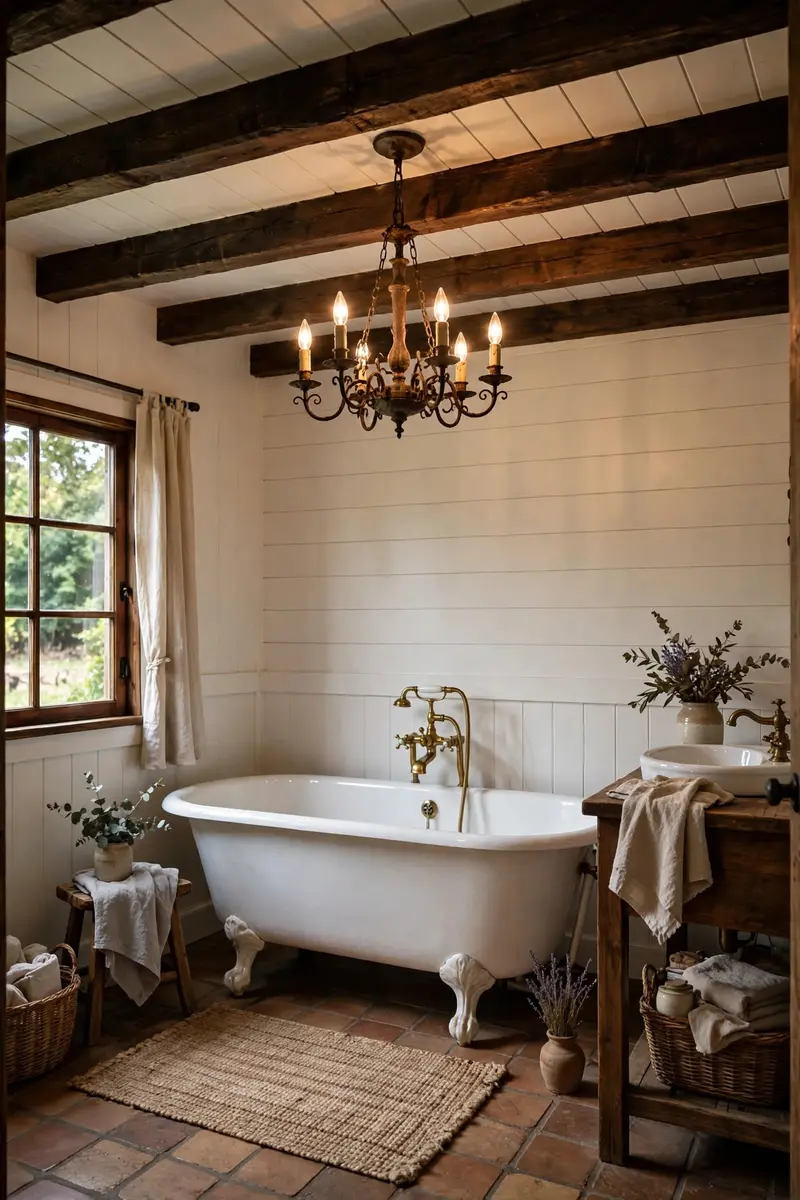
Bare tile is cold underfoot and cold to the eye — layering is how farmhouse bathrooms fix both at once. A large woven jute or cotton rug underfoot, topped with a smaller washable bath mat where you step out of the shower, adds softness, pattern, and that collected, lived-in feeling. It’s the fastest textile upgrade in the room.
Materials and cost: A 3×5-foot jute or braided cotton rug, $30–$80; a washable cotton bath mat, $15–$35; a non-slip rug pad, $10–$20. A layered setup: $55–$135.
Size the large rug to anchor the space — in front of a double vanity, or centered under a clawfoot tub — and let the smaller mat do the wet work at the shower or tub edge. Always use a rug pad: it keeps layers from sliding on tile and adds cushioning. Choose machine-washable cotton for the top layer (it takes the daily beating) and let the jute base be the decorative one. And here’s a Pinterest-trending trick: pull a trending earthy accent color — terracotta, clay, or warm sage — into your top mat or towels. That single warm note keeps an all-white farmhouse bathroom from feeling flat.
Tip: Washable rugs are non-negotiable in bathrooms. If it’s not machine-washable, it will eventually smell like mildew — no matter how pretty it is.
Variation: Try a vintage-style washable runner with a faded Persian pattern for a farmhouse look with more pattern, or layer two small mats at angles for an intentionally casual, collected feel.

15. Bring in Eucalyptus and Greenery
Every farmhouse bathroom needs something alive. Eucalyptus — fresh, dried, or faux — is the farmhouse plant of choice: silvery-green, beautifully scented, and sculptural even when it’s just a few stems in a jar. A little greenery softens all those hard surfaces and adds the one color (green) that never fights the farmhouse palette.
Materials and cost: A fresh eucalyptus bundle, $8–$15 (lasts 2–4 weeks, longer dried); a mason jar or stoneware vase, $5–$15; a humidity-loving live plant like a fern or pothos, $10–$25; a hanging planter, $15–$30. Total: $10–$40.
Hang a fresh eucalyptus bundle from the showerhead with twine — the steam releases its scent every time you shower, turning an ordinary morning into a spa ritual (replace it monthly). On the vanity, a single stem in a small amber bottle or mason jar is enough. For live plants, choose humidity lovers: pothos, ferns, spider plants, and orchids all thrive in steamy bathrooms with indirect light. No window? High-quality faux eucalyptus in a pretty vessel fools everyone at arm’s length.
Tip: Dried eucalyptus keeps its shape and a faint scent for months — when the fresh bundle fades, don’t toss it; move it to a shelf or the towel ladder as dried decor.
Variation: Swap eucalyptus for dried lavender bundles (purple + incredible scent) or cotton stems in a tall pitcher for a more rustic, harvest-farmhouse feel.
16. Tuck In an Antique Furniture Accent
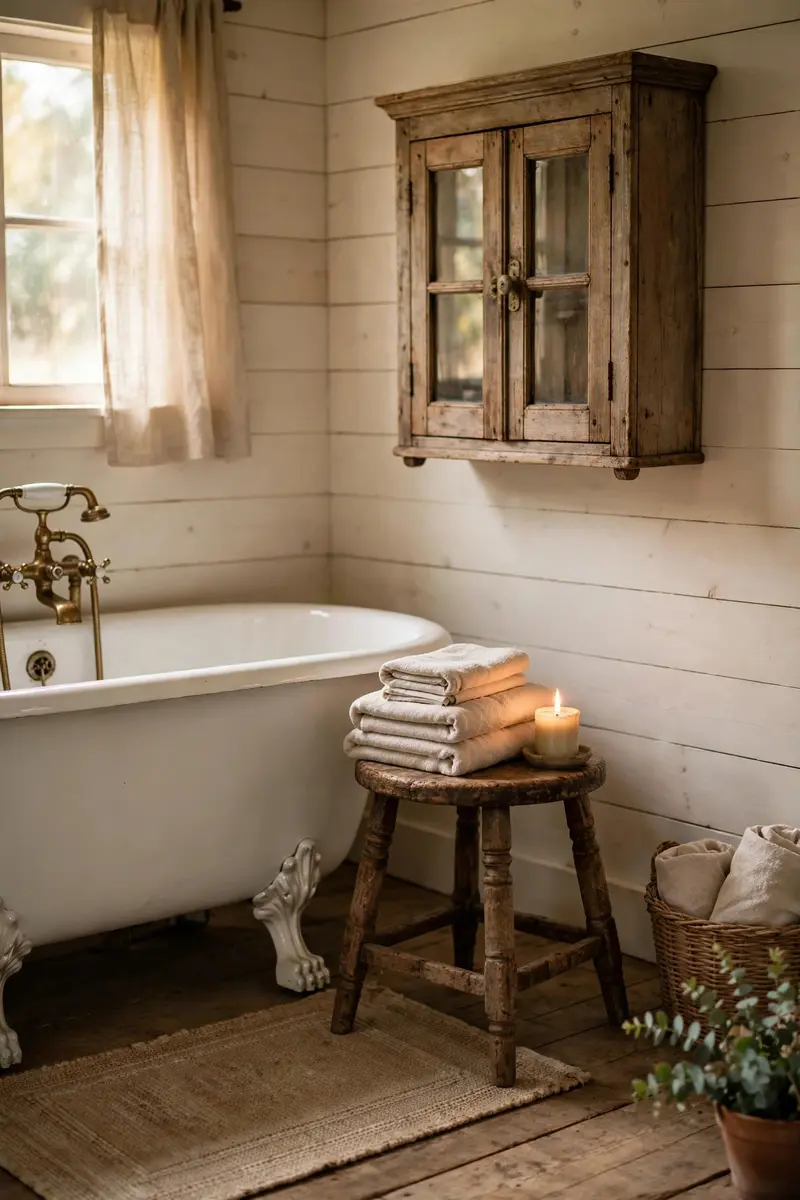
The secret ingredient that separates a real farmhouse bathroom from a catalog copy is one genuinely old thing. An antique stool beside the tub, a vintage cabinet for linens, an old wooden crate holding rolled towels — one piece with a past makes every new thing around it feel more authentic. It’s the soul of the room.
Materials and cost: A vintage wooden stool or small bench, $20–$60 (thrift/antique store); an antique wall cabinet, $40–$120; a wooden crate, $5–$15. Total: $5–$120.
Look for solid wood with good bones — wobbly legs can be reglued, and a bad finish can be sanded and resealed, but particle board isn’t worth saving. Seal any piece that will sit near water with marine-grade polyurethane, and put felt pads on the feet so it doesn’t scratch tile. Style it simply: a folded stack of towels on the stool, a candle and a small plant on top of the cabinet. One antique is a statement; five is a flea market — let it breathe.
Tip: Check the piece’s height before you buy. A stool beside the tub should be 18–24 inches tall — low enough to sit on, high enough to hold a book and a drink within reach from the water.
Variation: An old wooden ladder-back chair makes a perfect towel holder, and a vintage suitcase stacked on the floor hides extra toilet paper in plain sight.
Frequently Asked Questions
What’s the difference between modern and rustic farmhouse bathroom decor?
Modern farmhouse leans cleaner and more contrast-driven: white shiplap, matte-black fixtures, minimal clutter, and crisp lines. Rustic farmhouse leans warmer and more textured: reclaimed wood, distressed finishes, vintage finds, and layered textiles. Both share the same DNA (natural materials, cozy over sleek), so you can blend them — most real homes land somewhere in the middle, like black fixtures against a reclaimed-wood vanity.
How can I get the farmhouse look in my bathroom on a budget?
Start with the highest-impact, lowest-cost swaps: a fringed or textured shower curtain ($20–$40), woven baskets for storage ($25–$60), a thrifted wooden stool or ladder ($5–$20), and eucalyptus in a mason jar ($10–$15). Swap your cabinet hardware and towel hooks to matte black ($30–$60) for an instant modern-farmhouse update. A convincing farmhouse refresh is very doable for $100–$200 if you thrift and DIY the big pieces.
What colors work best in a farmhouse bathroom?
The classic palette is warm whites, creamy neutrals, soft grays, and natural wood tones. In 2026, designers are warming it up further with earthy accents — terracotta, clay, sage green, and muted dusty blue — which keep the farmhouse coziness while moving past the all-white-everything era. Keep walls light (small bathrooms need the brightness) and bring color in through towels, rugs, and plants.
Does farmhouse bathroom decor work in a small bathroom?
Absolutely — some farmhouse elements are made for small spaces. White shiplap and an oversized mirror make a tiny bath feel bigger, a leaning towel ladder needs zero wall space, and a sliding barn door saves the swing clearance of a regular door. Skip the clawfoot tub and the bulky antique cabinet; lean into baskets, a small stool, eucalyptus, and warm lighting instead.
What kind of vanity is best for a farmhouse bathroom?
A reclaimed-wood or distressed-finish vanity is the gold standard — it brings the warmth and character the style depends on. Converted antique dressers are the most authentic (and often cheapest) option; new vanities in wire-brushed oak or weathered gray are the low-maintenance alternative. Pair it with an apron-front sink for the full farmhouse statement, or a simple white vessel sink for a lighter look.
Conclusion
Farmhouse bathroom decor ideas work because they start from comfort: warm wood, honest materials, and little vintage touches that make a hard, steamy room feel like somewhere you actually want to linger. You don’t need a renovation budget or a 200-year-old house — a weekend, a few thrift-store finds, and two or three of these ideas will completely change how your bathroom feels.
Start with the easiest win (baskets, eucalyptus, a new shower curtain), then work your way up to the weekend projects like shiplap or open shelving. And if one of these ideas made you grab your tape measure — save this post to Pinterest so it’s there when you’re ready. Your future farmhouse bathroom is going to be so cozy.