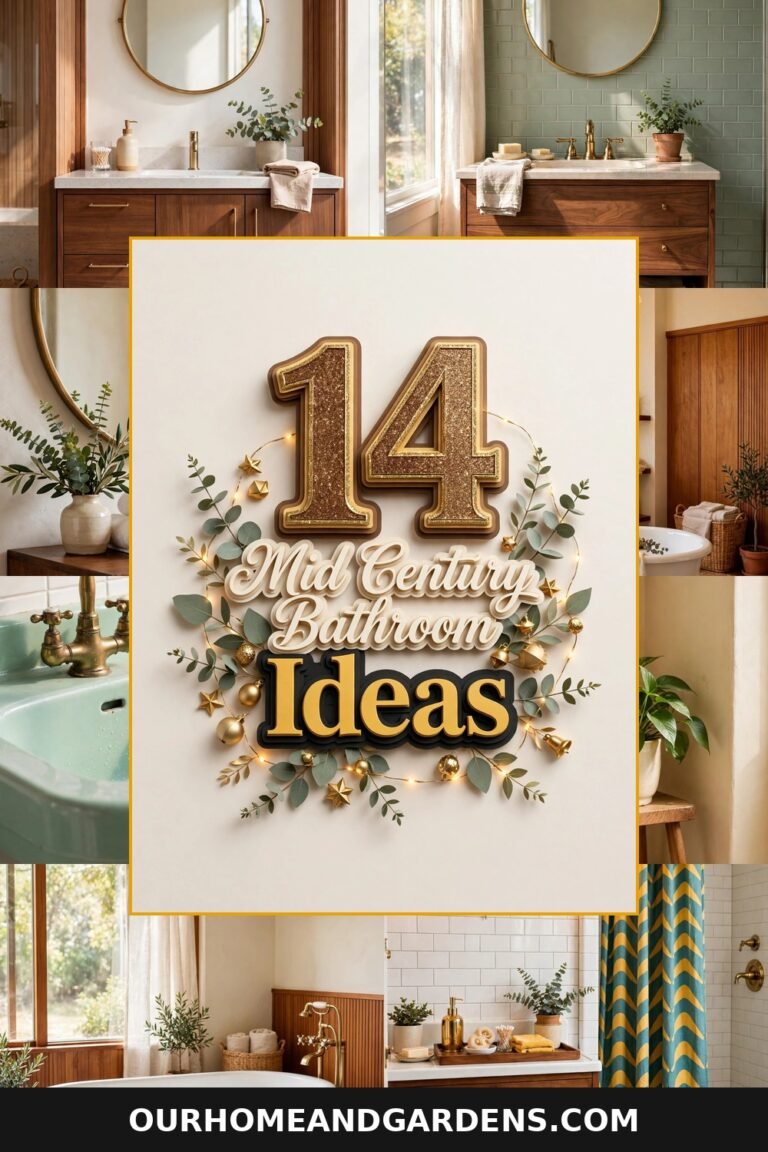
If you love clean lines, warm wood, and just the right amount of retro personality, these mid century bathroom ideas are for you. Mid-century style is that sweet spot between vintage charm and modern calm — nothing fussy, nothing cold, just honest materials and shapes that have looked good since the 1950s and still do today. The best part is that you do not need a full renovation to get the look. Many of the ideas below are weekend projects, and even the bigger ones are simpler than they sound.
Whether your bathroom is large or tiny, rented or owned, you will find a look here that fits. Think walnut vanities, terrazzo floors, globe lights, and pops of burnt orange or teal. For more retro inspiration, take a look at our vintage bathroom ideas and retro bathroom ideas — they pair beautifully with the mid-century touches below.
1. A Walnut Floating Vanity
Nothing says mid-century faster than a walnut vanity with clean horizontal lines. A floating design — one that hangs on the wall with the floor visible beneath — instantly makes the room feel lighter and larger, which is why it is the single most transformative of all mid century bathroom ideas for small spaces.
Materials and realistic cost: a ready-made walnut floating vanity runs about $300–$700; a wall-mount faucet adds $80–$150. If you are handy, converting a vintage credenza with tapered legs costs roughly $150–$350 plus plumbing parts.
Start by choosing a vanity with flat slab doors and no ornate trim. Keep the countertop thin — white quartz or terrazzo looks crisp against the wood grain. Mount it at standard counter height, around 32–34 inches, and leave at least a few inches of visible floor beneath it so the floating effect reads clearly.
Tip: Match your grout to your tile color around the vanity wall so the wood, not the grout lines, stays the star.
Variation: If floating feels too modern for your home, pick the same walnut vanity on tapered, splayed legs instead — the classic mid-century silhouette with the same warm effect.

2. A Terrazzo Floor That Grounds the Room
Terrazzo is the ultimate mid-century floor. Those cheerful speckles of stone set in cement or resin were everywhere in the 1950s and 60s, and they are back in a big way because they hide dirt, last for decades, and add instant character.
Materials and realistic cost: genuine terrazzo tile costs about $8–$15 per square foot; terrazzo-look porcelain tile is a budget-friendly $4–$8 per square foot. A small bathroom floor typically needs 30–50 square feet.
Choose a terrazzo with small to medium aggregate — chips around 8–12 millimeters read as texture rather than chaos. Pair it with plain walls and a simple vanity so the floor can be the pattern in the room. If real terrazzo is out of budget, the porcelain lookalikes are nearly indistinguishable once grouted, and they are easier to maintain.
Tip: Seal terrazzo once a year and clean it with a pH-neutral cleaner so the speckles stay bright and the surface stays stain-free.
Variation: If you love the look but not the commitment, try terrazzo-look peel-and-stick tiles in a powder room first — an easy test drive for under $100.

3. Geometric Tile: The Boldest of These Mid Century Bathroom Ideas
If there is one place to be playful, it is the tile. Hexagons, diamonds, checkerboard, penny rounds, and stacked subway tiles are all period-perfect, and a bathroom is small enough that a bold pattern never overwhelms.
Materials and realistic cost: penny round or hex tile runs $6–$12 per square foot; a feature wall of stacked 2-by-8-inch matte tile costs roughly $150–$400 in materials for a vanity wall.
Pick one surface for pattern — the floor or one feature wall — and keep the rest calm. A soft green vertical stack behind the vanity, a black-and-white checkerboard floor, or a honeycomb shower wall each deliver the retro punch on their own. Matte finishes feel more authentic to the era than high gloss, and matching grout keeps the pattern from shouting.
Tip: Order 10 percent extra tile for cuts and spares, and keep one full box stored — matching a discontinued tile later is almost impossible.
Variation: Renters can get the same graphic hit with stick-on geometric tiles or a bold patterned shower curtain, no demolition required.

4. A Round Mirror in Brass or Wood
Swap a plain rectangular mirror for a round or oval one and the whole vanity area softens. Mid-century design loved organic curves, and a thin brass or walnut frame is the detail that makes the mirror feel intentional rather than generic.
Materials and realistic cost: a quality round brass-framed mirror costs $60–$180; a pair for a double vanity runs $120–$350.
Hang the mirror so its center sits at eye level, about 60–65 inches from the floor, and keep it proportional to the vanity — roughly two-thirds the vanity’s width works well. Over a double vanity, two matching round mirrors are a classic mid-century move that beats one oversized slab of glass.
Tip: If your mirror has no frame, add a slim brass or wood frame kit for under $40 — it is the fastest mirror upgrade there is.
Variation: Try an organically shaped, slightly irregular “blob” mirror for a more sculptural, 1960s take on the same idea.

5. Globe Pendant Lights Beside the Mirror
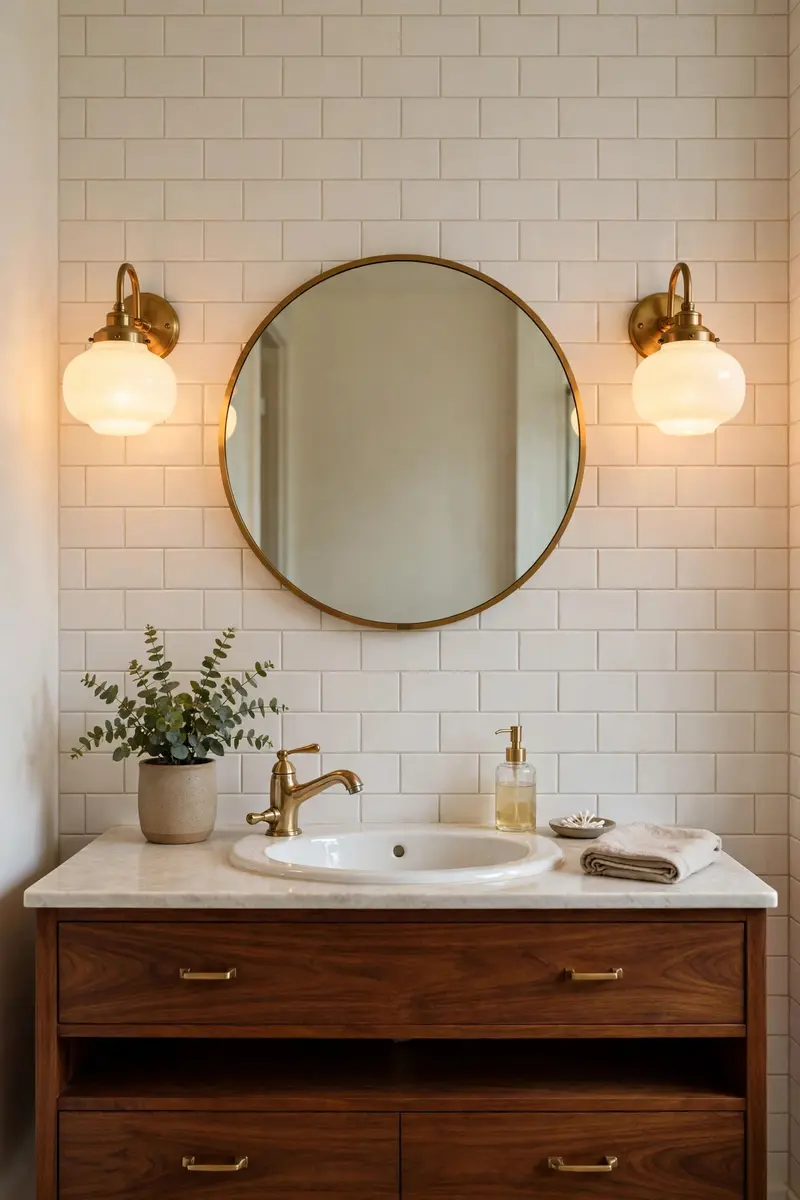
Globe lighting is the jewelry of the mid-century bathroom. Milk-glass globes on brass arms, hung beside the mirror instead of a harsh overhead bar, cast a soft, even light that flatters everyone and makes the room glow.
Materials and realistic cost: a pair of globe sconces costs $80–$220; globe pendants run $60–$150 each. Warm bulbs around 2700K are essential.
Mount sconces at eye level, about 60–66 inches high and 28–36 inches apart, so light hits your face evenly from both sides. If you only have one junction box, a single globe pendant centered over the mirror still delivers the look. Dimmers are worth every penny here — bright for getting ready, low for a relaxing bath.
Tip: Always buy warm-white bulbs for globe fixtures; cool daylight bulbs turn that cozy retro glow clinical in seconds.
Variation: For a more dramatic version, hang three small globes at staggered heights over a long double vanity.
6. A Sputnik Fixture for Instant Drama
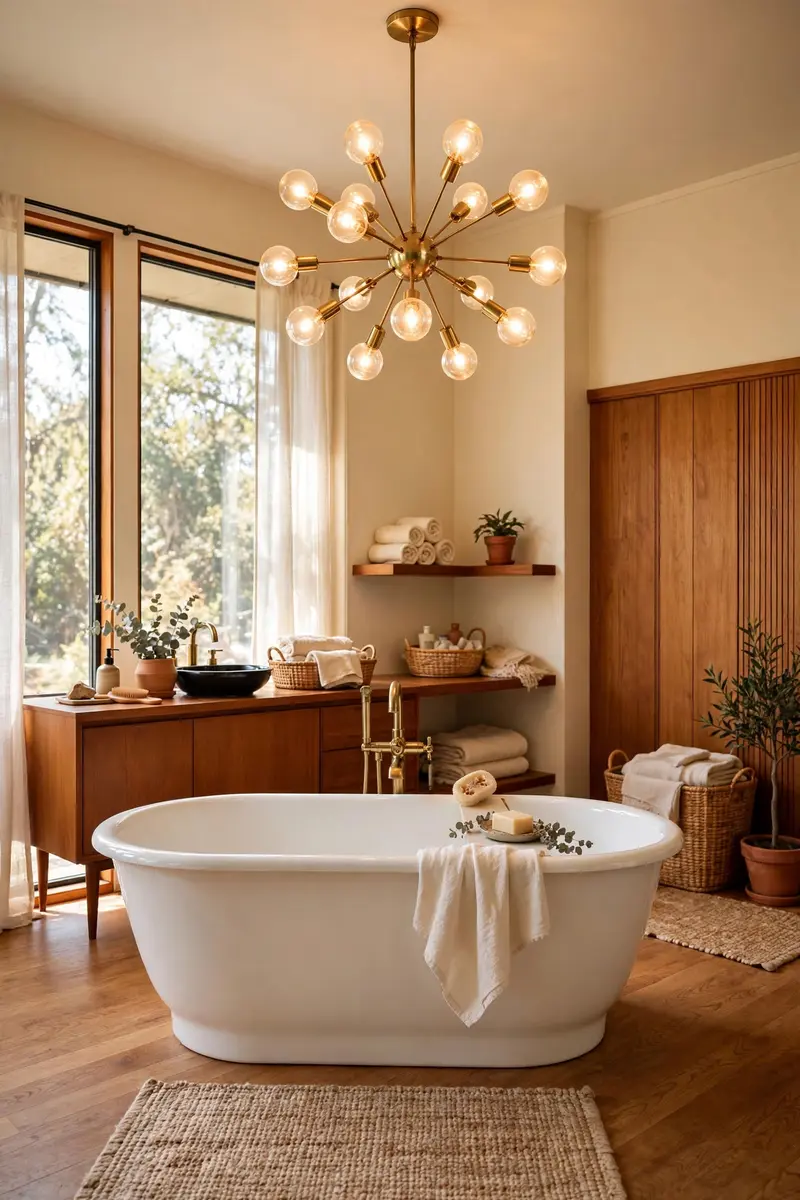
Nothing announces mid-century quite like a Sputnik chandelier — those starburst arms tipped with glowing orbs. In a bathroom it works best as the overhead centerpiece, especially over a freestanding tub or in a larger primary bath.
Materials and realistic cost: a small brass Sputnik fixture costs $120–$300; installation by an electrician runs $100–$200 if no wiring changes are needed.
Check your ceiling height first: you need at least 7 feet of clearance below the fixture in a walkway, and more above a tub. Keep the rest of the room’s lighting simple so the Sputnik stays the star, and choose a fixture with a dimmer so the starburst can go from statement to mood lighting in the evening.
Tip: Match the Sputnik’s metal finish to your faucets and mirror frame — one consistent metal keeps a bold fixture feeling curated, not random.
Variation: A smaller “mini Sputnik” or a saucer pendant gives the same space-age flavor in a low-ceiling bathroom.
7. A Teak Slatted Accent Wall
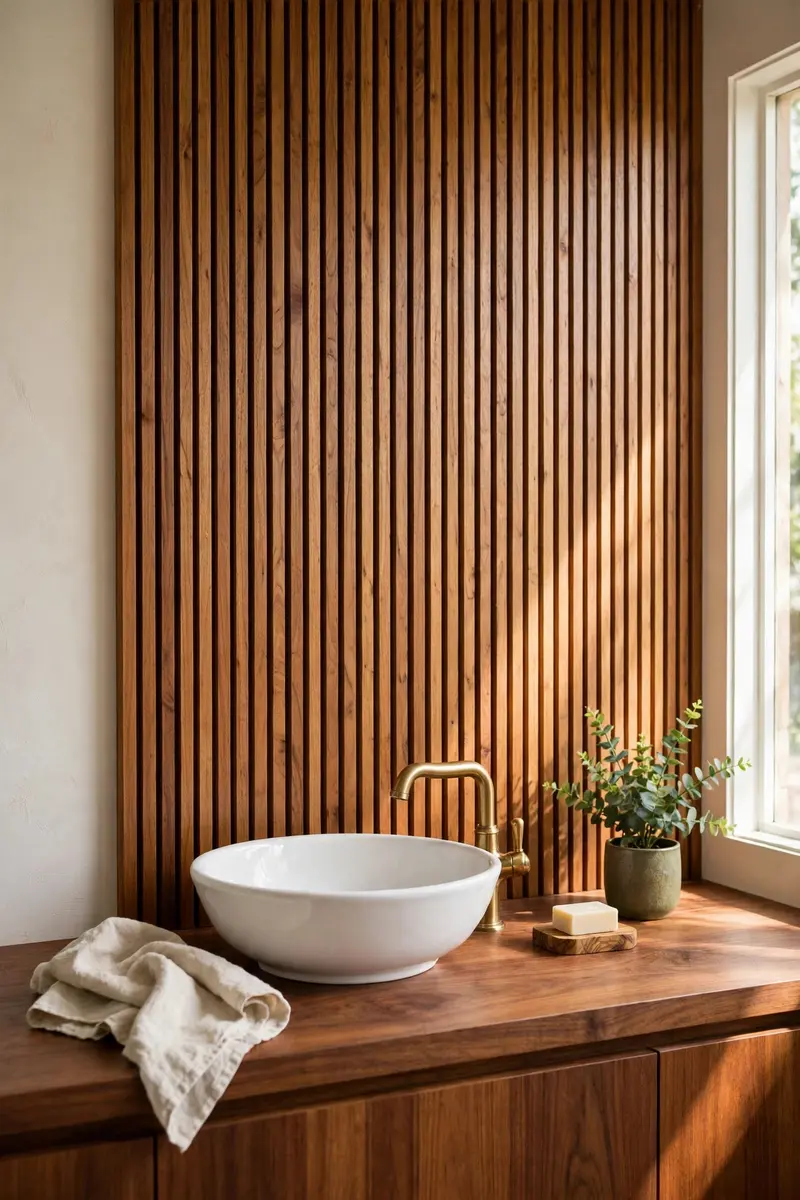
Slatted wood is pure mid-century texture. A wall of vertical teak slats behind the vanity or the tub adds warmth and architectural rhythm without a single patterned tile, and it photographs beautifully.
Materials and realistic cost: teak or teak-look slat panels run $6–$12 per square foot; a single accent wall costs roughly $200–$500 in materials.
Install the slats vertically with narrow, even gaps, and seal them well — bathrooms are humid, so use a water-resistant finish and leave a small gap at the bottom edge for airflow. Behind a vanity, slats pair perfectly with a round mirror and globe sconces. If real teak is too pricey, walnut-stained pine or wood-look PVC slats give the same lines for less.
Tip: Run the slats all the way to the ceiling, not just to mirror height — stopping short is what makes accent walls look unfinished.
Variation: Use the same slatted detail on the front of a plain vanity for a coordinated, custom-built feel.
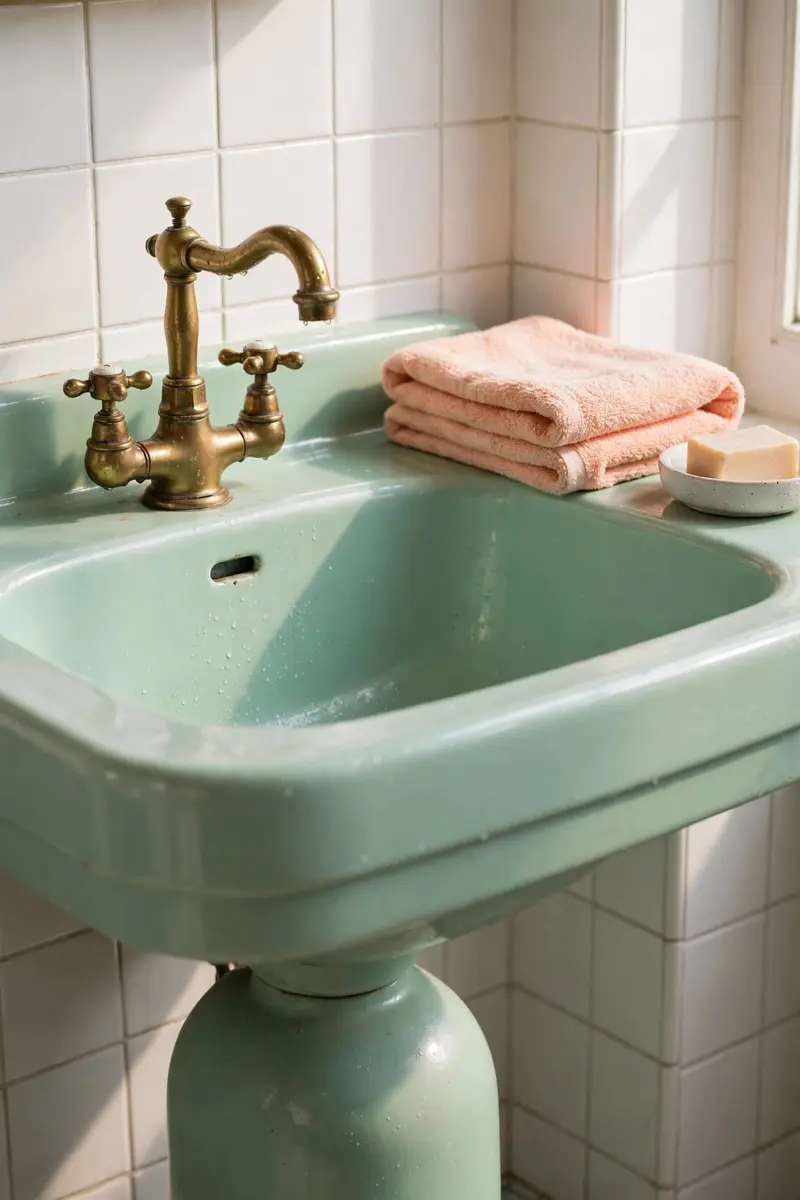
8. A Retro Pastel Sink
In the 1960s, bathrooms were not afraid of color — mint green, pale blue, and blush pink porcelain were everywhere. One pastel basin is an instant time machine, and it is far less commitment than a full colored suite.
Materials and realistic cost: a retro-style pastel vessel or pedestal sink costs $150–$400; a matching faucet in brass or chrome adds $80–$160.
Let the sink be the room’s one color pop: keep walls, floors, and towels neutral so the pastel reads as a deliberate accent rather than a leftover. Mint pairs beautifully with walnut and brass; blush pink loves warm white tile and gold hardware. If a new sink is too much, a pastel soap dish, tray, and towels can hint at the same era for under $50.
Tip: Before you buy a colored sink, check that replacement parts and matching toilets exist — or embrace a mixed suite, which is actually more authentic to how these bathrooms evolved.
Variation: Go bold in a powder room with a full pastel sink and toilet set, where the small space makes the retro color feel like a jewel box.
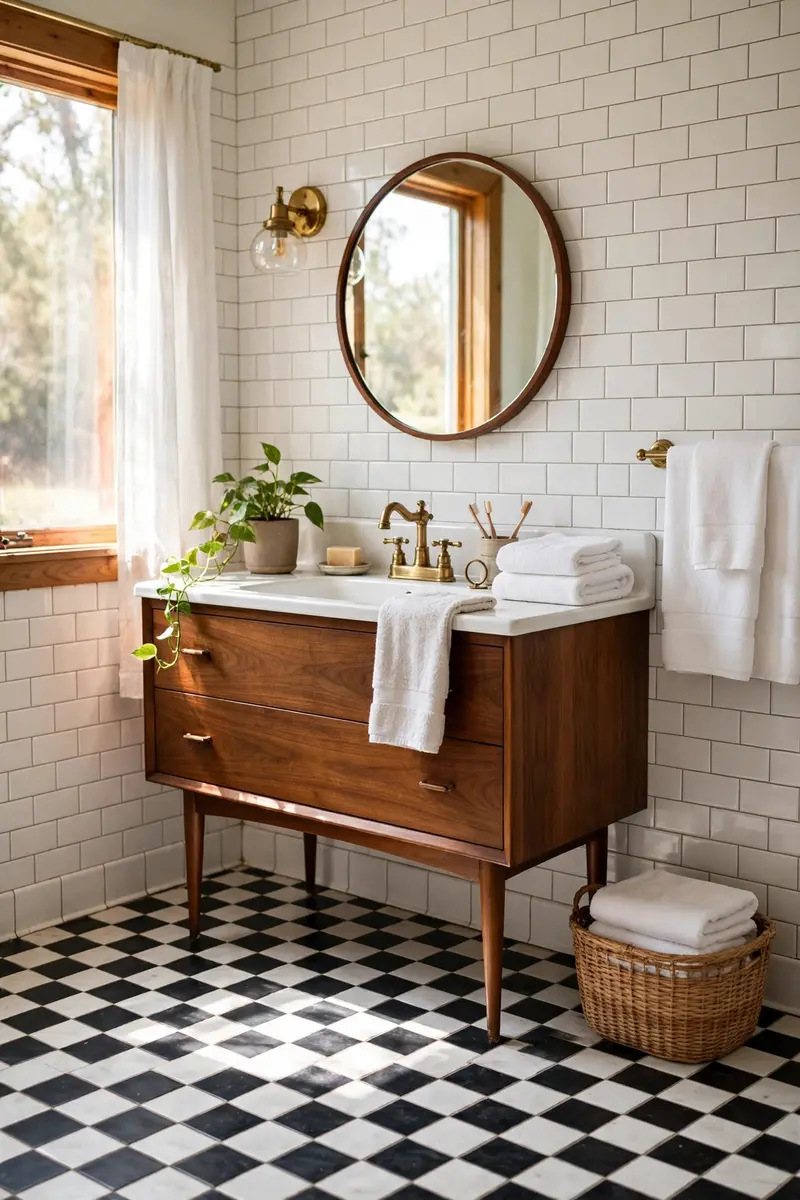
9. A Black-and-White Checkerboard Floor
Few floors are as timeless as checkerboard. It is graphic, it is clean, and it anchors a mid-century bathroom without competing with wood tones or brass. It also hides wear better than a plain floor, which is why it survived in so many original mid-century homes.
Materials and realistic cost: classic black-and-white porcelain checkerboard tile runs $5–$10 per square foot; a small bathroom floor costs roughly $200–$450 in materials.
Lay the pattern on the diagonal if you want the room to feel larger, or straight for a crisper, more graphic read. Keep grout lines thin and use a grout color that matches one of the tiles — grey grout is a forgiving middle ground. Pair it with a walnut vanity and white subway walls for the textbook mid-century combination.
Tip: Seal light grout before the first shower runs, and keep a grout pen on hand — checkerboard only looks sharp when the grid stays crisp.
Variation: Swap black for deep green or navy squares for a softer, more colorful take that still reads unmistakably retro.
10. Rattan and Woven Natural Accents
Rattan is mid-century’s softer side. A woven mirror frame, a rattan basket for towels, or a woven pendant shade adds organic texture that keeps all the clean lines from feeling stark.
Materials and realistic cost: a rattan-framed mirror runs $50–$140; woven baskets cost $15–$40 each; a rattan pendant shade is $40–$100.
Use rattan in two or three places at most — a mirror, a basket, and maybe a stool — so it feels layered rather than themed. Natural woven textures pair especially well with warm wood vanities and leafy plants, and they are one of the easiest ways to warm up a bathroom that leans too white or too grey.
Tip: Keep rattan away from constant direct splashes; a basket on a shelf or stool beside the tub lasts years longer than one sitting on the shower floor.
Variation: If rattan feels too boho for you, swap it for cane webbing on a cabinet door or a woven seagrass tray — same warmth, slightly more tailored.

11. One Bold Retro Accent Wall
Mid-century color palettes were brave: burnt orange, mustard, teal, and avocado green all had their moment. Painting a single wall in one of these shades is the highest-impact, lowest-cost move on this list.
Materials and realistic cost: a gallon of quality bathroom paint costs $40–$70, and one accent wall rarely needs more than that plus a $20 brush-and-roller kit.
Choose the wall behind the vanity or the tub — the one you see first when you walk in. Burnt orange glows against walnut and brass; deep teal makes white tile and chrome pop; sage or avocado green feels calm with natural wood. Use a satin or semi-gloss bathroom formula so the wall wipes clean, and test a large swatch for a full day before committing, since bathroom light changes color dramatically.
Tip: Paint the accent wall last, after mirrors and lighting are up — the fixtures change how the color reads, and you want to judge the finished combination.
Variation: Not ready for paint? A bold shower curtain or a set of burnt-orange towels gives you the same color story with zero commitment.

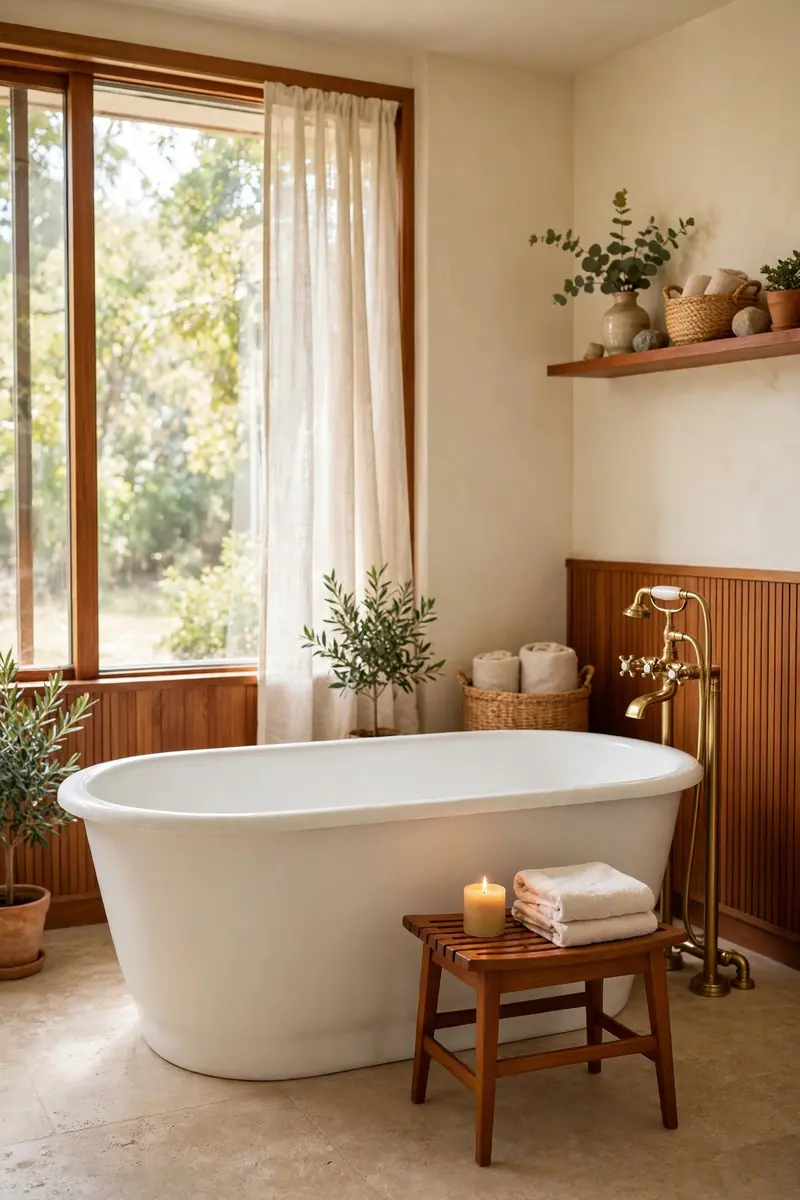
12. A Freestanding Oval Tub with a Wood Stool
A freestanding oval tub is the sculptural centerpiece a mid-century bathroom deserves. Its soft curves balance all the straight lines of tile and vanity, and a small teak stool beside it is the period-perfect finishing touch.
Materials and realistic cost: a freestanding acrylic oval tub runs $600–$1,500; a teak bath stool costs $40–$120. Plumbing relocation, if needed, adds $300–$800.
Place the tub where it can breathe — even a few inches of space on each side makes it read as a feature rather than a fixture squeezed into an alcove. A floor-mounted tub filler in brass or matte black completes the look, and the teak stool holds a candle, a book, or your towel within reach. If a new tub is out of reach, a teak stool and a curved shower curtain can suggest the same softness for under $150.
Tip: Measure your doorways before ordering a freestanding tub — many returns happen because a beautiful tub cannot make the turn into the bathroom.
Variation: A clawfoot tub in a soft white or pastel finish leans vintage rather than mid-century, but styled with teak and brass it bridges both eras beautifully.
13. Open Walnut Shelving for Display and Storage
Mid-century bathrooms were practical, and open shelving is practical done beautifully. A couple of walnut shelves above the toilet or beside the vanity keep daily essentials within reach while giving you a place to style rolled towels, a plant, and a ceramic jar or two.
Materials and realistic cost: two walnut floating shelves with brackets run $60–$180; styling props like baskets and jars add $30–$80.
Mount shelves at a height you can actually reach without a step stool — about 60–72 inches for the top shelf works for most people — and keep them edited: rolled white towels, one plant, and one or two decorative objects per shelf. Over-stuffed shelves are the fastest way to lose the clean mid-century calm. For more budget-friendly storage ideas, see our budget small bathroom ideas.
Tip: Anchor shelves into studs, not just drywall — wet towels and ceramic jars are heavier than they look, and a falling shelf ruins the whole look.
Variation: Try a single long shelf spanning the full width above the vanity mirror line for a hotel-style ledge that doubles as a display.

14. Atomic Art and Accessories: The No-Renovation Refresh
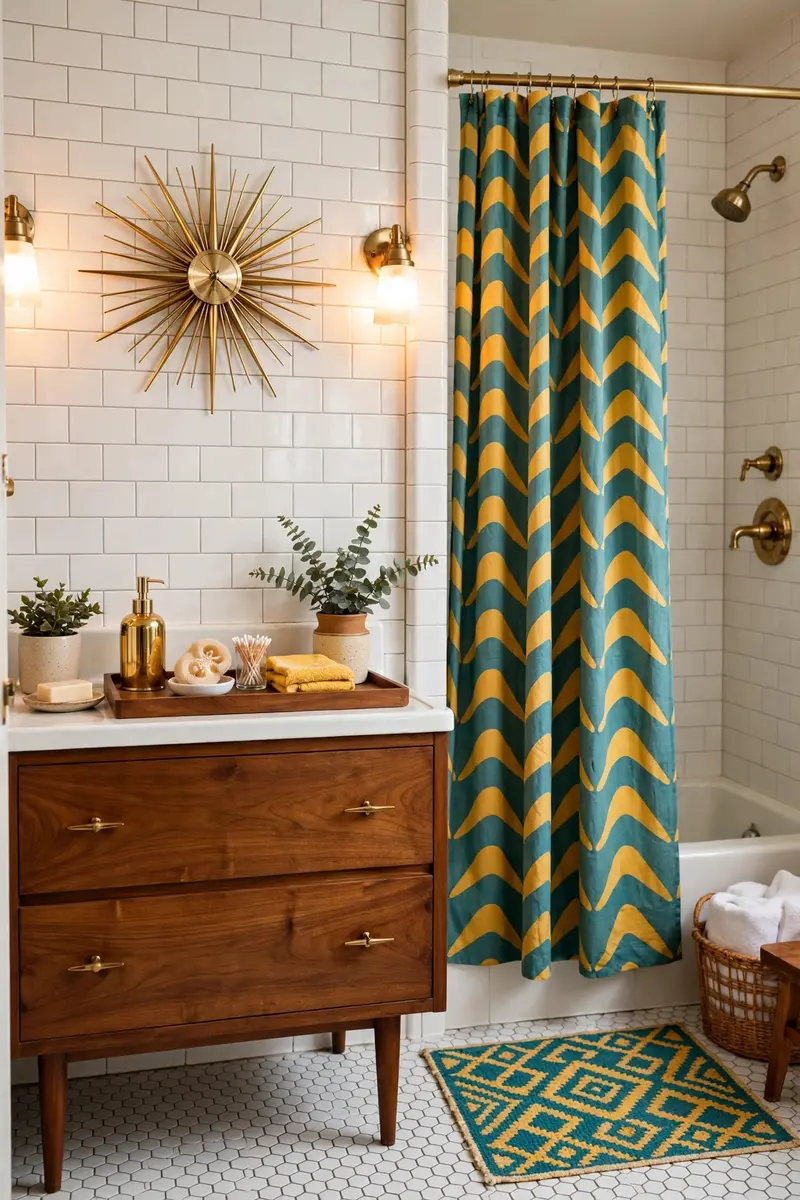
If you rent, or you simply are not ready to renovate, this is your idea — and it may be the most fun. Starburst clocks, boomerang-pattern hand towels, atomic-print shower curtains, and abstract art bring unmistakable mid-century energy with zero tools required.
Materials and realistic cost: a starburst wall clock runs $30–$80; a set of retro hand towels costs $20–$40; an atomic-print shower curtain is $25–$50; a framed abstract print is $30–$100.
Pick one hero accessory — the clock or the shower curtain — and let the rest of the room stay quiet, so the retro piece reads as a statement instead of clutter. Brass soap dispensers, a ceramic tray, and a small potted plant finish the look. This is also the perfect way to test whether you love mid-century style before committing to tile or a vanity. As the experts at The Spruce show in their roundup of midcentury bathrooms, even small accessories can carry the whole era, and Better Homes & Gardens makes the same point: start with lighting and accessories if a remodel is not on the cards.
Tip: Stick to a 70/30 rule — about 70 percent calm, neutral surfaces and 30 percent retro pattern and color — so the room feels curated, never chaotic.
Variation: Swap the starburst for a sunburst mirror, or the atomic print for a palm-leaf print, for a softer Palm Springs version of the same refresh.
Frequently Asked Questions
How do I style a mid century bathroom without remodeling?
Start with the surface layer: swap in a round mirror, globe sconces or a starburst clock, a patterned shower curtain, and brass hardware. Paint one accent wall if your lease allows it, and add walnut-toned accessories like a tray or stool. These changes alone can carry the whole mid century bathroom look for a few hundred dollars.
What colors go with mid century modern design?
Begin with warm neutrals — cream, warm white, soft grey, and natural wood tones — then add one or two retro accents. Avocado or sage green, mustard, burnt orange, and teal are the classics, while soft pastels like mint, blush pink, and butter yellow give a lighter 1950s feel. Keep the palette to three or four colors total.
What is the difference between retro and mid century modern?
Mid century modern refers to the clean lines, organic shapes, and functional design of roughly the 1940s–1960s, using wood, brass, and glass. Retro is broader nostalgia for the 1950s–1970s, often more colorful and playful, with chrome, plastic, and bold kitsch. The two overlap happily in a bathroom, but mid-century is the more restrained, design-led of the pair.
Can a mid century bathroom work in a small space?
Absolutely — mid-century design actually thrives in small rooms. Floating vanities show more floor, round mirrors soften tight corners, light walls reflect daylight, and one bold pattern (a checkerboard floor or a single tile wall) adds personality without crowding. Keep storage open and edited so the room stays airy.
How do I add mid century style on a budget?
Focus on the three highest-impact swaps: lighting, mirror, and hardware. Globe sconces, a round brass mirror, and brass drawer pulls can transform a bathroom for under $300 total. Add a bold shower curtain and rolled towels in a retro accent color, and save the vanity and tile for a later phase.
Conclusion
Mid century bathroom ideas prove that great design does not have to be complicated — warm wood, honest materials, one good pattern, and a touch of retro color are all it takes. Start with the idea that excites you most, whether that is a walnut vanity, a terrazzo floor, or simply a starburst clock, and build from there. Your bathroom will feel calmer, warmer, and more personal for it.
If you found a favorite here, save this post to Pinterest so you can find it again when you are ready to start — and share it with anyone planning a bathroom refresh. Happy decorating!


Leave a Reply