
If shoes pile up by your front door the moment you walk in, you are not messy, you just do not have a system yet. These entryway shoe storage ideas give every pair a real home, from slim cabinets that hide everything to open benches that make mornings faster.
Below you will find 30 ideas for every space, budget, and household, each with honest costs, simple steps, and a practical tip. Start with the one that fits your entryway today, then borrow tricks from the rest. For a bigger drop zone, see our mudroom laundry room combo ideas and our cozy home decor ideas.
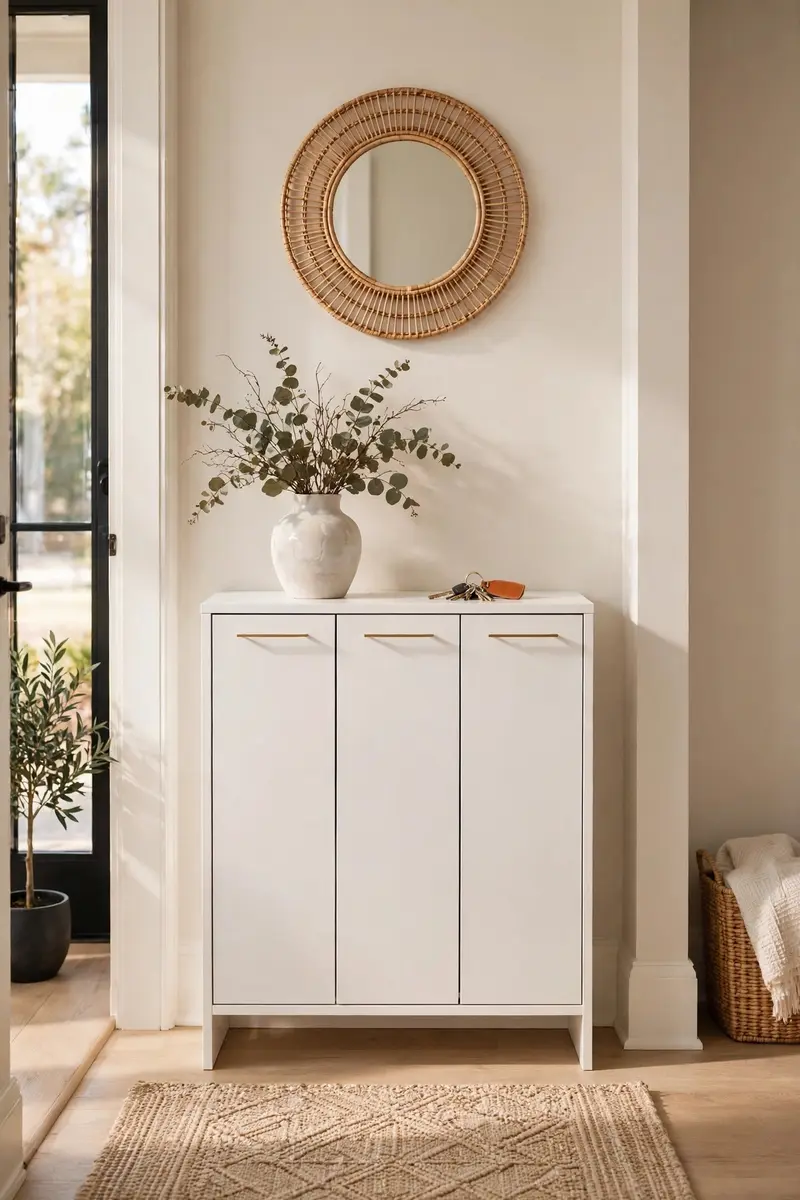
1. Slim Tilt-Out Shoe Cabinet
A slim tilt-out cabinet is the small-hallway hero, and it is one of the most popular entryway shoe storage ideas for a reason. It sits just inches from the wall, yet each tilting compartment hides two or three pairs. Closed doors mean guests see furniture, not footwear, and the top doubles as a key-and-mail landing spot.
You will need:
- A 2- or 3-tier tilt-out shoe cabinet, $60-$180
- Wall anchors, $5-$10
- A small tray for keys, $8-$15
Measure your wall and your tallest shoes first, since boots may not fit shallow compartments. Anchor the cabinet to a stud so it cannot tip when a compartment opens. Place everyday pairs in the top compartment and rotate seasonal pairs to the bottom.
Tip: Leave one compartment half-empty on purpose, so wet or muddy pairs always have a place to dry.
Stack two slim cabinets side by side for a built-in look, or paint one to match your trim.
2. Cubby Bench with Woven Baskets
A cubby bench gives everyone a seat and a slot, and it is one of the friendliest entryway shoe storage ideas for families. Open cubbies hold baskets, and each basket holds one person’s shoes. Sitting down to lace up is easier, and the morning shoe hunt mostly disappears.
You will need:
- A cubby bench, $80-$200
- Woven baskets, $10-$25 each
- Labels or tags, $3-$8
Choose a bench depth of about 14 inches so it never blocks the walkway. Assign one basket per person and label it clearly, especially for kids. Keep the two most-worn pairs in each basket and move the rest to a closet.
Tip: Line each basket with a washable liner, so mud and sand shake out in seconds.
Swap baskets seasonally: open cubbies in summer for sandals, lidded baskets in winter for boots.

3. Lift-Top Storage Bench
A lift-top bench hides everything in one big compartment, and it is one of the simplest entryway shoe storage ideas for a tidy first impression. Lift the seat and toss shoes in; close it and the entryway looks like a sitting room again. It is forgiving on busy mornings when sorting feels impossible.
You will need:
- A lift-top storage bench, $70-$160
- Small bins or dividers, $10-$20
Place the bench where you naturally stop to take shoes off, not across the room. Add two small bins inside so pairs do not become one tangled pile. Keep a boot tray beside it for wet days, so damp shoes never go straight into the bench.
Tip: Put a cedar sachet inside the bench to keep stored shoes smelling fresh.
Choose a bench with a washable cushion cover if you have kids or pets tracking in dirt.

4. Floating Console with Hidden Shoe Drawers
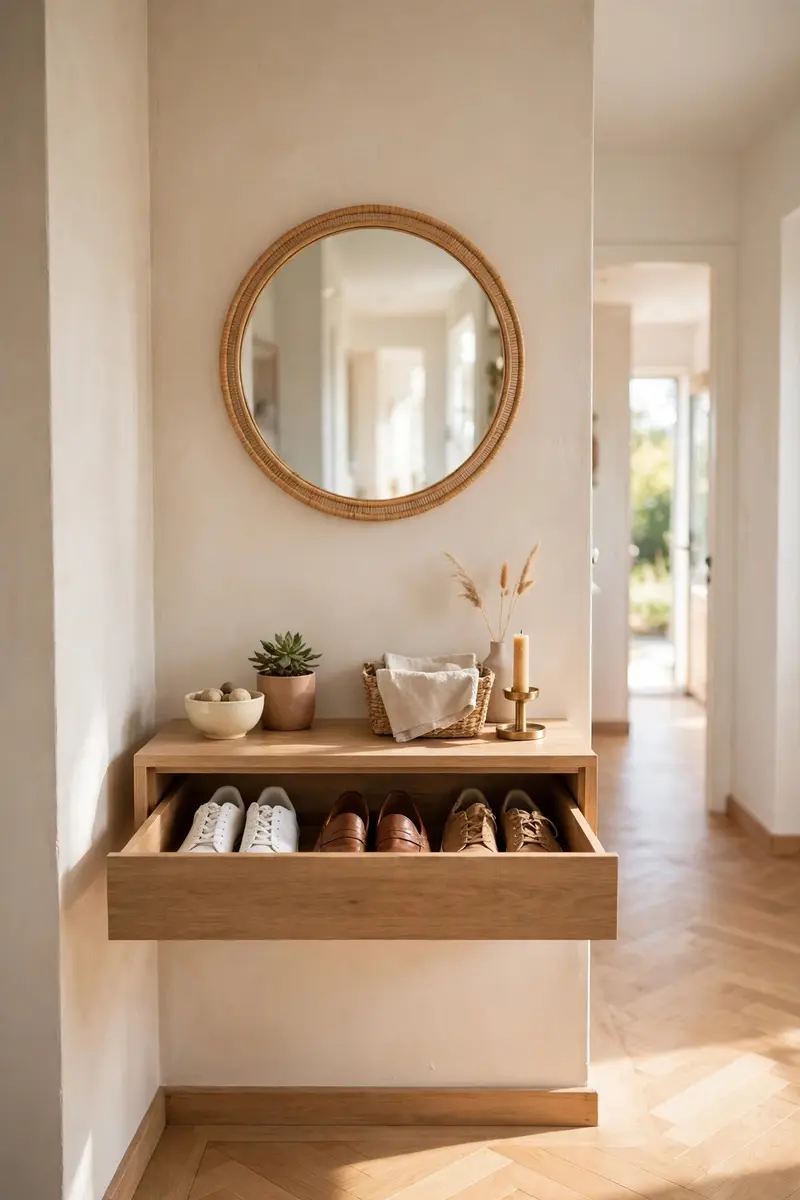
A floating console frees up floor space and hides shoes in drawers below, and it is one of the sleekest entryway shoe storage ideas for narrow apartments. Because it hangs on the wall, the floor underneath stays visible, which makes a tight entry feel larger. The top still holds keys, sunglasses, and a small plant.
You will need:
- A wall-mounted console with drawers, $90-$220
- Wall anchors rated for the load, $8-$15
Mount the console at a comfortable height, about 30 inches, into studs. Check that drawers clear the baseboard when they open. Keep only daily pairs in the drawers and store the rest elsewhere, so the console never overflows.
Tip: Add felt pads inside the drawers to stop shoes sliding and scuffing the drawer bottom.
Pair the console with a mirror above it to bounce light and double the sense of space.
5. Wall-Mounted Slanted Shoe Racks
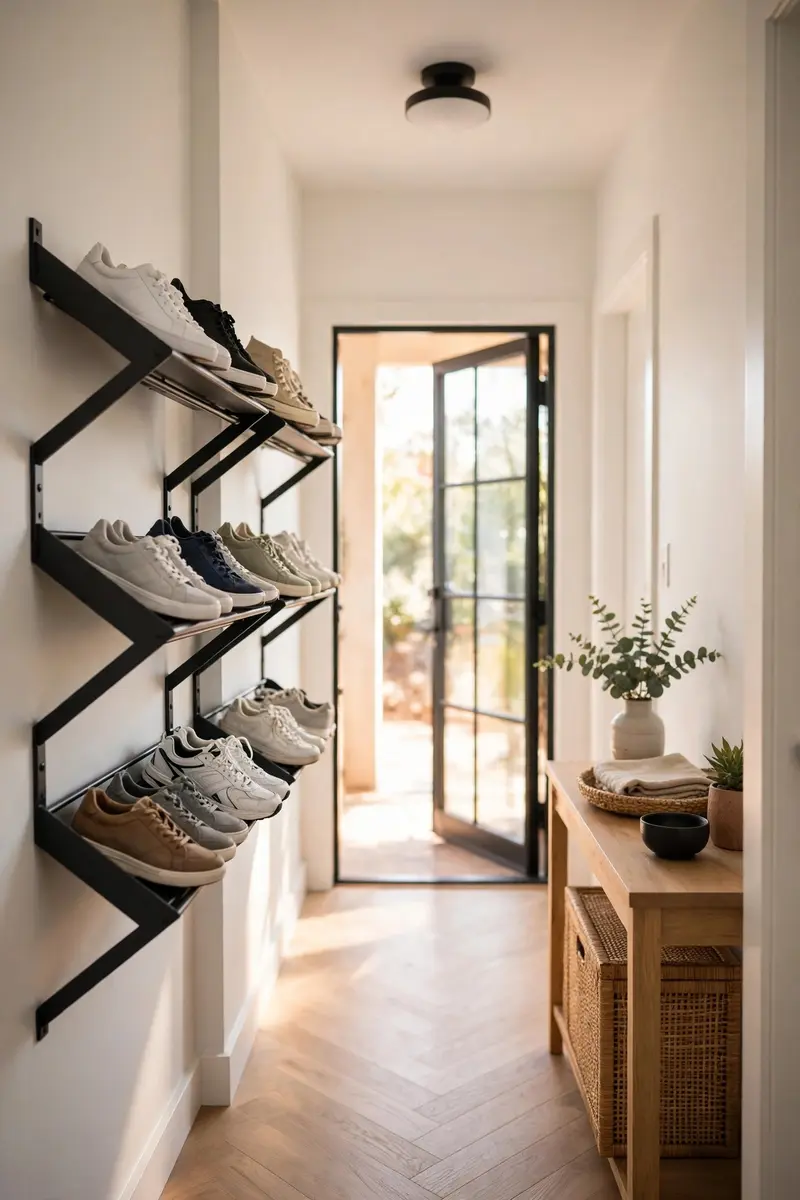
Slanted wall racks turn a blank hallway wall into shoe storage, and they are one of the smartest entryway shoe storage ideas for homes with zero floor space to spare. Shoes angle toe-down on metal rails, so they read like a neat display instead of clutter. A row of three racks can hold a whole family’s daily pairs.
You will need:
- Wall-mounted slanted shoe racks, $15-$35 each
- Wall anchors and screws, $5-$10
Mount racks at staggered heights, leaving room for tall sneakers below each rail. Use a level so the row looks intentional, not improvised. Keep heavier boots off these racks, since rails suit lighter everyday shoes best.
Tip: Mount the lowest rack high enough that a robot vacuum or mop can pass underneath.
Paint metal racks to match your wall color for a nearly invisible look, or black for a modern accent.
6. Over-the-Door Pocket Organizer
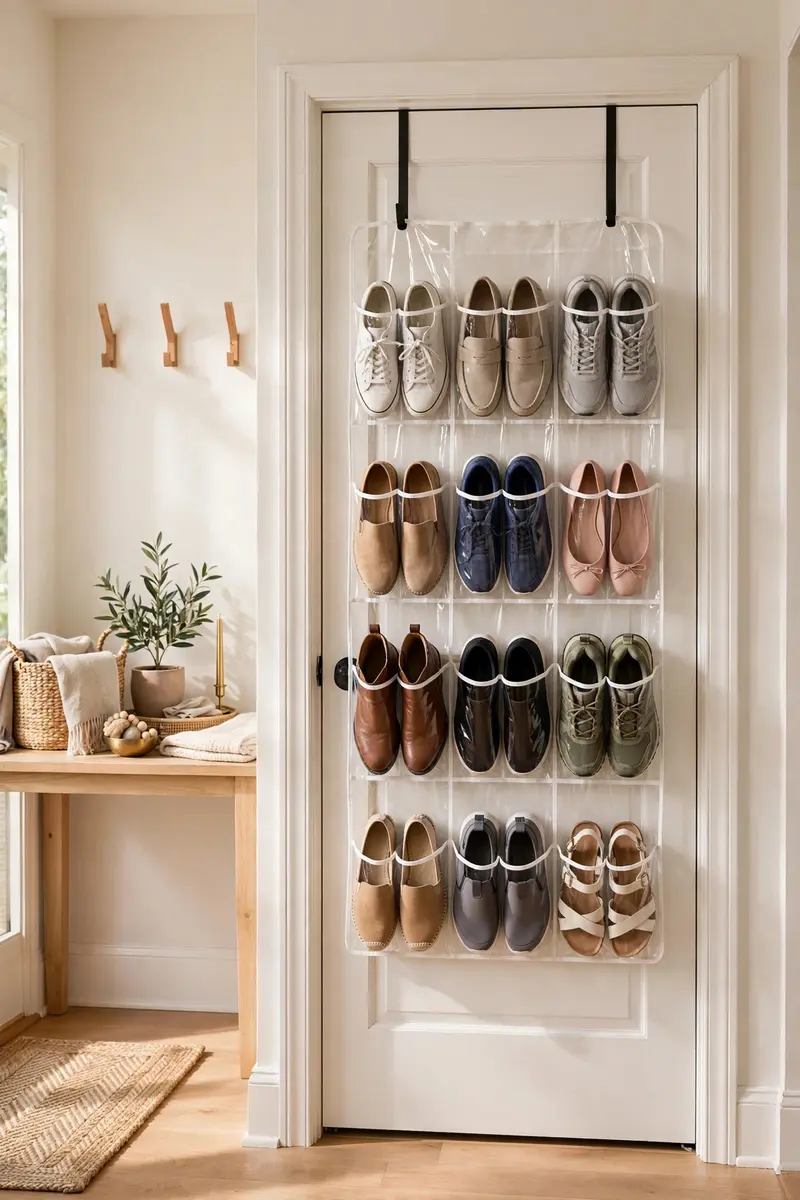
An over-the-door organizer is the classic renter fix, and it is one of the cheapest entryway shoe storage ideas that actually works. Clear pockets hold one pair each, and the whole thing hangs without a single screw. It is perfect for the inside of a coat-closet door right by the entrance.
You will need:
- An over-the-door shoe organizer, $10-$25
- Felt pads for the door, $3-$5
Hang it on the inside of a closet door so shoes stay hidden when the door closes. Put one pair per pocket and keep heavier shoes in the bottom rows. Add felt pads behind the hooks to protect the door’s finish from scratches.
Tip: Use the top pockets for small items like gloves and dog-waste bags, not shoes you grab daily.
Cut a tall organizer down for a short door, and use the leftover pockets inside a bedroom closet.
7. Stackable Clear Shoe Boxes
Clear shoe boxes stack into a tidy tower, and they are one of the most practical entryway shoe storage ideas for collectors and sneaker lovers. You can see every pair without opening a box, and the stack grows or shrinks with your collection. A drop-front door means you never unstack to reach the bottom pair.
You will need:
- Stackable drop-front shoe boxes, $25-$50 for a set of 6
- Labels, optional, $3-$6
Stack boxes on a low console or inside a closet near the door, no more than five high for stability. Sort by color or season so you find pairs fast. Keep the boxes you open daily at arm height and the rest higher up.
Tip: Choose boxes with small vents, so shoes air out instead of trapping odor inside.
Use black boxes for a uniform, high-end look, or clear ones if you like seeing the collection.

8. Woven Baskets Under a Console Table
A pair of woven baskets under a console is instant shoe storage with zero assembly, and it is one of the easiest entryway shoe storage ideas to start today. Shoes go in the basket, the basket slides under the table, and the entryway looks styled instead of stuffed. It suits farmhouse, coastal, and boho homes beautifully.
You will need:
- Two large woven baskets, $15-$35 each
- A console table, if you do not own one, $60-$150
Measure the space under your console first, then buy baskets that leave a finger-width of clearance. Give each basket a job: one for everyday shoes, one for guests or kids. Shake baskets out weekly so dirt never builds up inside.
Tip: Choose baskets with handles, so you can carry the whole basket to the closet for a seasonal swap.
Line baskets with a washable cotton liner for muddy-season use, and remove it in summer.

9. Boot Tray and Drip Mat Station
A boot tray is not glamorous, but it saves your floors, and it is one of the most sensible entryway shoe storage ideas for rainy and snowy climates. Wet shoes sit on a lipped tray, water stays off the wood, and the tray wipes clean in seconds. Pair it with a small bench and you have a complete wet-weather station.
You will need:
- A lipped boot tray, $15-$35
- A small bench or stool, $40-$90
- A shoe brush, $5-$10
Place the tray right inside the door, where wet shoes naturally land. Choose a tray at least as wide as two pairs side by side. Empty and wipe it weekly in wet seasons, and keep a brush nearby so mud comes off before shoes go inside.
Tip: Put a raised grid insert in the tray so shoes dry faster instead of sitting in puddles.
Use a galvanized metal tray for a rustic look, or a sleek black rubber tray for modern entries.

10. Under-Stair Pull-Out Shoe Drawers
The space under your stairs is wasted square footage, and pull-out drawers turn it into hidden shoe storage. It is one of the cleverest entryway shoe storage ideas for homes with a staircase near the door. Drawers roll out, shoes slide in, and the staircase looks untouched when they close.
You will need:
- Pull-out drawer units or a carpenter build, $150-$500
- Drawer dividers, $10-$20
Measure the under-stair triangle carefully, since depth changes along the slope. Use full-extension drawer slides so the back of each drawer stays reachable. Keep daily pairs in the tallest, easiest drawer and seasonal pairs deeper under the slope.
Tip: Label drawer fronts discreetly, so guests never have to guess which drawer is theirs.
Add a small bench at the stair base to complete the drop zone without extra furniture.

11. Hall Tree with Bench and Hooks
A hall tree combines bench, hooks, and shoe storage in one piece, and it is one of the most complete entryway shoe storage ideas for busy households. Coats hang up top, shoes live below, and bags have a hook of their own. One piece of furniture can replace three separate purchases.
You will need:
- A hall tree unit, $120-$350
- Baskets for the lower shelf, $10-$25 each
Measure ceiling height before buying, since hall trees run tall. Anchor the unit to the wall so it cannot tip when kids pull on coats. Assign one hook and one shoe slot per person, and keep the bench clear for sitting, not stacking.
Tip: Hang a small bag hook at kid height, so children can hang their own backpacks without help.
Choose a hall tree with a mirror panel if your entry lacks natural light.

12. Rolling Shoe Cart by the Door
A rolling cart brings shoe storage exactly where you need it, and it is one of the most flexible entryway shoe storage ideas for renters. Roll it out for a party, tuck it beside a console on normal days, and wheel it to the closet for a seasonal swap. Slim carts fit gaps as narrow as a few inches.
You will need:
- A rolling shoe cart, $30-$70
- A small mat underneath, $8-$15
Pick a cart with locking casters so it stays put once positioned. Keep the cart to two or three tiers, since taller carts tip when loaded with boots. Roll it out weekly to sweep underneath, where dust collects fast.
Tip: Lock the casters on the door side and leave the wall side free, so the cart pulls out easily.
Use a metal cart for an industrial look, or a bamboo one for a warmer, natural entry.

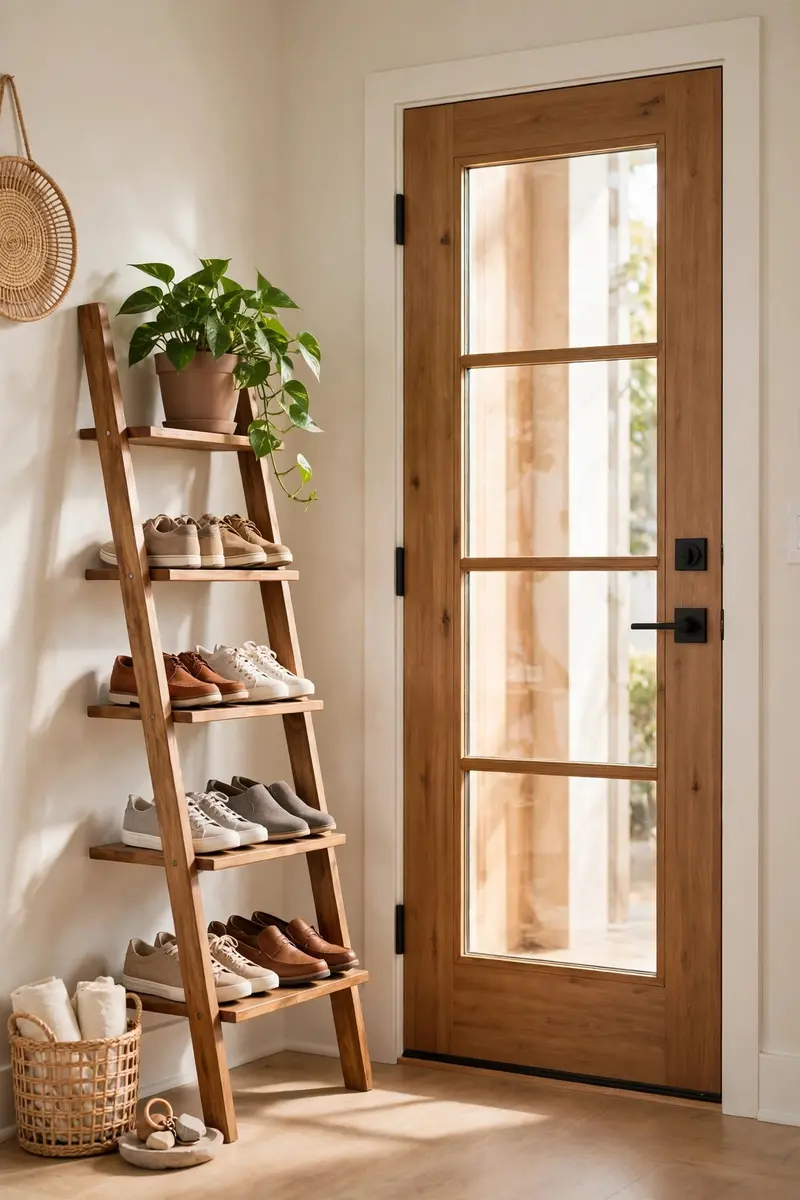
13. Leaning Ladder Shelf for Shoes
A leaning ladder shelf holds shoes on open tiers while looking like decor, and it is one of the prettiest entryway shoe storage ideas for small spaces. Deeper bottom rungs hold boots, shallow top rungs hold flats and sneakers. It leans against the wall, so there is nothing to mount and no floor space lost to a cabinet.
You will need:
- A leaning ladder shelf, $40-$100
- Small baskets for the top rung, $10-$20
Place the shelf flat against the wall with its feet on a non-slip pad. Put the heaviest shoes on the bottom rung to keep it stable. Keep the top rung for decor or a plant, so the shelf reads as furniture, not just storage.
Tip: Secure the top of the ladder to the wall with a small bracket if you have small children.
Paint a plain ladder shelf your wall color for a built-in feel, or leave wood natural for warmth.
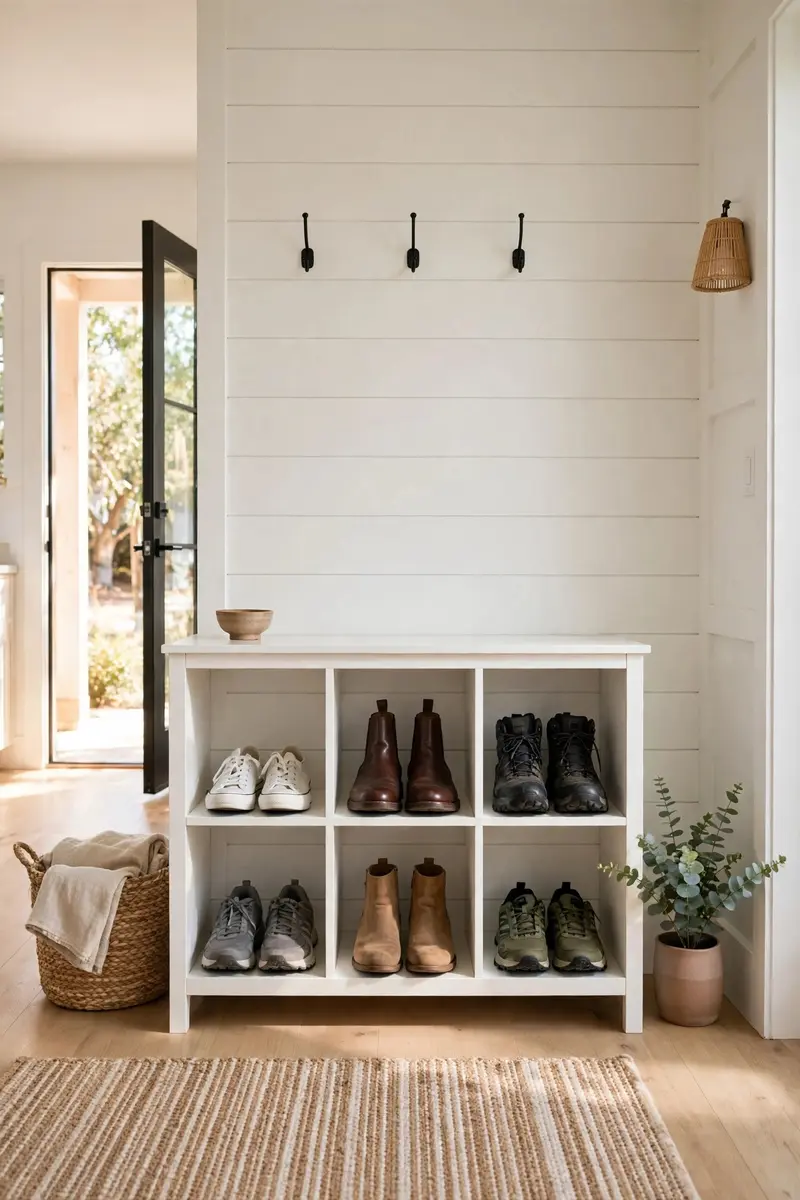
14. Repurposed Bookshelf Shoe Cubbies
A low bookshelf makes excellent shoe cubbies, and it is one of the most budget-friendly entryway shoe storage ideas around. Turn it on its side or keep it upright, and each shelf becomes a row for shoes. Thrifted bookshelves cost little, and a coat of paint makes them look made for the entry.
You will need:
- A low bookshelf, $20-$60 thrifted or $50-$120 new
- Paint, optional, $10-$20
Measure your largest shoes and remove a shelf if boots need more height. Anchor the bookshelf to the wall, especially if it stands tall. Sort shoes by owner across the shelves, and keep a basket on one shelf for slippers and small items.
Tip: Add adhesive felt to shelf edges to stop shoes scuffing painted wood.
Lay the bookshelf sideways under a window for a long, low shoe bench with a cushion on top.
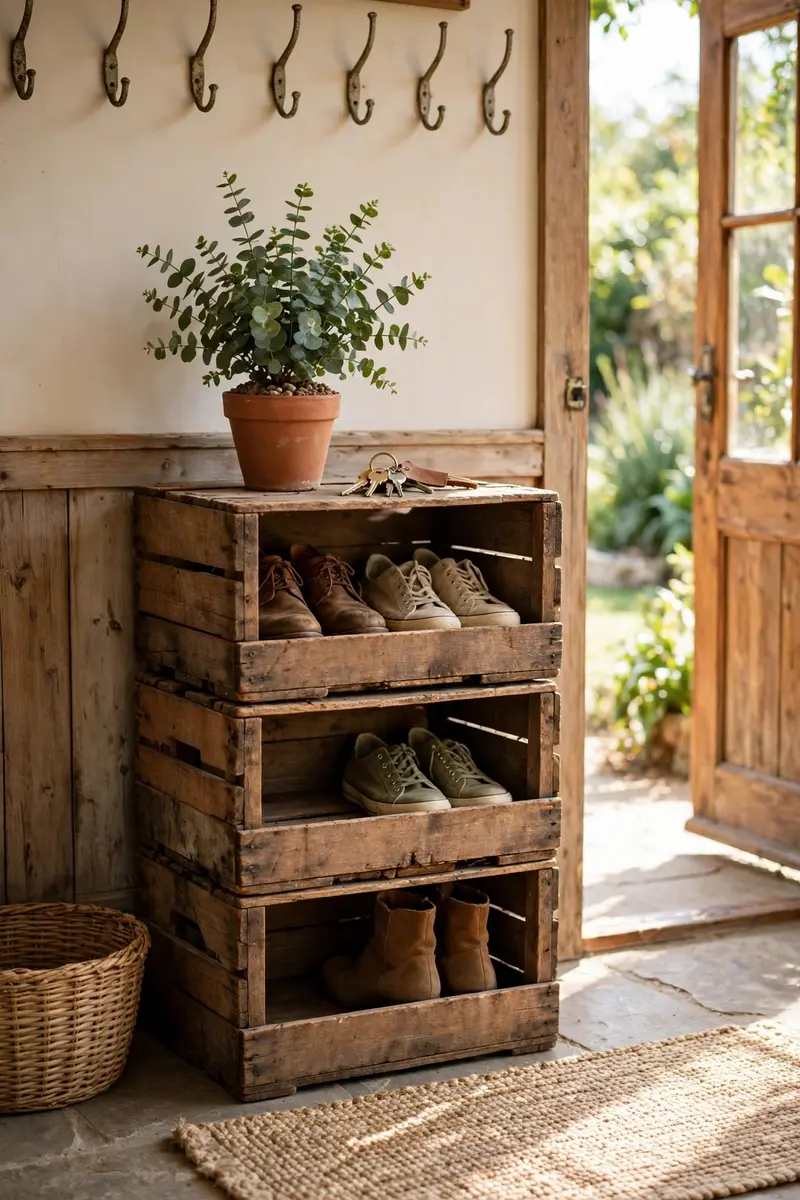
15. Stacked Vintage Crates
Stacked wooden crates make rustic, modular shoe storage, and they are one of the most charming entryway shoe storage ideas for farmhouse and cottage homes. Crates stack, turn, and rearrange as your collection changes, and each crate holds two or three pairs. They cost little and look intentional with a plant on top.
You will need:
- Wooden crates, $8-$20 each
- Sandpaper and wood stain, optional, $10-$15
Sand rough edges so crates never snag socks or scratch shoes. Stack crates no more than three high without wall support, and anchor tall stacks. Line crate bottoms with a thin mat to catch dirt, and rotate crates seasonally as your shoes change.
Tip: Stencil a small number or initial on each crate, so family members know which crate is theirs.
Mix crate finishes for a collected look, or paint them all one color for a cleaner, modern feel.
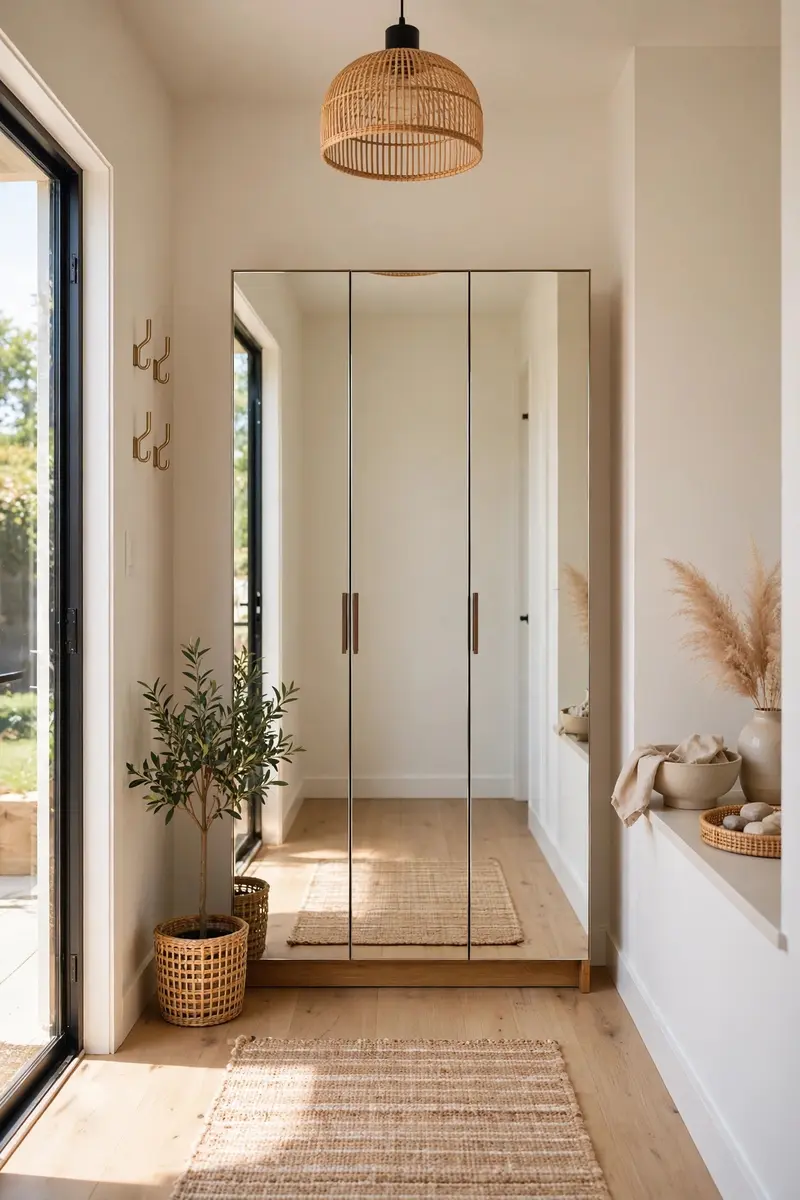
16. Mirror-Front Shoe Cabinet
A mirror-front cabinet hides shoes and checks your outfit at the same time, and it is one of the most space-smart entryway shoe storage ideas for tiny entries. The mirror bounces light, making a narrow hall feel wider, while the cabinet behind it holds a dozen pairs. It is two entryway essentials in one footprint.
You will need:
- A mirror-front shoe cabinet, $90-$220
- Wall anchors, $8-$15
Mount the cabinet at a height where the mirror is useful, usually with its center near eye level. Anchor it firmly, since mirror cabinets are heavier than plain ones. Keep daily pairs inside and store tall boots elsewhere, since shallow cabinets suit flats and sneakers best.
Tip: Clean the mirror weekly, since entryway mirrors collect fingerprints fast.
Choose a frameless mirror cabinet for a modern hall, or a wood-framed one for a classic entry.
17. Slim Two-Tier Hallway Rack
A slim two-tier rack is the simplest fix for a narrow hallway, and it is one of the most affordable entryway shoe storage ideas you can buy today. It holds everyday pairs in a footprint barely wider than the shoes themselves, and it slides against any wall. For under $30, the shoe pile by the door can be gone tonight.
You will need:
- A slim two-tier shoe rack, $15-$35
- A small rug underneath, $10-$20
Measure your hallway’s walking width first and keep at least 30 inches clear for passing. Place the rack on the wall opposite the door swing so it never blocks entry. Keep only daily pairs on it, and move the rest to a closet, or the rack will overflow.
Tip: Put the pair you wear tomorrow on the top tier tonight, so mornings start one step ahead.
Choose a bamboo rack for warmth, or a black metal rack that disappears against dark floors.

18. Full Mudroom-Style Wall Unit
A mudroom-style wall unit turns one entry wall into a complete drop zone, and it is one of the most hardworking entryway shoe storage ideas for large families. Bench, cubbies, hooks, and a top shelf each have a job, and shoes finally have a real home instead of a pile. It is the closest thing to a built-in mudroom without renovating.
You will need:
- A modular wall unit, $250-$700
- Baskets and hooks, $30-$60
Plan the unit around your wall width, leaving walking space clear in front of the bench. Anchor every section to studs, since a loaded unit is heavy. Give each family member one cubby, one hook, and one basket, and keep the top shelf for out-of-season gear.
Tip: Add a boot tray under the bench section, so muddy shoes never stain the cubby floor.
Build the unit in stages if budget is tight: bench first, then cubbies, then hooks and shelves.

19. Pull-Out Drawers Under a Bench
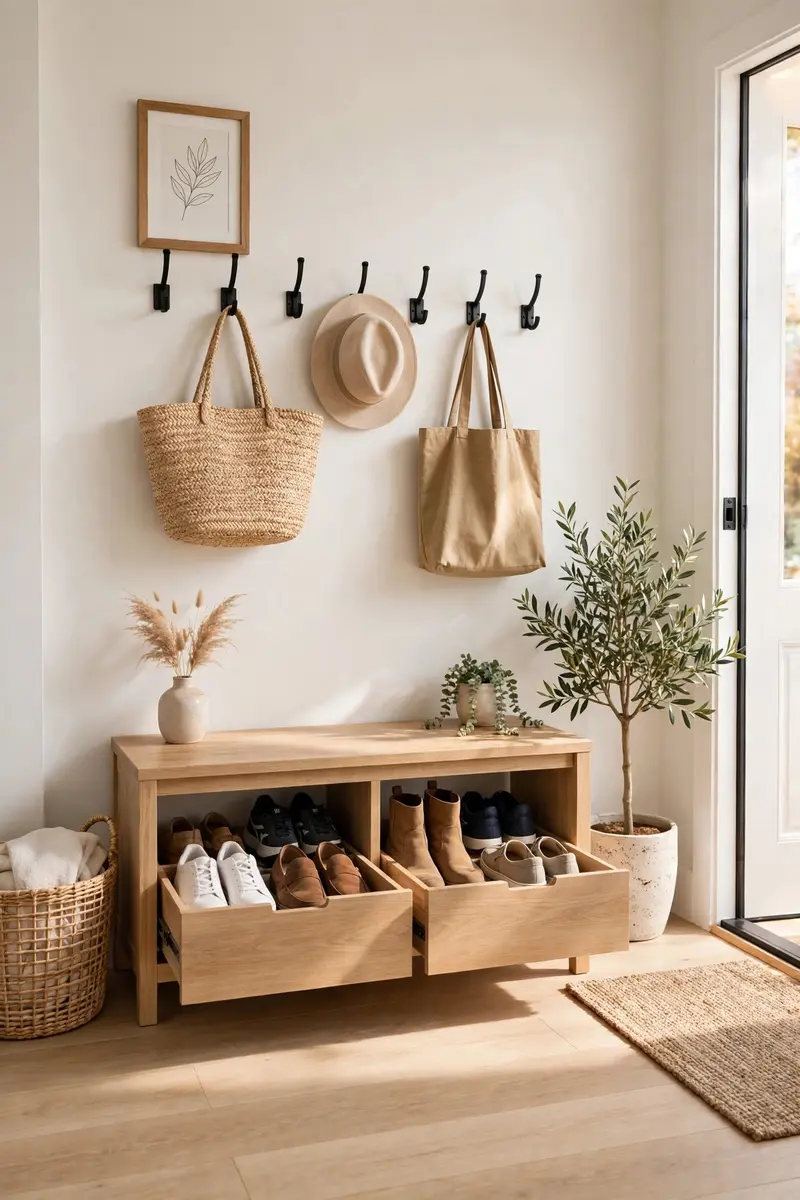
Pull-out drawers under a bench keep shoes hidden but reachable, and they are one of the neatest entryway shoe storage ideas for people who dislike open cubbies. Slide a drawer open, drop shoes in, slide it shut, and the bench looks like plain seating. Deep drawers even fit boots lying on their sides.
You will need:
- A bench with pull-out drawers, $120-$280
- Drawer liners, $5-$10
Check drawer depth against your longest shoes before buying, since shallow drawers frustrate. Keep one drawer per person or per shoe type, and label the drawer fronts inside, not outside, for a clean look. Wipe drawer bottoms monthly to keep dust down.
Tip: Store shoes toe-first in drawers, so you can grab a pair without pulling the drawer fully open.
Add soft-close slides if you buy custom, so drawers never slam in a quiet house.
20. Storage Ottoman for Shoes
A storage ottoman doubles as a seat and a shoe box, and it is one of the most discreet entryway shoe storage ideas for apartments. Guests see a pouf, not a shoe rack, and you get a soft place to sit while lacing up. It works beautifully in entries too small for a bench.
You will need:
- A storage ottoman, $40-$100
- A small tray inside, $5-$10
Choose an ottoman wide enough for two pairs side by side, but small enough to tuck against the wall. Keep only soft, clean pairs inside, since heavy boots wear out fabric ottomans fast. Place a small tray inside to catch dirt from everyday shoes.
Tip: Pick a wipeable faux-leather ottoman if your entry sees rain, snow, or muddy paws.
Use a round ottoman in a square entry to soften corners, or a rectangular one under a console.

21. Corner Shoe Tower
A corner tower uses the awkward corner most entries waste, and it is one of the cleverest entryway shoe storage ideas for L-shaped halls. Tall, narrow shelves turn a dead corner into storage for ten or more pairs. Because it sits in the corner, it never blocks the main walkway.
You will need:
- A corner shoe tower, $50-$130
- Wall anchor, $5-$8
Measure both walls of the corner, since towers need a true right angle to sit flush. Anchor the tower to at least one wall for stability. Put everyday pairs at hip height, heavy boots at the bottom, and rarely worn pairs at the top.
Tip: Add a small LED strip inside a dark corner tower, so you can actually see the top shelves.
Choose an open tower for easy grabbing, or a tower with doors if you prefer shoes hidden.

22. Under-Bench Sliding Bins
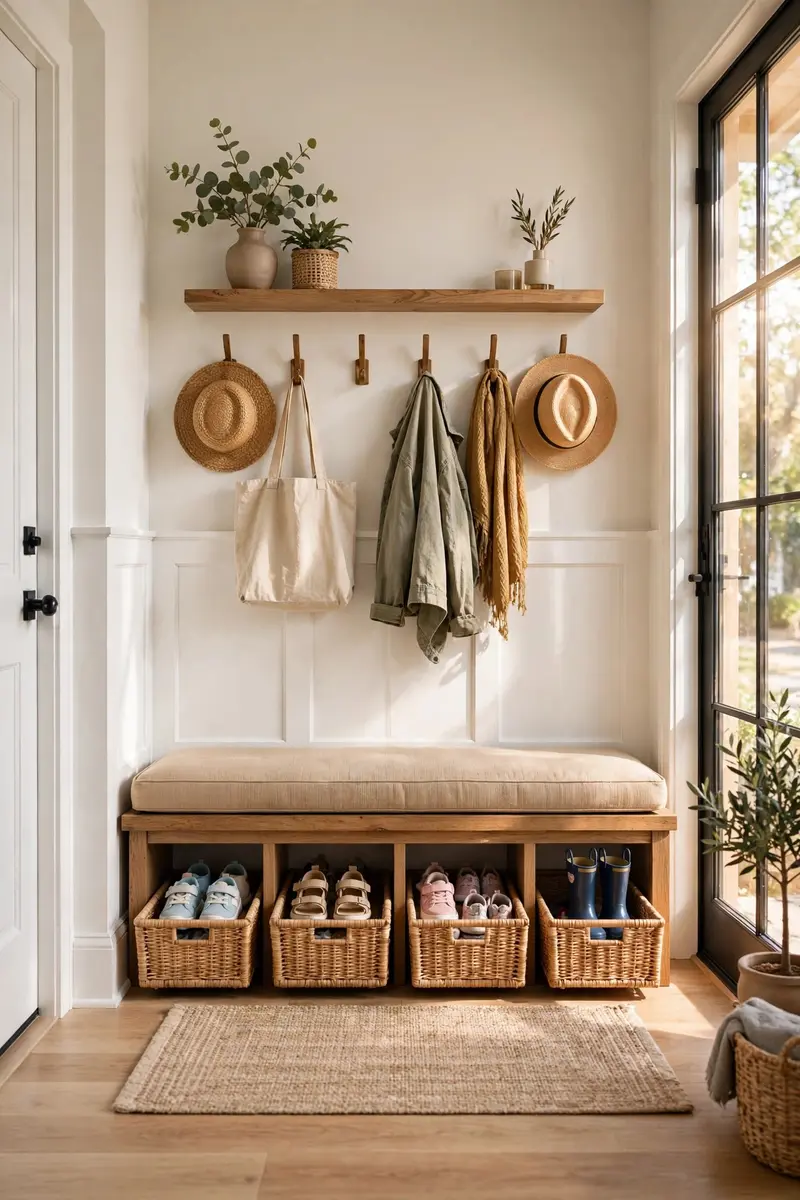
Sliding bins under a bench are the grab-and-go version of cubbies, and they are one of the most practical entryway shoe storage ideas for kids. Each child pulls out their own bin, finds their shoes, and slides it back. Bins wipe clean, swap easily, and cost far less than built-in drawers.
You will need:
- Sliding bins, $8-$18 each
- A bench or low shelf, $60-$150
Buy bins that slide freely under your bench with a finger-width to spare. Label each bin with a name or a color dot for young kids. Keep one bin per child, plus one spare for guests, and empty bins monthly to remove outgrown shoes.
Tip: Use clear bins for older kids who choose their own shoes, and colored bins for younger ones.
Stack a second row of shallow bins on top of the bench shelf for hats and gloves.
23. Rotating Shoe Tower
A rotating tower spins your shoe collection to you, and it is one of the most fun entryway shoe storage ideas for small closets near the door. Spin once and every pair passes by, no crouching or digging behind other shoes. It fits a corner or a closet and holds far more than a flat rack in the same footprint.
You will need:
- A rotating shoe tower, $60-$150
- A non-slip mat underneath, $8-$12
Place the tower where it can spin freely, away from door swings and walls. Balance the weight across tiers so it spins smoothly instead of wobbling. Keep the most-worn pairs at the easiest height and move occasion shoes to the top or bottom tiers.
Tip: Spin the tower slowly with one hand on the frame, so shoes never fly off the shelves.
Use a tower with adjustable tiers if your collection mixes flats, sneakers, and ankle boots.

24. Built-In Entryway Nook
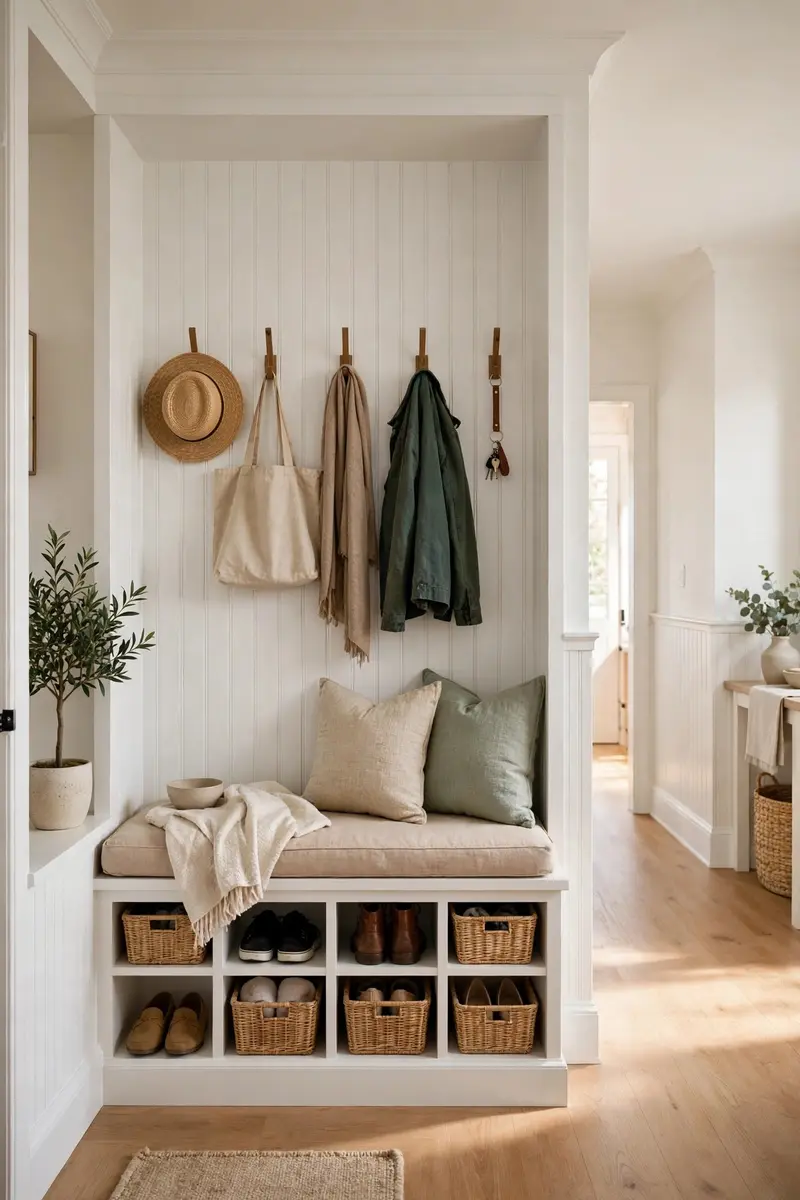
A built-in nook frames the entry with bench, cubbies, and trim, and it is one of the most polished entryway shoe storage ideas for homeowners planning a small upgrade. It looks custom because it is sized to your wall, and it adds value a freestanding rack never will. Even a simple nook with beadboard backing transforms a blank wall.
You will need:
- Beadboard panels and trim, $80-$200
- A bench and cubby boxes, $100-$300
- Paint, $20-$40
Measure the wall twice and sketch the nook before buying lumber or panels. Build the bench first, then cubbies above or below it, keeping walking space clear. Paint the nook the same color as your trim for a built-in look that blends with the house.
Tip: Add hooks at two heights, one for adults and one for kids, so everyone reaches their own.
Leave one open cubby for a plant or basket, so the nook reads as decor, not only storage.
25. High Wall Shelf for Off-Season Pairs
A high shelf moves off-season shoes out of the daily zone, and it is one of the most useful entryway shoe storage ideas for small entries. Sandals go up in winter, boots go up in summer, and the prime shoe spots stay free for what you wear now. A shelf near the ceiling costs little and uses space nothing else needs.
You will need:
- A wall shelf and brackets, $20-$50
- Labeled boxes, $10-$25
Mount the shelf above door height or over the entry bench, into studs. Use labeled boxes so you can identify pairs without climbing up. Swap the boxes twice a year, and use the swap as a chance to donate shoes you no longer wear.
Tip: Keep a small step stool nearby, or the high shelf becomes a place shoes go and never return.
Match the shelf to your trim color so it blends in, or use natural wood for a warm accent.

26. Labeled Cubbies for Kids
Labeled cubbies end the kids’ shoe chaos, and they are one of the most sanity-saving entryway shoe storage ideas for families. Each child gets a cubby with their name or photo on it, and shoes have exactly one home. Kids learn the system fast because it is visual, simple, and theirs.
You will need:
- A cubby unit, $60-$150
- Name labels or photo tags, $3-$8
- Small baskets, optional, $8-$15 each
Mount or place the cubby unit at kid height, not adult height, so children can use it alone. Put a photo label on each cubby for kids who cannot read yet. Keep one cubby per child plus one for guests, and do a monthly outgrown-shoe check together.
Tip: Add a small boot tray in front of the cubbies for rainy days, so wet shoes never soak the cubby floor.
Color-code cubbies with a painted back panel per child for an extra visual cue.

27. Tall Boot Rack with Drip Tray
A tall boot rack keeps boots upright and aired out, and it is one of the best entryway shoe storage ideas for boot lovers. Boots hang upside down or stand on pegs, so shafts keep their shape instead of flopping over. A drip tray underneath catches water, and the whole station looks intentional.
You will need:
- A boot rack with pegs or slots, $30-$80
- A drip tray, $12-$25
Place the rack near the door but out of the main walkway, since boots are bulky. Pair tall boots by height so shafts do not bend over shorter neighbors. Wipe the drip tray weekly in wet seasons, and stuff tall shafts with boot shapers for long-term storage.
Tip: Hang boots upside down on pegs to dry fastest after rain or snow.
Choose a rack with adjustable pegs if your household mixes ankle boots and knee-high pairs.

28. Console Cabinet with Decor Top
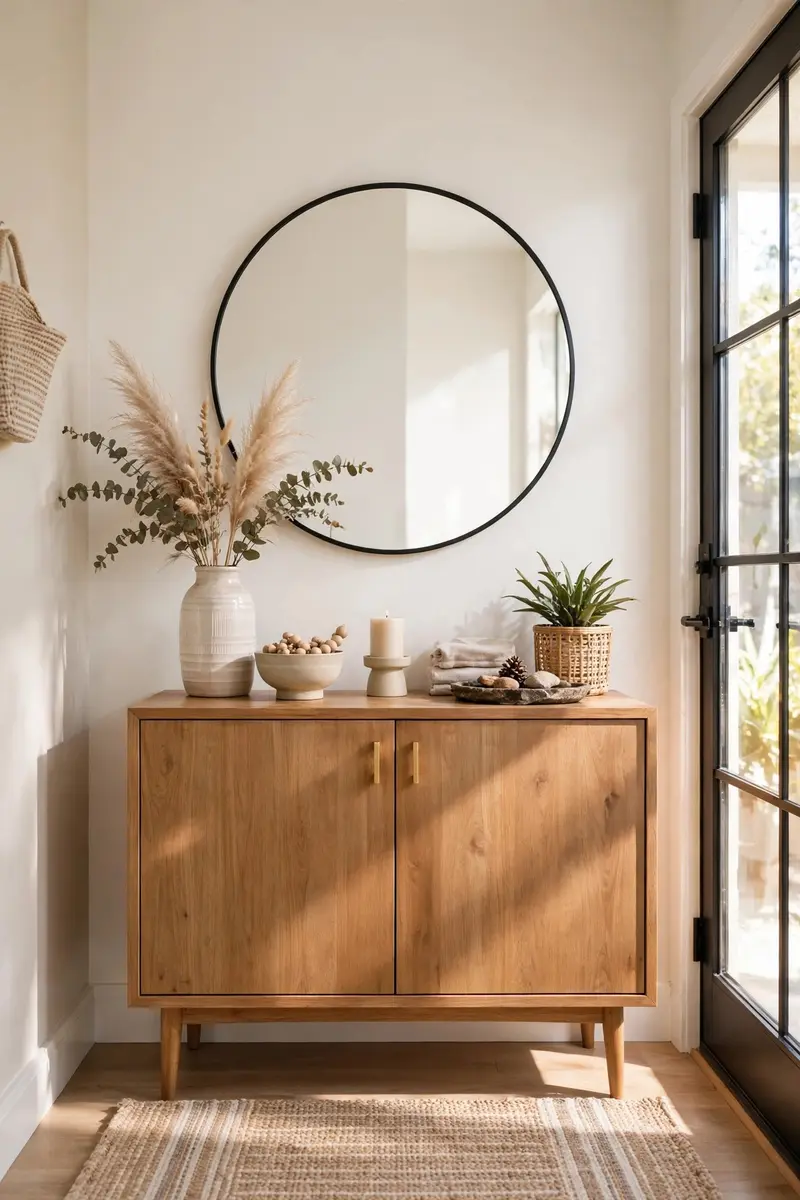
A console cabinet hides shoes behind doors while its top stays pretty, and it is one of the most stylish entryway shoe storage ideas for design lovers. A vase, a candle, and a tray on top say welcome home, while a dozen pairs hide inside. It is the entryway equivalent of a magician’s table.
You will need:
- A console cabinet, $120-$300
- Decor for the top, $20-$50
Measure your shoes against the cabinet’s interior depth, since decorative cabinets can run shallow. Keep daily pairs inside and use the top only for decor, never for shoe overflow. Anchor the cabinet if it is tall, and keep a small tray on top for keys.
Tip: Put a scented sachet inside the cabinet, since closed shoe storage needs airflow help.
Style the top in odd numbers: a tall vase, a short candle, and a small tray look balanced.
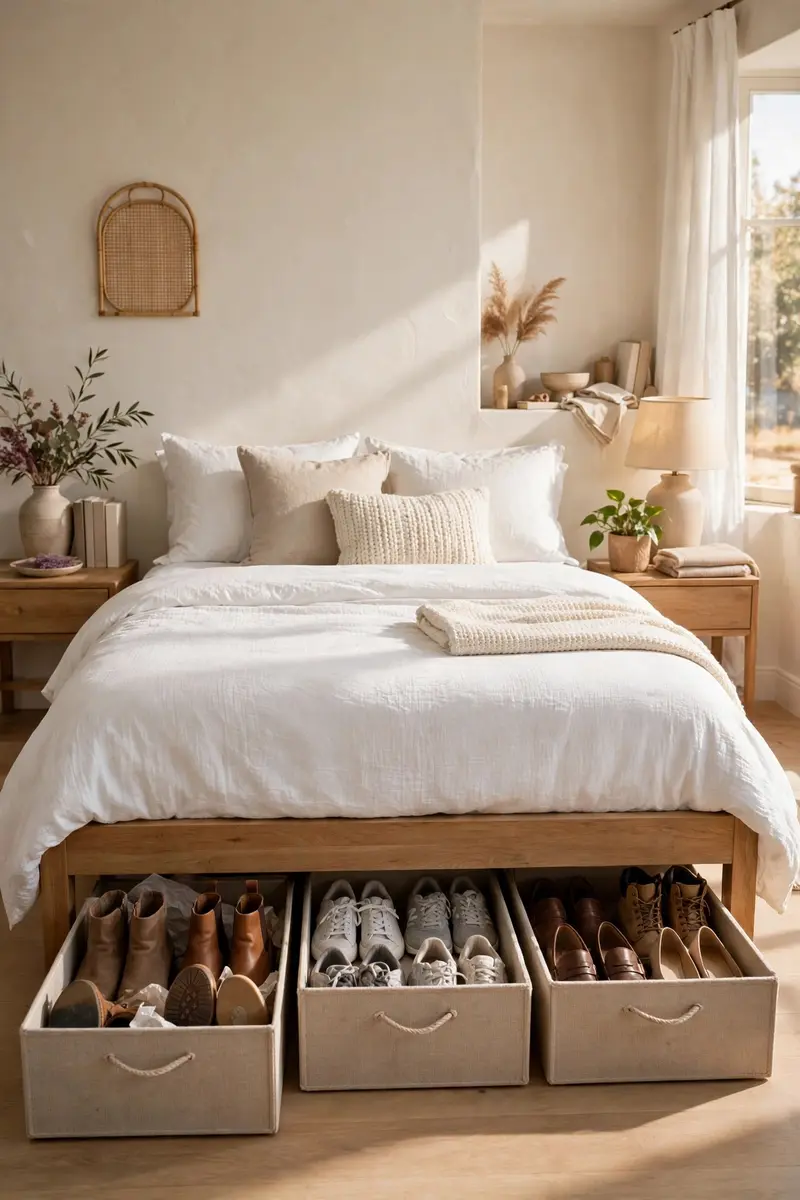
29. Under-Bed Boxes for Seasonal Rotation
Under-bed boxes are the overflow valve for your entryway, and they are one of the most practical entryway shoe storage ideas for homes with too many pairs. Off-season shoes slide under the bed in labeled boxes, freeing entry space for the pairs you wear now. The entry stays calm because only current shoes live there.
You will need:
- Under-bed shoe boxes, $20-$45 for a set
- Labels, $3-$6
Sort shoes by season before boxing them, and label each box clearly on the short end. Keep boxes flat and low so they slide easily, and choose boxes with lids to keep dust out. Rotate boxes twice a year, and donate any pair you skipped for a full season.
Tip: Photograph each box’s contents and tape the photo to the lid, so swaps take minutes.
Use rolling boxes if your bed sits on a hard floor, and flat boxes if it sits on carpet.
30. Shoe Care Station with Brush and Tray
A shoe care station keeps shoes clean and storage tidy, and it is one of the smartest entryway shoe storage ideas for people who love their footwear. A brush, a cloth, and a tray by the door mean mud comes off before shoes go into storage. Clean shoes last longer and smell better, and the station takes up almost no space.
You will need:
- A shoe brush and cloth set, $10-$20
- A small tray, $8-$15
- Leather cleaner or protector spray, $8-$15
Set the station on a small stool or shelf right inside the door, where you naturally pause. Brush shoes over the tray, not over the floor, so dirt stays contained. Keep the station stocked, since an empty station is one nobody uses.
Tip: Spray new shoes with protector before their first wear, so stains never get a foothold.
Add a small jar of cedar shoe trees for leather pairs, which keep their shape between wears.

Frequently Asked Questions
How do you store shoes in a small entryway without a closet?
Use the wall and the vertical space first: a slim tilt-out cabinet, slanted wall racks, or a floating console can hold daily pairs without touching floor space. Keep only two or three pairs per person in the entry and store the rest in a bedroom closet. A small entryway works when every pair has one obvious home, and the best entryway shoe storage ideas for tiny spaces always favor closed, shallow storage over a wide open rack.
What is the best shoe storage for a narrow hallway?
A slim cabinet or a two-tier rack no deeper than 12 inches keeps at least 30 inches of walking space clear, which matters more than capacity in a hallway. Wall-mounted racks and tilt-out cabinets are ideal because they hug the wall. Avoid deep benches and wide cubby units in narrow halls, since they turn a walkway into an obstacle course.
How many pairs of shoes should live in the entryway?
Two or three pairs per person covers daily life for most households: the pair you wear today, a backup, and one weather-specific pair. Everything else belongs in a closet or in seasonal rotation boxes. When the entry holds more than that, even good storage overflows, and the system stops working.
How do you keep entryway shoe storage from smelling?
Airflow is the fix: vented boxes, open cubbies, and cedar sachets all help, while sealed plastic traps odor. Let wet shoes dry on a tray before they go into closed storage, and wipe cabinet interiors monthly. Rotate pairs so no pair sits unworn and damp for weeks.
Are closed cabinets or open racks better for entryway shoes?
Closed cabinets look tidier and hide mismatched shoes, which suits small entries and guests’ first impressions. Open racks are faster to use and air shoes out better, which suits families with kids and muddy boots. Many homes do best with both: a closed cabinet for adults’ pairs and open cubbies or a tray for kids’ daily shoes. For more small-space inspiration, see The Spruce’s clever shoe storage ideas for small spaces and our cottage home decor ideas.
Conclusion
The best entryway shoe storage ideas are the ones your household will actually use on a tired evening, not the prettiest ones in a photo. Start with one system from this list, give every pair a home, and live with it for two weeks before buying anything else. A small system, used daily, beats a perfect setup nobody maintains.
Found a setup you want to try? Save this post to Pinterest so you can find it when you shop, and share it with anyone whose shoes live in a pile by the door. Your future, calmer mornings will thank you.



Leave a Reply