
Montessori nursery ideas are having a real moment, and it is easy to see why. Instead of a room built around what looks cute in a photo, a Montessori nursery is built around your baby: everything low, reachable, calm, and safe to explore. The result is a space that feels peaceful for you and empowering for your little one, from those first wobbly tummy-time sessions right through the toddler years.
The heart of the approach is simple. Give your child freedom of movement, a few beautiful things at their level, and a room that is not overstimulating. You do not need to buy a whole matching suite or follow the rules perfectly. Even two or three of these montessori nursery ideas will change how your baby uses the room, and every idea below can grow with your child.
Before you start, remember the golden rule of Montessori design: less, but better. A calm room with ten thoughtful pieces beats a packed room with fifty. Pick the ideas that fit your space and budget, and build slowly.
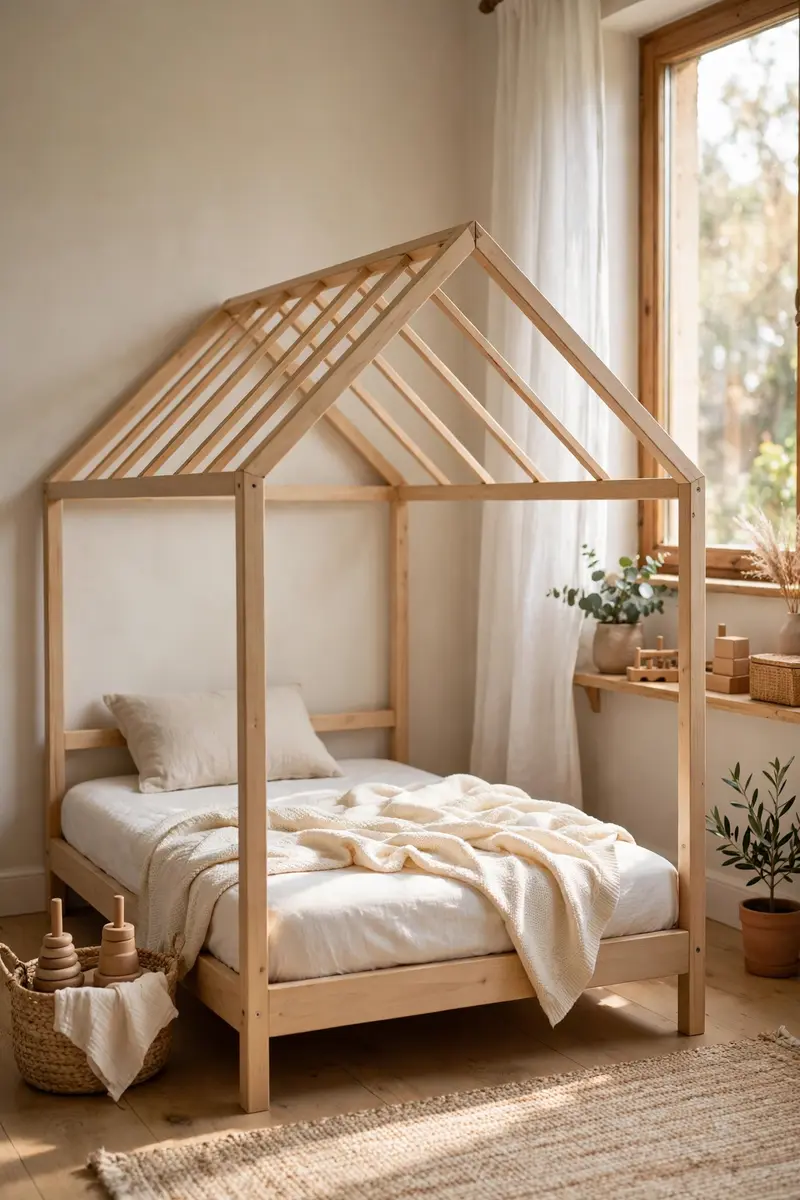
1. A Low House-Frame Floor Bed: Montessori Nursery Ideas
The floor bed is the signature piece of any Montessori nursery, and it replaces the traditional crib entirely. A mattress sits on a low wooden frame, or even directly on the floor, so your baby can climb in and out on their own as soon as they can crawl. That freedom builds confidence, body awareness, and healthy sleep habits, because your child learns to listen to their own tiredness instead of waiting behind bars.
Materials and realistic cost: a simple pine house-frame floor bed runs about $140–$300, a firm crib or twin mattress $80–$200, and a washable cotton fitted sheet $15–$25. If your budget is tight, a mattress on a low slatted base works just as well for under $120 total.
To set it up, place the bed against a wall in a corner of the room, away from radiators, cords, and windows. Keep bedding minimal: a fitted sheet and one light blanket only, with no bumpers, pillows, or loose toys in the sleep zone. Add a soft rug beside the bed so little feet land somewhere cozy, and put a baby gate at the bedroom door so the whole room becomes a safe yes-space.
Practical tip: start with a twin-size mattress if you have the space — it lasts from babyhood through the early school years, so you buy once. Among montessori nursery ideas, a floor bed is the single change that gives a baby the most independence.
Variation: skip the house frame and use a plain low platform frame for a cleaner, more grown-up look that still keeps the Montessori spirit.
2. A Movement Area With a Low Mirror — Montessori Nursery Ideas
Babies spend their first months mostly looking, reaching, and rolling, so a dedicated movement area is one of the most valuable montessori nursery ideas you can add. A soft mat on the floor, a shatterproof mirror mounted horizontally at your baby’s eye level, and a little open space to wiggle gives your child a place to study their own reflection, practice tummy time, and build gross motor skills.
Materials and realistic cost: a foldable play mat or thick cotton rug $40–$90, an acrylic shatterproof mirror $25–$60, and a low wooden bar or pull-up rail $20–$40 if you want one for later cruising.
Mount the mirror low on the wall, with its bottom edge almost touching the floor, and secure it firmly with proper wall anchors. Lay the mat in front of it and keep the area free of clutter. Rotate a single grasping toy or high-contrast card onto the mat rather than piling toys there. As your baby grows, this same corner becomes the spot for first steps, dancing, and dress-up play.
Practical tip: choose an acrylic mirror, never glass — it is lighter, safer, and it will not shatter if your toddler bonks it during a wobbly cruise. A low mirror is one of the montessori nursery ideas that turns tummy time into a daily discovery.
Variation: add a low wooden pull-up bar along the mirror wall for babies learning to stand, then remove it once they are confident walkers.

3. Low Open Shelves With Toy Rotation
Low open shelving is where Montessori magic happens day to day. Instead of a toy box your child has to dig through, a low shelf displays a small selection of toys and books at your child’s height, each in its own spot. Your child can see everything, choose independently, and — just as importantly — learn to put things back where they belong.
Materials and realistic cost: a two- or three-tier low wooden shelf $60–$150, a few small baskets or trays $5–$12 each, and 6–8 simple toys made from wood, cotton, or metal. Total setup usually lands between $100 and $200.
Place the shelf against a wall at your child’s level, with the heaviest items on the bottom. Display only a handful of activities at a time: one puzzle, one stacking toy, one book, one musical item, for example. Keep the rest in a closet bin and rotate every one to two weeks — your child will greet “new” toys with fresh excitement, and you will buy far less.
Practical tip: one toy per tray or basket, and always the same spot — consistency is what teaches your child to tidy up without being asked. Low open shelves are among the most practical montessori nursery ideas, because they make choice visible at child height.
Variation: use a low forward-facing book sling shelf next to the toy shelf so book covers face out and invite your child to pick one.

4. A Forward-Facing Book Ledge at Baby Height
Babies cannot read yet, but they absolutely choose books by their covers. A forward-facing book ledge mounted low on the wall turns story time into a choice your child makes themselves, which is exactly what Montessori design is about. It also keeps books visible and undamaged instead of stacked spine-out in a bin.
Materials and realistic cost: two or three picture ledges $15–$30 each, or one low book sling $40–$70. Add 8–12 sturdy board books, many of which you probably already own.
Mount the ledges about 12–18 inches from the floor for a baby, or at toddler knee height as they grow. Display 5–8 books facing out, and rotate them weekly along with your toy rotation. Pair the ledge with a small floor cushion or a cozy corner chair nearby so your child can pull a book down and “read” it on their own terms.
Practical tip: keep the ledge in the reading corner, not next to the bed — separating sleep and story zones helps your child wind down at night. Forward-facing books are one of the simplest montessori nursery ideas for a room where reading starts early.
Variation: if wall space is tight, a low basket of board books beside the nursing chair works the same way and costs almost nothing.

5. A Child-Sized Open Wardrobe: Montessori Nursery Ideas
Montessori philosophy treats getting dressed as a learning activity, not a chore to rush through. A child-sized open wardrobe — a low rail with a few outfits and a small basket for shoes — lets your toddler pick their own clothes, practice dressing, and feel ownership over their morning routine.
Materials and realistic cost: a small open clothing rack or low wardrobe $50–$120, 3–4 wooden hangers $10, and a small shoe basket $8–$15. Keep the bulk of clothes in a separate dresser or closet.
Hang just two or three weather-appropriate outfits at your child’s eye level, and place shoes in the basket below. Everything else stays out of sight so choices stay manageable — too many options overwhelm a toddler instead of empowering them. As seasons change, swap the outfits together with your child and talk about what they are choosing.
Practical tip: offer two outfits, not ten — a simple either-or choice builds decision skills without morning meltdowns. A child-sized wardrobe is one of the montessori nursery ideas that makes getting dressed a learning moment.
Variation: in a small room, a low wall rail with hooks and one shelf does the same job in a single foot of wall space.

6. A Weaning Table and Chair Nook
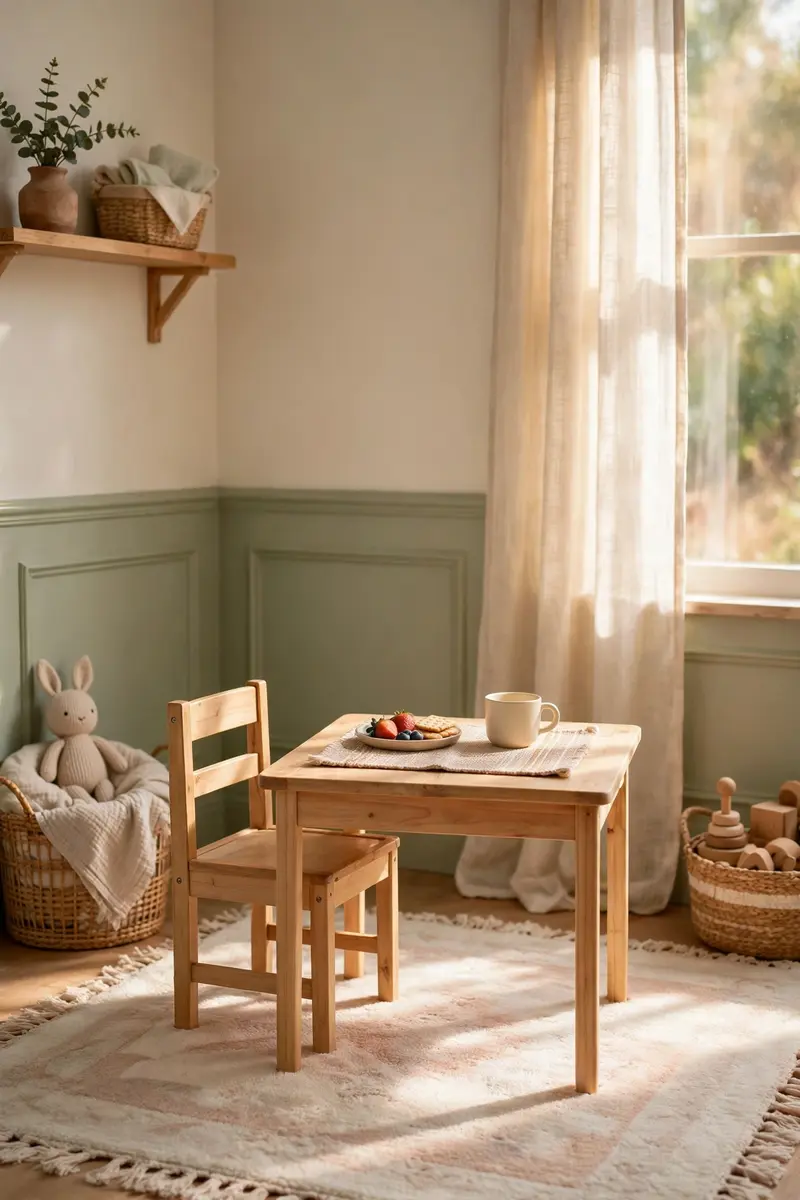
When your baby starts solids, a tiny table and chair set becomes one of the most charming montessori nursery ideas. Instead of always eating in a high chair, your child sits at their own table, feet on the floor, with a real place setting. It builds independence, posture, and table manners from the very first bites.
Materials and realistic cost: a sturdy wooden toddler table and chair set $60–$130, a small placemat $8, and a child-sized cup and plate set $15–$25. Look for heavy, stable pieces with rounded edges that will not tip when your child climbs in.
Set the table in a corner near the kitchen side of the room or in a bright nook, with a wipeable mat underneath. Keep the setting simple: one plate, one cup, one small fork or spoon. Let your child help set the table and clear their plate, even if “helping” is messy at first — that participation is the whole point.
Practical tip: buy a table that is heavy enough that your child cannot drag it across the room — stability matters more than style here. A tiny table and chair are among the most charming montessori nursery ideas for a baby starting solids.
Variation: start with just the chair and a low shelf for snacks and water, then add the table when your child is sitting confidently.
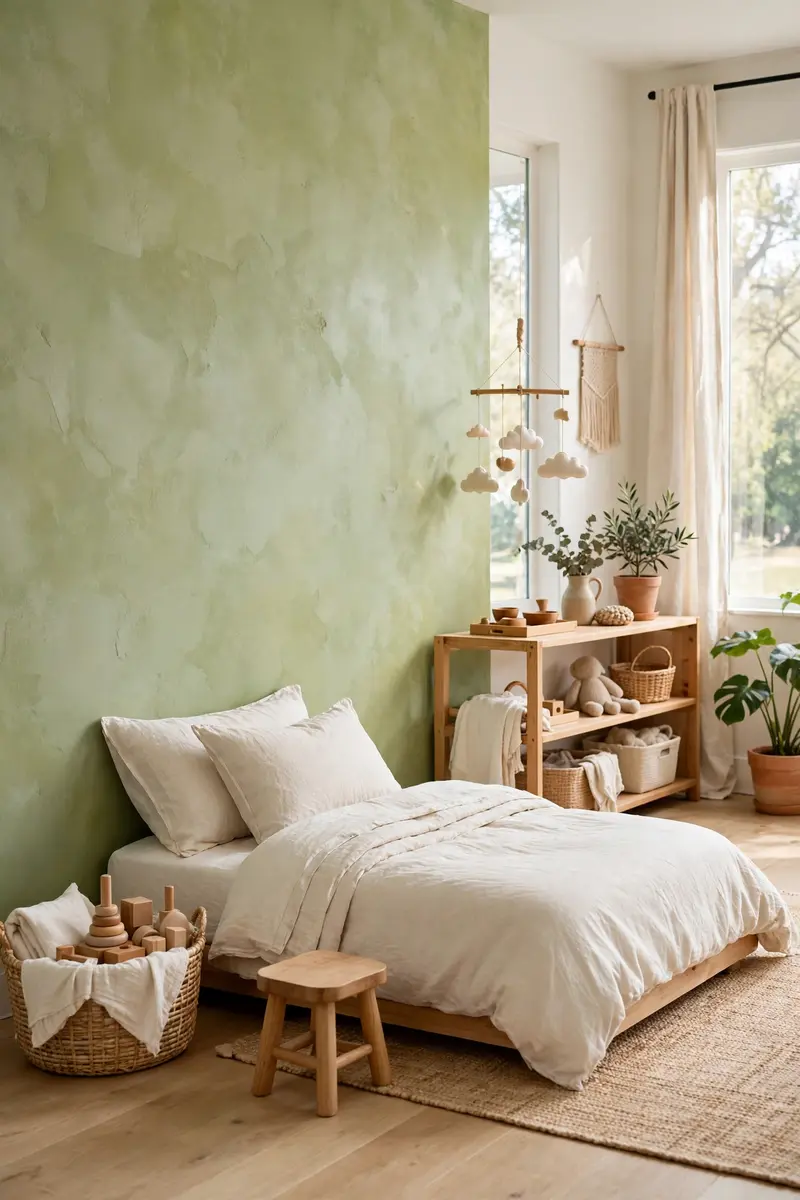
7. A Calm Neutral Palette With a Limewash Accent Wall
Color sets the mood of a Montessori nursery more than any single piece of furniture. Soft, warm neutrals — cream, warm white, sage, clay, and gentle beige — keep the room calm and let the toys and artwork be the visual focus. A limewash accent wall adds texture and depth without the busyness of a bold pattern.
Materials and realistic cost: a gallon of warm-white or soft sage paint $35–$55, limewash paint for one accent wall $60–$90, and painter’s tape and rollers $15. A full room repaint typically costs $100–$180 in materials.
Paint the room in one warm neutral, then add the limewash to the wall behind the floor bed or reading corner. Keep patterns subtle: a tone-on-tone stripe or a soft botanical print in bedding is plenty. Avoid bright primary murals and flashing wall decals, which compete with your child’s attention.
Practical tip: test your paint color in daylight and lamplight before committing — warm neutrals can shift pink or grey depending on the room’s light. A calm palette is one of the montessori nursery ideas that keeps the room restful, even on busy days.
Variation: if painting is not an option, removable peel-and-stick limewash-look wallpaper gives the same soft texture without the commitment.
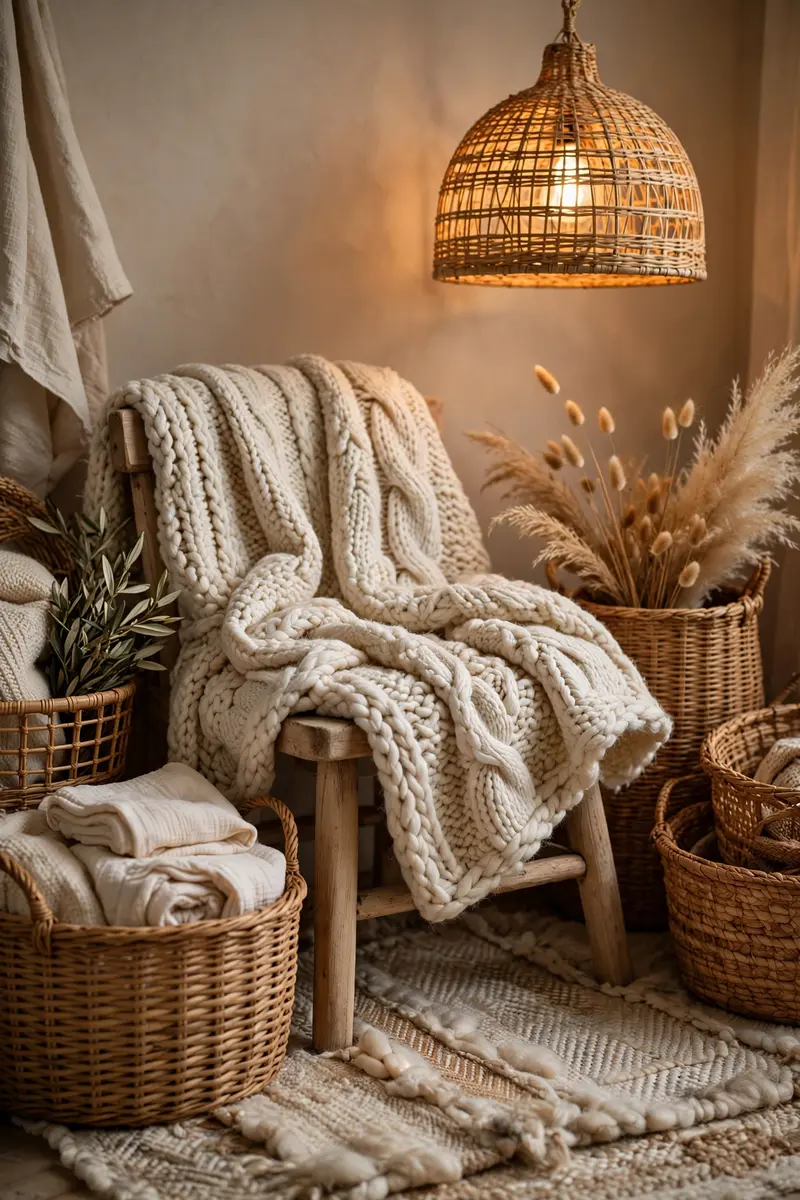
8. Natural Wood, Rattan, and Soft Textures Everywhere
Montessori spaces favor real materials over plastic: wood, cotton, wool, rattan, and metal feel better, last longer, and look calmer. Layering these textures — a rattan basket, a chunky knit throw, a woven wool rug, a wooden toy — makes the nursery feel warm and sensory without adding visual noise.
Materials and realistic cost: a woven wool or cotton rug $60–$120, two rattan baskets $15–$30 each, a cotton knit throw $25–$40, and a few wooden toys $10–$25 each. You can build this layer over time instead of buying it all at once.
Start with the rug, since it anchors the room and softens the floor for crawling. Add baskets for toy rotation storage, a knit throw on the floor bed, and wooden or fabric toys on the shelves. Keep plastic to a minimum, and when you do buy it, choose muted colors that blend with the room rather than neon pieces that shout for attention.
Practical tip: one natural texture per zone is enough — rug in the movement area, rattan in the storage corner, knit on the bed — so the room stays calm, not busy. Natural textures are among the defining montessori nursery ideas, replacing plastic with wood, cotton and rattan.
Variation: add a rattan pendant light or a woven wall hanging for a touch of texture at eye level without taking up floor space.
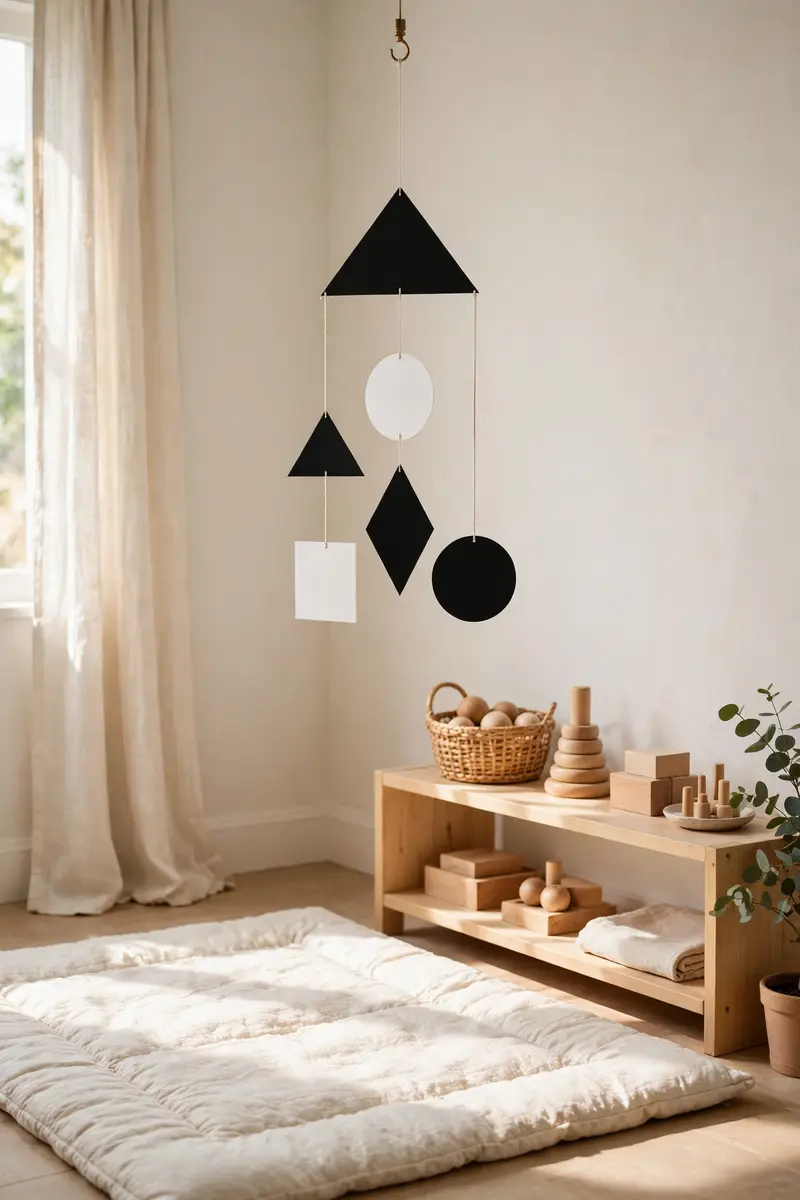
9. A Montessori Mobile Corner
Montessori mobiles are not the musical, battery-powered kind that spin above a crib. They are simple, beautiful, slow-moving objects hung at your baby’s eye level — the high-contrast Munari mobile for newborns, the colorful Gobbi mobile a few months later — designed to support visual tracking and concentration without overstimulating.
Materials and realistic cost: a ceiling hook and a handmade or shop-bought Montessori mobile $20–$50, plus a small hanging ring or stand if you cannot use the ceiling. Total is usually under $50.
Hang the mobile above the movement mat, about 12 inches from your baby’s face when they are lying down, and low enough that you can swap it easily. Change the mobile as your baby’s vision develops: black-and-white shapes first, then gentle color gradations, then simple three-dimensional objects. Keep it out of reach of grabbing hands and away from the sleep area so it stays a wake-time activity.
Practical tip: one mobile at a time, changed every few weeks — a single slowly moving object holds a baby’s focus far longer than a busy mobile with ten dangling toys. A single slow mobile is one of the montessori nursery ideas that holds a baby’s attention without overstimulation.
Variation: a simple wooden ring mobile or a set of hanging ribbons in soft colors works beautifully if you prefer a DIY approach.
10. A Cozy Floor-Level Reading Nook
A reading nook at floor level invites your child to curl up with books whenever they like, without needing an adult to lift them into a chair. A couple of floor cushions, a small basket of board books, and a soft light create a corner that feels like a hideaway, and it grows with your child into a favorite quiet spot for years.
Materials and realistic cost: two large floor cushions or a small nugget-style pad $50–$100, a book basket $15–$25, and a soft plug-in lamp or fairy lights $15–$30. Total setup is typically $80–$150.
Tuck the nook into a corner near the book ledge, away from the sleep zone. Keep the cushion arrangement simple and low so your child can climb in and out alone. Rotate the basket’s books along with your toy rotation, and add a favorite stuffed animal or two — but not a mountain of them, which turns a calm nook into a clutter pile.
Practical tip: place the nook near a window for natural daylight reading, and add sheer curtains so the light stays soft rather than harsh. A floor-level reading nook is one of the cosiest montessori nursery ideas, inviting books at any hour.
Variation: a small canopy or fabric arch over the cushions makes the nook feel extra special without costing much.

11. A Low Art Display Rail at Child Height
In most homes, children’s art lives on the fridge at adult height. A Montessori nursery flips that: a low art rail or picture ledge at your child’s eye level displays their own artwork and a few beautiful prints where they can actually see and enjoy them. It tells your child their work matters, and it makes rotating displays a fun ritual.
Materials and realistic cost: a wooden picture rail or wire display cable $15–$35, small clips $5–$10, and a few framed or unframed prints. If you already have your child’s art, the display itself costs under $40.
Mount the rail about 24–30 inches from the floor, low enough for a toddler to point at and talk about each piece. Hang three or four items: one piece of your child’s art, one nature print, one simple illustration. Change them monthly, and let your child help choose what goes up next.
Practical tip: hang art low in the hallway outside the nursery too — your child will love spotting their work as they walk past. Displaying art low is among the most personal montessori nursery ideas, letting children see their own work every day.
Variation: a simple washi-tape gallery on one wall section works in rentals where you cannot drill, and it peels off cleanly later.

12. A Sensory Nature Corner With Soft Light
Bringing nature indoors is a gentle way to round out a Montessori nursery. A nature basket filled with smooth stones, pinecones, and wooden slices, a trailing plant hung safely out of reach, and a soft lamp with warm light create a corner that invites quiet observation — a key Montessori value — without screens or noise.
Materials and realistic cost: a small basket $10–$18, nature finds collected outdoors for free, a hanging planter $15–$30, and a warm dimmable lamp $20–$40. This is one of the cheapest ideas on the list, often under $75 total.
Place the nature basket on a low shelf where your toddler can explore it under supervision, and hang plants high or use sturdy trailing varieties out of grabbing range. Use a warm-toned lamp with a dimmer rather than a bright overhead light, so the corner feels calm in the evening. Refresh the basket with seasonal finds — autumn leaves, spring flowers, smooth beach stones — to keep curiosity alive.
Practical tip: check every nature item for size and safety first — nothing small enough to fit through a toilet-paper tube goes in the basket for a baby or young toddler. A nature corner is one of the gentlest montessori nursery ideas for bringing the outdoors into a calm room.
Variation: a small indoor herb pot on a low windowsill lets older toddlers water and smell their own plant, adding a practical-life activity to the corner.

Frequently Asked Questions
What is a Montessori nursery?
A Montessori nursery is a baby’s room designed around independence and freedom of movement. It uses a floor bed instead of a crib, low open shelves, child-sized furniture, and a calm, uncluttered layout so your baby can explore safely and make choices on their own from a very young age.
Is a floor bed safe for a baby?
Yes, when the room is properly prepared. Use a firm mattress, keep the sleep area free of loose bedding, cords, and hazards, anchor all furniture to the wall, and put a baby gate at the door. Many families start with a floor bed from around six months, once their baby can move, and keep a bassinet for the earliest newborn weeks if they prefer.
What age can you start a Montessori nursery?
You can start before your baby is born or at any point in the first year. A movement mat and mirror work from day one, low shelves become useful once your baby sits up, and the floor bed shines once they start crawling. Even small changes, like lowering a bookshelf, make a real difference at any stage.
How do you keep a Montessori nursery clutter-free?
The secret is toy rotation and the one-in, one-out rule. Display only a small selection of toys and books at a time, store the rest out of sight, and rotate every week or two. Choose open storage with a clear spot for everything, and resist buying in bulk — a calm room helps your child focus and play longer.
Can you mix Montessori ideas with a regular nursery?
Absolutely. Montessori is not all or nothing. You can keep a traditional crib and still add low shelves, a floor-level mirror, and a child-sized wardrobe. Pick the montessori nursery ideas that fit your family, your space, and your comfort level, and let the room evolve as your child grows.
Conclusion
Designing a Montessori nursery is less about buying the perfect furniture and more about seeing the room through your child’s eyes. When everything is low, reachable, calm, and beautiful, your baby gains confidence with every independent choice — picking a book, climbing into bed, or putting a toy back on its shelf.
Start with one or two ideas from this list, live with them for a few weeks, and add more as your child grows. The best Montessori nursery is the one that works for your real life, not a showroom. If you found an idea you love, save this post to Pinterest so you can find it again when you are ready to build, and share it with a parent who is planning a nursery too.
For more nursery inspiration, see our woodland nursery ideas and ocean themed nursery ideas, plus our bedroom inspo ideas for rooms that grow with your child. If you want a deeper dive into the principles behind these rooms, the Montessori nursery design guide is a wonderful place to start.



Leave a Reply