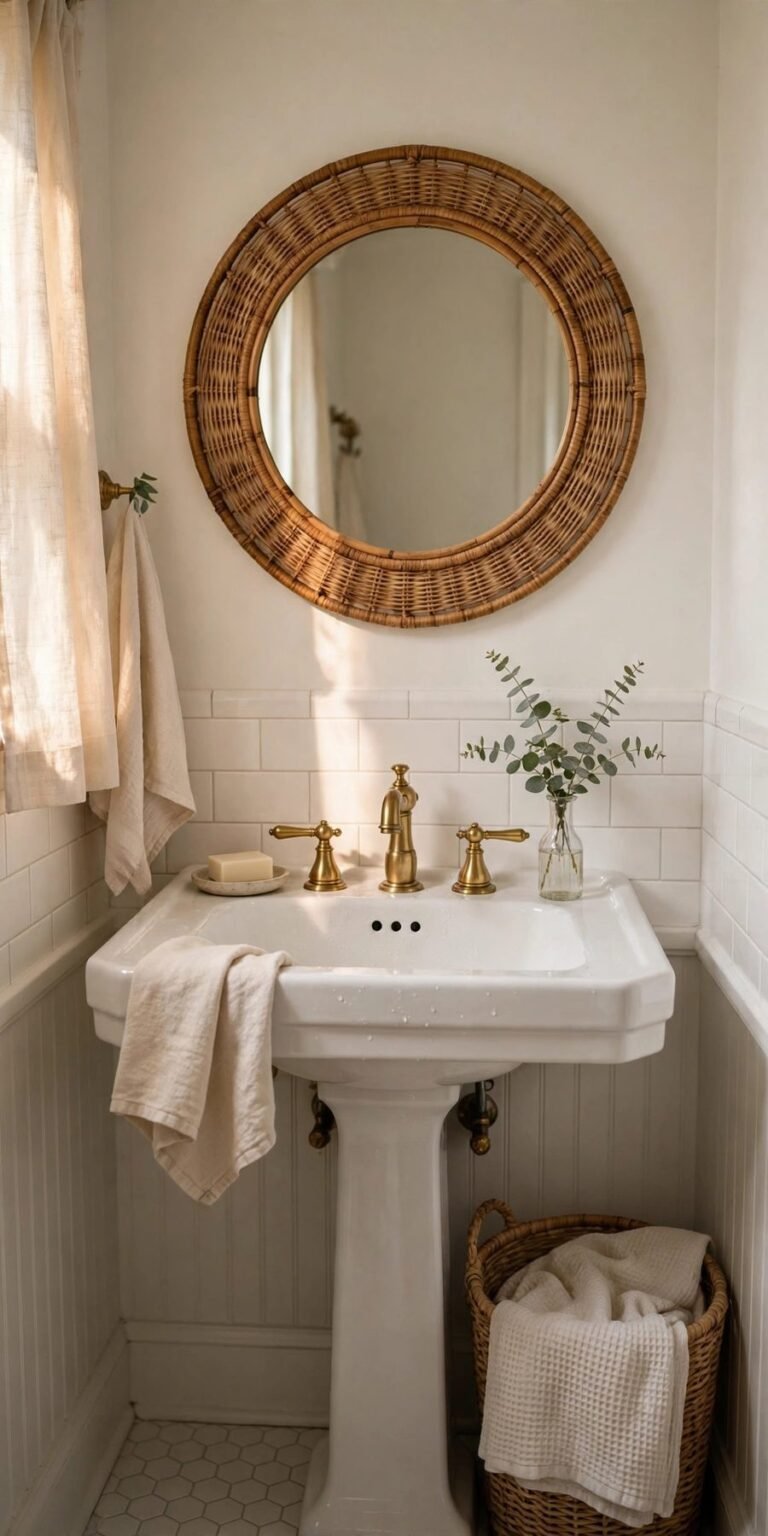
Half Bathroom Ideas: 26 Stunning Looks That Wow
Your half bathroom ideas search ends here — because the smallest room in your home deserves the biggest personality. A half bathroom, also called a powder room, has just a toilet and a sink, no shower or tub, which means you can be braver here than anywhere else in your house. There is very little wall to cover, very little floor to tile, and very little to lose if you try something bold. That is exactly why designers love powder rooms: a single daring choice can transform the whole space in a weekend, often for far less than a full bathroom remodel.
Below you will find 26 genuinely different half bathroom ideas, from budget-friendly peel-and-stick wallpaper to jewel-box dark walls and space-saving floating vanities. Pick one hero idea, add one or two supporting touches, and leave the rest alone — in a tiny room, restraint is what keeps a bold look feeling polished instead of chaotic.
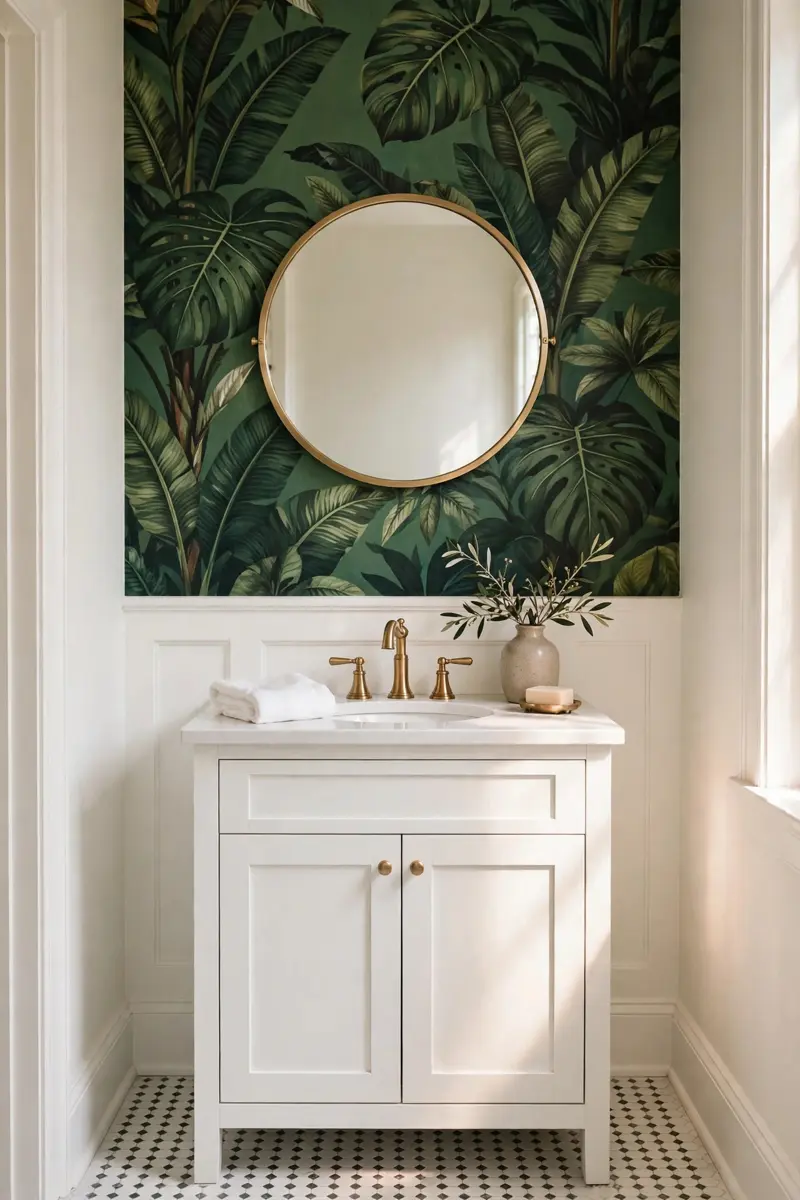
1. Bold Botanical Wallpaper Feature Wall
A half bathroom is the perfect place to go big with wallpaper, because you only need one or two rolls and the pattern never has a chance to overwhelm you. A large-scale botanical print — oversized leaves, trailing vines, or dramatic florals — turns a plain powder room into a little garden retreat the moment guests walk in.
Materials and realistic cost: one to two rolls of vinyl wallpaper ($40–$120), wallpaper paste or peel-and-stick rolls ($30–$80), a smoothing tool and sharp blade ($15). Keep the rest of the room quiet: a white sink, a simple mirror, and warm wood or brass accents let the print do the talking.
Start with the wall behind the vanity, since that is the wall guests see first. Measure twice, match the pattern at the seams, and work from the center outward so the print stays balanced around the mirror. If full coverage feels like too much, paper just that one wall and paint the others in a color pulled from the print.
Tip: Choose vinyl or moisture-resistant wallpaper near the sink — splashes happen, and wipeable paper lasts years longer than standard paper here.
Variation: Try the same bold print on the ceiling for a surprising fifth-wall moment, with plain painted walls below.
2. Moody Jewel-Box Dark Green Walls
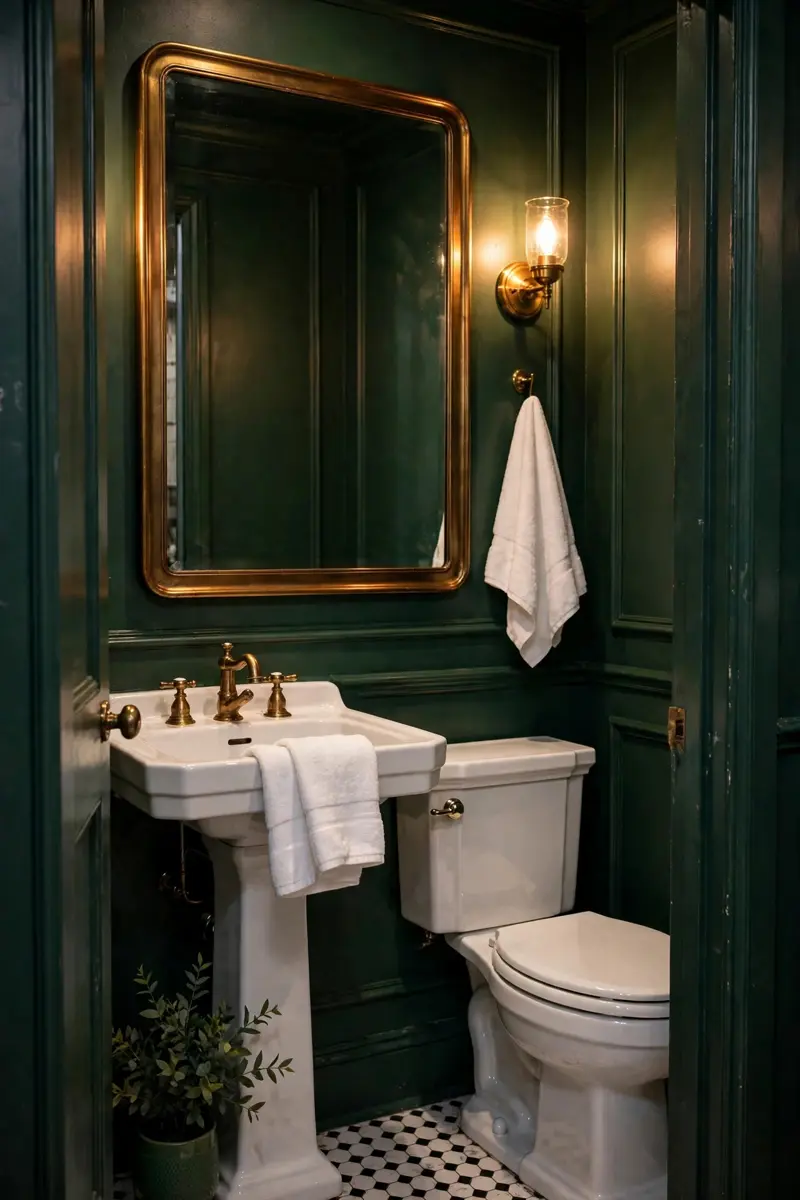
Deep green walls wrapped around a tiny powder room feel less like a small bathroom and more like a jewel box — intimate, rich, and deliberately dramatic. Dark colors actually work beautifully in windowless half bathrooms because there is no daylight fighting the mood; instead, warm lighting makes the whole room glow.
Materials and realistic cost: one gallon of deep green paint in satin or semi-gloss ($45–$70), painter’s tape and supplies ($20), brass or gold accents ($30–$80). A white toilet and sink pop crisply against the dark walls, so you rarely need to replace fixtures.
Paint walls and trim the same deep green for a seamless, enveloping look, then add a large mirror and warm-toned lighting to bounce light around. Keep towels white or cream so the room still feels fresh, and add one green plant for a living contrast against the paint.
Tip: Use satin or semi-gloss paint, not flat — it wipes clean easily and reflects just enough light to keep a dark room from feeling flat.
Variation: Swap green for deep navy or charcoal if your fixtures are chrome rather than brass.
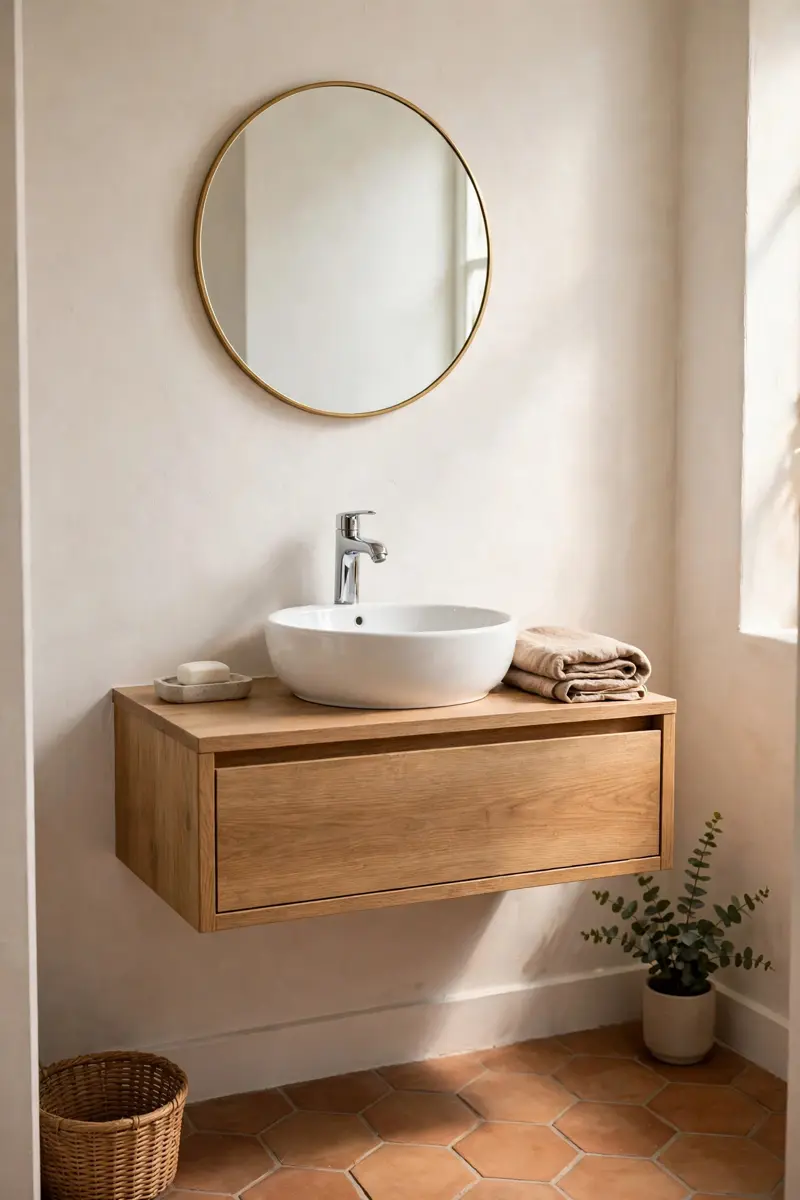
3. Floating Vanity That Opens Up the Floor
A wall-mounted floating vanity is one of the smartest half bathroom ideas for a tight space because it shows more floor, which tricks your eye into reading the room as bigger. Cleaning gets easier too — nothing blocks the mop underneath.
Materials and realistic cost: a floating vanity unit ($180–$450), wall-mount hardware and a vessel or undermount sink ($80–$200), a modern faucet ($60–$150). Budget for a plumber if your drain needs moving ($150–$300).
Mount the vanity at standard counter height, about 32–34 inches, and make sure it is anchored into studs, not just drywall. Pair it with a wall-hung faucet or a compact deck-mounted faucet, and leave the space below open — resist the urge to stuff baskets underneath, or you lose the airy effect.
Tip: Choose a vanity at least 18 inches deep so you still have usable counter space for soap and a small tray.
Variation: A floating wood shelf with a vessel sink on top gives the same open-floor look for less money.
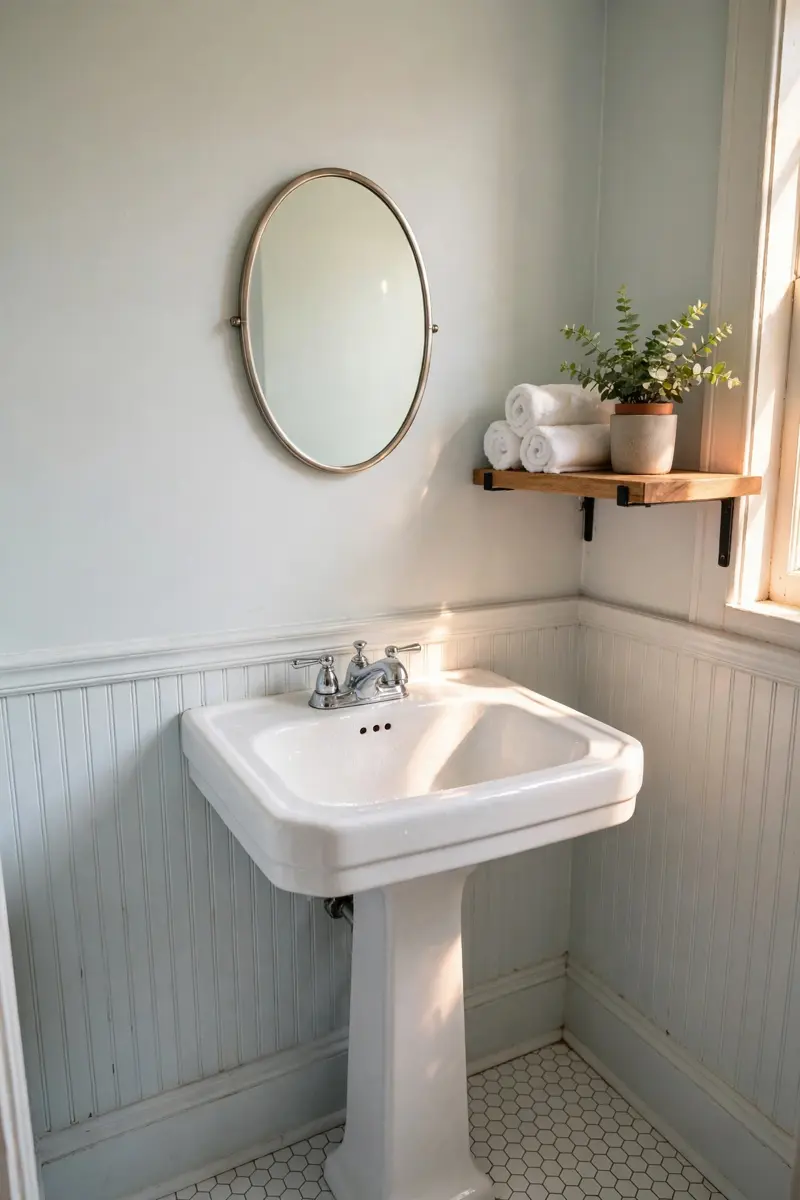
4. Classic Pedestal Sink for the Tiniest Rooms
When your half bathroom is barely bigger than a closet, a pedestal sink is your best friend. Its slim silhouette takes up minimal floor space while still giving you a proper place to wash up, and its classic shape suits traditional, farmhouse, and transitional homes alike.
Materials and realistic cost: a pedestal sink ($120–$300), a compatible faucet ($50–$120), new supply lines and a P-trap if needed ($30). Installation is usually straightforward if the plumbing already lines up.
Remove the old bulky vanity, patch and paint the wall behind it, then set the pedestal, level it, and caulk the base neatly. Because there is no counter, add a small wall shelf or a tray on the toilet tank for soap, and hang a hand towel ring within easy reach of the sink.
Tip: Pick a pedestal with a slightly wider basin if you can — a too-small bowl splashes everywhere, which is the one real drawback of this style.
Variation: A corner pedestal sink frees up even more floor space in an awkward, narrow layout.
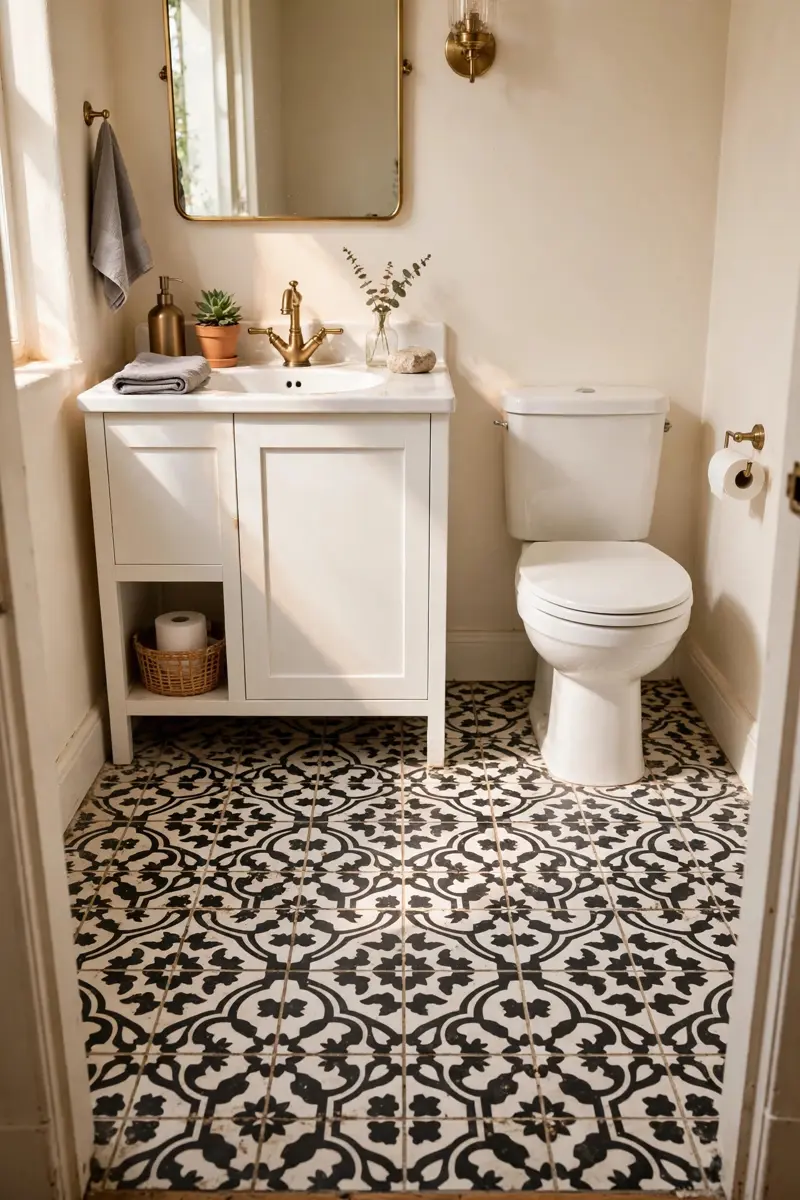
5. Patterned Encaustic-Style Floor Tile
In a half bathroom, the floor is small enough to splurge on — and patterned tile is the fastest way to give that little floor a big personality. A black-and-white graphic, a Moroccan-inspired motif, or a colorful encaustic-look pattern makes a strong first impression the moment someone opens the door.
Materials and realistic cost: patterned porcelain tile for 15–30 square feet ($90–$300), thinset, grout, and sealer ($50–$90). Because the area is tiny, a pro install often costs less than you expect ($200–$400).
Keep the walls simple if the floor is busy — white, cream, or one soft color pulled from the tile. Lay the pattern so it centers on the doorway, not on a hidden corner, and seal cement-look tiles properly so they resist stains from splashes and cleaning products.
Tip: Buy 10 percent extra tile for cuts and future repairs; patterned tiles are often discontinued, and a spare box saves a future headache.
Variation: If you rent, peel-and-stick patterned floor tiles give a similar look and come up cleanly when you move out.
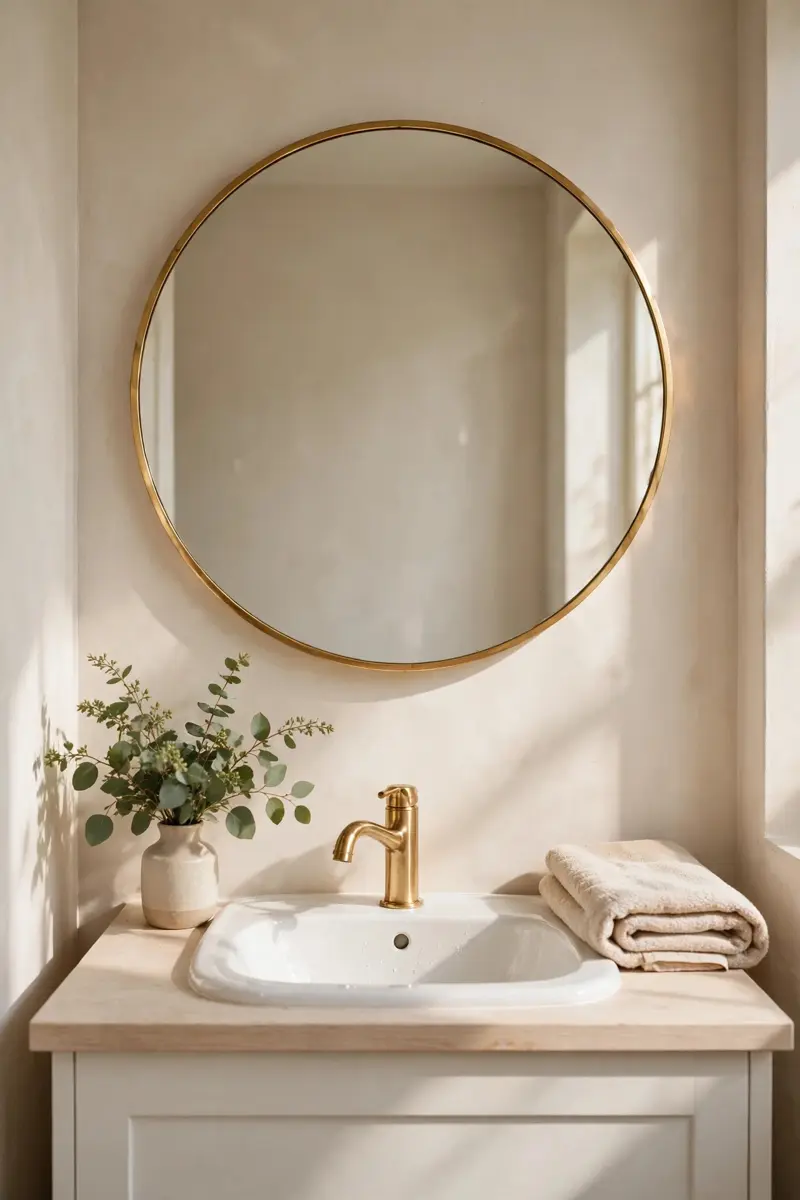
6. Statement Round Mirror as the Hero Piece
Since a half bathroom usually has just one mirror, it is worth spending more on this piece than you might elsewhere. A large round mirror, an arched mirror, or a decorative framed mirror can carry the whole room — and a bigger mirror bounces light around a tight space, making it feel larger.
Materials and realistic cost: a statement mirror ($60–$200), a sturdy wall anchor ($10), sconces if you are adding them ($60–$180 for a pair). Hang it at eye level, with the center roughly 60 inches from the floor.
Center the mirror over the sink, then build everything else around it: keep the faucet simple if the frame is ornate, or go bold with the faucet if the mirror is plain. A round mirror softens a room full of hard rectangles — toilet tank, vanity box, tile grid — which is why it works in almost every style.
Tip: Go bigger than you think you should; a mirror that feels slightly oversized in the store usually looks just right once it is on the wall.
Variation: An arched mirror adds height to a low-ceilinged powder room, while a backlit round mirror adds glow without extra fixtures.
7. A Pair of Sconces at Eye Level
Overhead-only lighting is unflattering and flat, especially in a small room. Sconces placed at eye level on either side of the mirror give far more even light, flatter every guest, and add visual interest to an otherwise plain wall.
Materials and realistic cost: a pair of damp-rated sconces ($80–$220), bulbs in warm white 2700K ($15), an electrician if new wiring is needed ($150–$300). Battery-operated sconces ($40–$90 a pair) are a no-wiring alternative.
Mount sconces about 60–65 inches from the floor and 28–30 inches apart, flanking the mirror. Choose shades that direct light outward or upward rather than straight down, so you avoid harsh shadows, and put them on a dimmer if you can — a powder room feels luxurious at half brightness in the evening.
Tip: Always check that sconces near a sink are rated for damp locations, and keep fabric shades away from direct splashes.
Variation: A single slim vertical sconce on each side works when wall space is too narrow for a full pair.
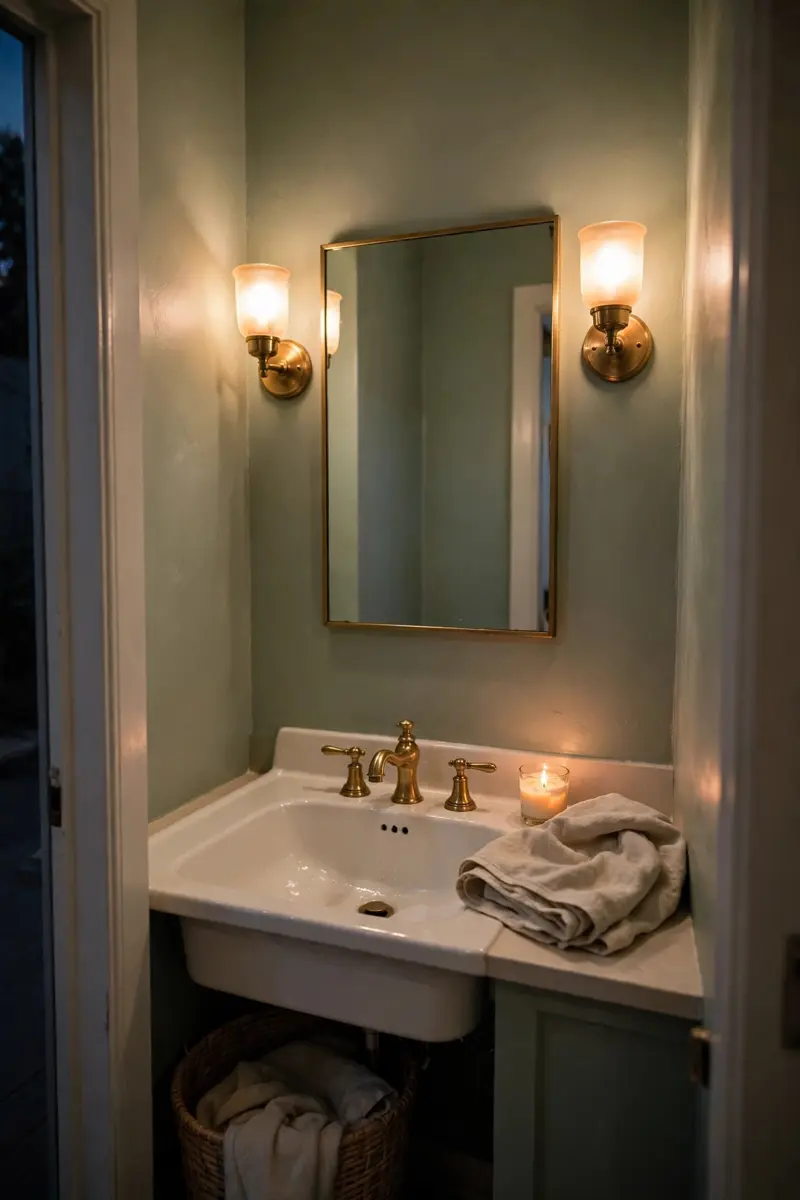
8. Shiplap Farmhouse Charm
Shiplap instantly makes a half bathroom feel like a cozy farmhouse retreat, and in a small room you can cover every wall in a single weekend. Painted white or sage, it adds texture without pattern, so the room feels layered rather than busy.
Materials and realistic cost: shiplap boards or MDF planks ($150–$350 for a powder room), paint ($45–$70), nails and caulk ($25). Peel-and-stick shiplap panels ($80–$150) are a renter-friendly shortcut.
Install boards horizontally to widen a narrow room visually, or vertically to add height. Caulk the seams and paint everything — boards, trim, and baseboards — the same color for a seamless look, then add a distressed wood vanity or a vintage-style mirror to complete the farmhouse feel.
Tip: In a windowless powder room, paint shiplap a warm white rather than bright white so the room glows instead of glaring.
Variation: Try shiplap on just the lower half of the walls with a painted upper wall for a classic wainscot effect.
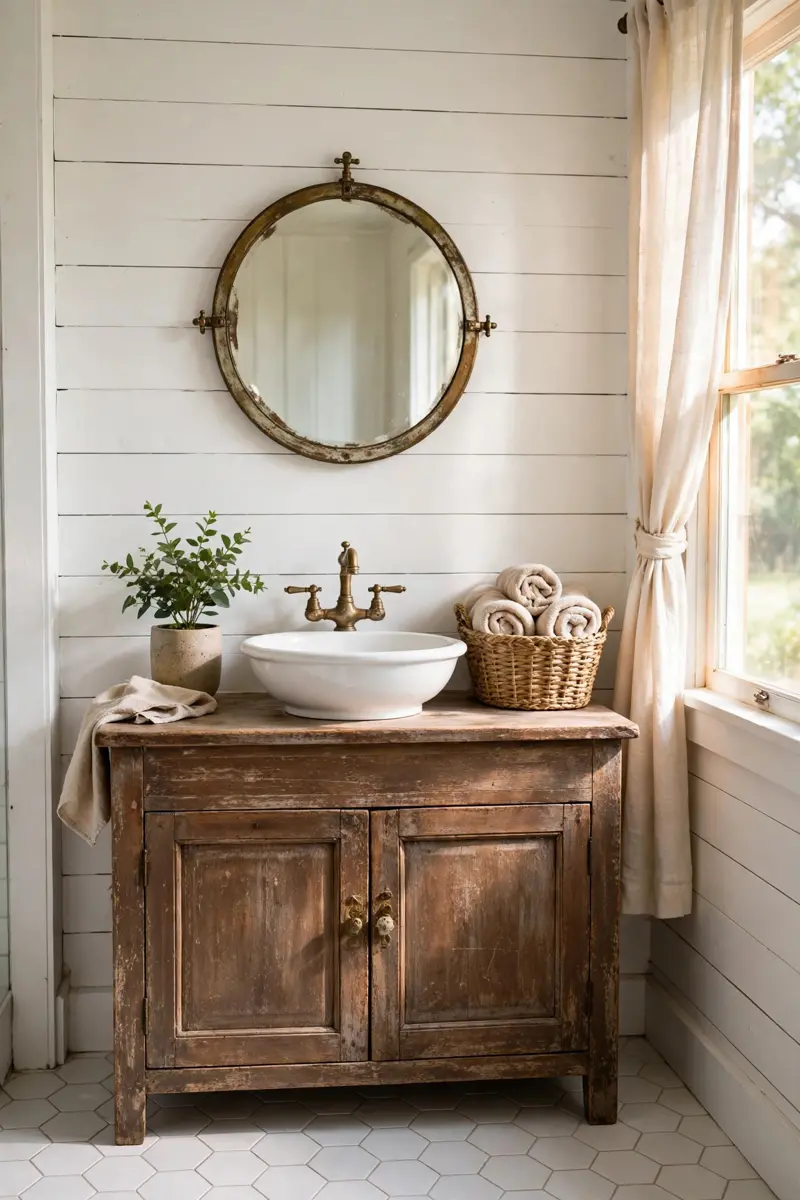
9. Vessel Sink on a Wood Console
A vessel sink sitting proudly on a wood console turns handwashing into a design moment. The bowl itself becomes sculpture — hand-blown glass, hammered copper, carved stone, or a simple white ceramic vessel — while the open console keeps the room feeling light.
Materials and realistic cost: a vessel sink ($90–$300), a wood console or repurposed table ($150–$400), a tall vessel faucet ($70–$150). Make sure the console height plus the vessel puts the rim at a comfortable 34–36 inches total.
Choose a faucet tall enough to clear the vessel rim by several inches, and seal wood consoles well against splashes. Keep the countertop around the vessel clear except for a soap dispenser and a small dish — clutter ruins the sculptural effect.
Tip: Test splash height before you commit: a very shallow vessel with a high-arc faucet will spray water everywhere.
Variation: A dark wood console with a white vessel suits modern farmhouse, while a live-edge slab suits rustic and organic styles.
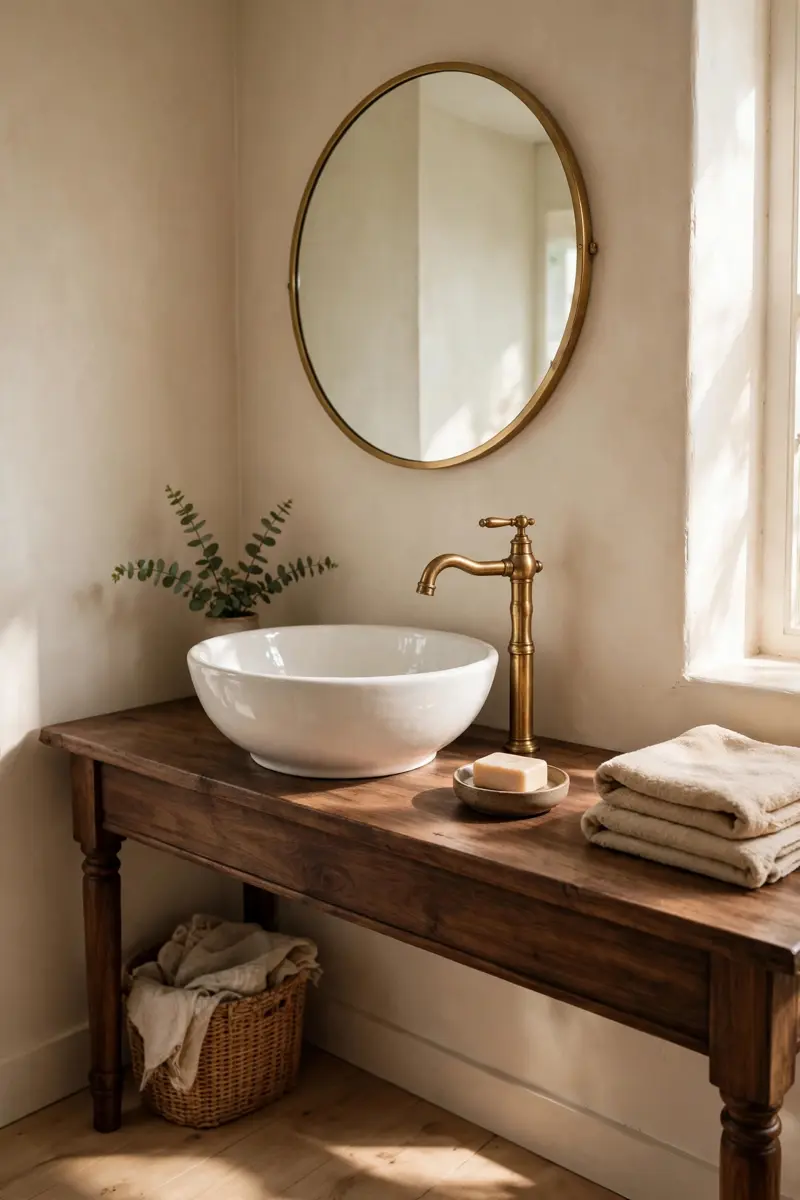
10. Marble-Look Vanity Top on a Budget
Real marble is gorgeous and expensive, but a marble-look quartz or laminate top gives you the same veined luxury in a powder room for a fraction of the price — and it is far easier to maintain around a sink.
Materials and realistic cost: a marble-look quartz remnant top ($150–$350 for a powder-room size), an undermount sink ($80–$180), a simple cabinet or console base ($150–$300). Stone yards often sell small remnants cheaply because the piece is too small for a kitchen.
Pair the veined top with a slim brass-framed mirror and a wall-mounted faucet so the stone stays the star. Keep cleaning simple: quartz needs no sealing, unlike real marble, so toothpaste and soap splashes wipe right off.
Tip: Ask local stone yards for remnants first — a powder-room top is exactly the size most shops have left over.
Variation: A marble-look top with a dark green or navy cabinet gives a high-end jewel-box look without repainting walls.
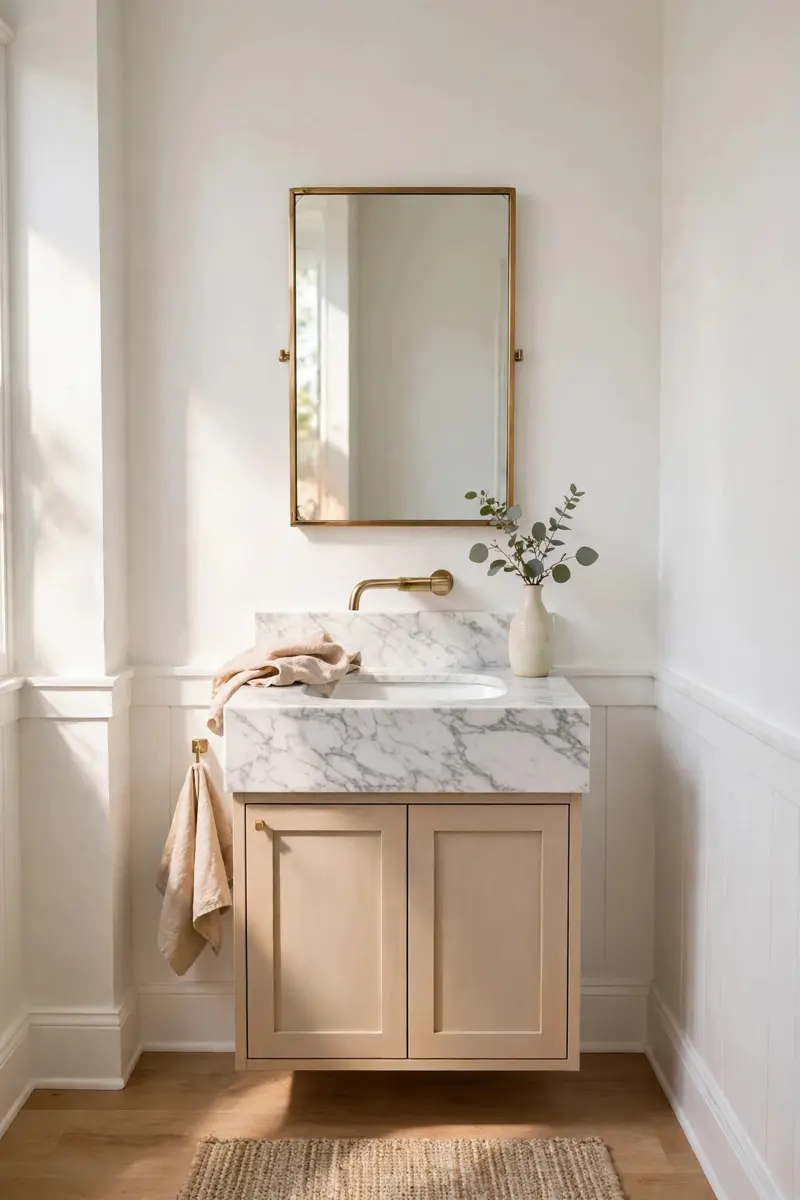
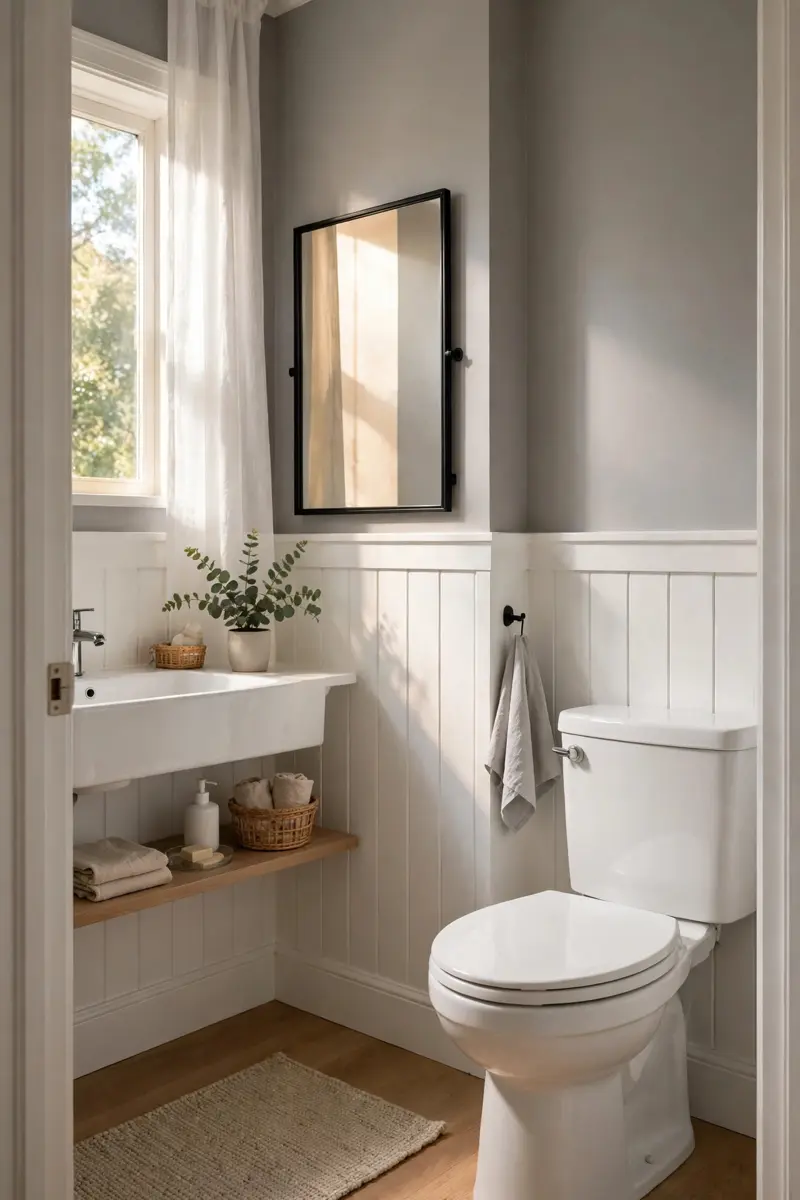
11. Board-and-Batten Wainscot
Board-and-batten wainscot adds architecture to a flat, boring powder room wall without any major construction. The vertical battens draw the eye upward, making low ceilings feel taller, and the painted panels give the room a finished, custom feel.
Materials and realistic cost: MDF boards and trim ($80–$200), paint ($45–$70), caulk and nails ($20). A single wall behind the toilet or vanity is often enough.
Run the wainscot to chair-rail height, about 36 inches, or go two-thirds up the wall for extra drama. Paint it the same color as the trim for a classic look, or paint it a bold accent color with neutral walls above for a modern twist.
Tip: Use a level and a stud finder for every batten — in a small room, one crooked board is impossible to ignore.
Variation: Paint the wainscot black or deep green with crisp white walls above for a striking two-tone powder room.
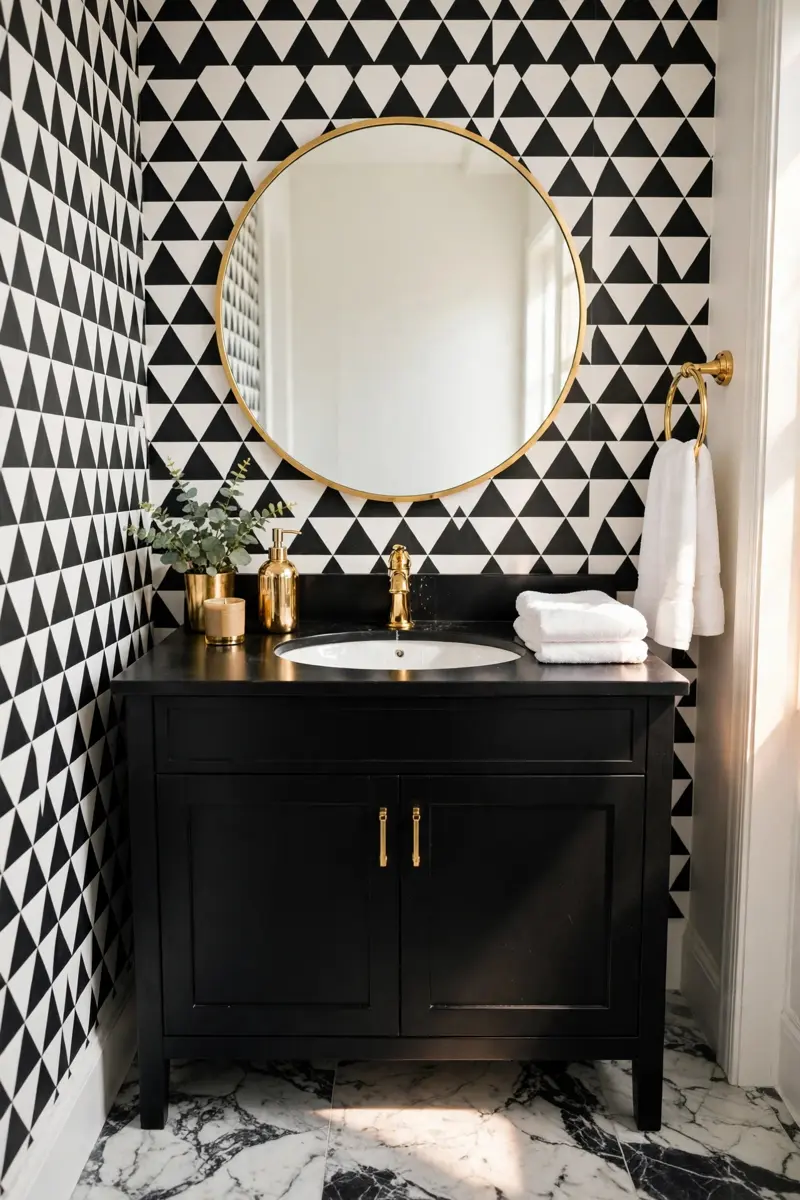
12. Black-and-White Graphic Scheme
You do not need color to make a bold half bathroom. Black, white, and gray can be just as eye-catching when done right — a black vanity, marbled flooring, black-and-white wallpaper, and gold accessories make a small powder room feel like a chic boutique hotel.
Materials and realistic cost: black vanity or black paint for an existing vanity ($60–$250), black-and-white wallpaper or tile ($60–$200), gold or brass accessories ($40–$90). White towels keep the scheme crisp.
Balance is everything here: if the vanity is black, keep the walls mostly white, and vice versa. Add one warm element — brass fixtures, a wood stool, a woven basket — so the graphic scheme feels inviting rather than stark.
Tip: Use soft black (a charcoal with warm undertones) rather than pure jet black, which can read harsh under bright bathroom lighting.
Variation: Swap gold accessories for matte black ones for a moodier, more modern monochrome look.
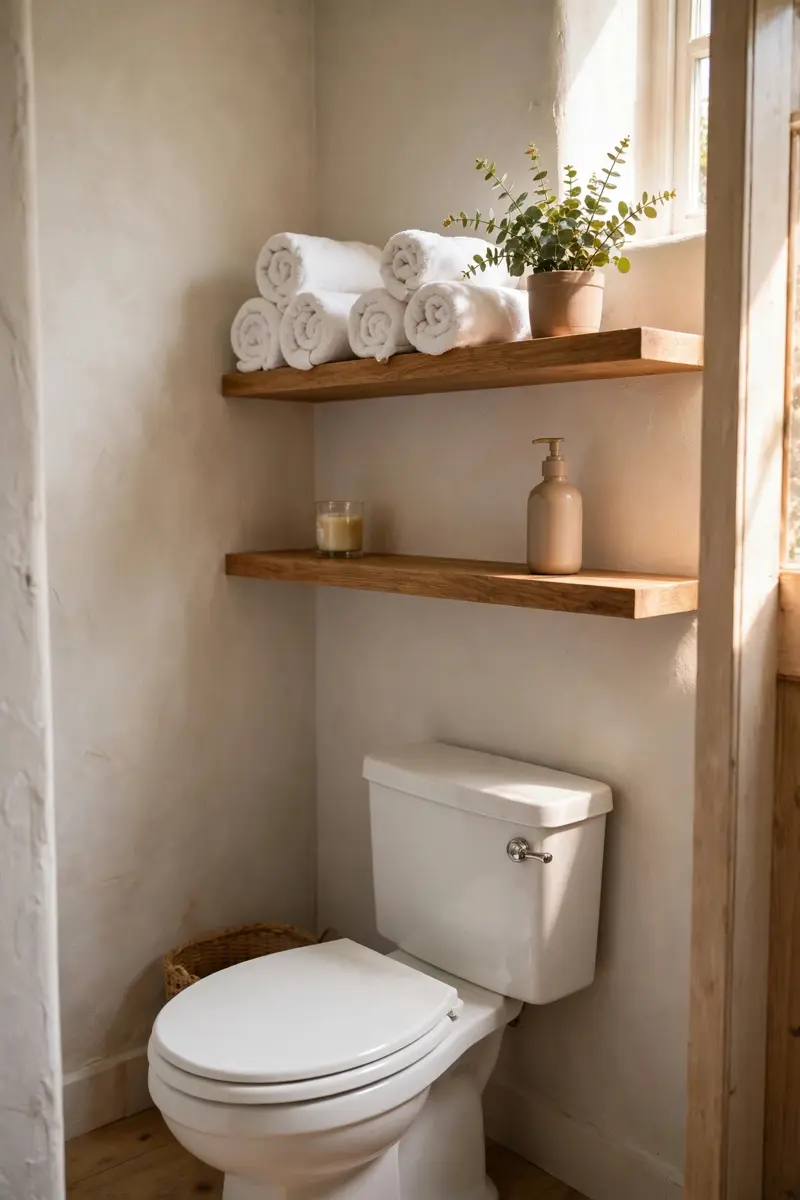
13. Open Shelves Over the Toilet
The wall above the toilet is prime real estate in a half bathroom, and open shelves turn it into both storage and display. Rolled hand towels, a small plant, a candle, and a pretty soap bottle look intentional here — and they keep essentials within reach for guests.
Materials and realistic cost: two wood shelves with brackets ($40–$120), baskets or small boxes ($20–$40), decor items you already own. Keep the total depth under 10 inches so nobody bumps their head.
Hang the lowest shelf high enough to clear the toilet tank lid — usually at least 24 inches above the tank — and style shelves with the rule of three: one tall item, one medium, one small per shelf. Leave breathing room; crammed shelves read as clutter in a tiny room.
Tip: Anchor shelves into studs, not just drywall anchors, since towels and toiletries add up to real weight over time.
Variation: A single long picture ledge over the toilet displays art and small plants and is easier to restyle seasonally.
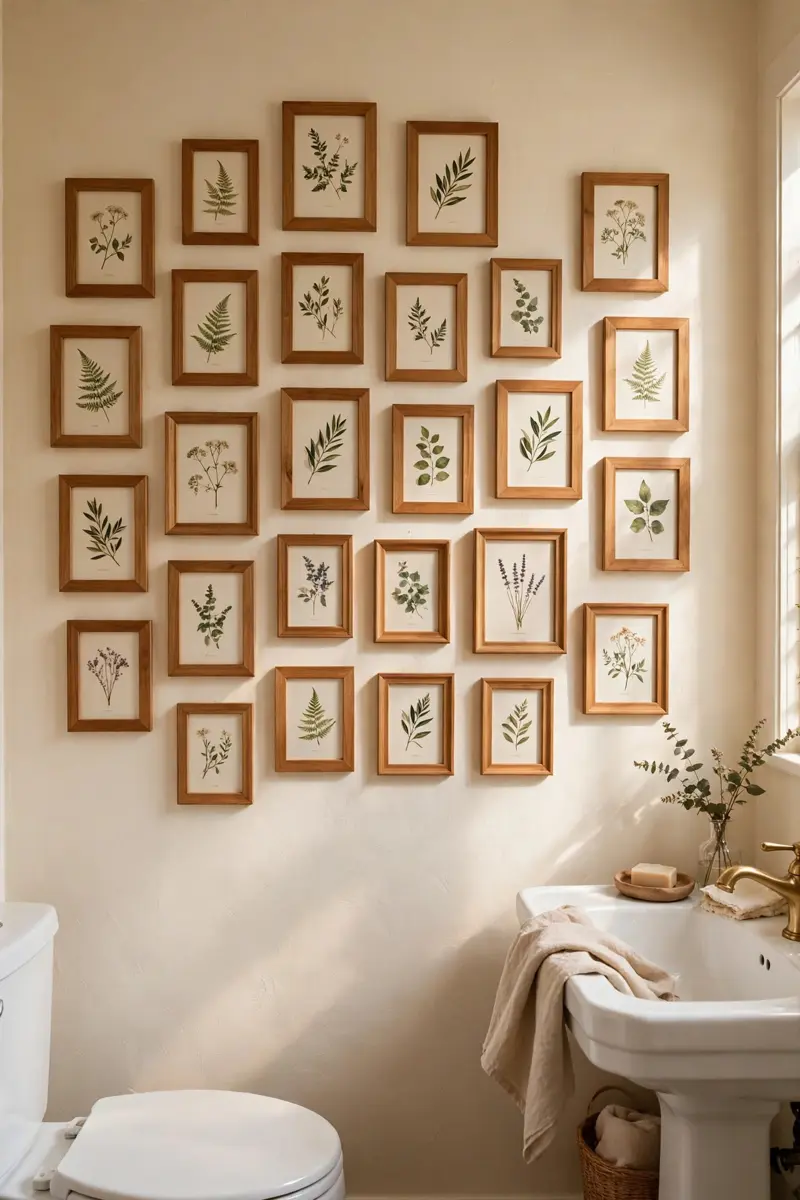
14. Gallery Wall of Small Art
A powder room is the perfect place for a gallery wall because guests actually stand still and look at the walls here. Small framed prints, vintage botanical plates, funny quotes, and family photos feel collected and personal in a way a single large print never does.
Materials and realistic cost: 5–8 small frames ($40–$100), prints or photos ($20–$60), picture-hanging strips or nails ($15). Thrifted frames painted one color tie a mismatched collection together.
Plan the layout on the floor first, keeping the whole arrangement roughly the size of a large mirror. Hang the center of the gallery at eye level, about 57 inches from the floor, and leave the wall behind the toilet or on the side wall for art — never behind the mirror, where it competes.
Tip: Use one unifying element — same frame color, same mat color, or one theme — so a mixed gallery still feels curated.
Variation: A salon wall of vintage mirrors in different shapes doubles as art and bounces light around the room.
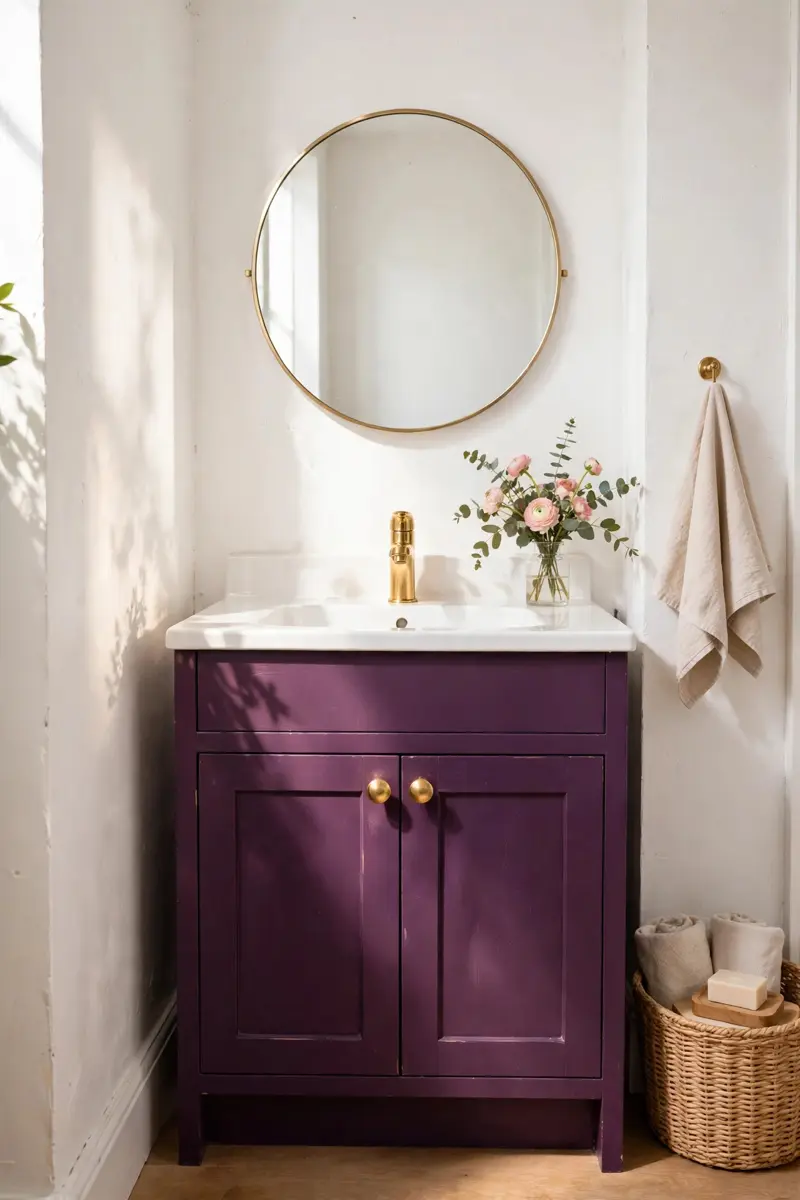
15. Bold Vanity Color as the Focal Point
Is your bland vanity giving you the blues? Paint it a fun and unexpected color instead. A dramatic plum, deep teal, or mustard vanity becomes the eye-catching focal point in a half bathroom, with gold or brass fixtures adding contrast and elegance.
Materials and realistic cost: cabinet paint and primer ($50–$80), new knobs or pulls ($20–$50), painter’s tape and sandpaper ($15). This is one of the cheapest transformations on this list.
Remove doors and hardware, sand lightly, prime, and apply two thin coats of cabinet paint rather than one thick coat — thin coats cure harder and resist chips. Let doors cure for at least 24 hours before rehanging, and swap in new hardware while you are at it.
Tip: Paint a test swatch on the inside of a door first and live with it for a day under your actual bathroom lighting before committing.
Variation: Paint just the vanity doors and leave the frame white for a two-tone look that is easier to change later.
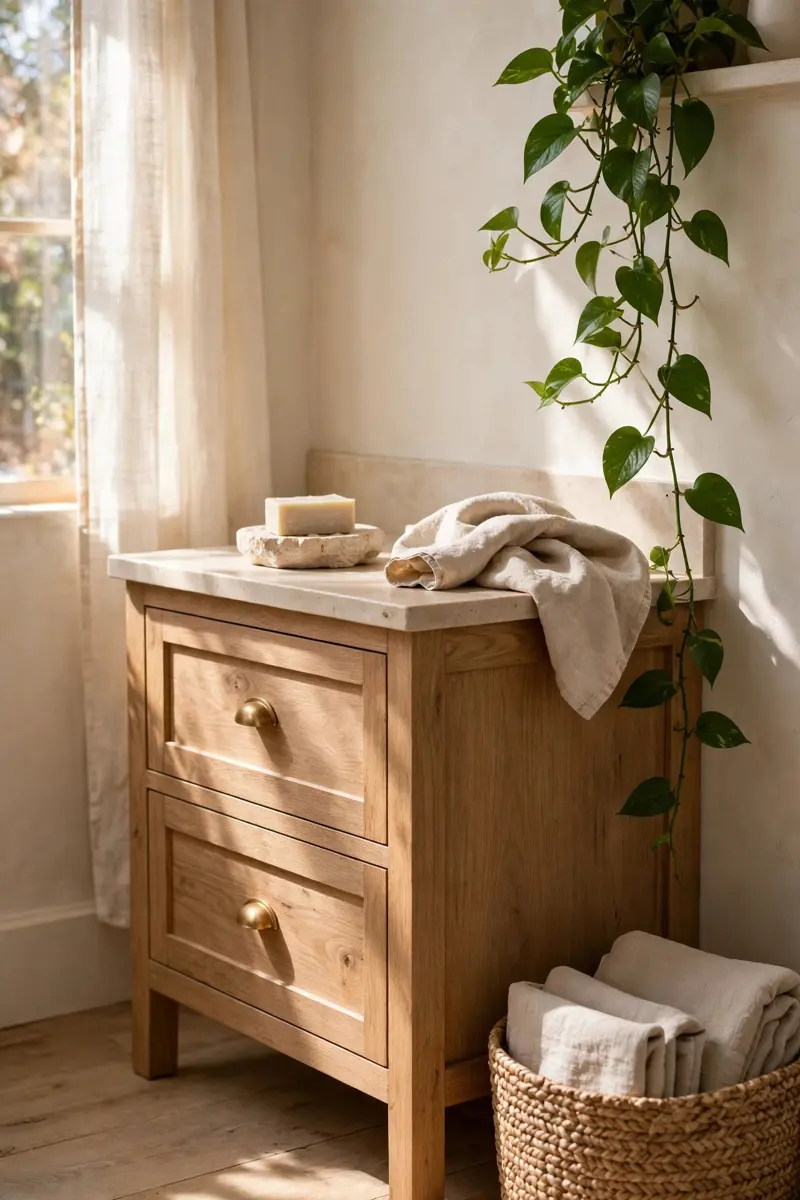
16. Spa-Like Neutrals with Natural Wood
Not every powder room needs to shout. Warm whites, soft beige, and natural wood create a calm, spa-like half bathroom that feels clean and current — and this palette is a safe bet if you plan to sell your home soon.
Materials and realistic cost: warm white paint ($45–$70), a wood vanity or wood-framed mirror ($150–$350), linen hand towels and a eucalyptus bundle ($25–$50). Natural textures do the decorating here.
Layer textures instead of colors: a woven basket, a wood tray, a linen towel, and a stone soap dish give a neutral room depth without clutter. Add one living plant — a pothos trailing from a shelf thrives in bathroom humidity — and keep counters almost bare.
Tip: Choose warm whites (creamy, not blue-white) for walls and towels so the room feels cozy rather than clinical.
Variation: Add a single black accent — a matte black faucet or frame — to keep an all-neutral room from feeling washed out.
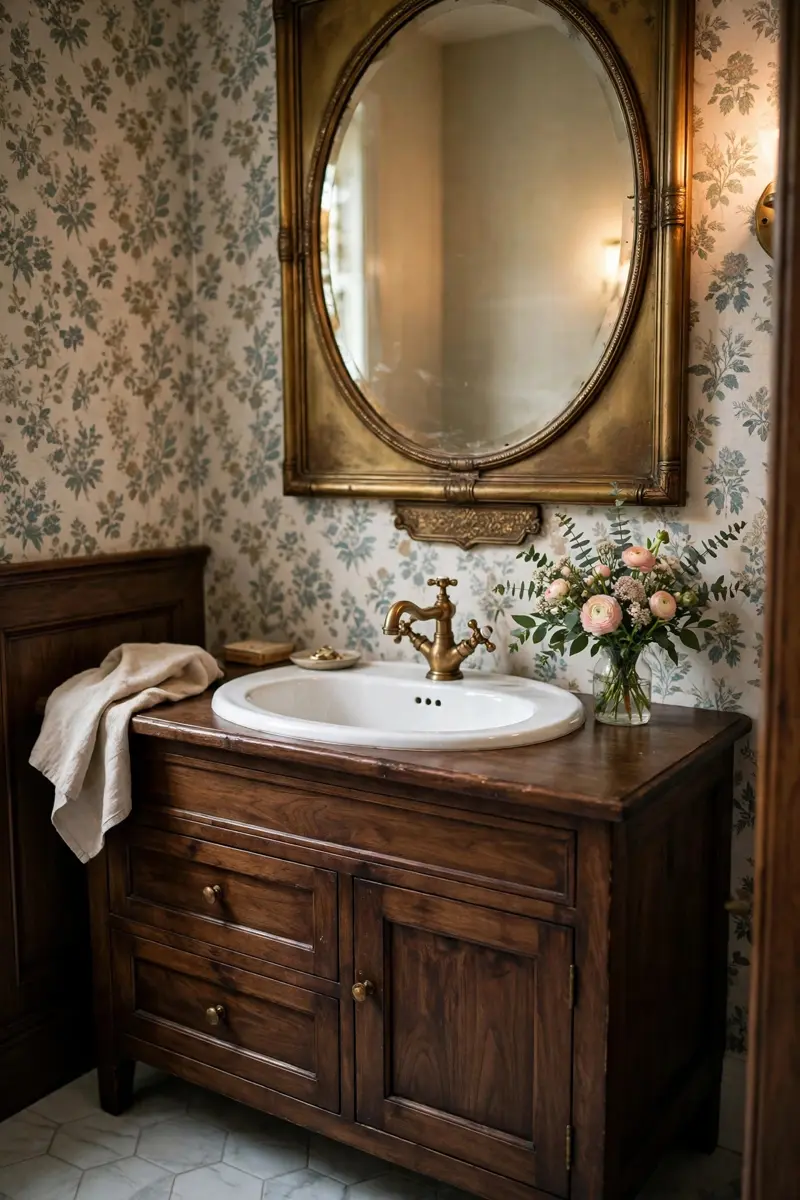
17. Vintage Brass and an Antique Mirror
A large antique-style brass mirror, warm metal fixtures, and patterned wallpaper give a compact powder room a collected, timeless character. The darker, richer palette makes the small room feel cozy rather than confined, like a tiny Parisian powder room.
Materials and realistic cost: a brass or brass-look mirror ($80–$200), brass faucet and hardware ($90–$200), vintage-style wallpaper or paint ($50–$120). Unlacquered brass develops a patina; lacquered brass stays shiny — pick one finish and stick with it.
Mix one genuine vintage piece — the mirror is the best candidate — with new brass fixtures in a matching tone so the room feels curated, not like a flea-market stall. Fresh flowers in a small vase on the vanity complete the look instantly.
Tip: Hold fixture samples against the mirror frame in your actual lighting before buying — “brass” ranges from pale gold to deep bronze, and mismatched tones clash.
Variation: Pair the brass mirror with olive-green paneled walls for a moody, sophisticated powder room that still feels warm.
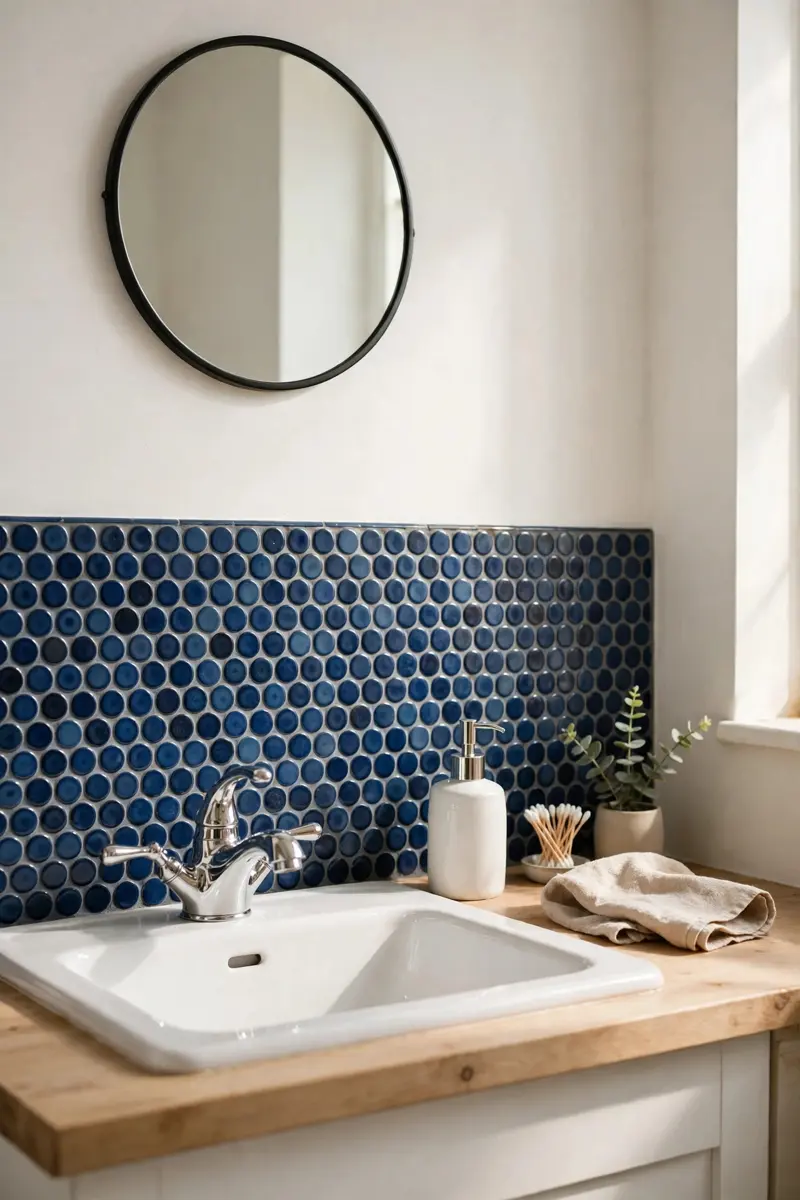
18. Geometric Penny Tile Accent
Penny tile in a bold color or an intricate mosaic pattern is a jewel-like detail that suits a powder room perfectly — you need so little of it that even a pricier tile stays affordable. Use it on the floor, as a vanity backsplash, or as a single accent strip.
Materials and realistic cost: penny or mosaic tile sheets ($60–$180 for a powder room), grout and sealer ($40), installation if you hire out ($150–$300). Bold colors — deep blue, forest green, terracotta — have the most impact.
Keep the rest of the room simple so the tile reads as intentional: plain walls, a white sink, and one metal finish. If you use penny tile on the floor, choose a grout color close to the tile color for a seamless look, or a contrasting grout if you want the pattern to pop.
Tip: Seal mosaic grout well — tiny tiles mean lots of grout lines, and sealed grout stays clean far longer in a splash zone.
Variation: Run penny tile up the vanity wall to the mirror for a backsplash that doubles as art.
19. Peel-and-Stick Wallpaper for Renters
Renters, this one is for you: removable peel-and-stick wallpaper transforms a half bathroom in an afternoon and peels off cleanly when you move out. Modern peel-and-stick papers come in the same bold botanicals, geometrics, and faux textures as pasted wallpaper.
Materials and realistic cost: 2–3 rolls of peel-and-stick wallpaper ($40–$90), a smoothing tool ($10), a sharp craft knife ($8). No paste, no steamer, no landlord drama.
Clean the wall thoroughly first — dust and bathroom humidity are the enemies of adhesion — then apply from the top down, smoothing as you go and trimming at the baseboard. Start on the vanity wall for maximum impact, and avoid applying it directly behind a sink splash zone unless the paper is vinyl-coated.
Tip: Order one extra roll beyond your measurements; pattern matching on peel-and-stick wastes more paper than pasted wallpaper.
Variation: Peel-and-stick shiplap or tile decals give the same renter-friendly transformation on a different wall.
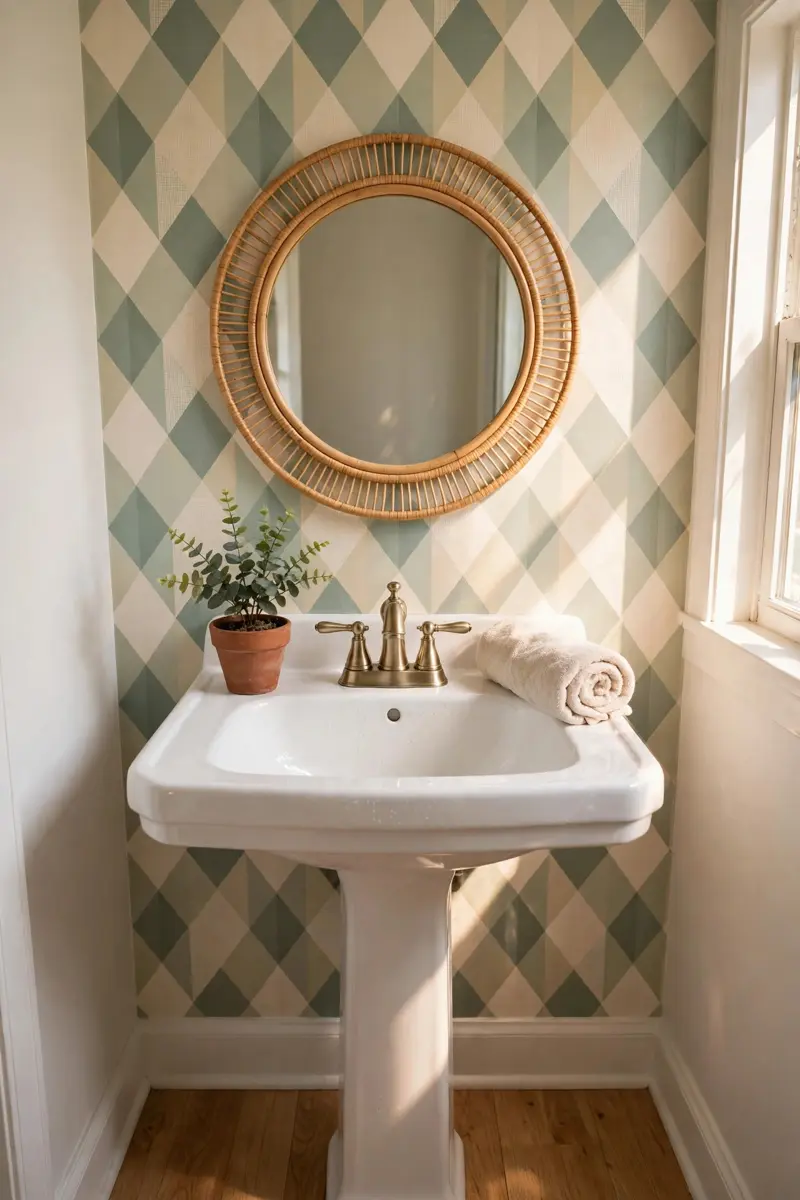
20. Corner Sink for an Awkward Layout
Some half bathrooms are so narrow or oddly shaped that a standard sink placement just does not work. A corner sink tucks neatly into the angle, freeing up the walking path and making an awkward room genuinely usable.
Materials and realistic cost: a corner sink ($100–$250), a compact corner faucet ($50–$120), plumbing adjustments if the drain moves ($100–$250). Measure the corner carefully — not all corners are a true 90 degrees.
Pair the corner sink with a corner mirror or a small round mirror hung on the angled wall above it, and keep the opposite wall free for the toilet and a towel ring. A wall-mounted corner shelf above the sink holds soap without crowding the basin.
Tip: Sit on the toilet and mime reaching for the sink before you finalize placement — in a tiny room, elbow room matters more than symmetry.
Variation: A triangular corner vanity with a tiny cabinet below adds storage that a pedestal corner sink cannot.
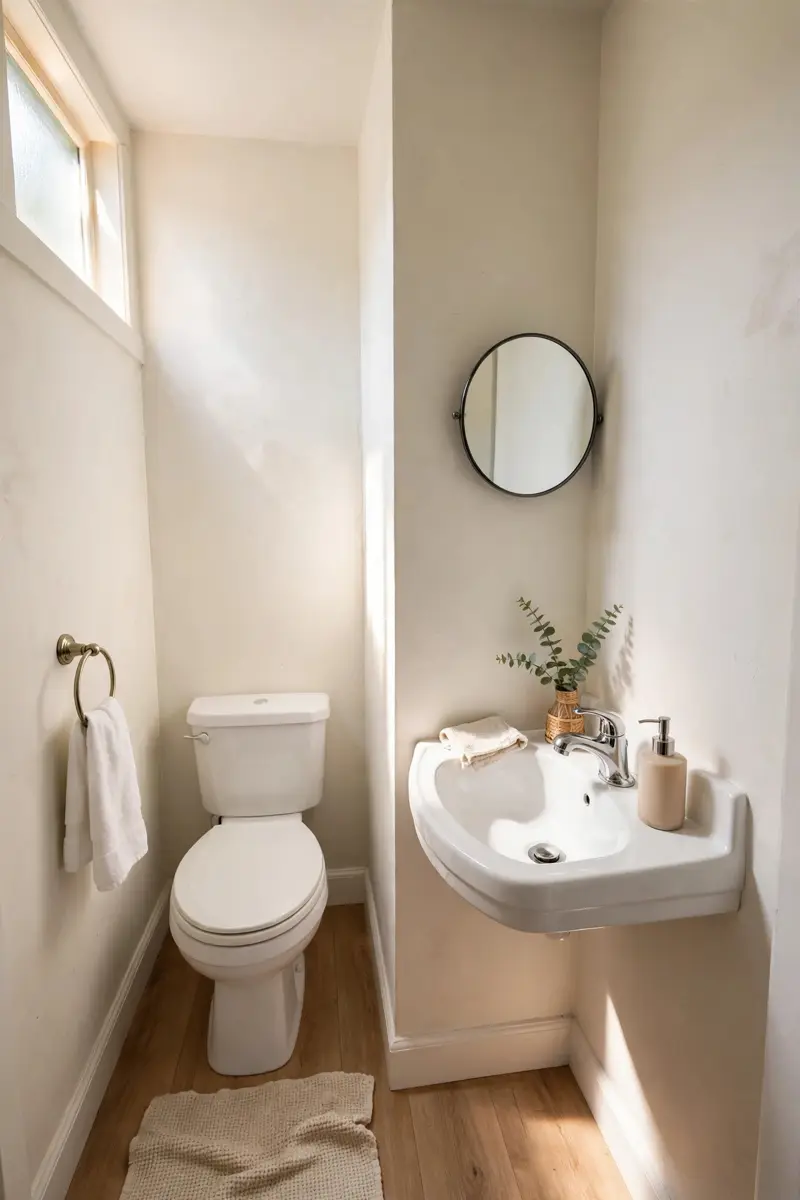
21. Backlit LED Mirror for Instant Glow
A backlit LED mirror adds a soft halo of light around the mirror, making the whole powder room feel modern, bright, and a little bit luxurious — without any extra fixtures on the wall. It is also genuinely useful: the even glow is flattering and shadow-free.
Materials and realistic cost: a backlit LED mirror ($120–$300), an electrician if hardwiring is needed ($100–$200), or a plug-in model ($90–$180) that avoids wiring altogether. Choose warm white 2700–3000K for a cozy glow.
Center the mirror over the sink and wire it to the same switch as the overhead light, or choose a model with a touch sensor for independent control. Keep the wall behind it plain — the halo effect needs a clean surface to glow against.
Tip: Check the mirror’s color temperature before buying; cool-white LEDs (4000K+) can make a warm powder room feel like an office.
Variation: A backlit arched mirror combines the glow with the height-adding shape of an arch.
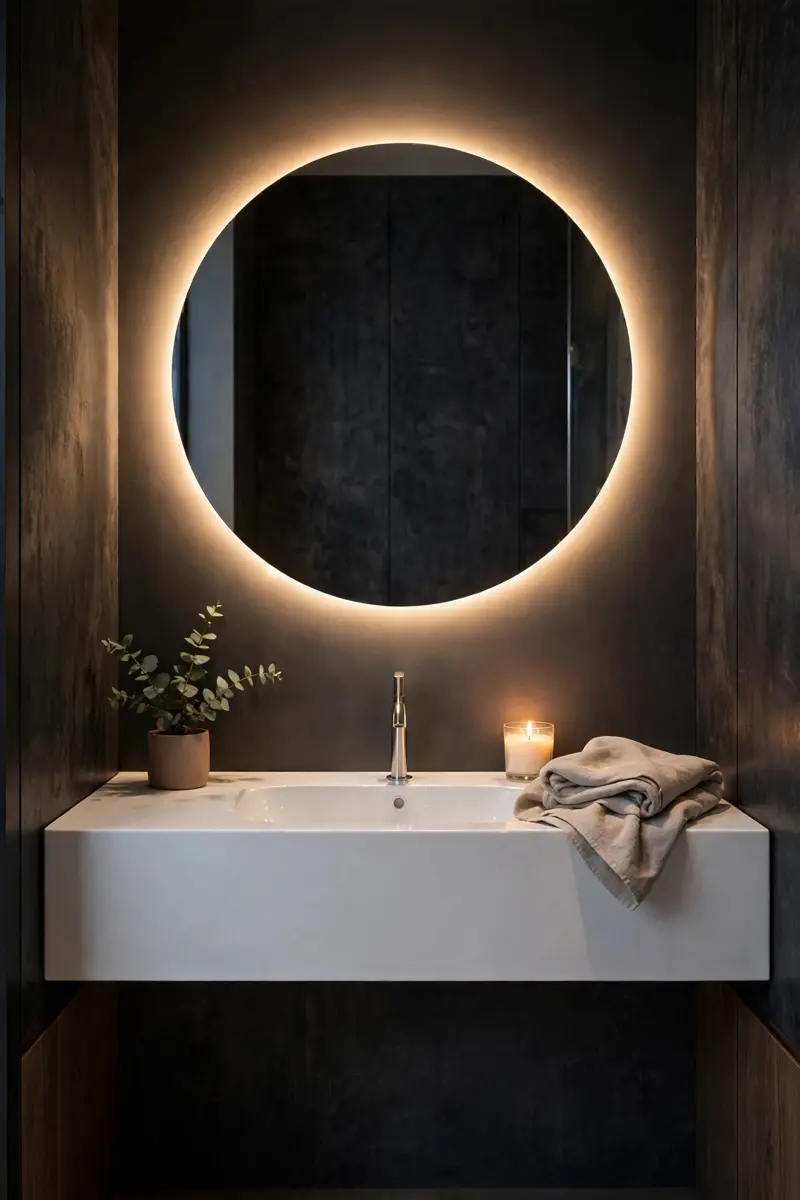
22. Woven Baskets and Textile Storage
A half bathroom rarely has a linen closet, so storage has to look good. Woven baskets, a rolled-towel ladder, and a pretty lidded hamper turn necessary storage into decor — and natural fibers warm up a room full of cold porcelain and tile.
Materials and realistic cost: 2–3 woven baskets ($30–$80), a leaning towel ladder ($40–$90), a small lidded basket for extras ($20). Roll hand towels instead of folding them — they look better and take up less room.
Place one basket on the floor beside the vanity for extra toilet paper, hang a towel ladder on the longest free wall, and keep one small basket on a shelf for guest essentials. Stick to one basket material — seagrass, rattan, or cotton rope — so the storage reads as a set.
Tip: Line baskets that hold toilet paper with a small plastic bag inside; bathroom humidity can dampen paper stored in open weave.
Variation: A wall-mounted woven pocket organizer holds brushes, soaps, and small items without any floor space at all.
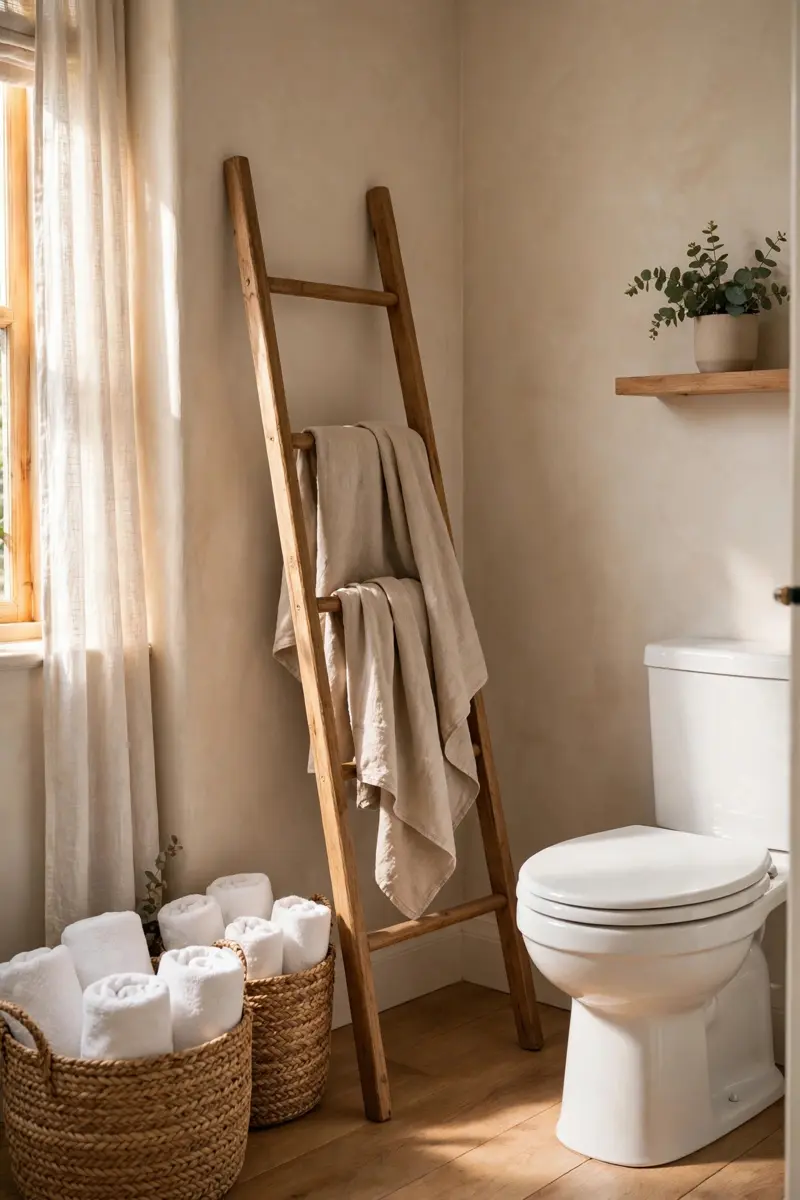
23. Sleek Monochrome Minimalism
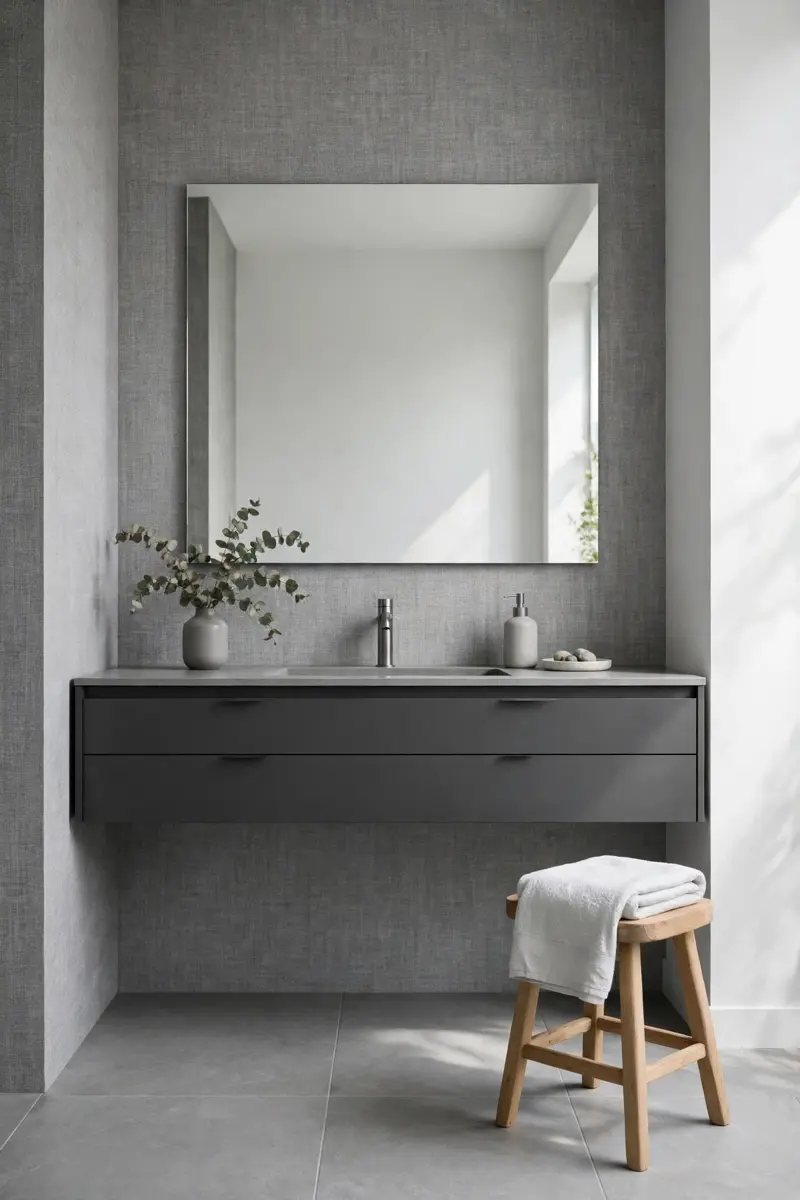
If bold patterns are not your style, a monochromatic half bathroom — varying shades of one color, usually gray, white, or beige — can be just as striking. Texture does the work here: textured wallpaper, large polished tiles, and a floating vanity in a deep charcoal finish.
Materials and realistic cost: textured wallpaper or paint ($50–$120), a floating vanity in charcoal or gray ($180–$400), a frameless mirror ($60–$150). One metal finish throughout keeps the minimal look clean.
Vary the shades deliberately: light walls, a mid-tone vanity, dark floors or fixtures. If everything is exactly the same shade, the room goes flat; if the shades step gradually, it feels layered and intentional.
Tip: Add one organic texture — a wood stool, a linen towel, a green stem — so a minimal room still feels lived-in.
Variation: An all-white monochrome room with marble-look tile feels bright and spa-like, while gray monochrome feels sleek and modern.
24. Coastal Blue Calm
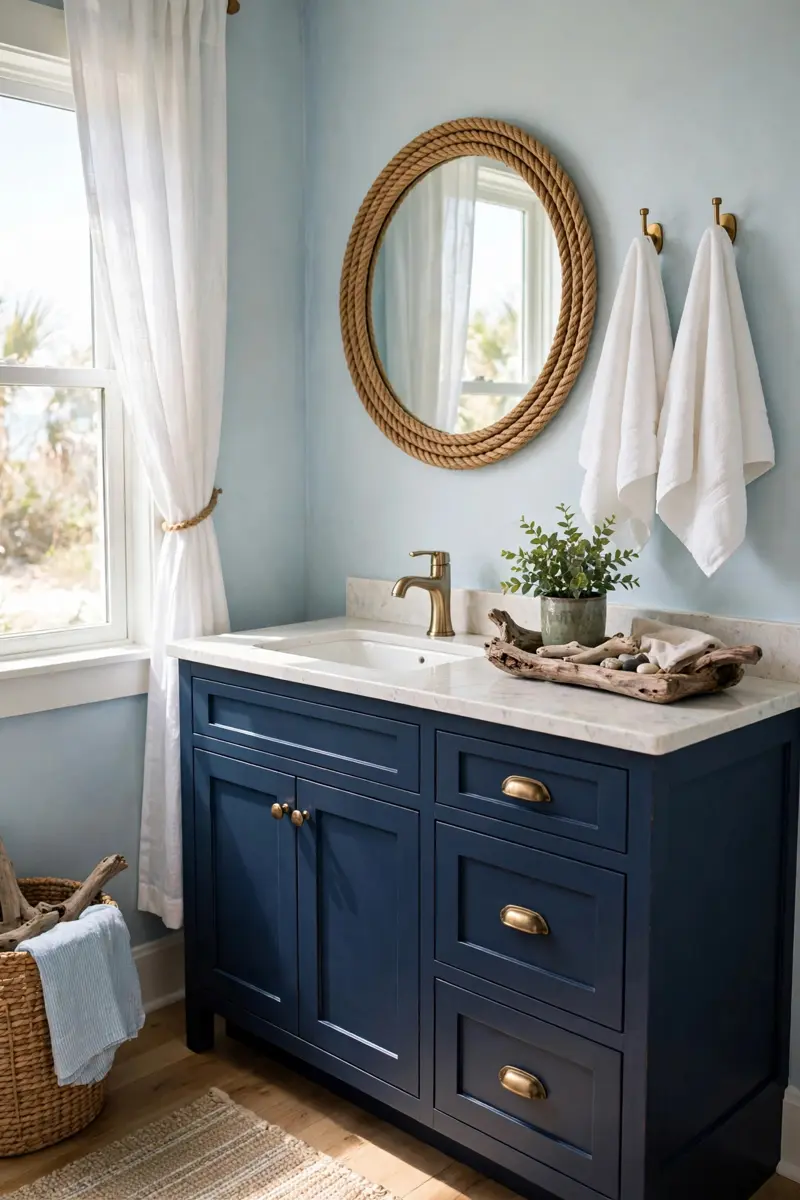
Blue tones are known for being soothing, and a coastal blue powder room feels like a deep breath. Layer complementary shades — pale blue walls, a navy vanity, white fixtures — and add white hand towels and a touch of natural wood for a relaxed, beach-house feel.
Materials and realistic cost: blue paint ($45–$70), a navy or blue vanity (paint an existing one for $50–$80, or buy for $200–$400), coastal accessories like a rope mirror or driftwood tray ($30–$70).
Keep the blues in the same family — all cool blues or all warm blues — so they harmonize instead of clashing. A custom blue tile accent or blue wallpaper on one wall adds depth, while white fixtures keep the room feeling fresh rather than dark.
Tip: Test blue paint in your actual lighting: blue shifts dramatically between warm and cool bulbs, and the wrong bulb can turn a serene blue muddy.
Variation: A single bold navy accent wall with white shiplap elsewhere gives coastal impact without repainting the whole room.
25. Art Deco Glam in Black and Gold
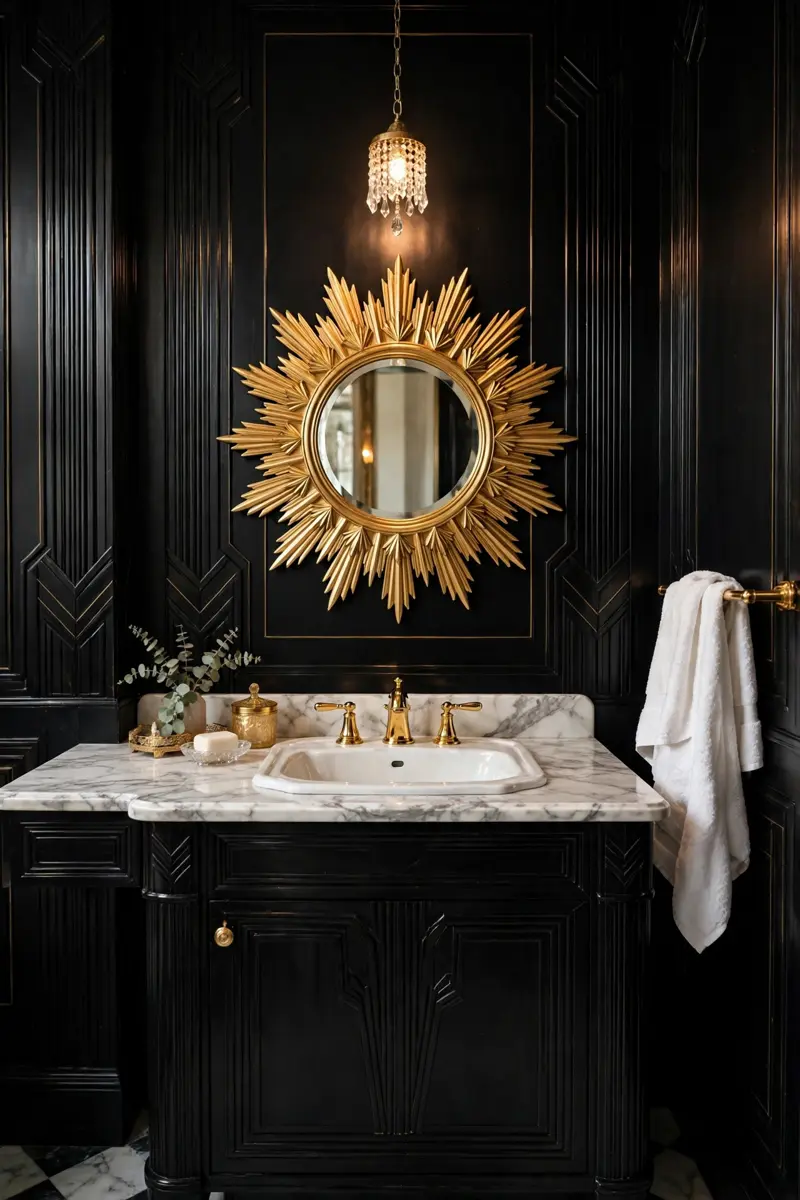
Black walls, gold fixtures, a geometric mirror, and a marble-look top turn a half bathroom into a tiny Art Deco lounge. It is dramatic, glamorous, and surprisingly easy in a small space — you need only a few gold pieces to sell the whole fantasy.
Materials and realistic cost: black or deep charcoal paint ($45–$70), gold faucet and mirror frame ($120–$250), a geometric or sunburst mirror ($80–$180). A crystal or glass pendant light adds sparkle ($60–$150).
Keep the gold consistent and the black matte or eggshell rather than glossy, so the room feels luxe rather than shiny. White fixtures provide contrast, and a single bold piece of Deco-style art on the side wall completes the theme.
Tip: Limit gold to two or three pieces — faucet, mirror frame, and one accessory — or the glam tips into gaudy.
Variation: Swap black walls for deep emerald with gold fixtures for a Deco look that feels a little softer and more jewel-like.
26. Guest-Ready Styling: The Finishing Layer
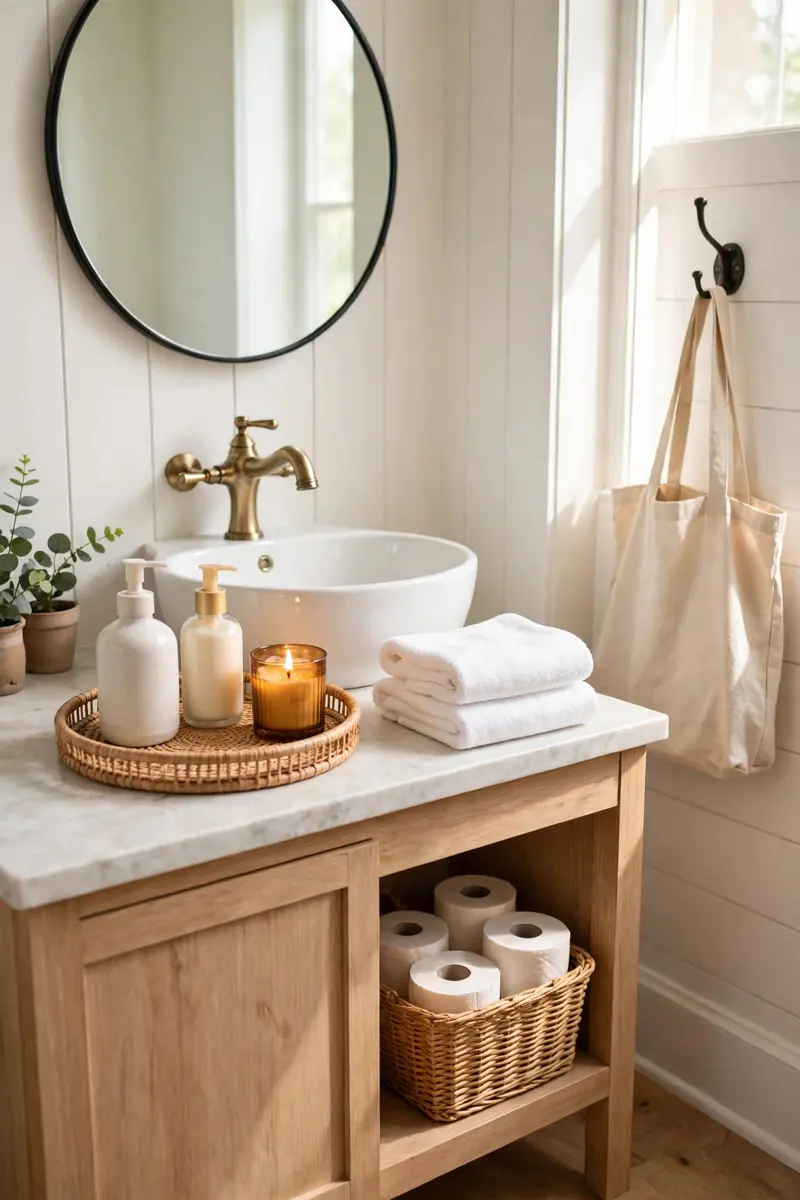
The last half bathroom idea is not a renovation at all — it is the styling layer that makes every other idea work for real guests. A beautiful powder room still fails if the soap is empty, the towel is damp, and there is nowhere to put a bag.
Materials and realistic cost: a matching soap dispenser and tray ($25–$50), fresh hand towels ($20–$40), a reed diffuser or candle ($15–$30), a small stool or hook for bags ($20–$40). This is the cheapest idea here and the one guests notice most.
Set a small tray on the vanity or toilet tank with soap, lotion, and a candle; hang two fresh hand towels (one in use, one spare); add a hook on the door for a bag or coat; and keep a spare toilet roll visible in a basket so no guest has to hunt for one. Refresh the scent and towels before guests arrive, and the room feels like a boutique hotel every time.
Tip: Choose a light, clean scent — linen, citrus, or eucalyptus — rather than a heavy floral, which can overwhelm a tiny room fast.
Variation: A seasonal swap — pine and cinnamon in winter, citrus and greenery in summer — keeps the guest layer feeling fresh all year.
Half Bathroom Ideas: Frequently Asked Questions
What is a half bathroom?
A half bathroom, also called a powder room, has a toilet and a sink but no shower or bathtub. It is usually 15 to 32 square feet, often located near living areas or entryways for guests, and it is the easiest bathroom to remodel because there is so little of it to change.
How do you decorate a small half bathroom on a budget?
Start with paint and hardware — a bold paint color, new faucet handles, and a statement mirror can transform a powder room for under $200. Peel-and-stick wallpaper, a new light fixture, and fresh towels are the next best budget moves, since they change the look without any plumbing or tiling work.
What color makes a small half bathroom look bigger?
Light, warm neutrals — warm white, soft beige, pale gray — reflect the most light and make a tiny room feel open. That said, a dark color used deliberately, with warm lighting and a large mirror, can also work beautifully by making the room feel like an intentional jewel box rather than a cramped afterthought.
Pedestal sink or floating vanity — which is better for a half bathroom?
A pedestal sink is best for the very tiniest rooms because it has the smallest footprint, while a floating vanity is better if you want counter space and storage without a bulky cabinet reaching the floor. If your room is under 20 square feet, go pedestal; if you have a little more room and want storage, go floating.
Can you put wallpaper in a half bathroom?
Yes — a half bathroom is actually the best bathroom for wallpaper because there is no shower steam to damage it. Choose vinyl or moisture-resistant wallpaper near the sink, avoid pasting paper directly inside a splash zone, and make sure the room has at least some ventilation so humidity does not build up behind the paper.
Conclusion: Pick One Hero, Then Stop
The secret to great half bathroom ideas is not doing more — it is doing one thing boldly and letting the rest of the room support it. Whether you choose bold wallpaper, a jewel-box dark wall, a floating vanity, or a statement mirror, pick your hero, add fresh towels and a good scent, and leave the rest alone. Your guests will notice, your tiny room will feel intentional, and you will have spent far less than a full remodel would cost.
If you found an idea you love, save this post to Pinterest so you can find it again when you are ready to start — and check out our other bathroom guides for more inspiration: our small bathroom decor ideas on a budget, our bathroom wall decor ideas, and our farmhouse bathroom mirror ideas. For even more powder room inspiration, browse the HGTV half baths and powder rooms gallery.