
There is something about a marble island that instantly makes a kitchen feel finished. The cool stone, the soft veining, and the way light moves across it give you a focal point that works in almost any style. If you are planning a remodel or just dreaming about one, these marble kitchen island ideas will help you pick a look you will love living with.
Before you fall for a slab, think about how you actually use your kitchen. Do you need seating for busy mornings, a sink close to the stove, or simply more prep space? Marble comes in many colors and finishes, so you can match it to white cabinets, warm wood, or a bold dark base. Keep reading for 28 distinct looks, plus realistic costs, care tips, and answers to the questions everyone asks before buying stone. Use these marble kitchen island ideas as a shortlist to take to the stone yard.
1. Classic White Carrara Island
A white Carrara island is the timeless starting point, and among marble kitchen island ideas it is the one designers return to again and again. Its soft grey veining on a white background feels calm, bright, and easy to pair with almost any cabinet color. It suits traditional kitchens, transitional spaces, and even modern rooms that need a little warmth.
Materials and cost: a Carrara slab typically runs $40–$100 per square foot for material, plus fabrication and installation. A standard island top often lands around $2,000–$4,500 in total, depending on size and edge detail. Add a penetrating sealer and pH-neutral cleaner to your shopping list.
To get the look, choose a slab with gentle, even veining rather than one dramatic streak. Pair it with white or light grey cabinets, brushed nickel hardware, and a simple subway tile backsplash. Keep the edge profile clean, like an eased or pencil edge, so the stone stays the star.
Tip: Seal Carrara on installation day and again every 6–12 months, and wipe up coffee, wine, and tomato sauce right away.
Variation: try honed Carrara instead of polished for a softer, matte finish that hides small etch marks better.
2. Dramatic Calacatta Statement Island
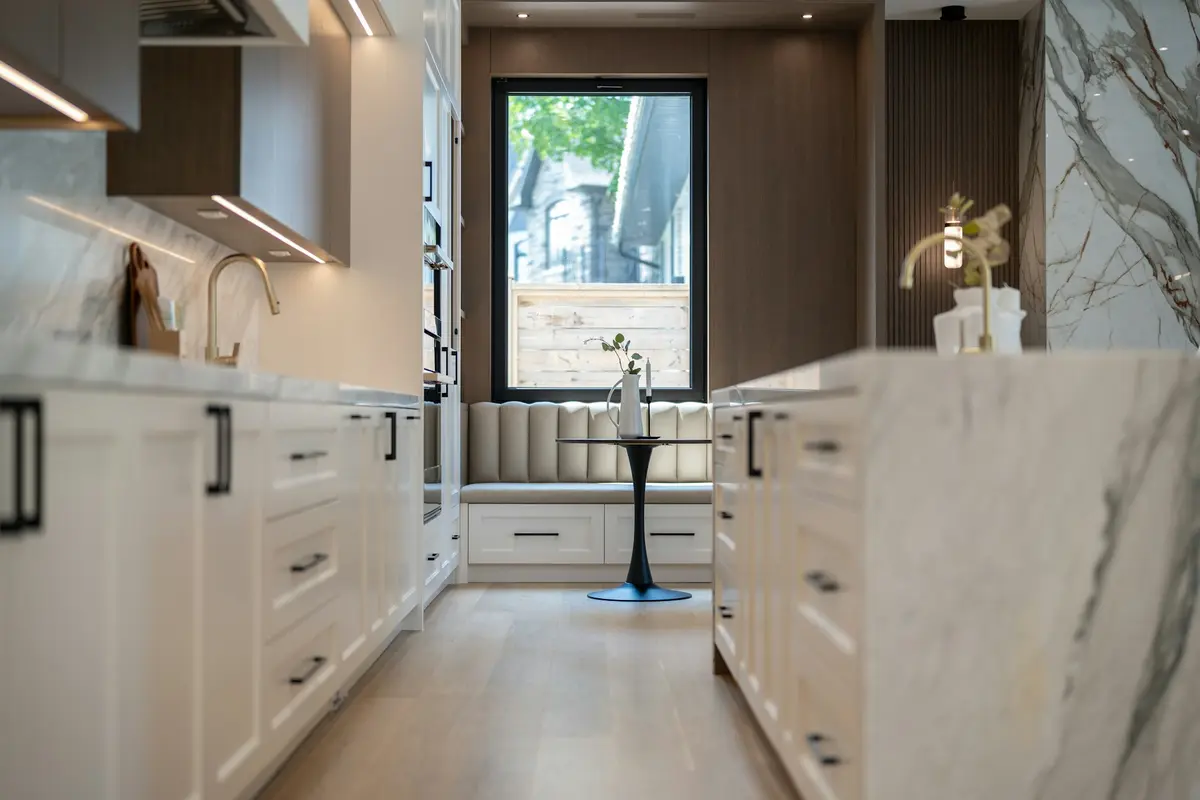
If Carrara whispers, Calacatta makes a statement. Its bolder, thicker veining in grey and gold turns the island into art, and it is one of the most saved marble kitchen island ideas on Pinterest right now. This is the choice when you want guests to stop and stare the moment they walk in.
Materials and cost: Calacatta is usually pricier than Carrara, often $100–$180 per square foot for material. Expect $4,000–$8,000 for a generous island top with fabrication. Because the veining is the feature, budget for a full slab so you can choose exactly where the veins fall.
Work with your fabricator to center the most dramatic veining on the front face or the longest run of the top. Keep surrounding surfaces quiet: plain cabinets, a simple backsplash, and minimal clutter let the stone breathe. Gold or brass hardware picks up the warm veins beautifully.
Tip: Photograph your chosen slab at the stone yard before cutting, so you can approve the vein placement.
Variation: use Calacatta only on the island and a quieter quartz or butcher block on the perimeter counters to save money.

3. Waterfall Edge Island
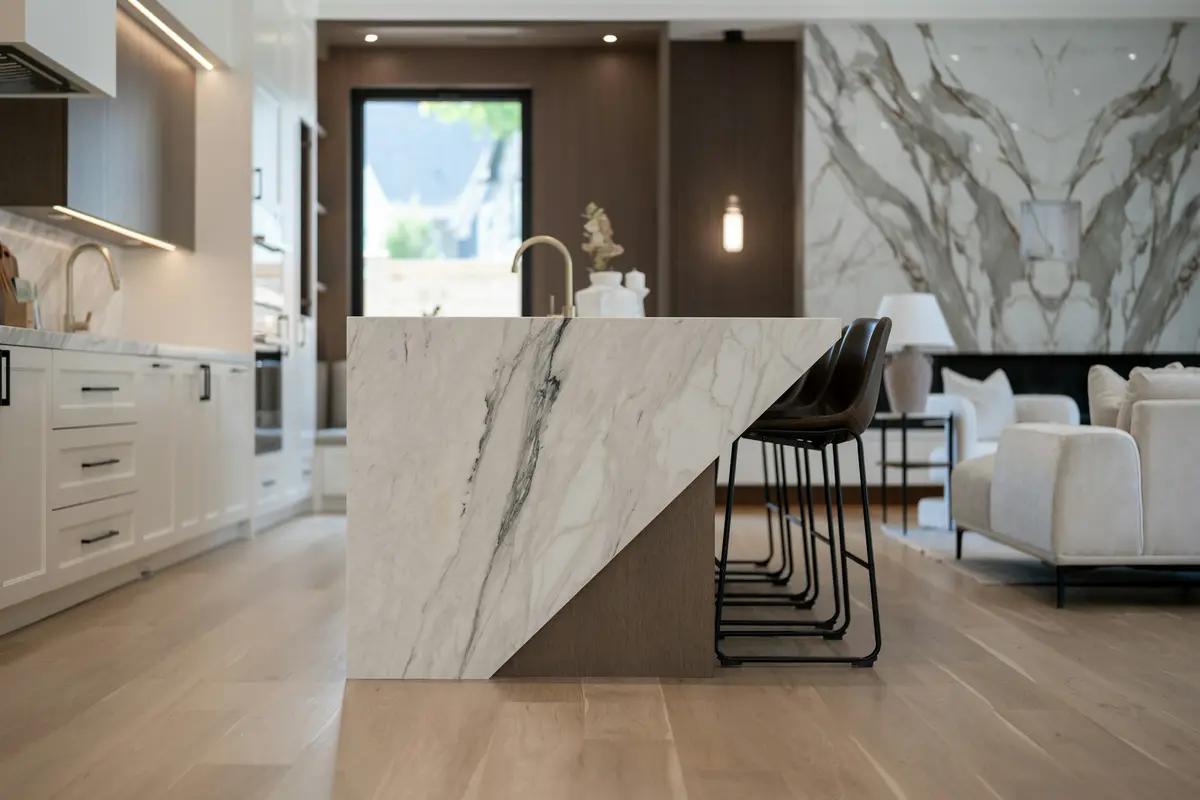
A waterfall edge is the most pinned look of the moment, and it is easy to see why. The marble flows from the countertop straight down the sides to the floor, creating one continuous, sculptural block. Among marble kitchen island ideas, this one delivers the biggest wow per square foot.
Materials and cost: a waterfall edge needs 30–50% more stone than a flat top, so add $1,500–$3,500 to a standard island budget. Book-matching, where the veining mirrors across the corner, costs extra but looks spectacular. Choose a slab large enough for the top plus both drops.
Ask your fabricator about mitered edges, which hide seams and make the fold look seamless. This style suits modern and transitional kitchens best, and it looks especially good in open-plan rooms where the island is visible from every angle. Keep the base simple so the stone does the talking.
Tip: Confirm the vein flow across the mitered corner before cutting — a broken vein pattern ruins the waterfall effect.
Variation: do a waterfall on one side only and a plain panel on the other to cut stone costs nearly in half.
4. Black Marble Island
A black marble island brings instant drama, especially against white cabinets or pale walls. White or gold veining across a deep black surface feels luxurious and modern, and it hides everyday crumbs far better than white stone. This is one of the boldest marble kitchen island ideas, and it rewards confident styling.
Materials and cost: black marble such as Nero Portoro or Black Marquina runs roughly $80–$160 per square foot for material. A full island top typically costs $3,500–$7,000 installed. Fingerprints and dust show more on dark polished stone, so plan on a quick daily wipe.
Pair the island with brass pendant lights, warm wood stools, and light perimeter counters to keep the room from feeling heavy. A honed finish softens the drama and shows fewer smudges than high polish. Keep decor minimal: a wooden board, a small plant, and little else.
Tip: Use a honed finish and a dark grout-free backsplash nearby so the black island reads as one clean block.
Variation: try black marble with gold veining and gold hardware for a glamorous, hotel-like kitchen.

5. Marble Island with Brass Accents
Brass and marble are a classic pairing because the warm metal softens the cool stone. Think brass pendant lights, a brass faucet, and slim brass bar pulls on the island base. This is one of those marble kitchen island ideas that feels expensive without requiring a rare slab.
Materials and cost: a white marble top ($2,000–$4,500) plus brass lighting ($150–$600 for pendants) and a brass faucet ($200–$500) keeps the upgrade focused. Unlacquered brass will patina over time, which many people love; lacquered brass stays shiny with less care.
Start with one brass hero, usually the pendants, then repeat the finish in small doses: faucet, cabinet pulls, and a tray. Avoid mixing too many metals — pick brass as your accent and keep appliances stainless. Warm white or sage cabinets sit beautifully under this combination.
Tip: If you love the patina look, choose unlacquered brass and skip the polish; if you prefer shine, choose lacquered.
Variation: swap brass for aged bronze if your kitchen leans farmhouse rather than glam.

6. Marble Island with a Warm Wood Base
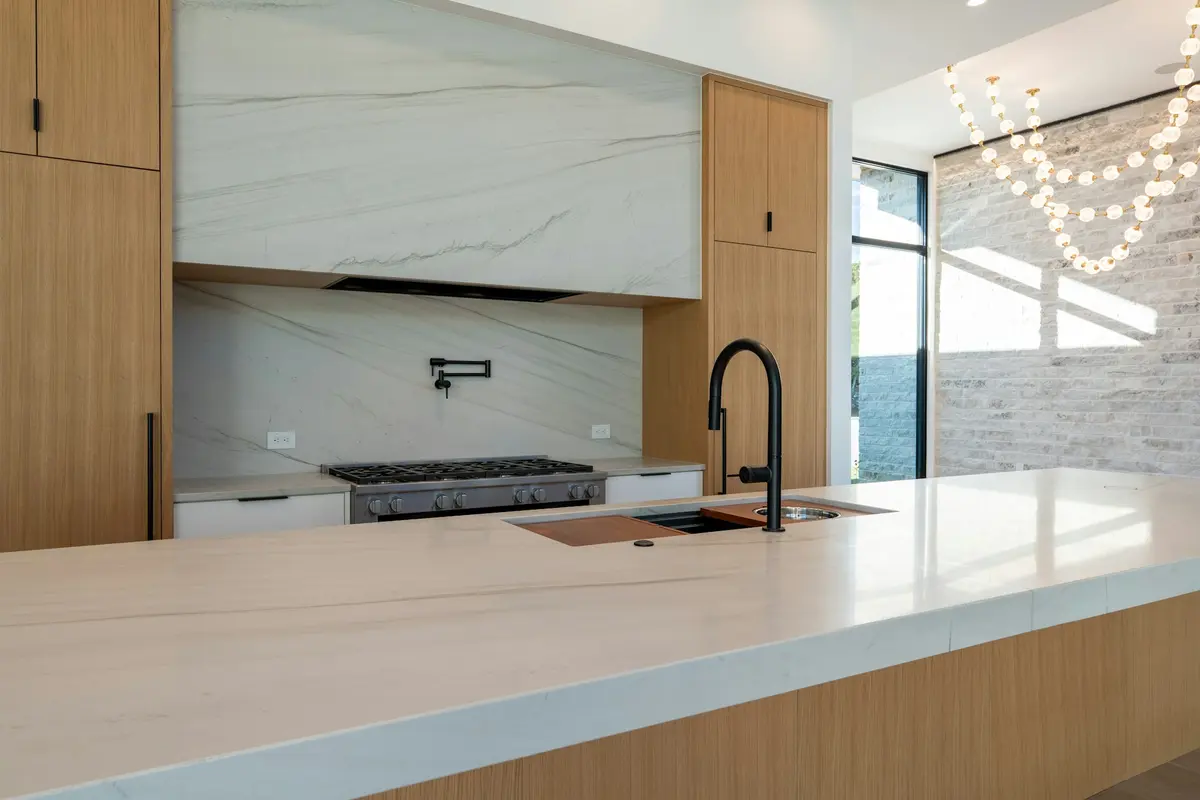
A marble top on a warm wood base solves marble’s one visual problem: it can feel cold. Oak, walnut, or reclaimed wood underneath adds warmth, texture, and a relaxed feel. This pairing is one of the most livable marble kitchen island ideas for family kitchens.
Materials and cost: a marble top ($2,000–$4,500) over a wood base or wood-paneled island ($800–$2,500 for paneling or a stock base) is often cheaper than an all-stone waterfall. Reclaimed wood costs more but adds character that new wood cannot copy.
Choose a wood tone that echoes something else in the room, like open shelves or a dining table, so the island feels connected. Keep the marble light and the wood medium-toned for balance. Add woven or leather stools to complete the warm, collected look.
Tip: Seal the wood base near the floor well, since mopping splashes are the wood’s biggest enemy.
Variation: use fluted wood panels on the island front for texture without a full reclaimed-wood price tag.
7. Two-Tone Island with a Colored Base
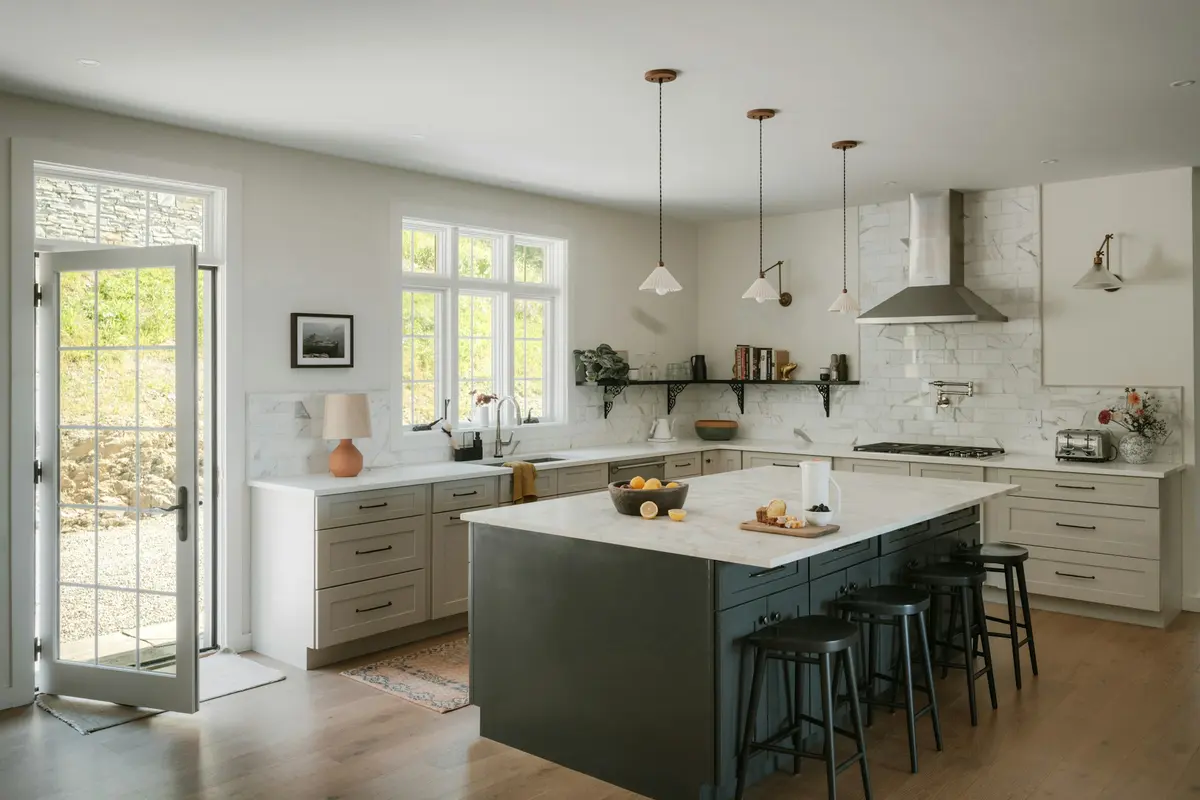
Painting the island base a different color from the perimeter cabinets is a simple trick with a big payoff. Navy, deep green, charcoal, or warm black under white marble makes the island read as furniture, not just cabinetry. It is one of the most popular marble kitchen island ideas for kitchens that need personality.
Materials and cost: a marble top ($2,000–$4,500) plus paint or a new base color ($200–$800 if repainting, more for new panels) makes this a budget-friendly transformation. If you are replacing the top only, the paint job is the cheapest part of the whole project.
Pick a base color with enough contrast to stand out but not fight the marble’s veining. Navy with Carrara is a safe classic; deep green with Calacatta feels fresh and current. Repeat the base color once elsewhere, like on a pantry door or bar stools, so it looks intentional.
Tip: Use a durable cabinet paint or lacquer on the base, since island corners take more bumps than wall cabinets.
Variation: try a soft sage or dusty blue base if dark colors feel too heavy for your space.
8. Marble Island with Breakfast Bar Seating
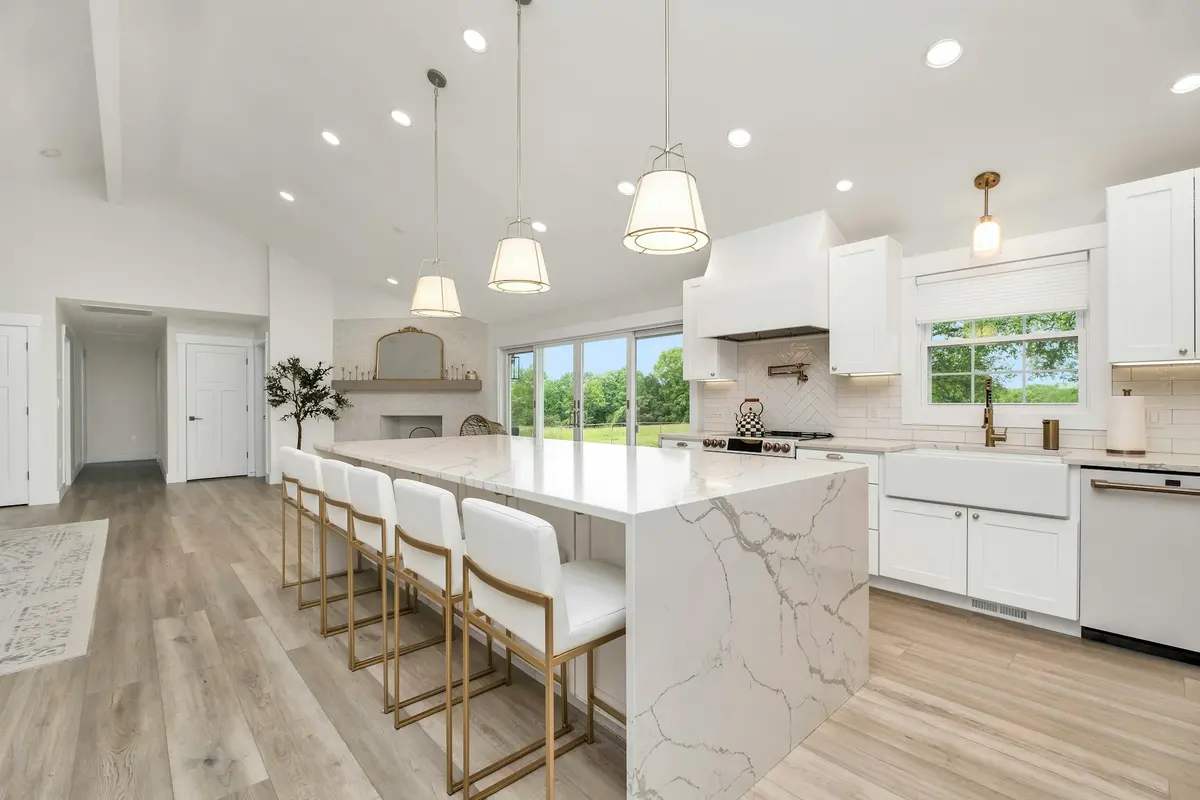
An island that seats people is an island that gets used. A 12–15 inch overhang on one side turns your marble top into a breakfast bar for two to four stools. Among practical marble kitchen island ideas, this one earns its keep every single morning.
Materials and cost: the marble top ($2,000–$5,000) plus overhang support brackets or corbels ($50–$300) and stools ($80–$300 each) complete the setup. A thicker 2-inch edge looks better over an overhang and feels more substantial when you lean on it.
Plan at least 24 inches of elbow room per stool and 36–42 inches of walkway behind seated guests. Backless stools tuck away neatly in small kitchens, while counter-height chairs with backs are kinder for long homework sessions. Keep the seating side free of outlets and clutter.
Tip: Ask your fabricator to confirm the overhang support — marble is heavy, and an unsupported overhang can crack.
Variation: raise one section to bar height for a two-level island that hides kitchen mess from the living room.
9. Double Island Layout
If your kitchen is large enough, two islands beat one. Use marble on the main prep island and a second island for seating, serving, or a sink. This is one of the most luxurious marble kitchen island ideas, and it works best in open-plan homes built for entertaining.
Materials and cost: two island tops can run $4,000–$10,000 in marble, so many homeowners put marble on one island and butcher block or quartz on the other. Keep at least 42–48 inches between islands and surrounding counters for comfortable traffic.
Assign each island a job before you design: one for cooking prep near the stove, one for gathering near the living space. That division keeps guests out of the cook’s way. Repeat one material, like the marble or the base color, across both islands so they feel like a pair.
Tip: Mock up the layout with painter’s tape on the floor and live with it for a week before committing.
Variation: in a smaller kitchen, pair a full island with a slim rolling marble-top cart for a double-island feel.

10. Slim Island for a Small Kitchen
Small kitchens deserve marble too. A slim island, just 24–30 inches deep, adds prep space and a landing spot without blocking traffic. This is one of the smartest marble kitchen island ideas for galley kitchens and compact apartments.
Materials and cost: a smaller slab means a smaller bill — often $1,200–$2,500 for the top. A narrow base with shallow drawers or open shelves underneath keeps the island useful without bulk. A marble-topped cart on casters ($300–$900) is an even cheaper route.
Keep 36 inches of clearance on each working side, and choose a light marble so the island does not visually crowd the room. Skip seating if space is tight; instead, use the island as a prep station and serving spot. A slim waterfall edge on one end adds style without width.
Tip: Measure your walkways with the island taped out first — 36 inches is the minimum that still feels comfortable.
Variation: use a slim marble peninsula attached to a wall instead of a freestanding island if floor space is very tight.
11. Marble Island with an Integrated Sink
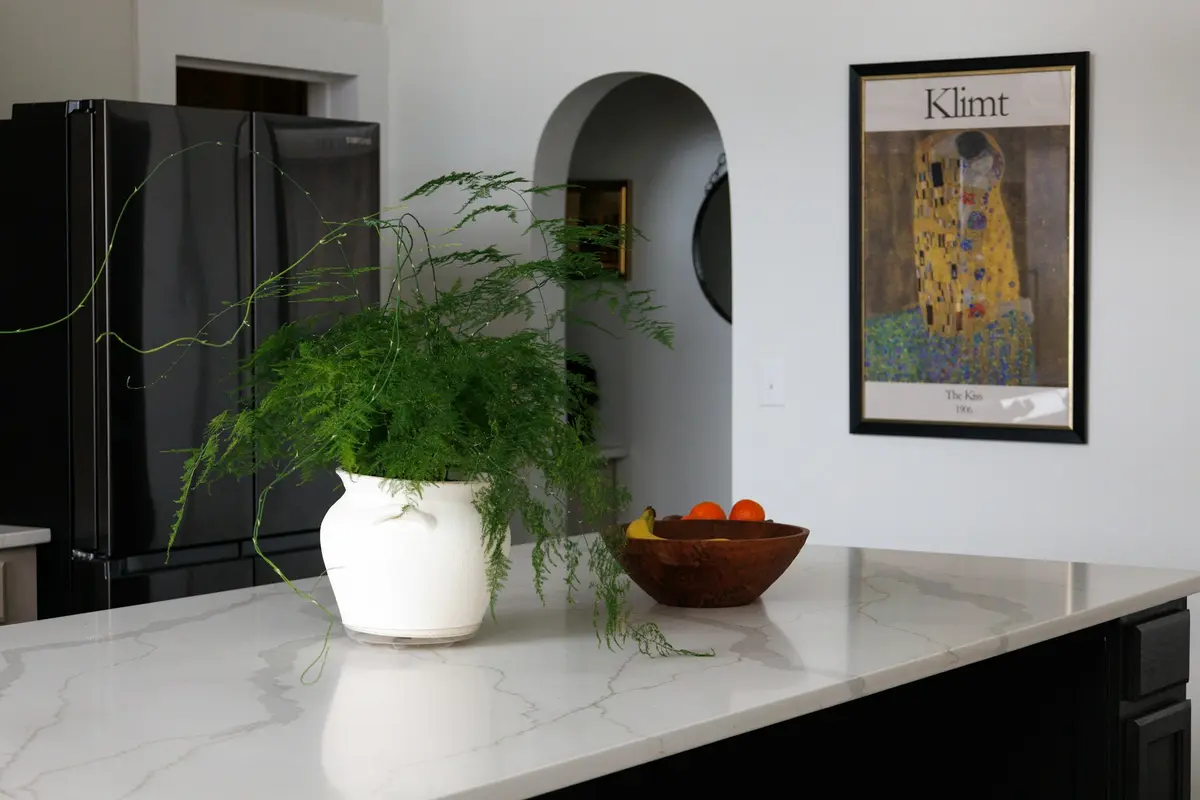
Putting the sink in the island puts you face-to-face with family and guests while you work. It also frees up wall space for windows or open shelving. As marble kitchen island ideas go, this one is all about how you live, not just how the kitchen photographs.
Materials and cost: add $400–$1,200 for an undermount sink and faucet, plus extra fabrication for the cutout. The marble top itself runs $2,000–$5,000. Choose a deep, single-bowl sink so large pots fit, and plan a drying area on one side.
Keep the plumbing run as short as possible to control costs, and confirm the island base can hide the pipes and garbage disposal neatly. A raised lip or a slightly higher back section can hide dirty dishes from the living room view. Wipe the sink rim often, since water spots show on marble.
Tip: Pick a faucet with a pull-down sprayer — it makes rinsing a big island sink far easier.
Variation: add a small prep sink in the island and keep the main sink on the wall if you want the best of both.
12. Marble Island with a Cooktop
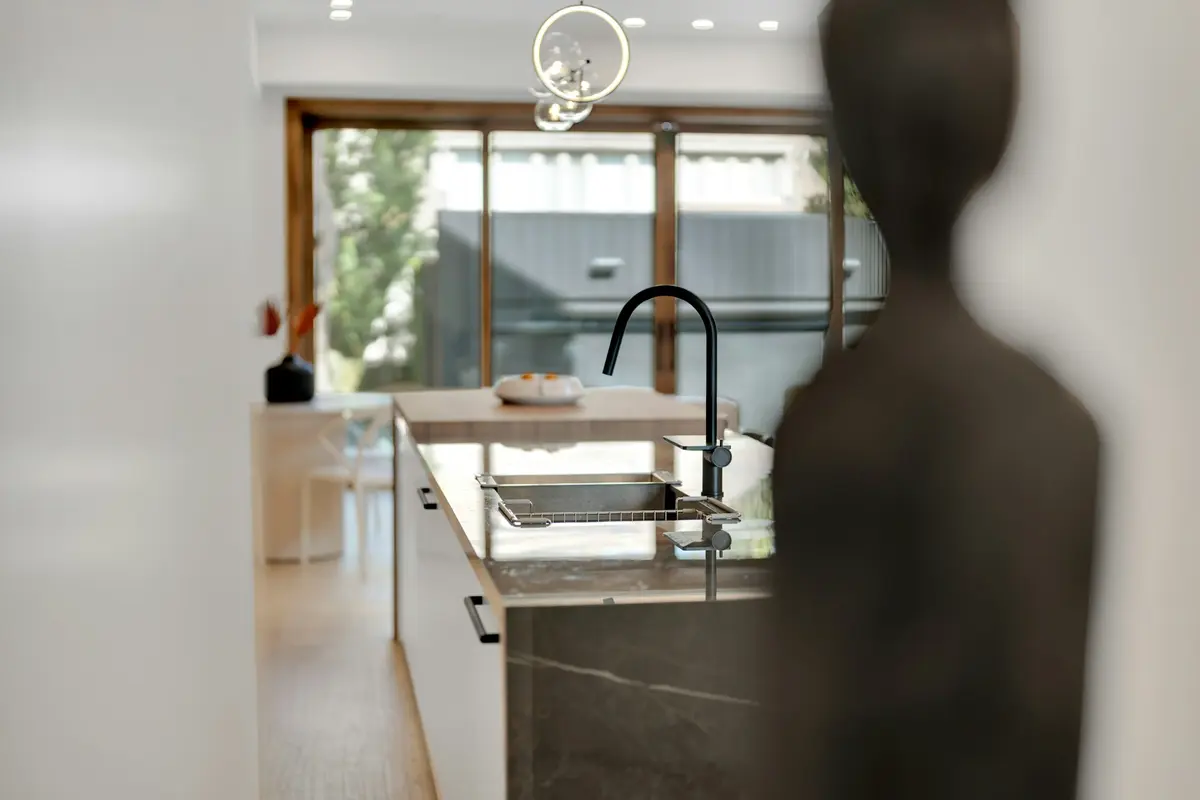
A cooktop in the island turns the cook into the host. You can stir, chat, and plate without turning your back on the room. This is one of the boldest marble kitchen island ideas, and it needs careful planning around ventilation and safety.
Materials and cost: the marble top ($2,000–$5,000) plus an induction or gas cooktop ($500–$2,000) and a downdraft vent or ceiling hood ($800–$2,500) make this a bigger investment. Induction is the easiest pairing with marble, since it keeps the surrounding stone cooler.
Leave at least 12 inches of counter on each side of the cooktop for landing space, and keep seating away from the hot zone. A downdraft vent preserves sightlines, while a statement hood becomes a second focal point. Always check local codes for clearance and ventilation before you order the slab.
Tip: Choose induction if kids sit at the island — the surface cools faster than gas or electric coils.
Variation: put a slim induction hob on one end of the island and keep the rest of the marble free for prep.
13. Marble Island with Open Shelving
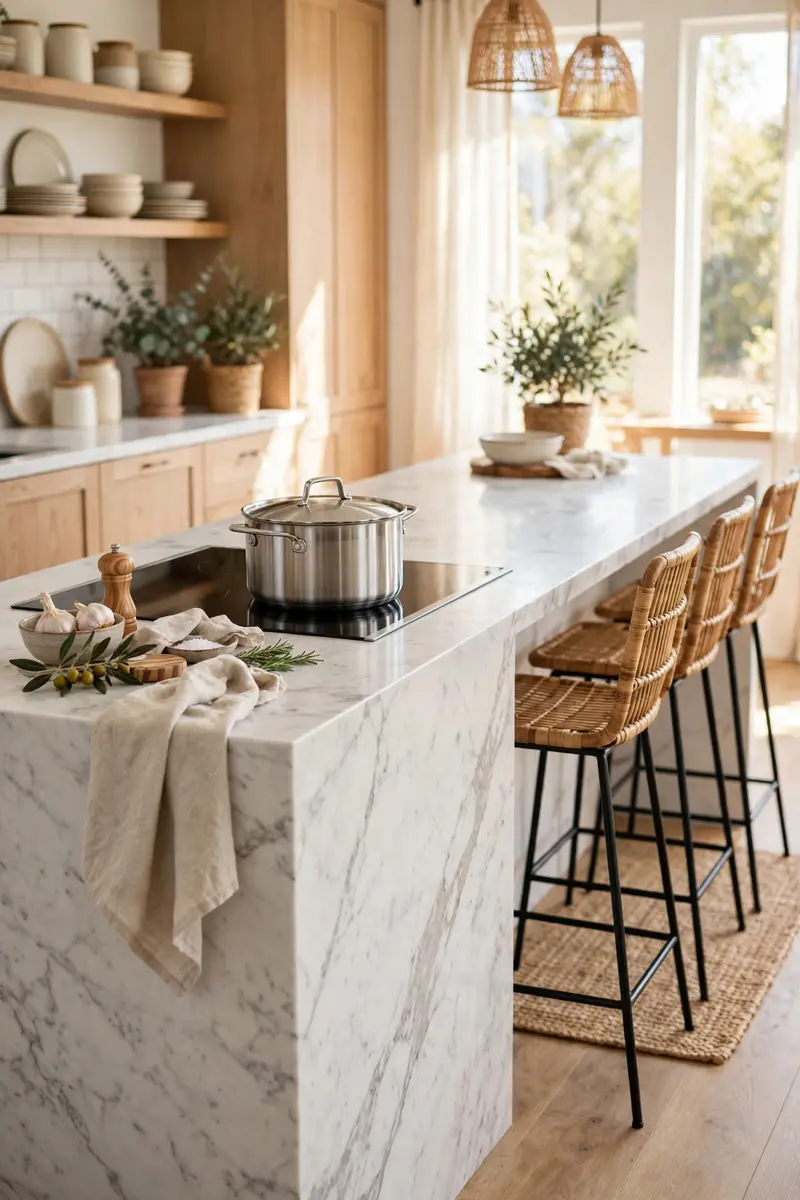
Open shelves under a marble top turn storage into display. Stack everyday dishes, cookbooks, and a few pretty bowls where you can reach them. This is one of the friendliest marble kitchen island ideas for kitchens that feel too closed-in with solid cabinetry.
Materials and cost: a marble top ($2,000–$4,500) plus open shelf construction ($300–$1,200) costs less than the same island filled with drawers. Use sturdy shelf brackets and a wipeable shelf surface, since open shelves collect dust and splashes.
Style the shelves loosely: group items in odd numbers, leave breathing room, and keep the prettiest pieces at eye level. Store heavy items low and everyday dishes at arm height. If open shelves feel too exposed, use them on one side only and drawers on the other.
Tip: Keep a small basket on the shelf for odds and ends, so the display stays tidy without constant fussing.
Variation: add a single open shelf on the seating side for cookbooks, with closed storage everywhere else.

14. Marble Island with Hidden Storage
The best islands hide a surprising amount of stuff. Deep drawers, a pull-out trash bin, a knife drawer, and a charging drawer keep counters clear. Among practical marble kitchen island ideas, hidden storage is the one you will thank yourself for daily.
Materials and cost: a marble top ($2,000–$4,500) plus upgraded drawer hardware and organizers ($300–$1,000) is money well spent. Full-extension, soft-close drawers make deep island storage actually usable instead of a dark hole.
Plan storage around your routines: a drawer for baking sheets near the oven side, a trash pull-out near the prep zone, and a shallow drawer for charging cables and scissors. Label nothing — good dividers do the organizing for you. Keep the heaviest items in low drawers to protect the drawer slides.
Tip: Measure your tallest pots before ordering drawer heights, so nothing ends up living on the counter.
Variation: add a toe-kick drawer at the base for flat items like baking trays and placemats.

15. Green Marble Island
Green marble is having a moment, from soft sage to deep emerald with white veining. It brings nature indoors and pairs beautifully with brass, walnut, and cream cabinets. If white marble feels too safe, this is one of the most exciting marble kitchen island ideas to try.
Materials and cost: green marble such as Verde Alpi runs roughly $90–$170 per square foot for material. Expect $3,500–$7,500 for an island top installed. Because green slabs vary wildly, always hand-pick your slab rather than ordering sight unseen.
Keep the rest of the kitchen calm: cream or light wood cabinets, a simple backsplash, and brass accents let the green lead. In a small kitchen, use green marble on the island only and keep perimeter counters light so the room stays bright. A honed finish suits green marble’s earthy character.
Tip: View your green slab in daylight, not just under showroom lights — green tones shift a lot between the two.
Variation: try a green marble island with white oak cabinets for a soft, organic modern look.

16. Marble Island with Gold Veining and Fixtures
Gold-veined marble, like Calacatta Oro, pairs naturally with gold or brass fixtures. The warm veins tie the faucet, pendants, and hardware together into one cohesive, glamorous scheme. This is one of the most elegant marble kitchen island ideas for a kitchen that leans luxe.
Materials and cost: gold-veined marble often runs $120–$200 per square foot for material, with island totals of $4,500–$9,000. Brass or gold fixtures add $500–$1,500 depending on how many you swap. Keep the gold warm-toned, not yellow, for a high-end feel.
Balance the glamour with matte or natural textures: a wood stool, a linen runner, or a ceramic vase stops the room from feeling like a jewelry box. White or warm-white cabinets keep the focus on the stone. Limit gold to three or four visible spots so it reads as intentional, not overdone.
Tip: Match your gold finishes as closely as possible — mixed gold tones clash more than mixed silver tones do.
Variation: use champagne bronze fixtures for a softer gold effect that is easier to live with.
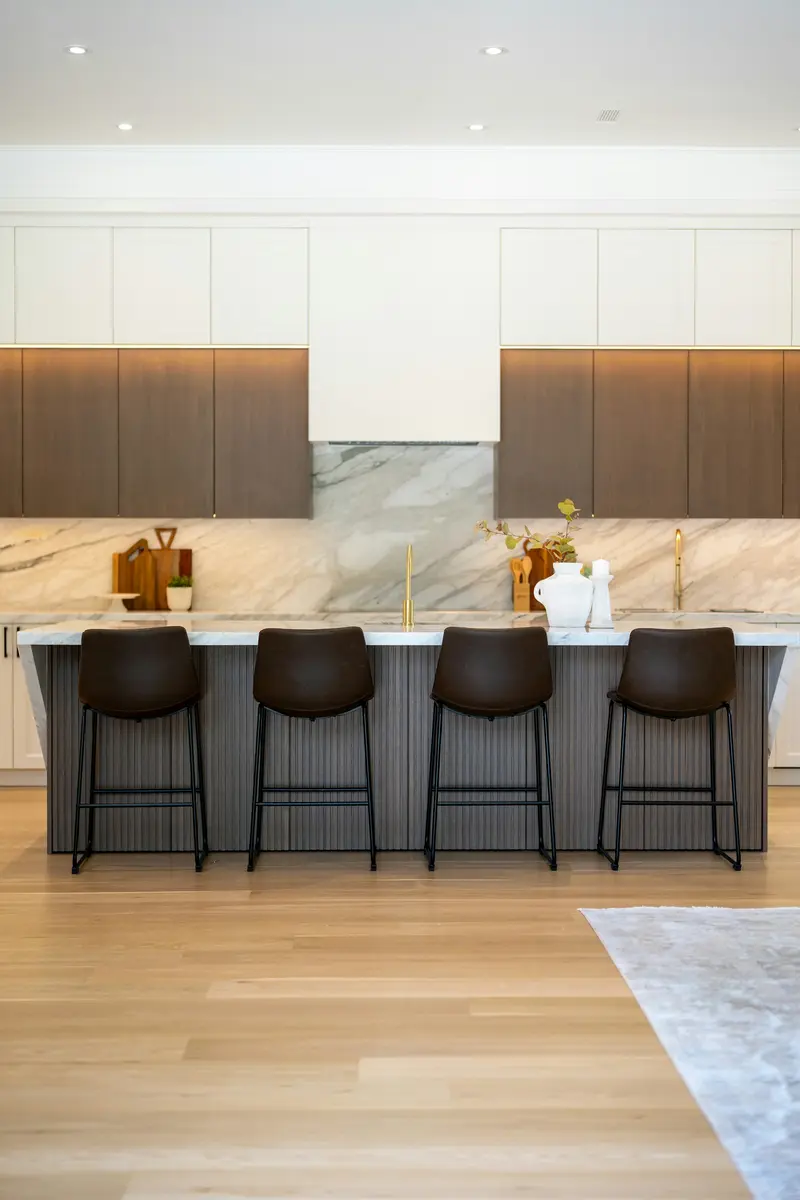
17. Rustic Farmhouse Marble Island
Marble works in a farmhouse kitchen too, especially when the base is rustic. Think a chunky wood or beadboard base, a thick marble top, and vintage-style stools. This is one of the warmest marble kitchen island ideas, proving that luxury stone and casual living can share a room.
Materials and cost: a marble top ($2,000–$4,500) over a beadboard or shiplap base ($500–$1,500) keeps the look affordable. Salvaged wood for the base costs more but adds instant history. A farmhouse sink nearby completes the story, though it does not have to sit in the island.
Choose a honed marble with soft veining rather than a dramatic polished slab — the matte finish suits the relaxed style. Add open shelving, a crock of wooden spoons, and linen towels for texture. Keep colors warm: cream, sage, and natural wood tones.
Tip: Honed marble hides the small marks of a busy farmhouse kitchen far better than polished marble does.
Variation: add corbels or turned legs to the island base for a furniture look straight out of a country kitchen.

18. Modern Minimalist Marble Island
In a minimalist kitchen, the island is the sculpture. A simple rectangular block with a white marble top, handleless cabinets, and no visible hardware lets the stone’s veining carry the whole design. This is one of the cleanest marble kitchen island ideas, and it demands discipline.
Materials and cost: a marble top ($2,000–$4,500) plus handleless cabinetry and push-to-open hardware ($500–$1,500 extra over standard) complete the look. Spend your budget on one excellent slab, since there is nothing else to distract from it.
Keep the palette to two or three tones: white marble, one cabinet color, and one metal finish. Hide outlets inside drawers or on the island ends, and keep small appliances in a garage cabinet. The payoff is a kitchen that feels calm even when dinner is chaotic.
Tip: Photograph the room before styling it, and remove one item at a time until the photo feels calm.
Variation: add a single warm element, like oak stools, so the minimalism feels inviting rather than stark.
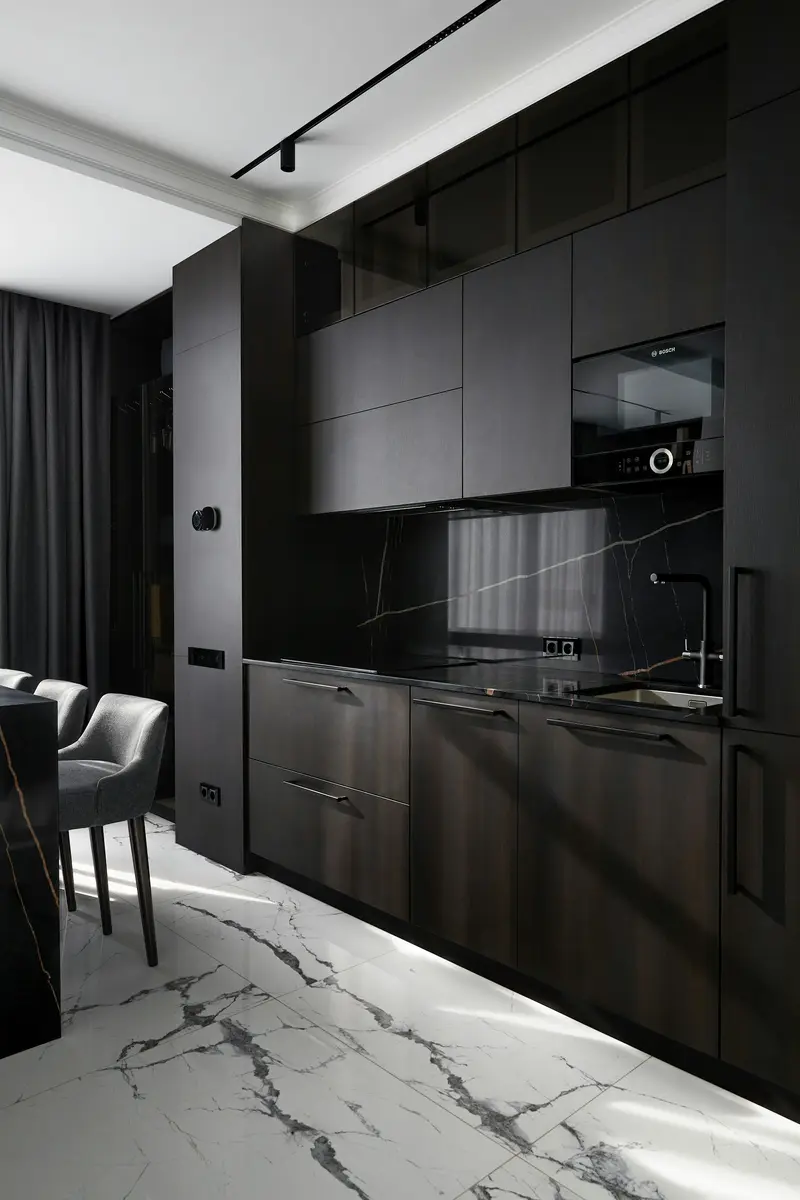
19. Marble Island with Statement Pendant Lighting
Pendant lights do more for a marble island than almost any other accessory. Three matching pendants over the island create rhythm, add task light, and frame the stone from across the room. Done well, this is one of the easiest marble kitchen island ideas to get right.
Materials and cost: pendants run $100–$500 each, so a trio costs $300–$1,500 plus installation. Hang them 30–36 inches above the countertop and space them evenly, usually 24–30 inches apart. Dimmers are essential — bright for prep, soft for dinner.
Scale matters: oversized pendants suit a long island, while slim pendants suit a compact one. Glass pendants keep sightlines open; metal shades focus light downward. Match the pendant finish to your faucet or hardware for a pulled-together look.
Tip: Put pendants on a dimmer and use warm bulbs (2700K) so the marble glows in the evening.
Variation: use one long linear pendant over a slim island instead of three separate shades.
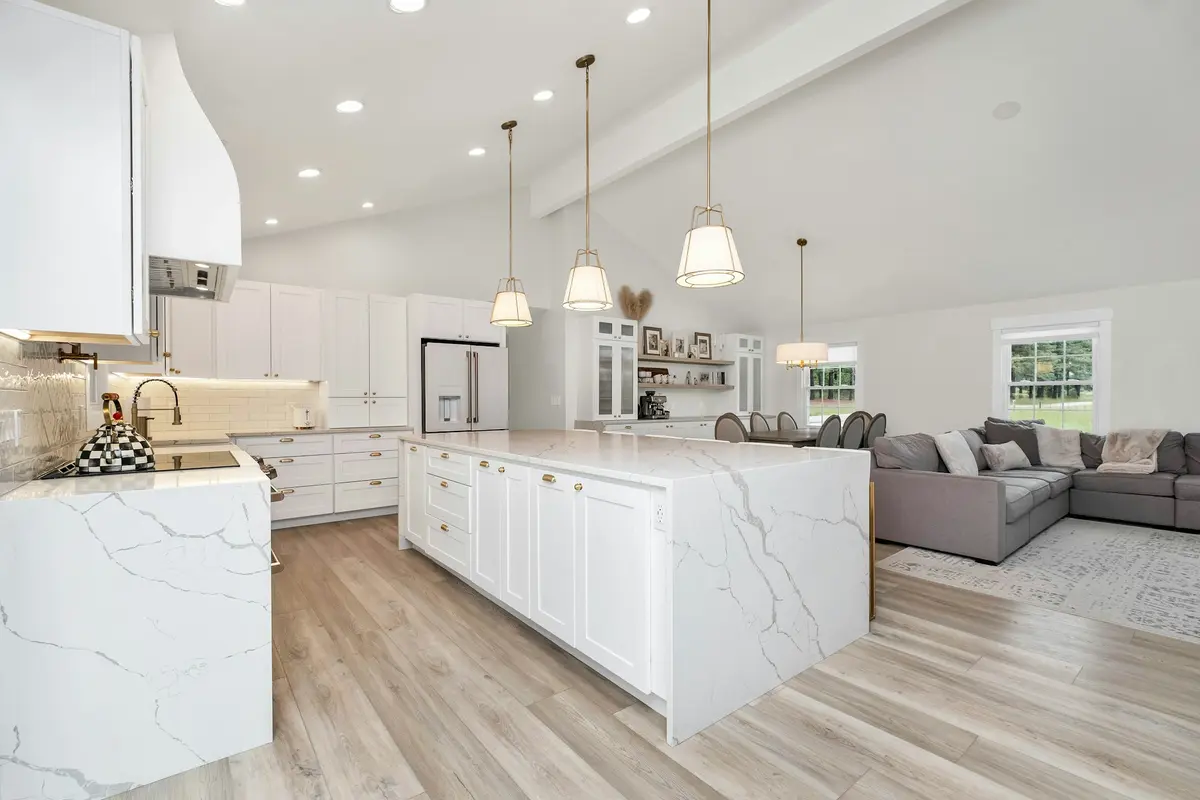
20. Marble and Butcher Block Combination Island
Pairing marble with butcher block gives you two work surfaces in one island: cool stone for pastry and baking, warm wood for chopping and everyday prep. It is one of the most practical marble kitchen island ideas, and it also cuts the stone bill.
Materials and cost: a half-marble, half-wood top often costs $1,500–$3,500 total, versus $2,000–$4,500 for full marble. The wood section needs food-safe oil every few months, while the marble section needs sealing — two routines, both simple.
Place the marble section near the oven for baking and the wood section near the sink for chopping. Use a flush joint or a slim metal divider between materials so crumbs do not collect in a gap. This combo suits farmhouse, transitional, and rustic kitchens especially well.
Tip: Oil the butcher block before first use and keep a dedicated cutting board on the marble side to prevent knife marks.
Variation: use a thick butcher block end cap on a marble island as a built-in chopping station.
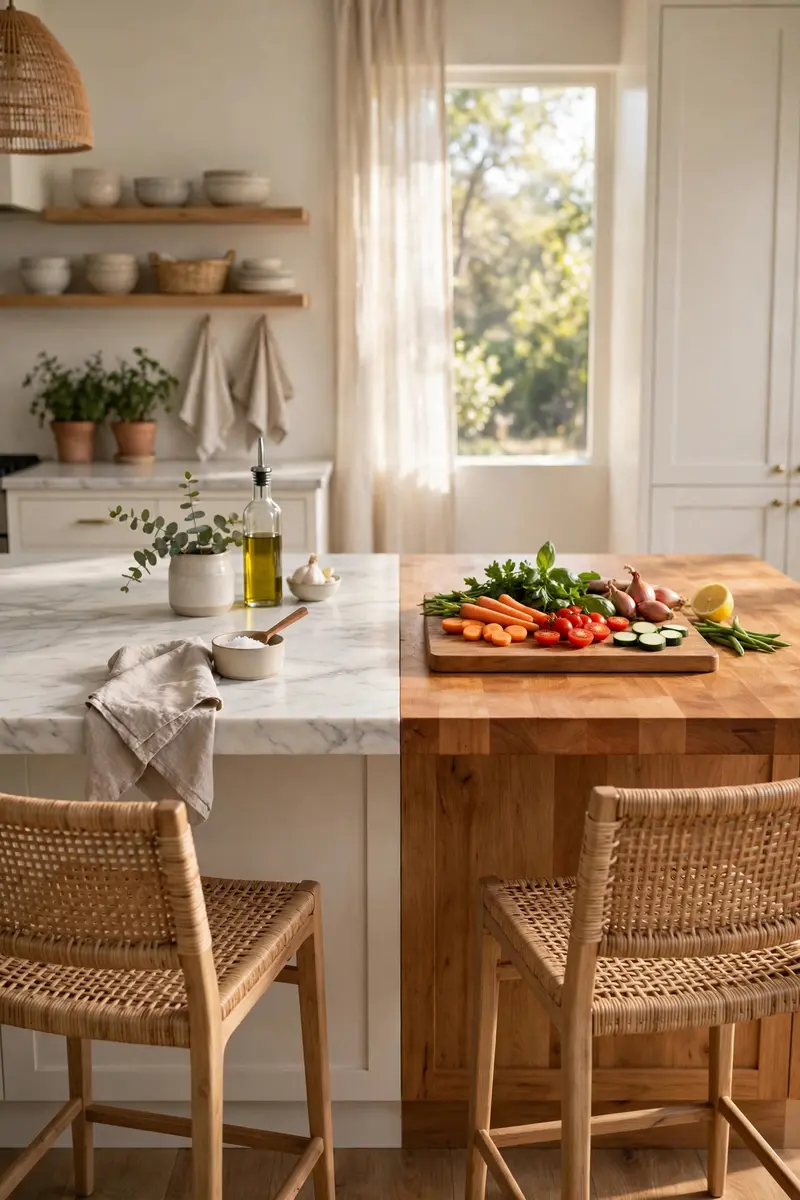
21. Book-Matched Marble Island
Book-matching is the showpiece technique of the stone world. Two slabs cut from the same block are opened like a book, so the veining mirrors perfectly across the island front or top. This is one of the most jaw-dropping marble kitchen island ideas, and it belongs in kitchens where the island is the art.
Materials and cost: book-matched slabs add $1,000–$3,000 over standard fabrication, with island totals often reaching $5,000–$10,000. You need two consecutive slabs from the same block, so order early and confirm availability before finalizing the design.
Use book-matching on the island front face, where the mirror pattern is visible from the living space, or across a waterfall edge. Keep the rest of the kitchen deliberately quiet so the mirrored veins stay the hero. Photograph the slabs laid out together before cutting to approve the match.
Tip: Ask the stone yard to number the slabs in cutting order — a swapped slab breaks the mirror.
Variation: book-match just the island front panel and use a simpler cut on the top to control costs.

22. Honed Matte Marble Island
Not everyone loves a shiny countertop. Honed marble has a soft, matte finish that feels velvety to the touch and hides etch marks better than polished stone. This is one of the most practical marble kitchen island ideas for busy families who still want real stone.
Materials and cost: honing usually costs about the same as polishing, so island totals stay in the usual $2,000–$5,000 range. Honed marble is slightly more porous, so sealing matters even more — plan on resealing every 6 months in a hard-working kitchen.
Honed marble suits farmhouse, rustic, and relaxed modern kitchens, and it pairs beautifully with wood, linen, and matte black fixtures. Spills still need wiping, but the dull spots that acids leave are far less visible on a matte surface. Clean with a pH-neutral stone cleaner only.
Tip: Do the water-drop test every few months: if water soaks in within minutes instead of beading, it is time to reseal.
Variation: hone only the island top and keep polished marble on a backsplash or bathroom vanity for contrast.

23. Marble Island with Wine Storage
A wine fridge or a few cubbies built into the island turns it into an entertaining hub. Guests can help themselves while you cook, and the island becomes the natural gathering spot. This is one of the most fun marble kitchen island ideas for people who love hosting.
Materials and cost: a marble top ($2,000–$4,500) plus an undercounter wine fridge ($400–$1,500) or open wine cubbies ($200–$600) complete the setup. Keep wine storage away from the oven side of the island, since heat is wine’s enemy.
Place the wine zone on the seating side, near glasses and a small serving area. If you skip the fridge, store bottles horizontally in cubbies to keep corks moist. A marble top above makes an ideal tasting ledge for cheese boards and appetizers.
Tip: Keep a few everyday glasses in the island drawer above the wine fridge, so hosting needs no extra trips.
Variation: use a narrow beverage drawer for sparkling water and mixers if wine is not your thing.

24. Curved or Oval Marble Island
Most islands are rectangles, which is exactly why a curved island stands out. A rounded end or a full oval softens a kitchen, improves traffic flow, and makes conversation easier since no one sits at a sharp corner. This is one of the most elegant marble kitchen island ideas for open-plan homes.
Materials and cost: curved fabrication adds $1,000–$2,500 over a rectangular top, with totals often $3,500–$7,000. The base cabinetry also needs custom work, so get the cabinet maker and stone fabricator talking early. A curved end on an otherwise straight island is a cheaper compromise.
Curved islands suit kitchens with generous floor space and rounded design details elsewhere, like arched doorways or a round dining table. Stools tuck neatly under the curve, and the shape naturally guides foot traffic around the work zone. Keep the marble light so the curve reads clearly.
Tip: Test the curve with a cardboard template on the floor before ordering — curves eat more floor space than you expect.
Variation: round just one corner of a rectangular island for a softer look at a fraction of the custom cost.
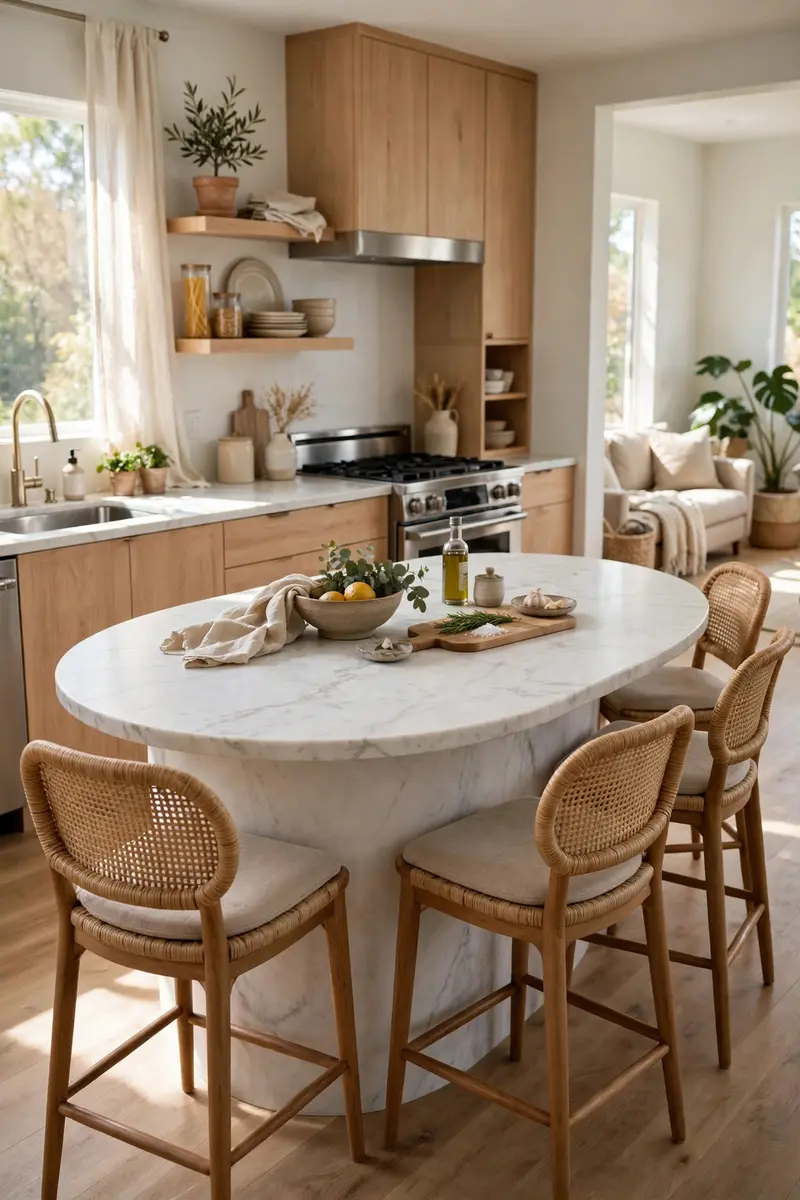
25. Marble Island with Contrasting Perimeter Counters
You do not have to use marble everywhere. A marble island with darker perimeter counters — soapstone, black granite, or dark quartz — makes the island pop like a centerpiece. This is one of the smartest marble kitchen island ideas for budgets, since you buy one showpiece slab instead of a whole kitchen of stone.
Materials and cost: one marble island top ($2,000–$4,500) plus darker perimeter counters ($1,500–$4,000 depending on material) often costs less than marble throughout. The contrast also hides wear on the hard-working perimeter counters, where most chopping happens.
Choose perimeter counters that share an undertone with the marble’s veining, like grey veining with a charcoal counter. Repeat the island’s hardware on the perimeter cabinets to tie the two zones together. This scheme works in modern, transitional, and traditional kitchens alike.
Tip: Order samples of both stones together and view them side by side in your kitchen’s light before committing.
Variation: flip it — dark island base with a white marble top, and light perimeter counters for a bright room.
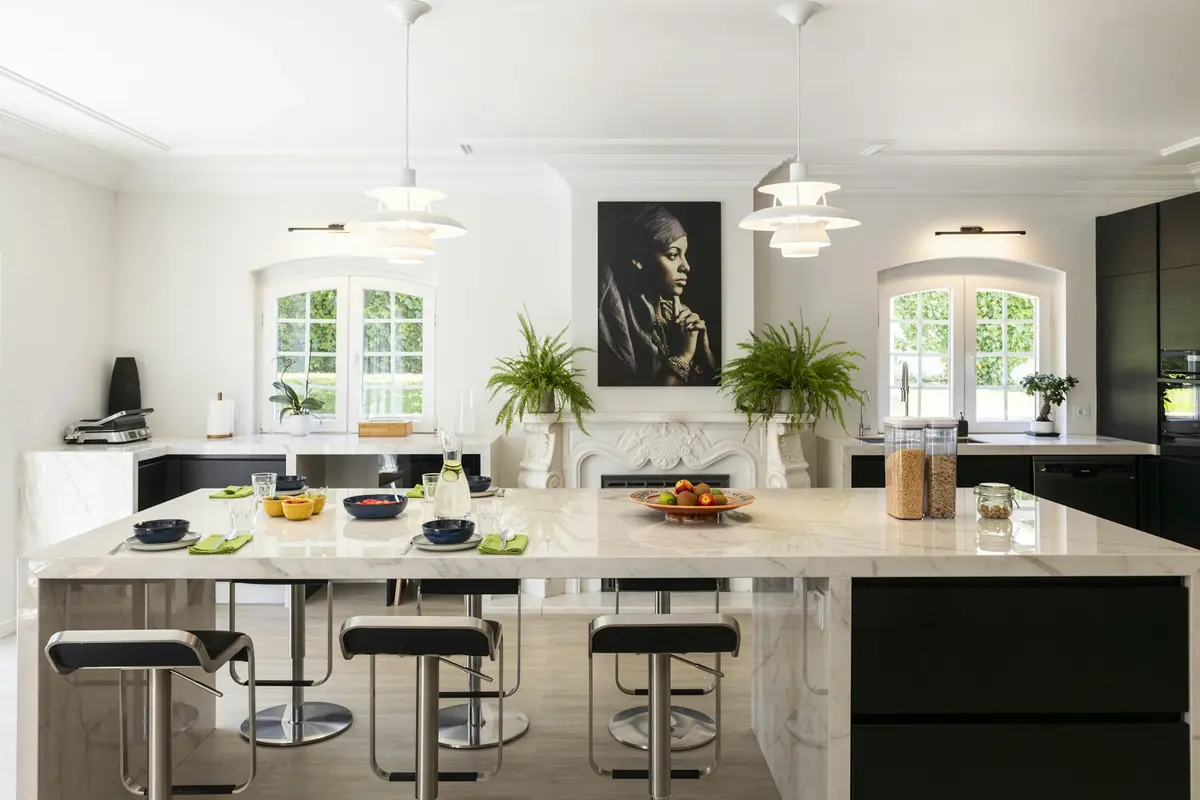
26. Budget-Friendly Marble Island with a Remnant Slab
Real marble on a tight budget is possible if you shop remnants. Stone yards sell leftover pieces from larger jobs at steep discounts, and a small island often fits a remnant perfectly. This is one of the most resourceful marble kitchen island ideas, and it keeps beautiful stone out of landfill too.
Materials and cost: remnant slabs can cut material costs by 30–60%, bringing an island top to $1,000–$2,500 installed. The trade-off is choice: you pick from what is available rather than ordering a specific stone. Fabrication and edge costs stay the same.
Call local stone yards and ask about remnant sizes before designing, and be ready to move fast when a good piece appears. A remnant with an unusual vein pattern can become the most characterful island in the neighborhood. Pair it with painted cabinets to keep the rest of the budget low.
Tip: Bring your island’s exact measurements to the stone yard, plus 2 inches of wiggle room for cutting.
Variation: use marble tiles on the island top for an even cheaper route, accepting grout lines as part of the look.
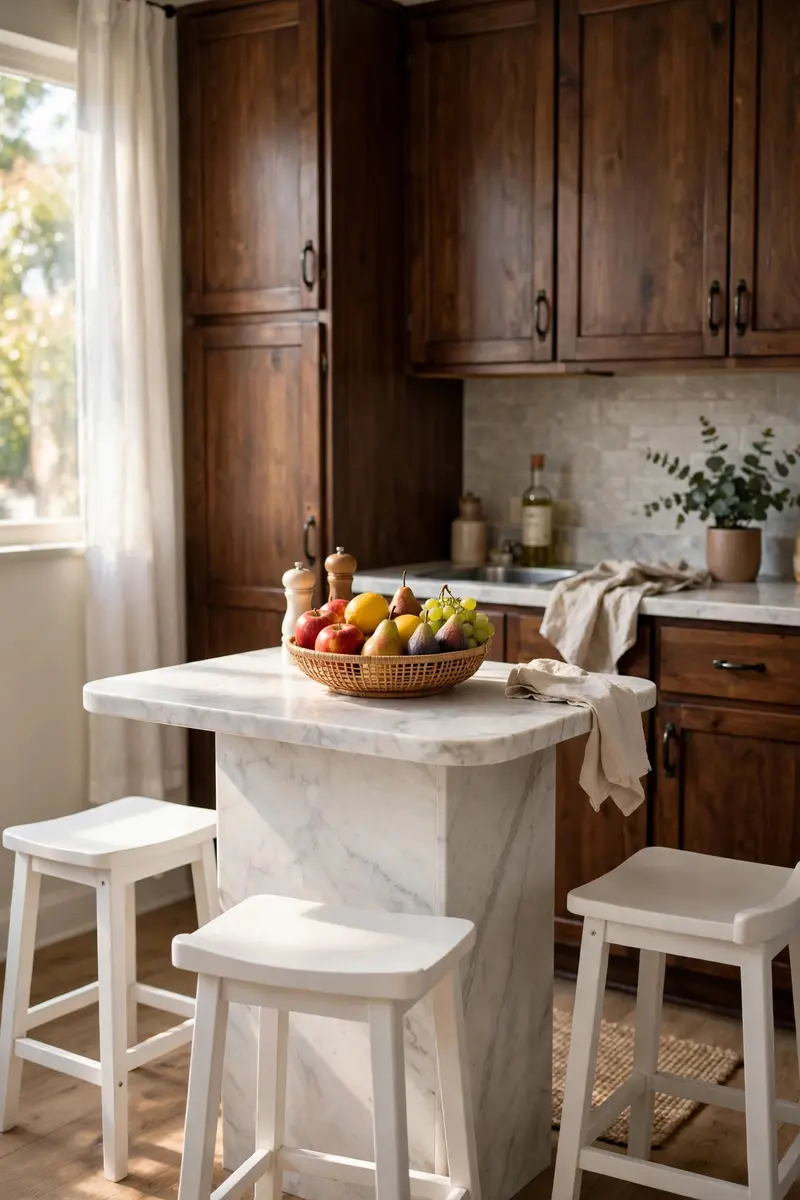
27. Marble Island with a Dining Table Extension
An island that flows into a dining table gives you the best of both worlds: a work surface and a proper place to eat, without a separate table crowding the room. The marble top steps down to a wood table at dining height. This is one of the most clever marble kitchen island ideas for open-plan living.
Materials and cost: a marble top ($2,000–$4,500) plus a wood table extension ($500–$2,000) and matching chairs ($100–$300 each) create a full dining zone. The height change needs a sturdy join, so have your cabinet maker and fabricator coordinate the support.
Keep the table section at standard dining height (30 inches) and the island at counter height (36 inches). Use the same wood for the table and the island base details to tie them together. This layout shines in kitchens that open onto a living area, where the table becomes the room’s anchor.
Tip: Leave 24 inches of table width per diner, and keep the table end free of outlets and clutter.
Variation: extend the marble itself at a lower height for a two-level stone island, if wood does not suit your style.
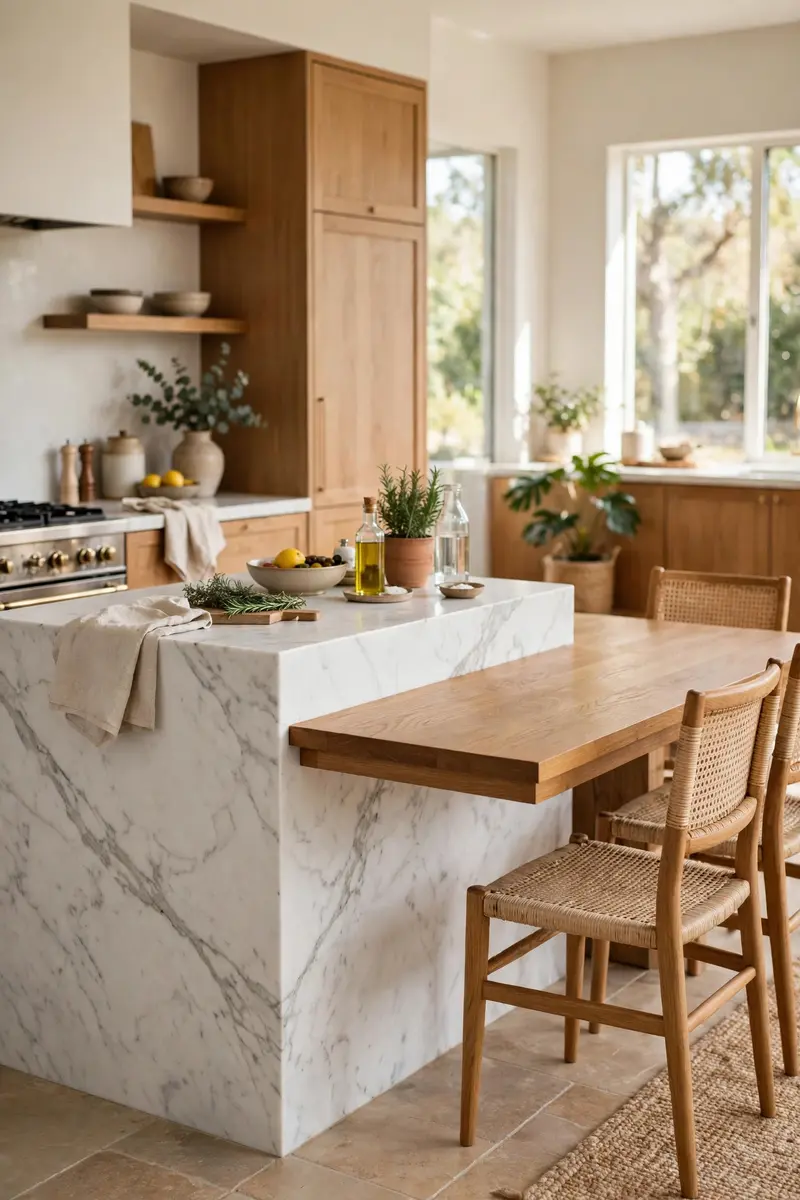
28. Styled and Sealed Marble Island
The final idea is not a new shape at all — it is the finishing layer that makes every other island look its best. A styled, well-sealed marble island with a board, a vase, and clear workspace feels inviting every day. Among marble kitchen island ideas, this one costs almost nothing and changes everything.
Materials and cost: styling costs $50–$200 for a wooden board, a small vase, a candle, and a linen towel. Sealer costs $30–$60 per bottle and lasts for several applications. Together, they are the cheapest upgrade in this entire guide.
Style in threes: one tall item (a vase with greenery), one flat item (a board or tray), and one small item (a candle or bowl). Leave at least half the island clear for actual cooking. Reseal on schedule, wipe spills immediately, and use trivets under hot pans to protect the seal.
Tip: Keep a dedicated marble cleaner and a soft cloth in the island drawer, so care takes seconds, not a special trip.
Variation: swap the styling seasonally — greenery in spring, a bowl of citrus in summer, and candles in winter.

Frequently Asked Questions
What is the best marble for a kitchen island?
Carrara is the safest all-rounder: soft grey veining, wide availability, and a moderate price. Calacatta is bolder and pricier, with dramatic veins that suit statement islands. For dark kitchens, Nero Marquina or black marble with gold veining adds drama. Always choose your exact slab in person, since no two pieces of natural marble look alike — that is true of every one of these marble kitchen island ideas.
Is marble good for a kitchen island or does it stain?
Marble is beautiful but porous, so it can stain and etch if left unsealed. Sealing every 6–12 months, wiping spills quickly, and avoiding acidic cleaners keeps it looking great for decades. If you want a zero-maintenance surface, quartz is the easier choice — but it will never match real marble’s depth. For honest care guidance, see The Spruce’s countertop materials guide and its marble stain-removal tips.
How much does a marble kitchen island cost?
A standard island top usually costs $2,000–$5,000 installed, including material and fabrication. Waterfall edges, book-matching, and rare stones like Calacatta Oro push that to $5,000–$10,000. Remnant slabs, a slim island, or marble only on the island (with cheaper perimeter counters) bring the price down without giving up real stone.
How do you seal and care for a marble island?
Clean with warm water and a pH-neutral stone cleaner, never vinegar, lemon, or bleach. Seal with a penetrating stone sealer on installation day, let it cure, and reapply every 6–12 months. Use cutting boards, trivets, and coasters as daily habits. If a stain appears, a poultice paste left overnight usually lifts it — act fast for the best results.
Can you put a sink or cooktop in a marble island?
Yes, both work well with planning. A sink needs a short plumbing run and a deep single bowl, while a cooktop needs ventilation and at least 12 inches of landing space on each side. Induction cooktops pair especially well with marble. Always confirm support, clearances, and local codes with your fabricator before cutting the slab.
Conclusion
A marble island is more than a pretty surface, and the marble kitchen island ideas above cover every budget and kitchen size — it is where mornings start, homework happens, and friends gather while dinner cooks. Whether you choose a classic Carrara top, a dramatic waterfall edge, or a budget-friendly remnant, the right island makes your whole kitchen feel more considered. If you are still choosing cabinet colors, our beige kitchen cabinets and kitchen with light wood cabinets guides pair beautifully with marble, and our mint green kitchen ideas show how a soft color works under stone.
Save this guide to Pinterest before you visit the stone yard, and take your favorite ideas with you. When you find the slab that makes you stop and smile, you will know — that is the one. Happy renovating, and may your new island host a thousand good meals.




Leave a Reply