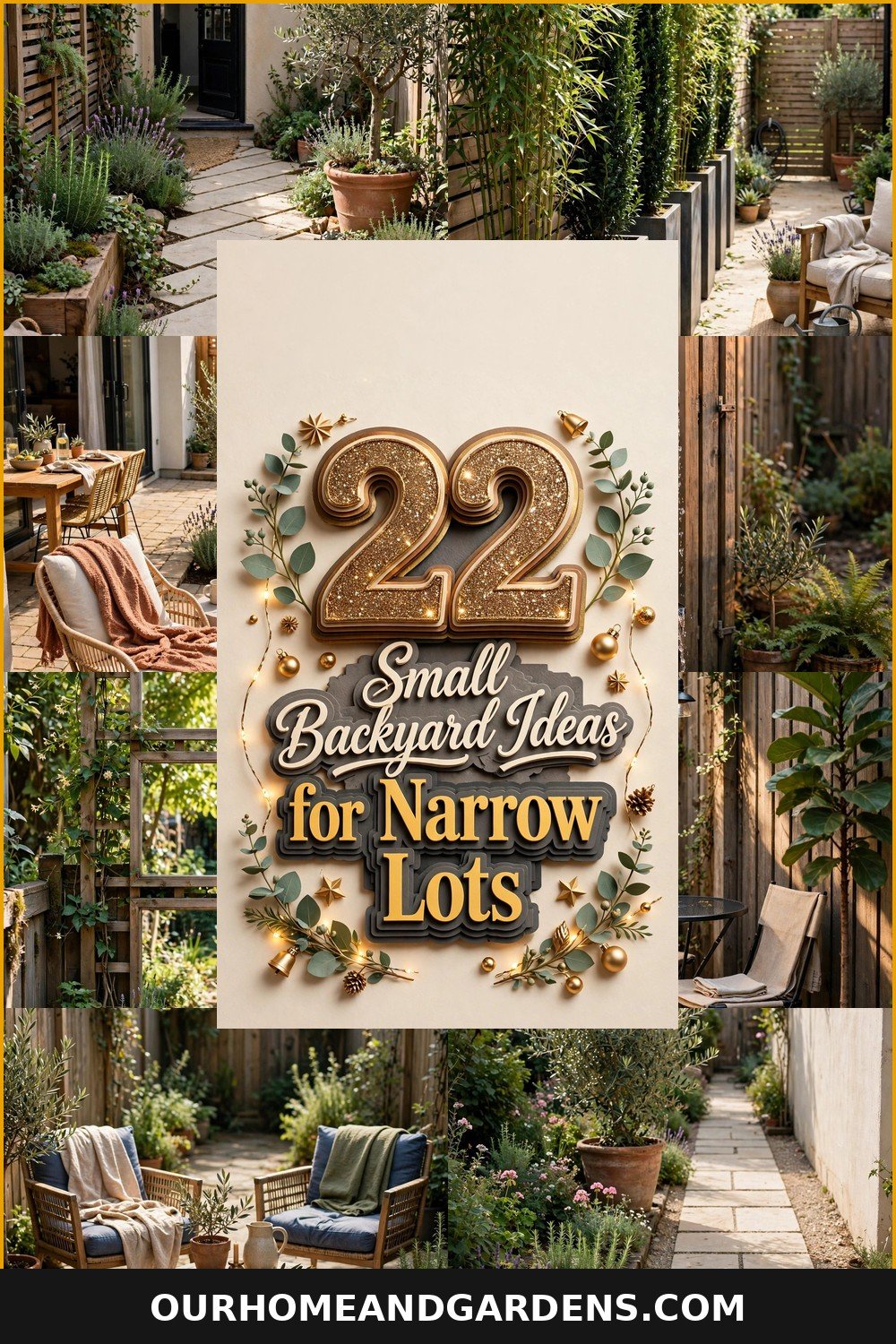
A long, skinny backyard can feel like a hallway you happen to own — too narrow for a patio, too overlooked to relax in, and too awkward to plant. But these small backyard ideas for narrow lots are built for exactly that shape: the 12-foot-wide strip, the bowling-alley backyard behind a townhouse, the side yard that never quite became a garden. The secret is not to fight the narrowness. You work with it: you draw the eye along the longest line, you push planting up instead of out, and you give every stretch of the yard one clear job.
Start by measuring your yard and noting where the sun falls, where neighbors can see in, and where water pools after rain. Then pick two or three ideas from this list — a path, a privacy fix, and one place to sit are the smartest first moves — and build from there. If budget is tight too, our small backyard ideas on a budget pair perfectly with this list, and the zoning tricks in our small backyard ideas for dogs work just as well for people-only yards.
1. Lay a Diagonal Path to Break the Corridor
A path that runs straight down the middle of a narrow yard splits it into two even skinnier strips and makes the corridor feeling worse. A diagonal path does the opposite: it pulls the eye across the yard, makes the space feel wider, and turns a walk to the back fence into a little journey.
Materials + cost: large-format pavers or flagstones ($80–$250), gravel or sand for joints ($30–$60), and landscape fabric ($15–$25).
Lay the path at a gentle angle from the back door toward the far corner, not the far center. Use big pavers rather than small bricks — large pieces visually expand a small space instead of chopping it up. Leave planting pockets along the edges so the path feels planted, not paved over. A slight curve works even better than a straight diagonal if you have room for it.
Tip: Stand at the back door before you lay anything and check the sightline — the path should lead your eye to something pretty at the far end, not to the fence. This works for many small backyard ideas for narrow lots.
Variation: Stepping stones set in gravel give the same diagonal effect for less money and drain better after rain.

2. Grow a Vertical Garden Wall: A Small Backyard Ideas for Narrow Lots Essential
When floor space is scarce, the only way to grow is up. A vertical garden wall turns a bare fence into a living tapestry of herbs, flowers, and trailing greenery, and it costs you almost no ground space at all.
Materials + cost: wall-mounted planters, pocket planters, or a trellis panel ($40–$150), potting mix ($20–$40), and plants such as herbs, ferns, and trailing flowers ($40–$100).
Fix planters or a trellis securely to the sunniest fence, starting at waist height so watering is easy. Mix textures — upright herbs, trailing vines, and a few flowering plants — so the wall reads as a garden, not a grid. If your fence is shady, choose ferns and hostas; in full sun, herbs and succulents thrive. Add a simple drip line along the top row if you can, since wall planters dry out fast.
Tip: Water wall planters from the top down and check the bottom row most — it catches the runoff and can stay soggy while the top dries out. This tip applies to many small backyard ideas for narrow lots.
Variation: A pallet garden leaned against the fence is a budget-friendly starter version that you can build in an afternoon.

3. Screen with Slim Planters, Not a Solid Wall: Small Backyard Ideas for Narrow Lots
A tall solid fence in a narrow yard can feel like a box, blocking light and air. Slim planters filled with upright greenery give you privacy at eye level — usually 4 to 6 feet is enough — without swallowing the yard.
Materials + cost: tall narrow planters ($30–$80 each), clumping bamboo, sky pencil holly, or boxwood ($25–$60 per plant), and potting mix ($20–$40).
Place planters only where neighbors actually have a sightline, usually near their windows or a raised deck, not along the whole boundary. Clumping bamboo (never running bamboo) grows fast and stays slim; sky pencil holly gives a neat, formal look in a very narrow footprint. Keep the planters on casters if you rent, so the whole screen can move with you.
Tip: Screen just the one or two spots where you are truly overlooked — screening everything makes a narrow yard feel smaller, not more private. This works for many small backyard ideas for narrow lots.
Variation: A freestanding trellis panel with a fast vine gives the same eye-level screen in a single season.

4. Build Bench Seating Into the Boundary Wall
Freestanding chairs eat floor space in a narrow yard, and dragging them around gets old fast. A bench built along one wall gives you generous seating that takes up almost no usable width — and it doubles as a planting edge.
Materials + cost: timber or composite boards and brackets ($80–$200), outdoor cushions ($30–$60), and a few pots for the ends ($20–$40).
Build the bench 16 to 18 inches deep along the longest wall, at standard seat height, with storage underneath if you can manage it. Add weatherproof cushions in a light color to keep the wall feeling bright, and leave the middle of the yard completely open. A bench along the wall also gives guests somewhere to sit without blocking the path, which is the whole point in a skinny space.
Tip: Keep the bench depth under 18 inches — any deeper and it starts stealing the path, which is the one thing a narrow yard cannot spare. This tip applies to many small backyard ideas for narrow lots.
Variation: A row of sturdy storage boxes with cushion tops gives you the bench plus a place to hide cushions, tools, and toys.

5. Fold the Patio into an L Shape: Small Backyard Ideas for Narrow Lots
A straight rectangular patio emphasizes the narrowness of a yard, like a rug laid down a hallway. An L-shaped or folded patio that changes direction slightly as it moves through the space breaks that tunnel effect and creates two distinct spots instead of one long one.
Materials + cost: pavers or decking boards ($150–$400 for a small patio), gravel base ($40–$80), and edging ($20–$40).
Start with a small patio by the back door for dining, then fold a second, smaller pad around the corner for lounging or a fire bowl. The change in direction is what does the work — even a shift of a few feet is enough. Use the same paving material throughout so the two pads read as one designed space, and let planting soften the inside corner where they meet.
Tip: Make the main pad generously sized rather than timid — a too-small patio in a small yard makes everything around it look smaller too. This works for many small backyard ideas for narrow lots.
Variation: If a full rebuild is too much, an outdoor rug laid at an angle over part of the patio fakes the folded feeling for under $50.

6. Turn the Side Strip into a Kitchen Garden
The narrow strip along the side of the house is often wasted on weeds and bins, but it is perfect for a kitchen garden: it gets sun, it is close to the kitchen door, and raised beds or pots fit it exactly.
Materials + cost: narrow raised bed kits or long planters ($40–$120), soil ($20–$40), and herbs and salad plants ($25–$60).
Run one long, slim raised bed along the sunny side, no more than 2 feet wide so you can reach everything from the path. Plant herbs you actually cook with — basil, rosemary, mint in its own pot, parsley — plus salad leaves and cherry tomatoes in summer. A gravel path beside the bed keeps feet clean and the whole strip looking intentional rather than leftover.
Tip: Put mint in a pot sunk into the bed, never loose in the soil — it will take over a narrow bed in one season if you let it. This tip applies to many small backyard ideas for narrow lots.
Variation: If the side strip is shady, grow leafy greens and herbs that tolerate shade, like lettuce, chives, and mint.

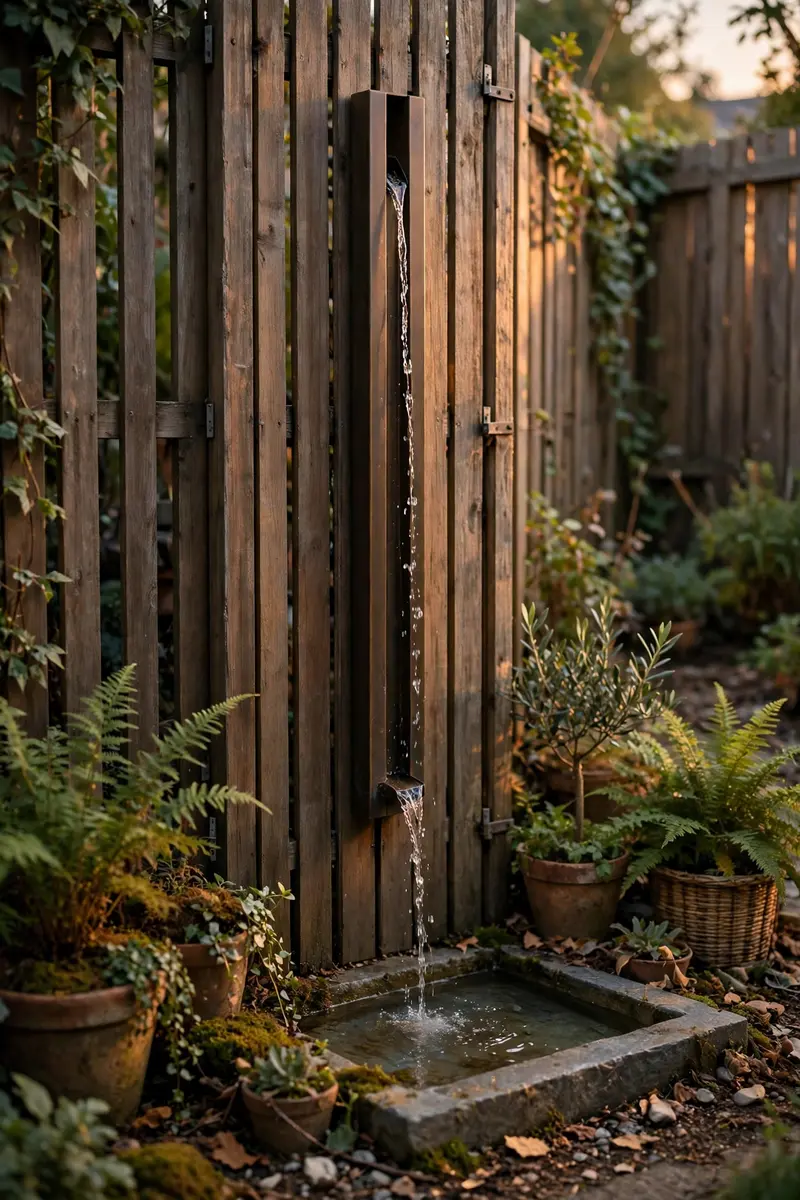
7. Add a Slim Wall Fountain for Sound and Calm
A narrow yard can feel exposed and noisy, especially in a city. A slim wall fountain masks street noise with trickling water, adds a focal point, and takes up no more depth than a picture frame on the fence.
Materials + cost: a wall fountain kit ($80–$200) or a solar-powered wall fountain ($60–$120), plus a nearby outlet or solar panel position.
Mount the fountain on the fence or house wall where you can see and hear it from your main seating spot — sound only works if it reaches you. Choose a simple, flat design that sits close to the wall, and keep the basin shallow so it is easy to clean. Solar models avoid wiring entirely, which is a blessing in a yard where trenching a cable means digging up the only path.
Tip: Run the fountain on a timer for evenings only if you want to save power — the sound matters most when you are actually sitting outside. This works for many small backyard ideas for narrow lots.
Variation: A narrow channel or rill of water along one edge gives the same calming sound in a more modern, architectural style.
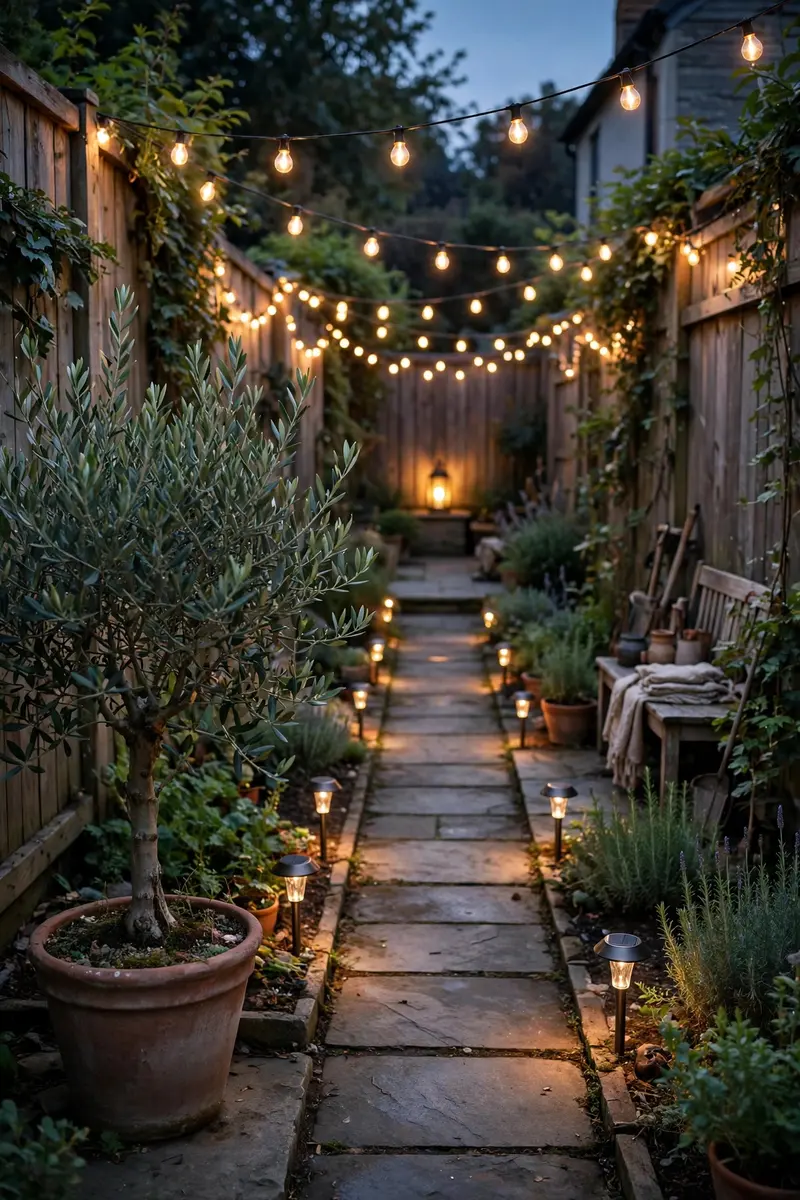
8. Light the Length of the Yard, Not Just the Patio
Most narrow yards are lit only at the back door, which leaves the rest of the space a dark tunnel after sunset. Lighting the full length — low path lights, string lights overhead, and one warm glow at the far end — makes the whole yard feel usable and much larger at night.
Materials + cost: solar path lights ($20–$40 for a set), string lights ($20–$50), and one solar lantern or uplight for the far end ($15–$30).
Line the path with low, warm-toned solar lights, zigzag string lights overhead between the house and fence posts, and put a single lantern or uplight on the far-end feature — a tree, a trellis, or a pot. That far-end glow is the trick: it draws the eye down the whole length of the yard and stops the space from ending in darkness.
Tip: Keep lights low and warm, not bright white — harsh floodlights flatten a narrow yard and make it feel like a corridor, not a garden. This tip applies to many small backyard ideas for narrow lots.
Variation: Fairy lights wound through a fence trellis give the same guidance with a softer, more romantic look.
9. Hang a Weatherproof Mirror to Double the Depth
Mirrors are the oldest small-space trick indoors, and they work outdoors too. A weatherproof mirror panel on a fence reflects greenery and light, and in a narrow yard it can make the space feel almost twice as wide.
Materials + cost: weatherproof acrylic mirror panels ($40–$100), a wooden frame or trellis to mount them on ($30–$60), and fixings ($10–$20).
Mount the mirror where it reflects plants, not the neighbor’s wall or your own back door — the reflection should be greenery. Frame it with a trellis or climbing plant so it reads as a garden feature, not a bathroom mirror stuck outside. Angle it very slightly downward so birds are less likely to fly into it, and keep it out of direct hot sun if you can, since reflected heat can scorch nearby plants.
Tip: Use several smaller mirror panels in a gallery arrangement rather than one huge sheet — it looks intentional and is safer for birds. This works for many small backyard ideas for narrow lots.
Variation: A polished metal garden ornament or a mirrored gazing ball gives a hint of the same depth trick without a full panel.

10. Layer Planting in Three Depths
Flat, single-row planting makes a narrow yard look like a green wall on both sides. Layered planting — low plants at the front, medium shrubs in the middle, and tall, slim plants at the back — creates depth that tricks the eye into seeing more distance than there really is.
Materials + cost: low ground cover or edging plants ($30–$60), medium shrubs such as hydrangea or boxwood ($40–$90), and tall slim plants like columnar trees or bamboo ($40–$100).
Work in three planes along each boundary: a low front edge of ground cover or small perennials, a middle layer of rounded shrubs, and a tall back layer hugging the fence. Keep the front layer under a foot tall so it never crowds the path, and repeat the same few plants down the length of the yard for rhythm. The layers do the widening work even before anything flowers.
Tip: Repeat one plant at intervals down the whole yard — repetition reads as design, while a jumble of different plants reads as clutter in a narrow space. This tip applies to many small backyard ideas for narrow lots.
Variation: In a very shady yard, use ferns for the low layer, hostas for the middle, and slim evergreens at the back.

11. Tuck a Bistro Dining Nook into a Corner
You do not need a full dining set to eat outside in a narrow yard. A tiny bistro table and two chairs tucked into a corner — especially a corner that catches evening sun — gives you proper outdoor meals without blocking the main route through the yard.
Materials + cost: a folding bistro set ($60–$150), an outdoor rug or small paver pad ($30–$60), and two large pots to frame the corner ($30–$60).
Choose a round table, which is easier to move around than a square one in tight space, and folding chairs you can hang on the fence when you need the floor back. Frame the nook with two tall pots so it feels like a destination, not a leftover corner. If the corner is shady, add a small café light overhead and it becomes the spot you use every evening.
Tip: Measure the corner with the chairs pulled out, not pushed in — that pulled-out footprint is the real space the nook needs. This works for many small backyard ideas for narrow lots.
Variation: A wall-mounted fold-down table gives you a dining spot that disappears completely when you are done eating.

12. Create a Compact Fire Bowl Zone
A fire pit is usually the first thing cut from a narrow yard plan, but a small fire bowl needs only a few feet of clear space and turns the far end of the yard into the place everyone gathers on cool evenings.
Materials + cost: a tabletop or small standing fire bowl ($60–$150), a gravel pad ($30–$60), and two compact chairs or a bench ($60–$120).
Set the fire bowl on a gravel pad at the far end of the yard, with seating facing back toward the house so the fire frames the view rather than blocking it. Keep at least 3 feet clear around the bowl, never put it under a pergola or low tree, and check local rules on open flames before you buy. A gas or bioethanol bowl is easier and cleaner than wood in a tight, overlooked space.
Tip: A gravel pad under the fire zone does double duty — it drains well, looks tidy, and clearly marks where the fire area ends and the planting begins. This tip applies to many small backyard ideas for narrow lots.
Variation: A chiminea fits a narrow yard beautifully, since its chimney directs smoke up and away instead of across your seating.

13. Define Zones with an Outdoor Rug: Small Backyard Ideas for Narrow Lots
In a narrow yard, one long space can feel like nothing in particular. An outdoor rug instantly defines a zone — this is the lounge, this is the dining spot — without building a single wall, and it adds color and softness underfoot.
Materials + cost: a weatherproof outdoor rug ($40–$100) and rug grippers or tape ($10–$15).
Lay the rug under your main seating, choosing a size that fits all four chair legs, not just the table — a too-small rug looks like a doormat. Use a second, smaller rug or a different paving material for the next zone down the yard, so each stretch has its own identity. Bring rugs in over winter or choose a quick-dry weave, since narrow yards can stay damp longer than open ones.
Tip: A striped rug laid across the width of the yard, not along it, subtly makes the space feel wider — the same trick as horizontal stripes in a small room. This works for many small backyard ideas for narrow lots.
Variation: Painted pavers or a stenciled concrete pad give the same zone-defining effect permanently and never blow away.

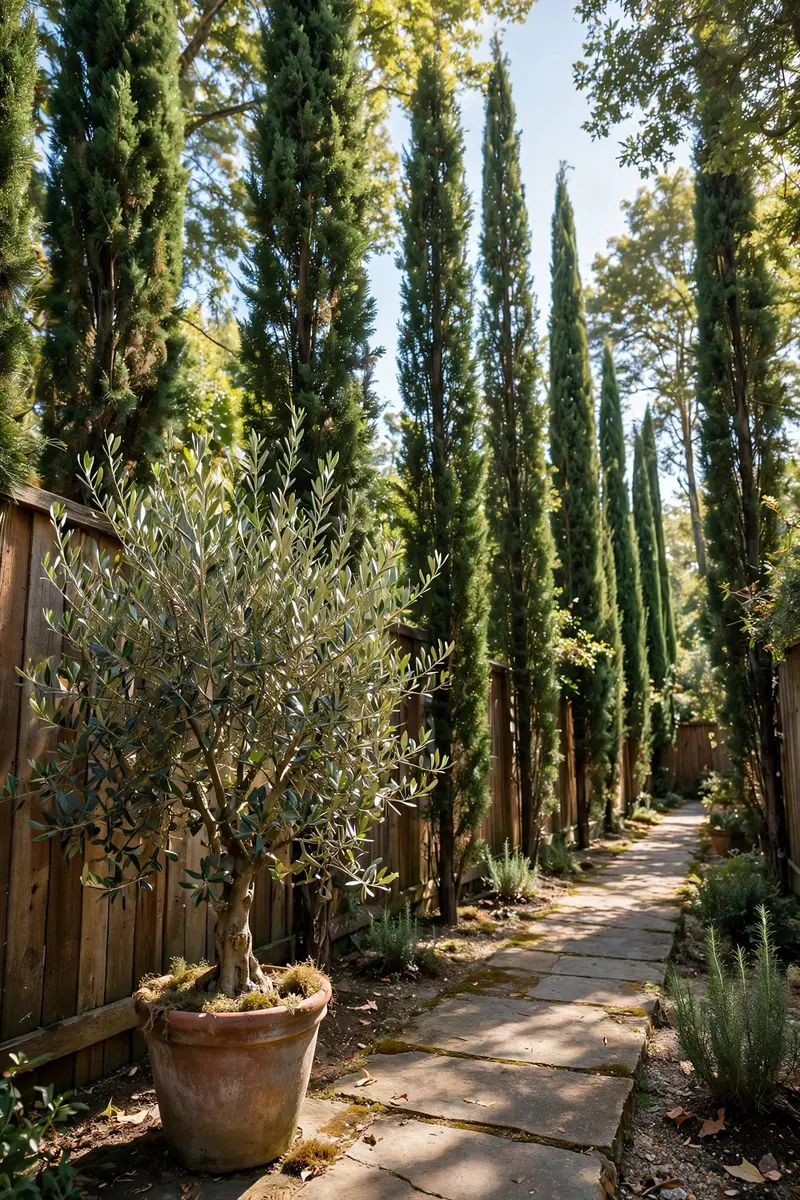
14. Plant Columnar Trees for Height Without Width: Small Backyard Ideas for Narrow Lots
A spreading shade tree will overwhelm a narrow yard within a few years, but a columnar tree — one bred to grow tall and slim — gives you height, shade, and privacy without stealing your ground space.
Materials + cost: columnar trees such as columnar hornbeam, Italian cypress (in mild climates), or slim crabapple ($60–$150 each), plus compost and mulch ($20–$40).
Plant columnar trees along the boundary where you want height, spacing them by their mature width (usually just 3 to 5 feet) rather than guessing. They frame the yard vertically, draw the eye up, and give birds somewhere to perch without shading out the whole space. In colder climates, choose hardy columnar varieties and protect young trees from wind until established.
Tip: Check the mature width on the plant label, not the size in the pot — a tree that looks slim at the nursery can still spread if you pick the wrong variety. This tip applies to many small backyard ideas for narrow lots.
Variation: A row of tall, slim planters with small ornamental trees gives the same vertical rhythm and can be moved if the layout changes.
15. Swap Patchy Lawn for Gravel and Large Pavers
A narrow strip of lawn is the hardest lawn to keep: it wears out along the path, stays soggy in shade, and needs mowing with no room to turn. Gravel with large-format pavers is lower maintenance, drains well, and looks deliberately designed rather than defeated.
Materials + cost: large pavers ($100–$250), gravel ($40–$80), landscape fabric ($15–$25), and edging ($20–$40).
Lay pavers with generous gravel joints, which drain rain where it falls instead of pooling on the path. Keep the paver color light — pale stone brightens a narrow, shaded yard noticeably. Leave a planting strip down one side so the space still feels like a garden, not a driveway, and edge everything firmly so gravel does not migrate into beds.
Tip: Use one paver size and one gravel color throughout — mixing too many materials in a narrow space chops it up visually. This works for many small backyard ideas for narrow lots.
Variation: If you love green underfoot, a clover or creeping thyme lawn tolerates foot traffic better than grass and needs far less mowing.

16. Hide Storage in a Slim Shed Nook
Bins, tools, and garden clutter have nowhere to hide in a narrow yard, and they end up lining the path. A slim storage nook — a narrow shed, a tall cabinet, or a screened bin store at the far end — gets the clutter out of sight and frees the whole yard for living.
Materials + cost: a slim storage shed or tall outdoor cabinet ($150–$350), or timber screening and a bin store kit ($80–$180).
Put storage at the far end or behind a planting screen, never right by the back door where it becomes the first thing you see. Choose the narrowest unit that fits your tools — in a skinny yard, a tall, shallow cabinet beats a wide, low one every time. Paint it the same color as the fence so it visually disappears, and add a green roof or a trailing plant on top if you want it to vanish completely.
Tip: Measure your longest tool before you buy storage — a shed that cannot fit the lawnmower or the ladder is just an expensive cupboard. This tip applies to many small backyard ideas for narrow lots.
Variation: A bench with deep storage underneath hides tools in plain sight and gives you seating at the same time.

17. Frame the Far End as a Destination
A narrow yard that just ends at a fence feels unfinished, like a sentence that stops halfway. Giving the far end a strong frame — a timber arch, a painted garden portal, or a trellis archway — turns it into a destination and makes the whole yard feel deliberately composed.
Materials + cost: a timber or metal garden arch ($80–$200), climbing plants such as clematis or jasmine ($25–$60), and a feature pot or small statue for beyond it ($30–$60).
Set the arch a few feet before the back fence, not flat against it, so there is a small space beyond it — even a single pot or a birdbath is enough to reward the walk. Train a flowering climber over it, and put your best seating or a small feature where it frames the view back toward the house. The arch works as a full stop at the end of the yard’s long sentence.
Tip: Paint the arch a light color or natural wood tone — a dark arch in a narrow yard can read as a tunnel entrance rather than a garden feature. This works for many small backyard ideas for narrow lots.
Variation: Two tall planters flanking the far-end path give a simpler, cheaper version of the same framed-destination effect.

18. Cluster Containers at Different Heights
A row of same-size pots along a fence looks like a waiting room. A cluster of containers at different heights — tall, medium, and low, grouped in threes — looks like a designed garden bed and lets you pack a lot of planting into a very small footprint.
Materials + cost: pots in three heights ($40–$100 total), potting mix ($20–$40), and plants of varying heights and textures ($40–$80).
Group pots in odd numbers near seating or the back door, with the tallest at the back and trailing plants spilling from the front pots. Mix materials — terracotta, glazed ceramic, and woven planters — but keep the color palette tight so the cluster reads as one arrangement. Containers also let you move the garden around until the layout feels right, which is priceless in a yard you are still learning.
Tip: Water container clusters as a group and check the smallest pots first — they dry out fastest, especially in sun and wind. This tip applies to many small backyard ideas for narrow lots.
Variation: Raise the back pots on bricks or a low wooden stand to get the height difference without buying new planters.

19. Run a Slim Grill Station Along One Wall
A full outdoor kitchen will swallow a narrow yard, but a slim grill station hugging one wall gives you everything you need for outdoor cooking in a strip barely 2 feet deep.
Materials + cost: a compact grill ($80–$200), a narrow prep table or rolling cart ($50–$120), and heat-resistant wall protection if the grill sits near a fence ($20–$40).
Set the grill against the wall with the least foot traffic, leave clear space on one side for prep, and keep the cooking zone away from seating so smoke drifts out, not across your guests. A rolling cart is the secret weapon here: it holds tools and plates, rolls out for cooking, and tucks away when dinner is done. Always check clearances from fences and overhangs before the first cookout.
Tip: Keep a small fire extinguisher or a bucket of sand by the grill station — in a tight yard, safety distances are shorter than you think. This works for many small backyard ideas for narrow lots.
Variation: A tabletop grill on a sturdy wall shelf gives you outdoor cooking in the very narrowest yards, with almost no footprint at all.

20. Hang a Reading Nook in the Sunniest Corner
Every narrow yard has one corner that gets the best sun and the least wind, and it is usually wasted on a bin or a bare patch. A hanging chair or a compact lounge chair turns that corner into a reading nook — a private retreat that makes the whole yard feel like it was designed for lingering.
Materials + cost: a hanging egg chair or compact lounge chair ($100–$250), a small side table ($30–$60), and a throw and cushion ($25–$50).
Hang the chair from a sturdy stand, not a tree branch you have not checked, and place it so you face into the garden rather than at the fence. Add a side table just big enough for a book and a drink, and a throw for cool evenings. A single well-chosen chair in a sunny corner will get used far more than a full seating set squeezed into shade.
Tip: Sit in the corner at different times of day before you buy — the sunniest spot at noon is not always the sunniest spot at 5 p.m., when you will actually use it. This tip applies to many small backyard ideas for narrow lots.
Variation: A simple hammock strung diagonally across a corner gives the same retreat feeling for a fraction of the price.

21. Angle Pergola Slats to Block Overlooks
A pergola over the seating area in a narrow yard does more than shade you — if you angle its slats toward the neighbor’s house, it blocks overhead views while keeping the space open underneath, which a solid roof never could.
Materials + cost: a small pergola kit ($200–$450) or timber and brackets for a DIY version ($150–$300), plus climbing plants if desired ($25–$60).
Build the pergola only over the seating zone, not the whole yard, so the rest of the space stays open to the sky. Angle the top slats toward the overlooking side, and train a light vine — jasmine or clematis — over the top for dappled shade that improves every year. Keep the posts slim and painted a light color so the structure does not visually narrow the yard further.
Tip: Before building, stand where your neighbors stand — a second-floor window or raised deck — and check exactly which angle actually blocks the view. This works for many small backyard ideas for narrow lots.
Variation: A retractable shade sail angled the same way gives you the privacy effect for less money and can come down in winter.
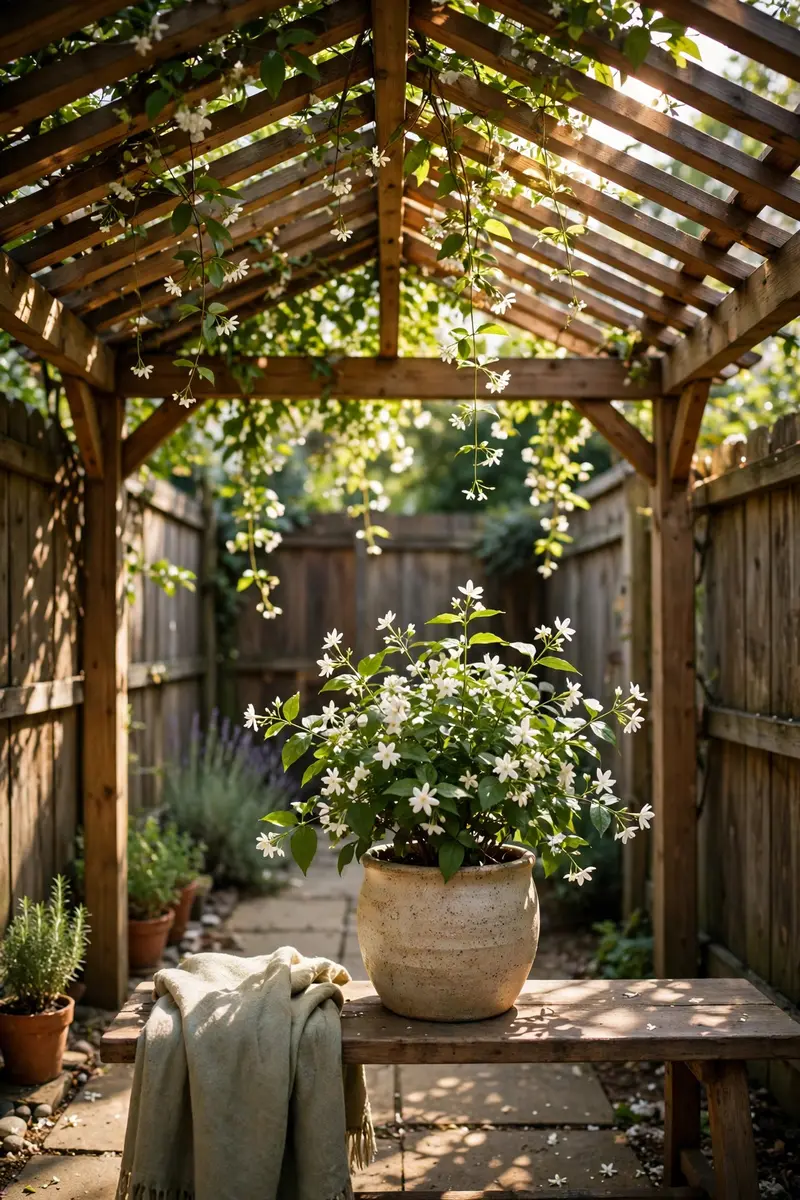
22. Go Renter-Friendly: A Portable Narrow Yard Kit
If you rent, you may not be allowed to dig, build, or attach anything to the fence — but these small backyard ideas for narrow lots still work as a portable kit. Freestanding pieces give you every zone without a single hole, and the whole yard moves with you.
Materials + cost: freestanding planters and trellis panels ($80–$180), a folding bistro set ($60–$150), removable pavers or deck tiles ($80–$200), and string lights on freestanding poles ($30–$60).
Lay deck tiles or removable pavers over the existing ground, arrange planters along the fence for privacy and greenery, and set the bistro set in the sunniest corner. Nothing is attached to the property, so your landlord has nothing to object to, and you can live with the layout for a season before committing to anything permanent. Apartment Therapy’s tiny backyard patio redo shows how far removable pavers and trellises can go — a neglected rental yard became a cozy European-style patio with exactly this approach, as you can see in their before-and-after story.
Tip: Photograph your setup before and after so you can show your landlord the yard is undamaged when you move out. This tip applies to many small backyard ideas for narrow lots.
Variation: Even homeowners can use a portable kit as a trial run — live with the layout for a month, then build the permanent version of whatever you actually used.

Frequently Asked Questions
How do you make a narrow backyard feel wider?
Use diagonal or curved paths, large-format pavers, and layered planting in three depths. Keep furniture slim and against the walls, leave the middle of the yard open, and add a focal point at the far end so the eye travels the full length instead of stopping at the fence.
What is the best layout for a long, narrow backyard?
Divide it into two or three zones along its length — for example, dining by the house, lounging in the middle, and a fire or garden feature at the far end — connected by a diagonal path. Each zone should have one clear job, and the path should shift direction at least once so the yard never reads as a single corridor.
How can I get privacy in a narrow backyard without a tall fence?
Screen only the spots where neighbors can actually see in, using slim planters with bamboo or sky pencil holly, a freestanding trellis with a vine, or a pergola with slats angled toward the overlooking side. Eye-level screening at 4 to 6 feet is usually enough, and it keeps light and air flowing in a way a solid tall fence does not.
What plants work best in a narrow backyard?
Choose slim, upright, and columnar plants: clumping bamboo, sky pencil holly, columnar trees, and climbing vines on trellises. For beds, layer low ground cover in front, medium shrubs in the middle, and tall slim plants at the back, and repeat the same few plants down the length of the yard for a designed look.
Can you fit dining and lounging in a narrow backyard?
Yes, if you zone it. Put a small bistro dining nook in one corner and a built-in bench or a single lounge chair in another zone, connected by a path. Built-in seating along a wall and folding furniture are the keys — freestanding dining sets and lounge sets together will crowd any narrow yard.
Conclusion
A narrow backyard is not a problem to apologize for — it is a shape with its own strengths. It is easier to water, quicker to light, and cozier to sit in than a big open lawn, once you give it a path with a purpose, planting that goes up instead of out, and a few zones that each do one job well. Start with the diagonal path and one privacy fix this weekend, then add a place to sit and a far-end feature over the next few weeks. And if you want more small-space thinking for the rest of your home, our small apartment decor ideas use the same slim, layered approach indoors.
Found an idea that would widen your yard? Save this post to Pinterest so you can find it again when you are ready to build — and if you try one of these ideas, we would love to hear which one changed your yard the most.

Leave a Reply