Your front door opens, and in three seconds a guest has decided how the rest of your home feels. That is a lot of pressure for a space barely bigger than a doormat — but it is also great news, because small entryway decor ideas work fast and cost very little. A slim table, one good mirror, and a place for your keys can turn a cramped landing into the most welcoming corner of your home.
You do not need a grand foyer, custom built-ins, or a full weekend of DIY to pull this off. Most of the small entryway decor ideas in this guide cost under $100, need no landlord permission, and can be finished in an afternoon. Pick the three that solve your biggest daily annoyance — shoes everywhere, keys always lost, coats on the nearest chair — and start there.
Every idea below is sized for real small spaces: narrow hallways, apartment landings, and front doors that open straight into the living room. Keep about 30 inches of clear walkway, choose pieces that store something or reflect light (ideally both), and your tiny entry will feel intentional instead of accidental. If you live in a small apartment, pair these with the storage tricks in our small apartment decor ideas guide for a whole-home plan.
1. Slim Console Table That Fits a 10-Inch Wall
A slim console table is the single easiest way to give a small entryway structure. Look for one 10 to 12 inches deep and 30 to 48 inches wide, so it hugs the wall and still leaves your walkway clear. It gives you a landing spot for keys and mail without eating the room.
Materials + cost: slim console table ($60–$150), small tray or bowl ($8–$15), vase with stems ($10–$20). Total: about $80–$185, or under $40 if you thrift the table.
Style the top with just three things: something tall, something low, and something personal. A vase with a few stems, a small framed print, and a candle is a classic combination that works in almost any small entryway. Keep the surface mostly clear so it stays useful, not just pretty.
Tip: Measure your walkway first — if the table leaves less than 30 inches of clear path, go narrower or switch to a wall-mounted shelf instead.
Variation: Try a demilune (half-moon) table in a tight corner; its curved front softens the space and never catches a hip.

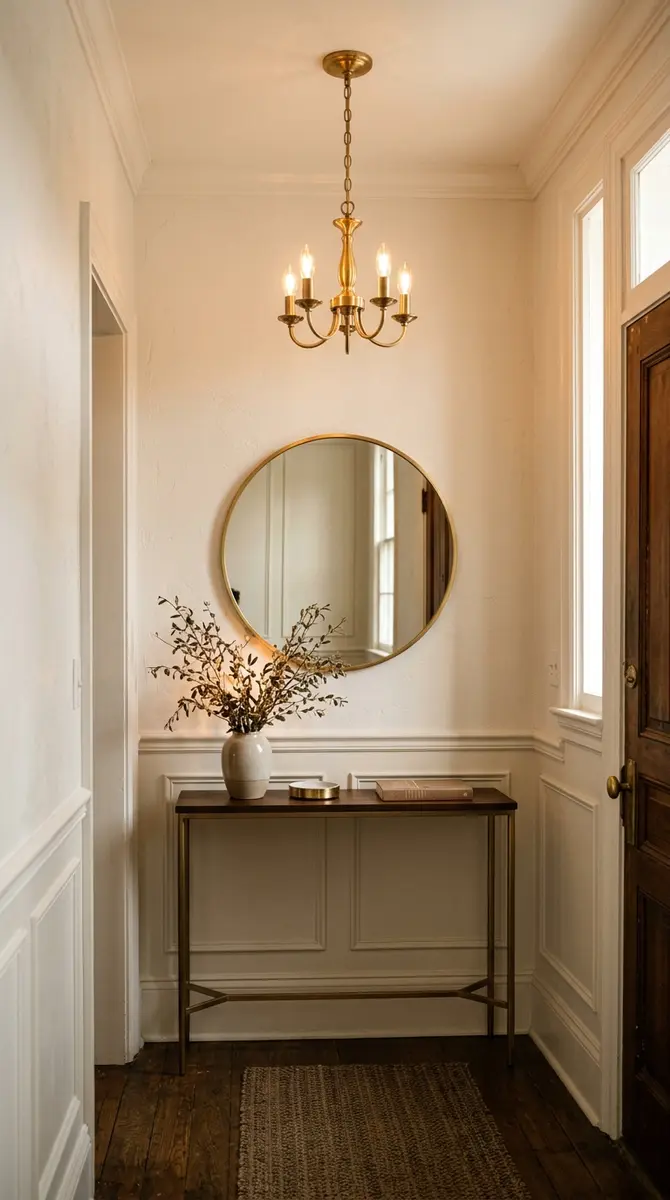
2. Round Mirror Above the Console
A mirror is the oldest trick for making a small entryway feel bigger, and it works because it does two jobs at once. It bounces light from the nearest window or lamp across the hall, and it gives you a last look before you leave. These small entryway decor ideas always start with light, and a mirror is the cheapest way to get more of it.
Materials + cost: round mirror 24–28 inches ($30–$80), picture-hanging hardware ($5). Total: about $35–$85.
Hang it above the console table with the center at about 57 to 60 inches from the floor, which is eye level for most people. A mirror two-thirds to three-quarters as wide as the table looks balanced, so a 36-inch table pairs well with a 24- to 28-inch mirror. The Spruce’s roundup of small entryway ideas shows the same rule in dozens of real homes.
Tip: Hang the mirror opposite or beside the front door, never directly facing it, so it catches window light instead of a blank wall.
Variation: Try an arched mirror for a softer, trendier silhouette, or a sunburst mirror if your style leans midcentury.

3. Floating Shelf With Hooks Underneath
When floor space is zero, go vertical. A floating shelf with a row of hooks underneath holds keys, mail, sunglasses, and coats in one slim package — and it keeps the floor completely clear, which makes the whole entry feel larger. This is one of the most practical small entryway decor ideas for renters, because it needs only two screws.
Materials + cost: floating shelf with hooks ($25–$60), wall anchors ($5), small baskets or a key bowl ($10). Total: about $40–$75.
Mount the shelf at about 60 inches high, with hooks at a comfortable reach below it. Leave the shelf top mostly empty except for one small plant or framed photo, so it reads as decor rather than clutter. Hooks staggered at two heights work beautifully for adults and kids sharing one wall.
Tip: Use a stud finder or heavy-duty wall anchors — a shelf loaded with coats pulls harder than you think. It is a small detail, but it keeps these small entryway decor ideas safe as well as stylish.
Variation: Swap the shelf for a slim picture ledge and lean two small art prints on it for a gallery feel with the same hooks below.

4. Storage Bench With Baskets Underneath
A bench gives you somewhere to sit while you put on shoes, and in a small entry that one convenience changes your daily routine. Choose a bench 17 to 19 inches high, which is standard seat height, and 36 to 48 inches long so two people can sit or one person can sit with a bag beside them.
Materials + cost: storage bench ($80–$180), two woven baskets ($15–$30 each), seat cushion ($20–$40). Total: about $130–$280, or under $100 secondhand.
Tuck baskets underneath for shoes, scarves, and dog gear, and keep one basket per person so clutter has an owner. A bench with a lift-up lid hides even more, but open baskets are easier to use every day — you will actually put shoes away if you can see where they go.
Tip: Put the bench against the longest wall, not blocking the door swing, and leave 30 inches of walkway in front of it. That breathing room is what makes small entryway decor ideas feel spacious instead of cramped.
Variation: No room for a bench? A single upholstered cube or pouf gives you the same seat in half the footprint.

5. Tall Slim Shoe Cabinet
Shoes are the number-one source of entryway chaos, and a tall slim shoe cabinet solves it in under 10 inches of depth. These cabinets tilt open to hold 8 to 12 pairs while looking like a simple console or sideboard. Among all small entryway decor ideas, this one delivers the biggest visual payoff, because the floor goes from shoe pile to clear in one move.
Materials + cost: slim shoe cabinet ($70–$160), small tray on top ($10), wall anchor strap ($5). Total: about $85–$175.
Place it against the wall nearest the door and anchor it to the wall — tall, narrow furniture tips easily when a drawer is pulled open. Style the top like a console: a mirror above, a small lamp or vase, and a tray for keys. The cabinet reads as furniture, not storage, which is exactly the point.
Tip: Measure your bulkiest shoes first — chunky boots need deeper tilt-out compartments than flat sandals do.
Variation: In a rental, try a narrow open shoe rack with a pretty curtain or a bench cushion on top to disguise it.

6. Staggered Peg Rail for Coats and Bags
Wall hooks are the hardest-working piece in a small entryway, and they take up no floor space at all. Hang a rail of three to five hooks at about 60 to 66 inches from the floor, which is comfortable for most adults to reach without stretching. Staggering the pegs at two heights doubles capacity on the same rail.
Materials + cost: peg rail or individual hooks ($15–$45), screws and anchors ($5). Total: about $20–$50 — the cheapest big win on this list.
Give every household member one hook and keep one spare for guests. Hang the rail near the door but not behind it, so coats never block the swing. Wooden pegs suit farmhouse and Scandinavian rooms; matte black or brass hooks feel modern and deliberate.
Tip: Add one low hook at kid height (about 48 inches) so little coats actually get hung up instead of dropped.
Variation: Try sculptural hooks in loose, artful formations instead of a straight rail — a trending 2026 look that doubles as wall decor. It is a fresh angle on small entryway decor ideas that costs almost nothing to try.

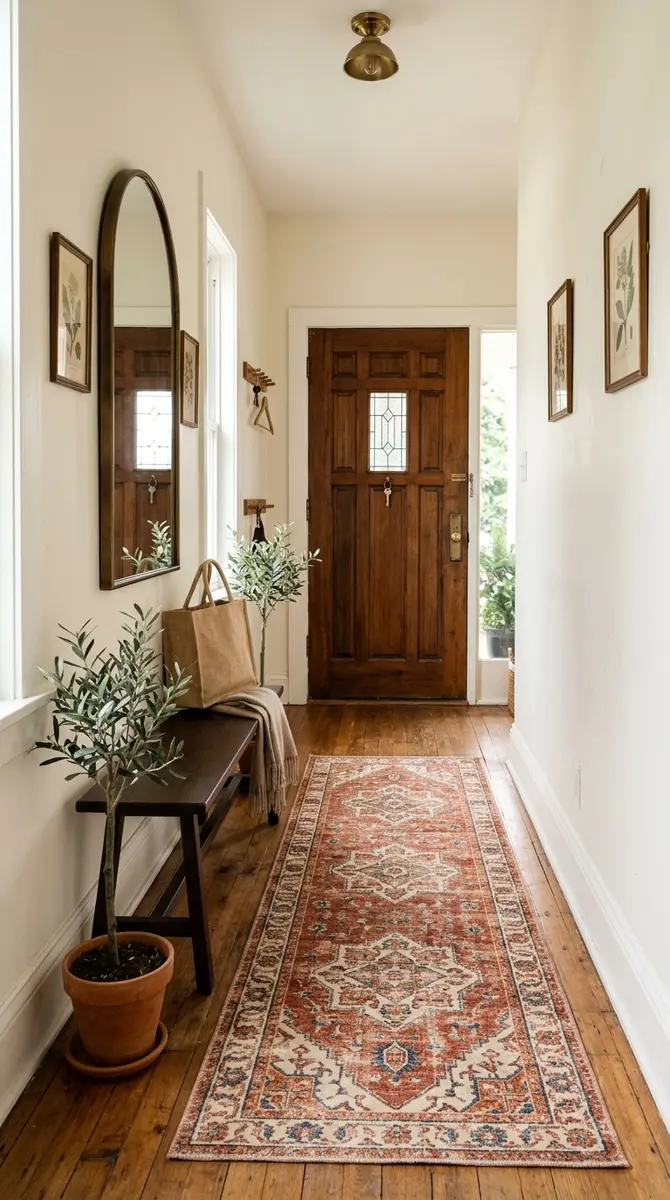
7. Washable Runner Rug to Define the Zone
In an open-plan apartment, a rug is what tells your eyes where the entryway ends and the living room begins. A 2-by-3-foot rug suits a tight landing, while a 3-by-5-foot rug fits a longer hall. Choose a washable, low-pile runner so muddy shoes and everyday crumbs never stand a chance.
Materials + cost: washable runner rug ($40–$120), non-slip rug pad ($10–$15). Total: about $50–$135.
Pick a vintage-inspired pattern to disguise dirt between washes, and make sure the rug sits flat with no curled corners near the door swing. A runner that runs the length of the hall draws the eye forward and makes a narrow entry feel longer and more intentional.
Tip: If your door opens inward over the rug, choose a low-pile style under a quarter-inch thick so the door never catches. A rug that fits properly is one of the easiest small entryway decor ideas to get right the first time.
Variation: Layer a small coir doormat over the inner end of the runner for a two-texture look that traps even more dirt.
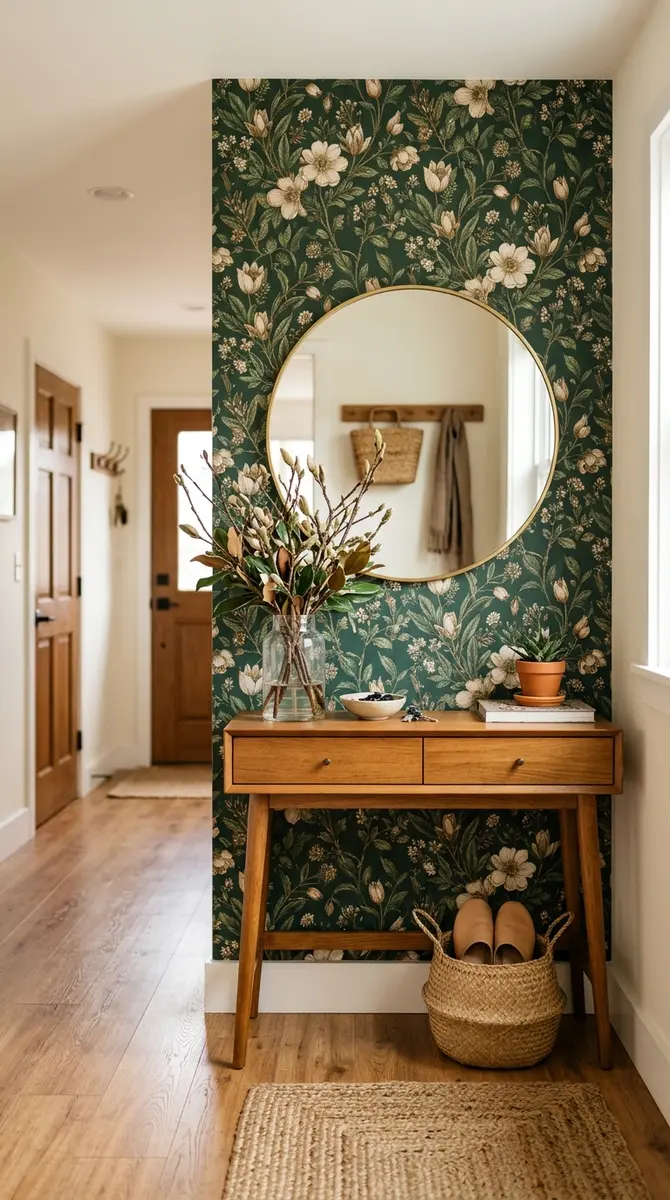
8. Bold Wallpaper on One Accent Wall
Small spaces can handle big personality, and nowhere is that truer than the entryway. One wall of bold wallpaper — a large-scale floral, a geometric print, or a deep moody color — turns a forgettable landing into the most memorable part of your home. These small entryway decor ideas prove that a tiny room is the safest place to be brave with pattern.
Materials + cost: one roll of peel-and-stick wallpaper ($30–$80), smoothing tool ($5). Total: about $35–$85.
Peel-and-stick wallpaper is renter-friendly and forgiving: if a strip goes on crooked, peel it back and try again. Apply it to the wall you face when you walk in, or the wall behind the console, so the pattern frames your furniture. Vertical stripes and upward-moving patterns make ceilings feel taller.
Tip: Order one extra roll beyond the calculator’s estimate — pattern matching wastes more paper than you expect.
Variation: Not ready for full wallpaper? A painted arch behind the console gives the same focal-point effect for the price of a sample pot.
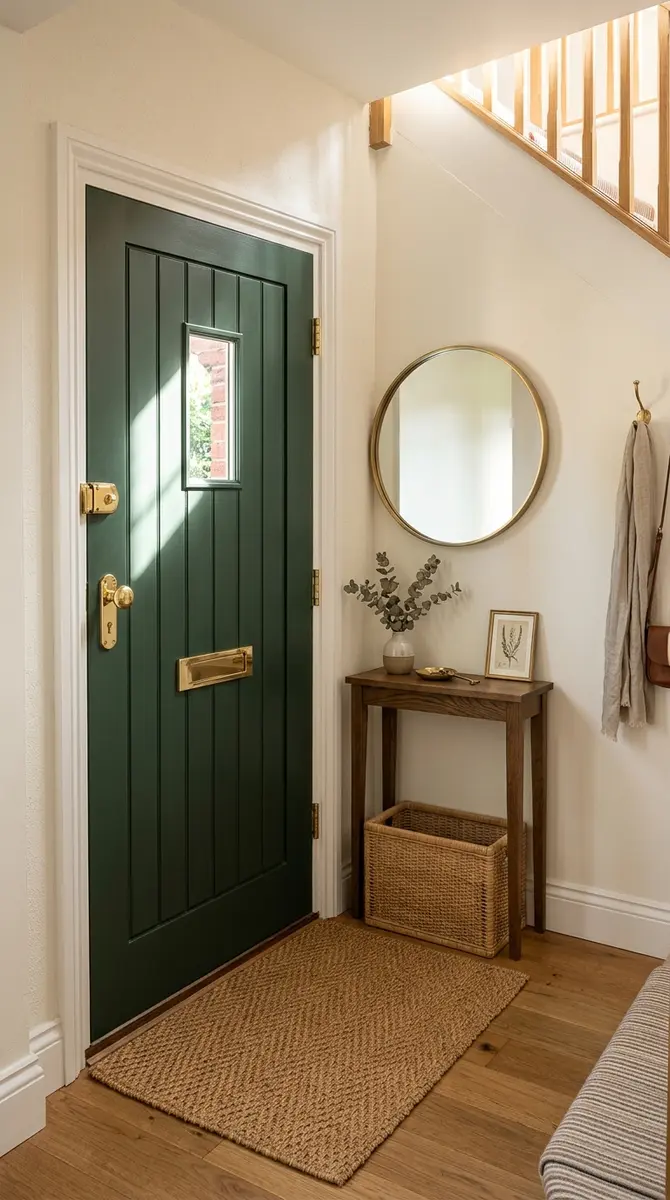
9. Painted Front Door in a Bold Color
Your front door is the largest single surface in most small entries, so painting it is the highest-impact move per dollar. A deep green, navy, plum, or cheerful red door makes the whole entry feel designed, even if nothing else changes. Guests notice it before anything else, and you see it every single day.
Materials + cost: quart of exterior or interior door paint ($15–$30), brush and roller ($10), painter’s tape ($5). Total: about $30–$45.
Remove the hardware, sand lightly, and apply two thin coats for a smooth finish. If you rent, check with your landlord first — many welcome the upgrade, and some will even pay for the paint. Paint the interior side only if the exterior must stay neutral.
Tip: Match your door color to one small accent inside the entry — a cushion, a vase, a frame — so the bold choice feels deliberate, not random. Color matching is a quiet trick behind the best small entryway decor ideas.
Variation: Try a two-tone door with a contrasting frame, or paint just the door’s inner panels for a subtle pop.
10. Vertical Gallery Wall Up the Hall
Narrow hallways can be challenging, but they are perfect for a vertical gallery wall. Family photos, travel prints, and small art pieces stacked floor-to-ceiling turn a plain passage into a personal story. Keep frames in one color family so the collection feels curated instead of cluttered.
Materials + cost: 5–7 frames in mixed sizes ($30–$70), prints or photos ($10–$25), picture-hanging strips ($8). Total: about $50–$100.
Start with the largest frame at eye level and build outward, keeping 2 to 3 inches between frames. In a rental, use adhesive hanging strips instead of nails. A narrow ledge shelf lets you lean art and swap pieces seasonally without new holes.
Tip: Lay the arrangement on the floor first and photograph it — you will spot spacing mistakes in seconds that your eye misses on the wall. Planning on the floor first is how polished small entryway decor ideas come together without extra holes.
Variation: Mix in one small mirror or a woven wall hanging to break up the rectangles and add texture.

11. Floating Console With No Legs at All
A wall-mounted console is the ultimate trick for a truly tiny entry. With no legs touching the floor, the eye reads more open space, cleaning underneath takes seconds, and the piece seems to float. This is one of the smartest small entryway decor ideas for apartments where the front door opens straight into the living room, because it marks the entry without building a wall.
Materials + cost: wall-mounted console or floating shelf unit ($50–$120), heavy-duty brackets or anchors ($10). Total: about $60–$130.
Mount it at standard console height, about 30 to 34 inches, and keep the styling minimal — a lamp on one side, a key tray in the middle, and nothing else. The emptiness underneath is the point, so resist the urge to slide shoes under it.
Tip: Anchor into studs wherever possible; a floating console loaded with books and bags needs real support.
Variation: Try a clear acrylic console for the same floating effect with even less visual weight — it nearly disappears against the wall.
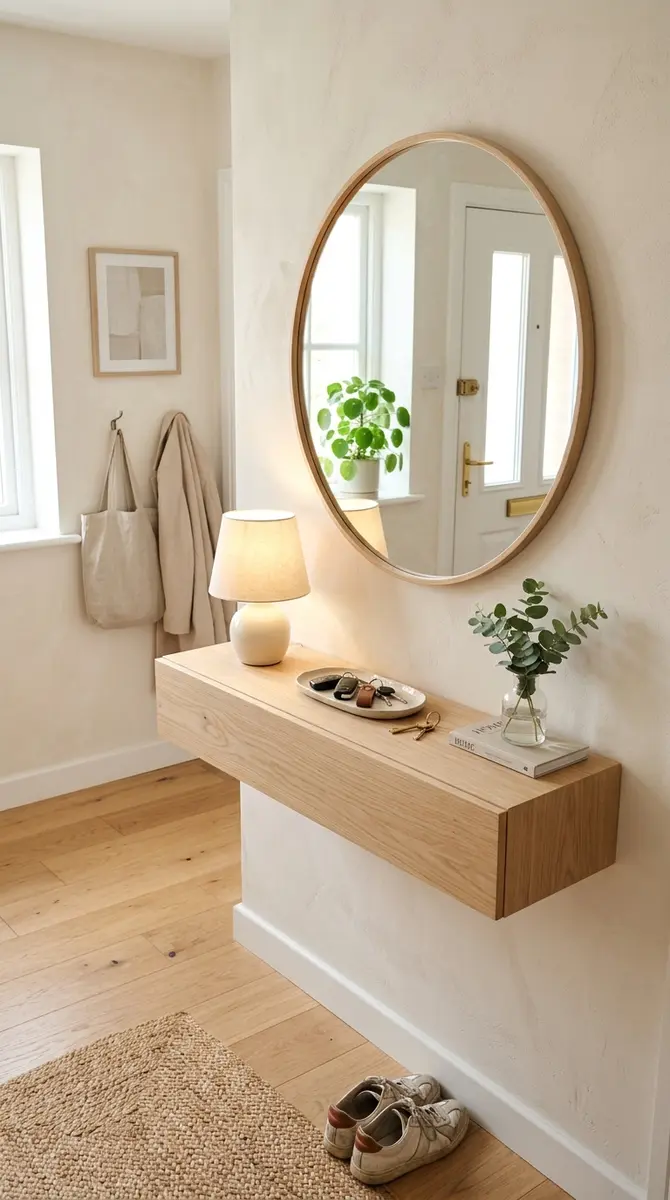
12. Woven Baskets for the Small Stuff
Keys, dog leashes, sunglasses, spare change, mail — the small stuff is what makes an entryway look messy even when the big furniture is perfect. A set of woven baskets, each assigned to one job, hides all of it while adding warm natural texture. Choose a size for a specific job instead of buying a pretty set and hoping it works.
Materials + cost: 2–3 woven baskets ($10–$25 each), small labels or tags ($5). Total: about $25–$80.
Place one lidded basket on the bench or under the console for odds and ends, and a smaller open basket on the console top for keys and sunglasses. Label the hidden ones so everyone in the house knows where things live. Seagrass, rattan, and cotton rope all suit entryways because they are sturdy and forgiving.
Tip: Measure your shelf or bench opening before buying — baskets that are an inch too tall are the most common entryway mistake. Getting the fit right is a small detail that separates good small entryway decor ideas from frustrating ones.
Variation: Hang a row of small baskets on the wall as open cubbies for hats and gloves in winter.
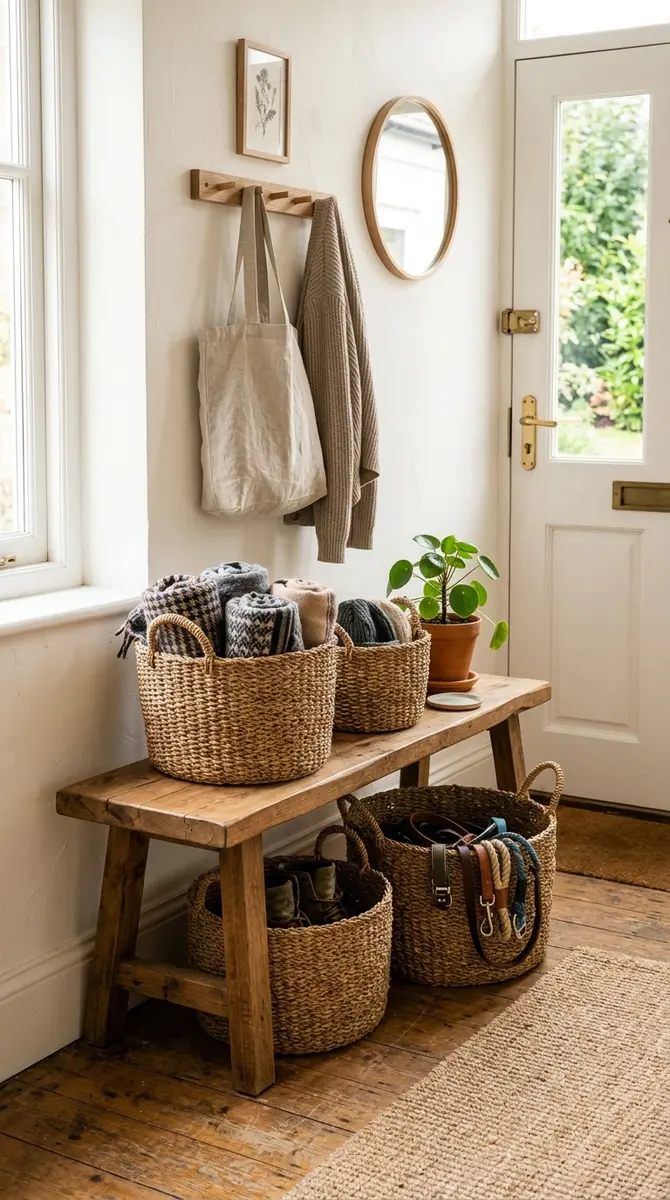
13. Key Bowl and Mail Tray Drop Zone
Every entryway needs a designated landing spot for the things in your hands when you walk in. A tray on the console plus a small bowl for keys means nothing lands on the floor or the kitchen counter ever again. It is a tiny habit change with an outsized effect on daily clutter.
Materials + cost: decorative tray ($12–$30), small ceramic bowl or dish ($8–$15). Total: about $20–$45.
Put the tray on the console closest to the door and the bowl inside it or right beside it. Add a small hook or clip on the wall above for the day’s mail, and empty the tray every Sunday so it never becomes a junk drawer. This is one of those small entryway decor ideas that costs almost nothing and saves you five minutes every morning.
Tip: Choose a tray with a raised edge so keys and coins cannot slide off onto the floor.
Variation: Use a vintage brass dish, a marble tray, or a handmade ceramic bowl — the drop zone is a great place for one beautiful object.

14. Layered Lighting: Sconce, Lamp, and Glow
Most small entries have one harsh overhead light, and it flatters no one. Layered lighting fixes that with three small sources instead of one big one: an overhead light for general brightness, a table lamp or wall sconce at eye level for warmth, and a small accent like a candle or an LED strip under a shelf for glow.
Materials + cost: plug-in wall sconce ($30–$70) or small table lamp ($25–$50), warm bulbs 2700K ($8), LED strip ($12). Total: about $45–$130.
Choose bulbs around 2700K, which reads as soft and welcoming, and avoid cool white bulbs above 4000K in the entryway because they make skin tones and wood finishes look flat. Plug-in sconces need no electrician and no holes beyond two small screws, so renters can use them too.
Tip: Put the lamp on a timer or smart plug so the entry is lit before you get home on dark winter evenings. A lit entry is one of the warmest small entryway decor ideas you can add for almost no money.
Variation: A battery-operated picture light above a mirror or art piece adds gallery warmth with zero wiring.
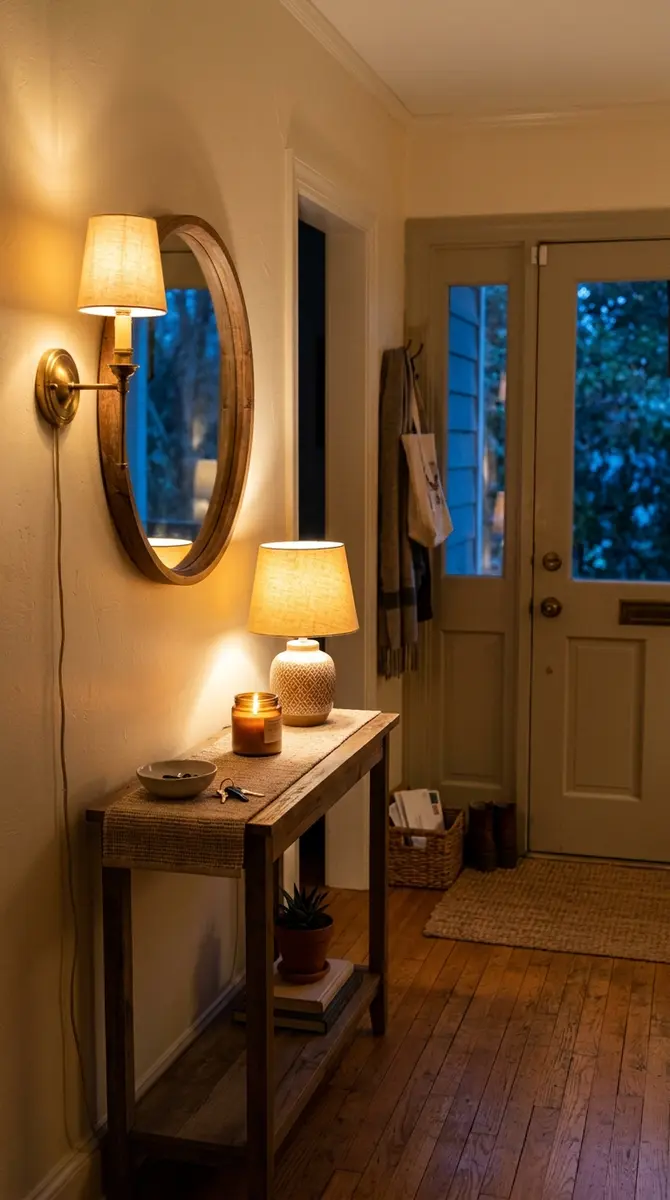
15. Over-the-Door Organizer Inside the Closet
No entryway closet? No problem — or rather, a closet you cannot see into is almost as bad. An over-the-door organizer on the inside of the nearest closet door holds scarves, hats, gloves, dog gear, and umbrellas in clear pockets, freeing your entry walls for decor instead of clutter. It is one of the most practical small entryway decor ideas for homes where the entry itself has no storage at all.
Materials + cost: over-the-door organizer ($15–$30), adhesive hooks for the door ($5). Total: about $20–$35.
Hang it on the inside of a coat closet or pantry door near the entry, and assign one row per person or per season. Clear pockets beat fabric ones because you can see what is inside without digging. If there is no closet at all, hang the organizer on the back of the front door itself.
Tip: Keep only entry gear in it — the moment it becomes general storage, it stops working for the entry.
Variation: Swap a bulky closet door for a curtain on a tension rod to free up swing space and soften the entry.

16. Ladder Shelf for Tiered Storage
A leaning ladder shelf gives you four or five tiers of storage in a footprint barely wider than a picture frame. Shoes go on the bottom rungs, baskets in the middle, and plants and decor on top. Its open, airy frame suits small entries because you can see the wall through it, so it never feels like a solid block of furniture.
Materials + cost: leaning ladder shelf ($60–$120), 2–3 small baskets ($10–$20 each). Total: about $80–$180.
Lean it against the wall beside the door and anchor the top to the wall for safety, especially in homes with kids or pets. Keep the bottom rung for the shoes you wear daily and the top shelf for decor only, so the piece reads as styled rather than stuffed.
Tip: Place heavier items on the lower rungs — a top-heavy ladder shelf is a tipping hazard. Safety first is the unglamorous rule behind all lasting small entryway decor ideas.
Variation: A narrow leaning shelf with a built-in mirror on top combines two entry essentials in one slim piece.
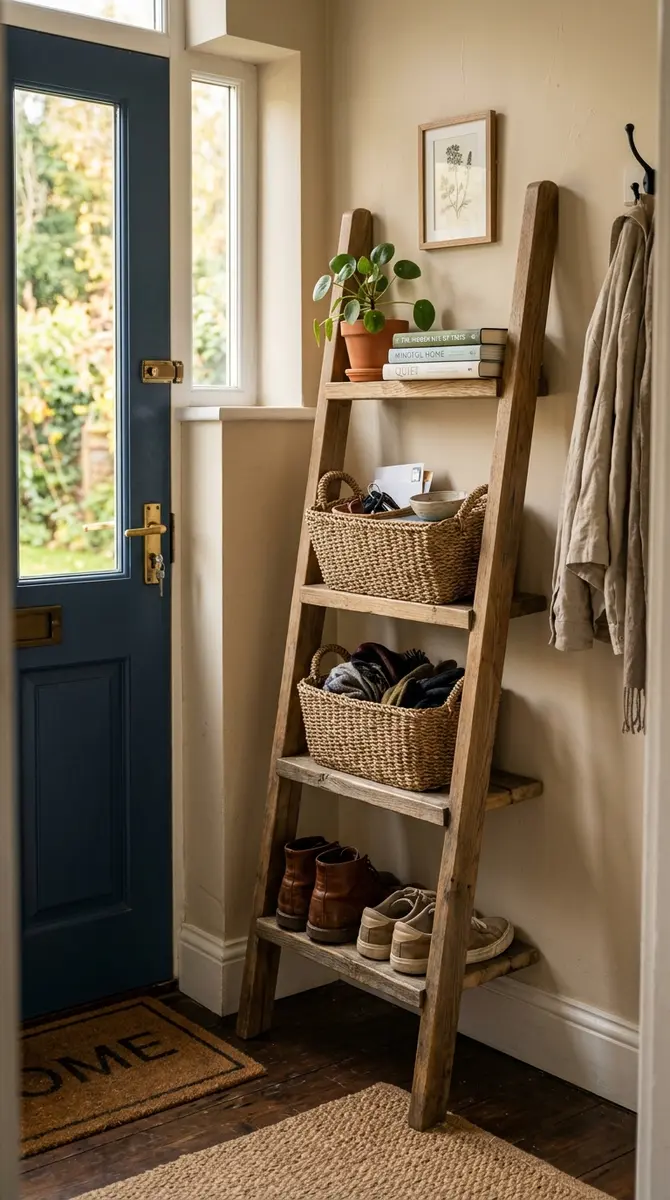
17. Oversized Mirror Leaning Against the Wall
A full-length mirror leaning against the wall does more than any other single piece to make a small entry feel double its size. Framed mirrored panels or one supersized mirror reflect the whole room, bounce light into dark corners, and give you a head-to-toe check before you leave. These small entryway decor ideas lean on reflection, and this one leans literally.
Materials + cost: large leaning mirror 60–72 inches ($80–$200), anti-slip pads ($5), wall anchor ($5). Total: about $90–$210.
Lean it at a slight angle against the longest wall and secure the top to the wall with an anchor strap — leaning mirrors are heavy, and safety comes first. A thin black or brass frame keeps the look modern; a chunky wood frame leans farmhouse. Place it where it reflects a window or a pretty view, not a blank wall.
Tip: If floor space is truly zero, hang the same mirror flat on the wall instead — you keep the light and lose nothing.
Variation: Try two matching narrow mirrors side by side for a paneled, architectural effect.

18. Patterned Floor Tile or Peel-and-Stick Tiles
Your entryway floor can be a design feature, not just a surface to wipe. Patterned floor tile — or renter-friendly peel-and-stick tiles — creates a beautiful “rug” that never needs washing and defines the entry zone permanently. Bold encaustic-look patterns are a favorite in small entries because they deliver maximum style in minimum square footage.
Materials + cost: peel-and-stick floor tiles ($1–$3 per square foot, about $30–$60 for a small entry), utility knife ($8). Total: about $40–$70.
Clean the floor thoroughly, then lay tiles from the center outward so the pattern stays symmetrical at the edges. Peel-and-stick versions lift off cleanly when you move, which makes them ideal for rentals. Seal the edges with a clear caulk line if your entry sees wet boots often.
Tip: Choose a pattern with your wall color in it so the floor and walls feel connected rather than competing. That kind of color echo is what makes small entryway decor ideas look professionally planned.
Variation: Paint a faux tile pattern with a stencil and floor paint for a custom look at a fraction of the cost.

19. One Big Plant or a Greenery Moment
A single healthy plant softens every hard edge in a small entryway and makes the space feel alive the moment you walk in. A tall snake plant in a corner, a trailing pothos on a shelf, or a small olive tree beside the console all work — the key is choosing one plant that fits the light you actually have, not the light you wish you had.
Materials + cost: low-light plant like snake plant or pothos ($15–$35), decorative pot ($10–$25). Total: about $25–$60.
Snake plants and ZZ plants thrive in the low, indirect light most entries get, and they forgive forgotten watering. Set the pot on the floor in a corner that does not block the walkway, or hang a trailing plant from a ceiling hook to keep the floor clear entirely.
Tip: A faux olive branch in a tall vase gives the same softening effect with zero maintenance if your entry has no natural light at all. A faux branch keeps these small entryway decor ideas working even in windowless entries.
Variation: A small herb pot on the console — rosemary or lavender — adds scent as well as greenery.

20. Sculptural Hooks That Feel Designed
In 2026, entryways are ditching the standard coat rack for sculptural hooks arranged in loose, artful formations. A brass orb, a curved wooden peg, or a ceramic knob becomes wall decor in its own right — and still holds your coat. It is a small move that makes the whole entry feel designed rather than assembled.
Materials + cost: 3–5 sculptural hooks ($8–$20 each), wall anchors ($5). Total: about $30–$105.
Arrange hooks at staggered heights instead of a straight line, and leave breathing room between them so each one reads as an object. Mix two finishes — brass and matte black, or wood and ceramic — for a collected look. Keep one hook free for guests at all times.
Tip: Test the arrangement with painter’s tape outlines on the wall before drilling a single hole. Testing first saves walls and keeps small entryway decor ideas renter-friendly.
Variation: A single oversized statement hook beside the door handles bags and leashes while looking like sculpture.
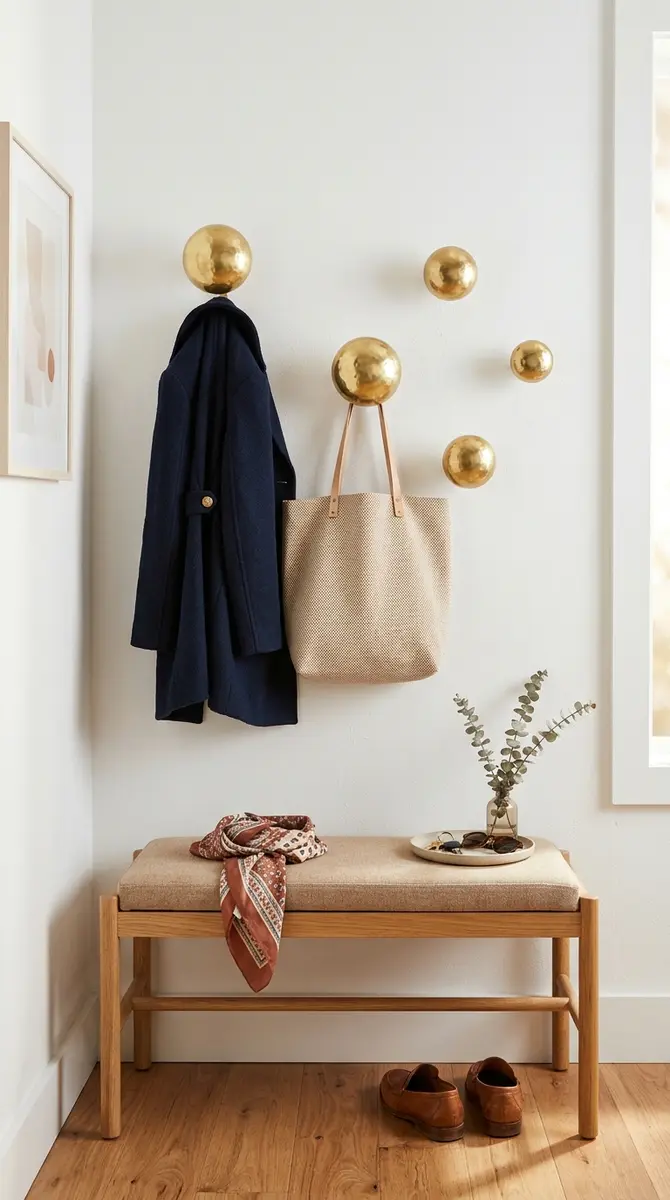
21. Bench Cushion and Throw Pillows
A bare bench is a seat; a bench with a cushion and two throw pillows is an invitation. Soft textiles warm up the hardest-working corner of your entry and give you a low-stakes way to change the look with the seasons. Swap pillow covers in spring and fall and the whole entry feels new for under $20.
Materials + cost: bench cushion ($25–$50), two throw pillow covers ($10–$20 each). Total: about $45–$90.
Choose outdoor or performance fabric for the cushion so muddy bags and wet coats never stain it. A cushion in a washable slipcover is the most practical choice for a high-traffic seat. Keep pillows small — 16 inches square is plenty — so they never crowd the sitter.
Tip: A cushion with ties stays put; a loose cushion slides off the bench within a week. Small fixes like this are what make small entryway decor ideas actually last in daily use.
Variation: Drape a folded throw over one end of the bench for a cozy, lived-in look that also warms cold hands.

22. Wall-Mounted Mail Sorter Command Center
Mail is the silent clutter-maker of every entryway. A wall-mounted mail sorter with two or three slots — incoming, outgoing, and “deal with it” — plus a small chalkboard or dry-erase board for reminders turns one wall into a command center. Everything has a slot, so nothing piles on the console.
Materials + cost: wall-mounted mail sorter ($25–$55), small chalkboard or whiteboard ($10–$20), chalk markers ($5). Total: about $40–$80.
Mount it at eye level beside the door, at a height every adult can reach without stretching. Sort mail the moment you walk in — junk goes straight to recycling, bills go in their slot, and the console stays clear. Add a small hook below for keys so the whole leaving-the-house routine lives in one spot.
Tip: Empty the “deal with it” slot every Sunday or it becomes a second junk drawer on the wall. A weekly reset is the habit that keeps small entryway decor ideas working long after the decorating is done.
Variation: A single file holder plus a small calendar covers the same jobs in half the wall space.

23. Acrylic Console for Visual Airiness
When every solid piece of furniture makes your entry feel smaller, try a piece you can see through. A glass or acrylic console gives you a top surface for keys and decor without the visual weight of wood or metal. It is one of the most elegant small entryway decor ideas for tight spaces, because the wall behind it stays visible and the room keeps breathing.
Materials + cost: acrylic or glass console table ($120–$300), small tray ($10–$15). Total: about $130–$315 — the priciest idea here, so thrift it if you can.
Style it lightly: a single vase, a small stack of books, and a key bowl are enough. Too many objects on a clear table look cluttered fast, because you see them from every angle. Wipe it weekly — fingerprints show on acrylic more than on any other material.
Tip: Choose acrylic with UV protection so it never yellows, and avoid harsh cleaners that scratch the surface.
Variation: A glass-top console with slim metal legs gives the same airy feel at a lower price.

24. Seasonal Swap Vignette on a Tray
The fastest way to keep a small entry fresh is a single tray you restyle four times a year. A small wooden tray on the console holds a candle, a tiny vase, and one seasonal object — pinecones in winter, fresh stems in spring, a shell in summer, a mini pumpkin in fall. The entry always feels current, and the swap takes five minutes.
Materials + cost: small decorative tray ($10–$25), candle ($8), seasonal object ($5–$15). Total: about $25–$45 per season, less if you reuse the tray and candle.
Keep the vignette to three objects so it never looks crowded. Store off-season pieces in one labeled box in the closet, and set a phone reminder for the first of each season. A tray corrals everything, so the swap never spreads across the whole console.
Tip: Choose one hero object per season and let the candle and vase stay the same — the swap stays cheap and quick. That one-hero-object rule is why seasonal small entryway decor ideas stay affordable year after year.
Variation: Use a small stack of books as the tray’s base in winter for a cozier, layered look.

25. Built-In-Look Cubbies From a Simple Hack
Custom built-ins cost thousands, but a row of cube shelves with baskets reads the same way for a fraction of the price. Stack two cube units, add a bench cushion on top, and hang hooks above — suddenly your entry looks like a mudroom. These small entryway decor ideas borrow the built-in look without the built-in budget or the renovation.
Materials + cost: two cube shelf units ($40–$80 each), 4 baskets ($10–$15 each), bench cushion ($25). Total: about $145–$245.
Anchor the units to the wall and to each other so the tower never wobbles. Assign one cubby per person and one for shared gear like umbrellas and reusable bags. Paint the units the same color as the wall so they blend in and read as architecture, not furniture.
Tip: Leave one cubby empty on purpose — a little breathing room keeps the wall from looking like a storage unit.
Variation: A single cube unit turned on its side becomes a low bench with two shoe cubbies underneath.
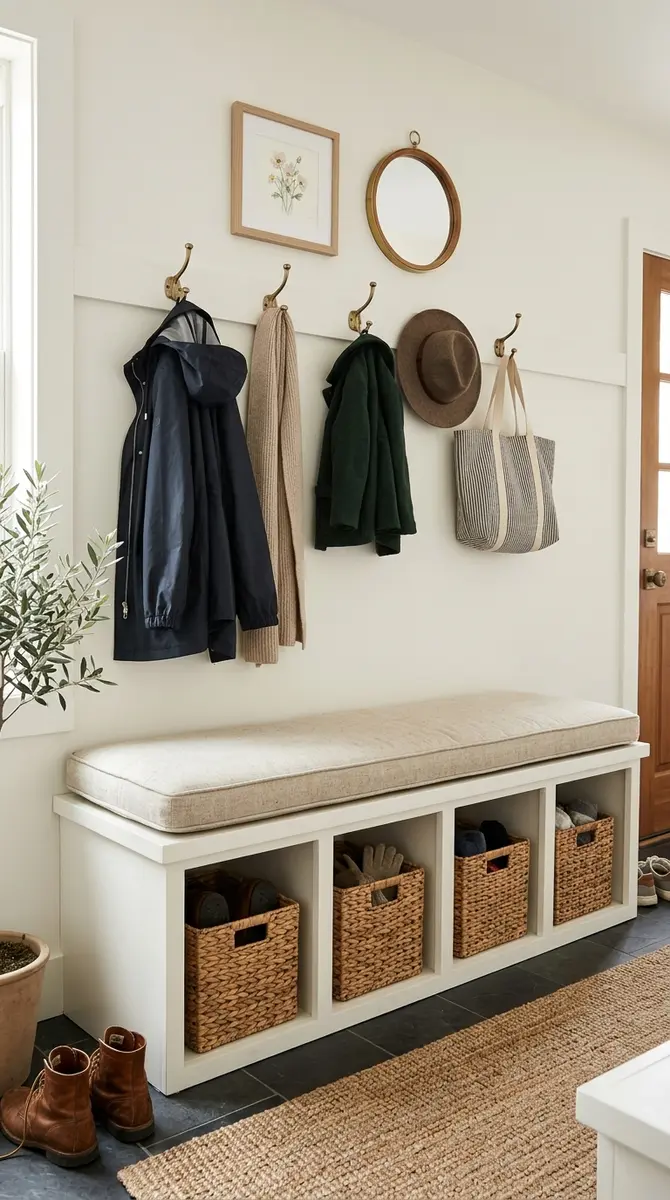
26. Statement Pendant or Mini Chandelier
The ceiling is the most underused surface in a small entry, and a statement pendant or mini chandelier uses it beautifully. One beautiful light fixture makes the whole space feel finished, draws the eye upward, and adds the warm glow that a bare bulb never will. It is the jewelry of the entryway.
Materials + cost: mini chandelier or pendant ($60–$150), warm bulb 2700K ($8), ceiling hook or electrician ($0–$80). Total: about $70–$240.
Choose a fixture scaled to the space — a 12- to 16-inch diameter suits most small entries — and hang it so the bottom sits about 7 feet above the floor. Plug-in pendant kits with a ceiling hook need no electrician and are renter-friendly. A dimmer switch, even a plug-in one, lets you set the mood for evenings.
Tip: Match the fixture’s metal finish to your hooks and mirror frame so the whole entry feels coordinated.
Variation: A cluster of two small pendants at different heights works beautifully in entries with taller ceilings. For more small-space lighting tricks, see our small living room decor ideas on a budget guide.
Frequently Asked Questions
How do you decorate a small entryway?
Start with the five essentials: a mirror to bounce light, a surface for drop-offs, a place to sit and store shoes, warm layered lighting, and a durable rug. Then add one personal touch — art, a plant, or a bold color. These small entryway decor ideas work best when every piece stores something or reflects light, so keep the walkway clear and let each item earn its place.
What furniture fits in a small entryway?
Slim pieces made for tight spaces: a console 10 to 12 inches deep, a storage bench 36 to 48 inches long, a tall shoe cabinet under 10 inches deep, or a wall-mounted floating shelf. Measure your walkway first and keep at least 30 inches clear — if a piece leaves less room than that, it is too big for your entry.
How can I make a small entryway look bigger?
Use a large mirror to reflect light, paint the walls a light color, choose furniture with visible legs or a floating design, and keep the floor as clear as possible. A runner rug that draws the eye forward also makes a narrow entry feel longer. Avoid bulky furniture and dark colors, which close the space in.
What should I put in a small entryway?
The essentials are hooks or a rail for coats, a tray or bowl for keys, a mirror, a rug, and shoe storage. Add a bench if you have room, a plant for life, and one piece of art that makes you smile. Everything else is optional — in a small entry, less truly is more.
How do I organize a small entryway with no closet?
Go vertical and use the nearest wall: a floating shelf with hooks, an over-the-door organizer on a nearby closet door, and a slim shoe cabinet. Give every item a home — one hook per person, one basket per job — and do a weekly five-minute reset so clutter never builds up. These small entryway decor ideas for renters work without a single built-in.
Conclusion
Your entryway may be the smallest room in your home, but it is the first thing you see when you come home and the last thing guests remember when they leave. These 26 small entryway decor ideas prove that a tiny space can be organized, beautiful, and full of personality — usually for less than the cost of one dinner out.
Start with the three ideas that fix your biggest daily frustration, then add one more each weekend. Before long, your entry will work as hard as you do. Save this post to Pinterest so you can find it when you are ready to start, and share it with a friend whose entryway needs a little love too.



Leave a Reply