
If your kitchen feels either too safe or too stark, this pairing fixes both problems at once. These sage green and black kitchen ideas balance soft, calming green with bold black contrast, so the room feels calm but never boring, and stylish but still easy to live in. Sage brings the nature-inspired warmth, black adds the graphic edge, and together they work in farmhouse, modern, traditional, and small kitchens alike.
Below you will find 28 genuinely different ways to use the combination, from a simple hardware swap to a full cabinet-and-countertop renovation. Each idea includes realistic costs and practical guidance, so you can start small, mix and match, and build the look at your own pace. For more inspiration on the green side of the palette, see our rustic sage green kitchen cabinets guide, and if you love dark contrast elsewhere, our dark wood kitchen cabinets post shows how deep tones can still feel warm.
1. Classic Sage Green and Black Kitchen Ideas with Shaker Cabinets
Shaker cabinets are the safest, most timeless starting point for this palette. The simple framed doors keep the look calm, the sage paint softens the room, and matte black knobs and pulls give every door a crisp, finished edge.
Materials and realistic cost: cabinet paint or repainting, $150–$400 for DIY paint and supplies or $2,500–$5,000 professionally; matte black hardware, $3–$8 per piece.
Clean, sand, and prime the doors before painting, and paint two thin coats rather than one thick one for a smooth, factory-like finish. Swap the hardware last, so you can line up every pull at exactly the same height. Keep the walls warm white so the sage stays the star.
Practical tip: Test your sage paint in both morning and evening light — north-facing rooms can pull sage toward grey or blue.
Variation: Choose a slightly deeper sage on the island and a paler sage on the perimeter cabinets for a subtle two-tone effect.
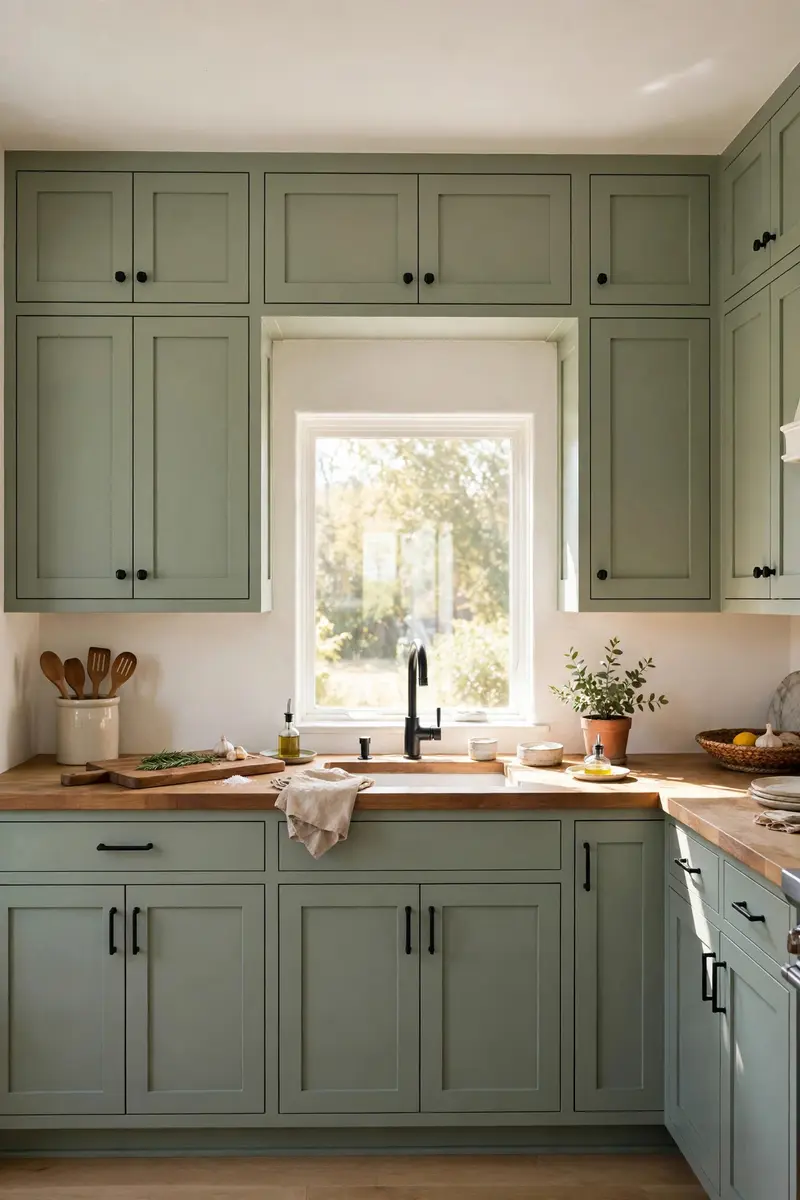
2. Matte Black Countertops with Sage Cabinets
Matte black quartz or granite grounds soft sage cabinets beautifully. The dark surface makes the green feel deliberate and sophisticated, and it hides everyday crumbs far better than a white counter ever will.
Materials and realistic cost: matte black quartz, $60–$100 per square foot installed; honed black granite, $50–$90 per square foot installed.
If your kitchen is small or dark, use black counters on the island or near a window and keep the perimeter counters lighter, so the room never feels closed in. Pair the counters with a white or cream subway tile backsplash to lift the whole scheme.
Practical tip: Choose a honed or leathered finish over high gloss — it shows fewer fingerprints and water marks.
Variation: Try black soapstone for a softer, more organic black with natural veining that ages beautifully.
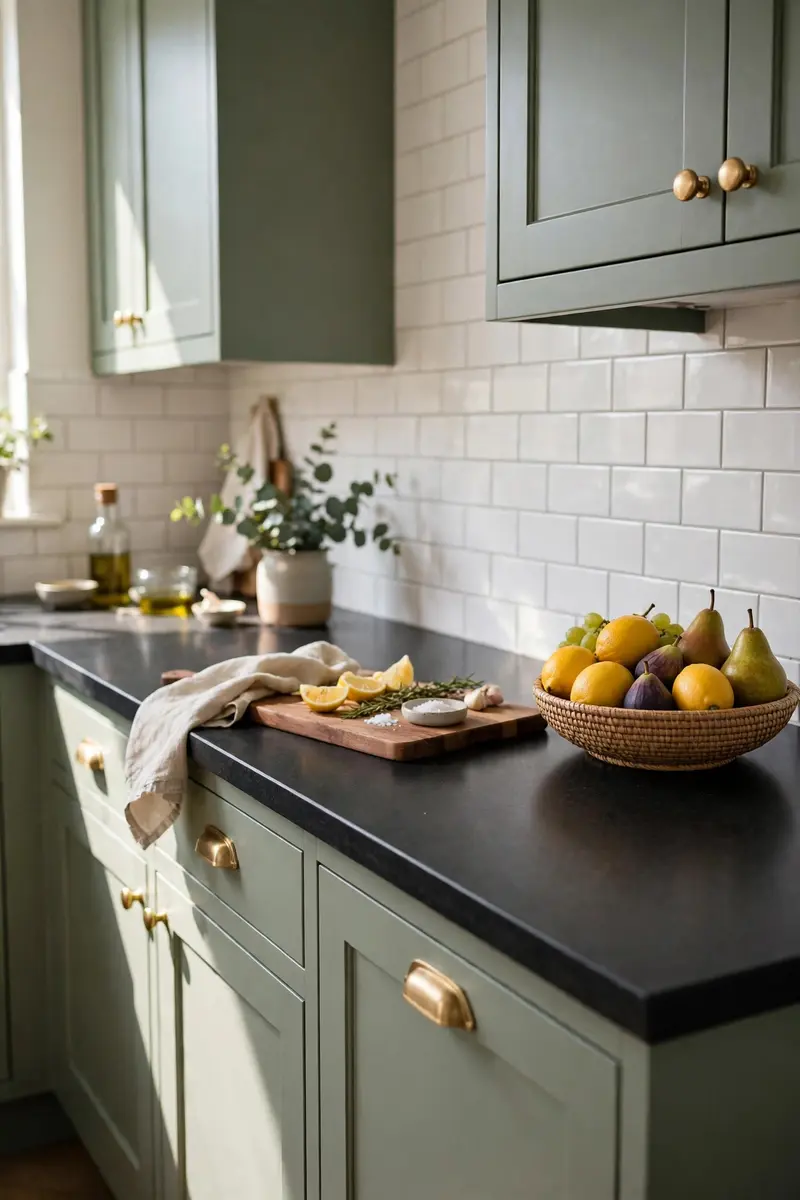
3. Black Hardware on Every Door and Drawer
If a full renovation is not in the budget, black hardware alone can transform sage cabinets overnight. It is the fastest, cheapest entry point on this list, and it instantly makes pale green cabinetry look intentional.
Materials and realistic cost: matte black bar pulls and knobs, $2–$7 per piece; a full kitchen usually needs 20–40 pieces, so $80–$250 total.
Remove one old pull and check the hole spacing before ordering, since bar pulls come in several standard lengths. Install with a simple cardboard template so every handle sits at the same height. Match the finish across the faucet, hinges, and light fixtures for a pulled-together look.
Practical tip: Buy one extra pull and knob and keep them in a drawer — matching a finish years later is surprisingly hard.
Variation: Mix slim black bar pulls on drawers with small black knobs on doors for a classic, tailored feel.
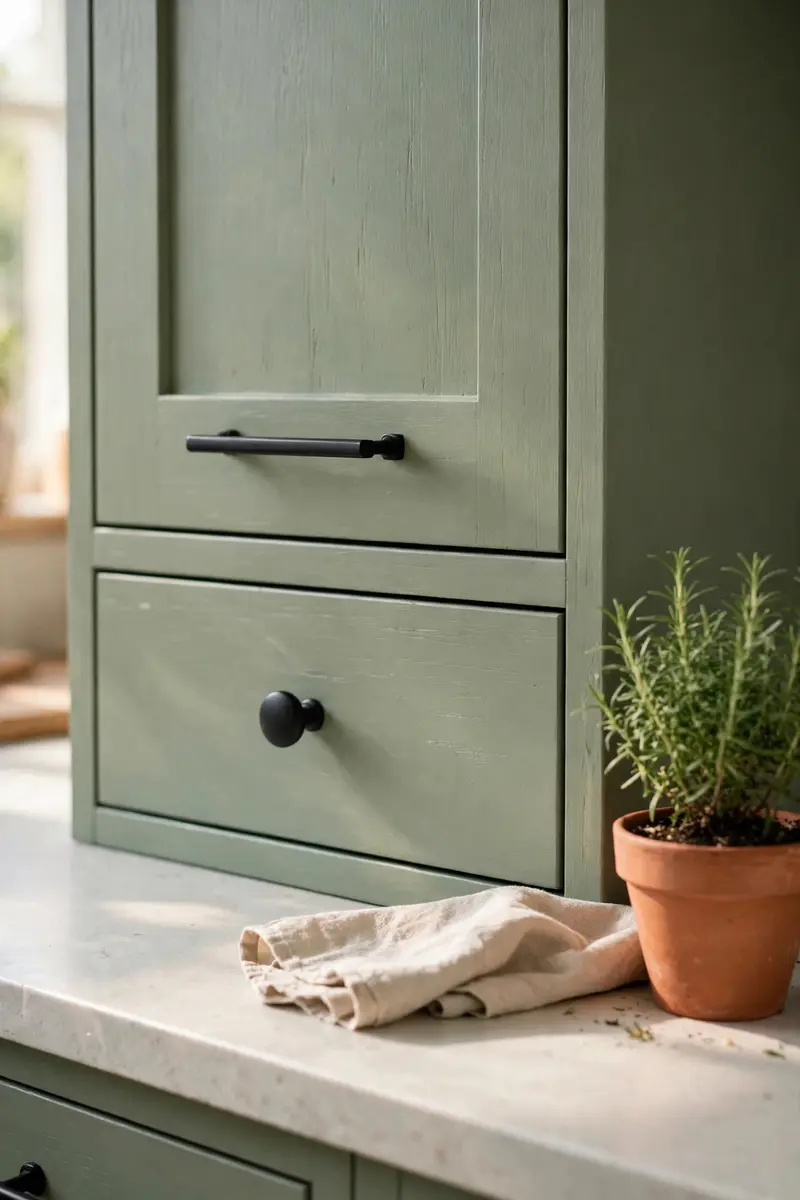
4. Sage Island with Black Pendant Lights
A sage island topped with black counters, lit by black pendant lights, becomes the natural gathering point of the kitchen. The pendants add drama overhead without taking up a single inch of counter space.
Materials and realistic cost: pendant lights, $40–$150 each; sage paint for an island, $30–$80 DIY.
Hang pendants 30–36 inches above the countertop, spaced evenly over the island, and put them on a dimmer so the same lights work for cooking and for dinner. Choose simple dome, cylinder, or cage shapes that echo your cabinet hardware rather than competing with it.
Practical tip: Use warm-white bulbs (2700K) in black pendants — cool bulbs can make sage look washed out.
Variation: Try three small black pendants over a long island, or one oversized black dome over a compact island.
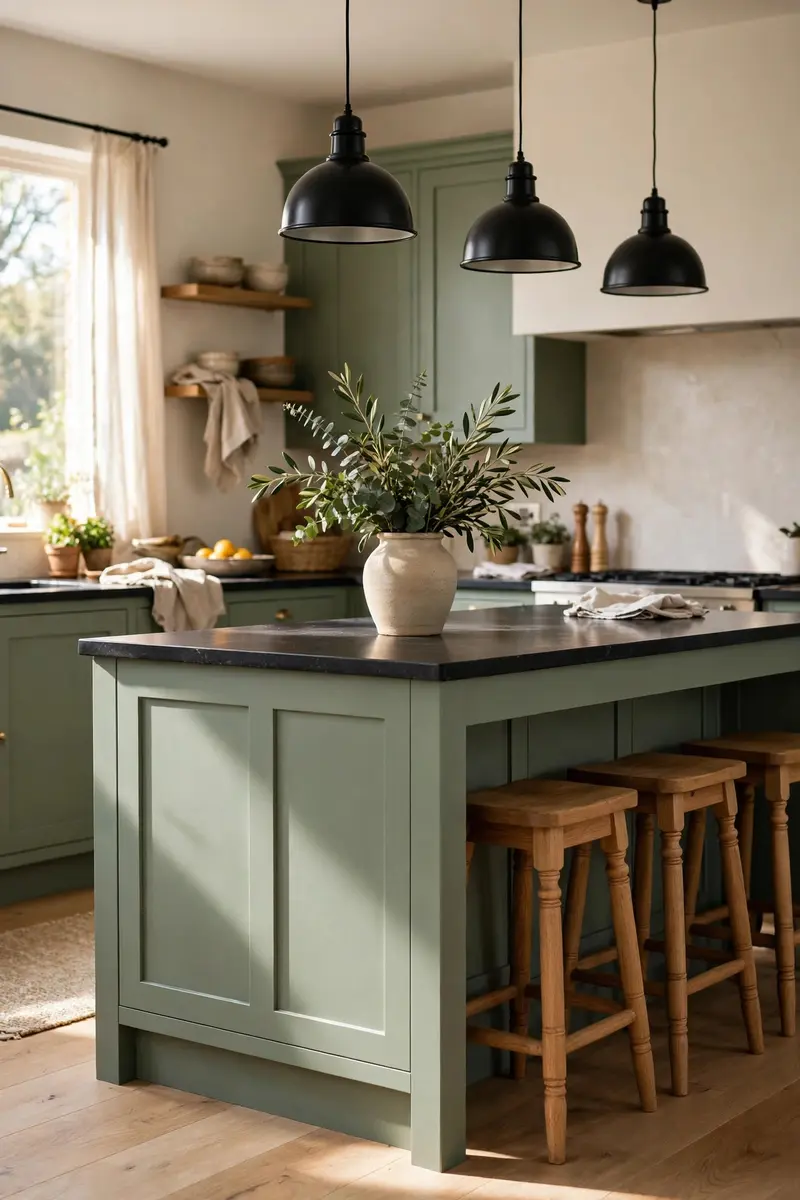
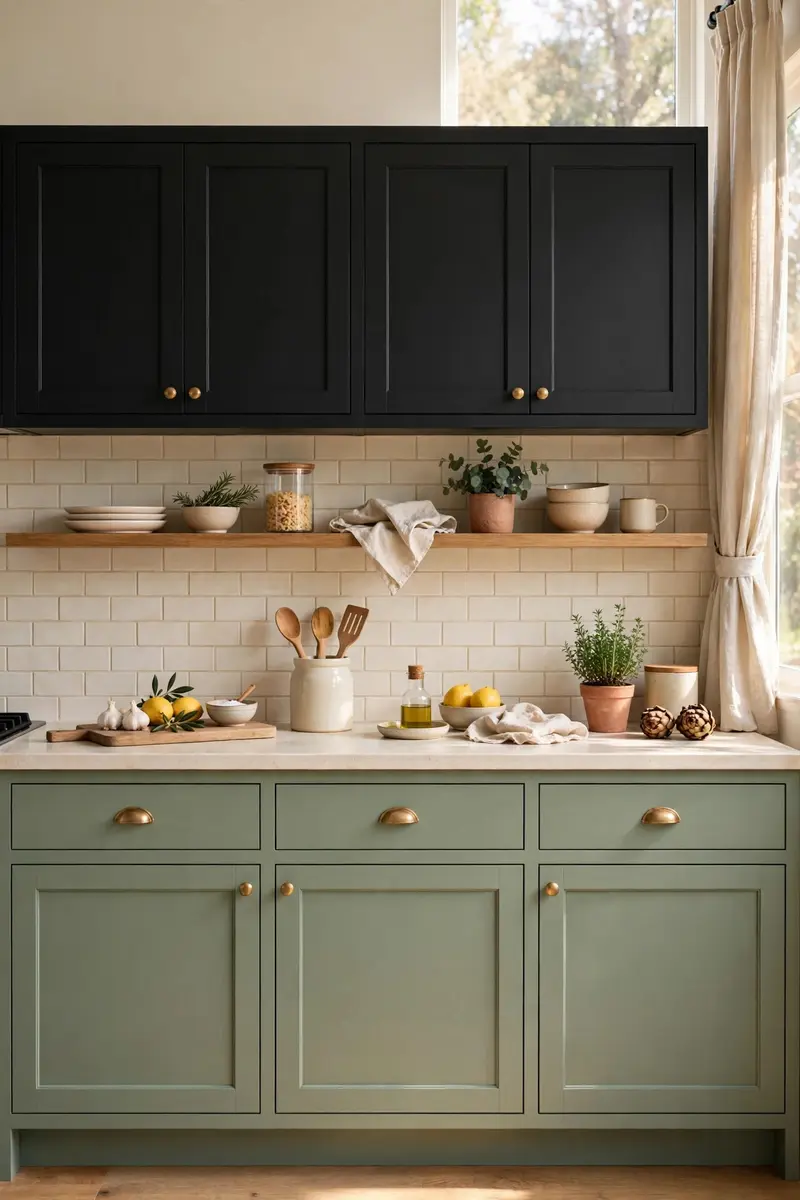
5. Two-Tone Cabinets: Sage Below, Black Above
Two-tone cabinets are one of the smartest ways to use both colors without overwhelming the room. Sage on the base cabinets keeps the lower half calm and grounded, while black uppers — or the reverse — add depth and a modern edge.
Materials and realistic cost: repainting in two colors adds little to a standard repaint, roughly $200–$500 DIY or $3,000–$6,000 professionally.
Put the darker color on the bottom if you want the room to feel anchored, or on top if you want a dramatic, cocooning effect. Keep the backsplash and counters light in either case, so the two cabinet colors can breathe.
Practical tip: Paint a sample board with both colors side by side and lean it against the cabinets for a full day before committing.
Variation: Use sage lowers, black uppers, and open wood shelving in between to break up the color blocks.
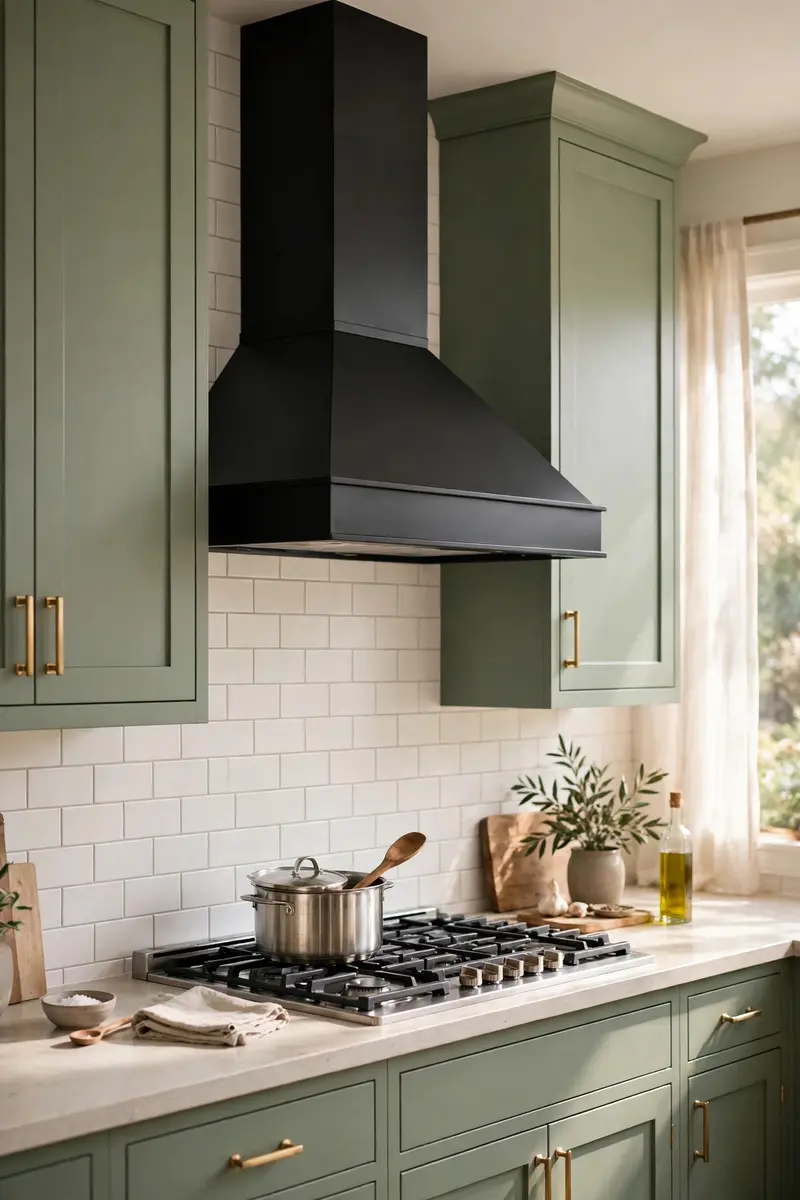
6. Black Range Hood as the Focal Point
A black range hood turns a purely practical appliance into a design statement. Against sage cabinets it reads bold and graphic, and it pulls the eye upward, which makes the whole kitchen feel taller.
Materials and realistic cost: black chimney or canopy hood, $300–$1,200; installation, $200–$500 if ducting is needed.
Measure your range width first — the hood should match or slightly exceed it — and check the height rules for your model before ordering. A matte black finish suits sage best, since glossy black can look harsh next to soft green.
Practical tip: Choose a hood with at least 400 CFM for a gas range, so style never comes at the cost of ventilation.
Variation: Pair a black hood with a black pot rail or black open shelf on either side for a balanced, chef-style wall.
7. Sage Walls with Black Open Shelving
If you cannot repaint cabinets, paint the walls sage and add black open shelving instead. The shelves give you display space, the black frames the dishes, and the whole wall becomes a feature for the price of paint and brackets.
Materials and realistic cost: wall paint, $40–$80 per gallon; black metal shelf brackets, $15–$40 per pair; wood boards, $20–$60 each.
Hang shelves at a height you can actually reach daily, and style them with everyday dishes, a few plants, and one or two decorative pieces — not so full that they look cluttered. Keep heavier items low and lighter decor up high.
Practical tip: Style shelves in odd groups of three and leave some empty space, so the display looks curated rather than crowded.
Variation: Use black floating shelves with hidden brackets for a cleaner, more modern line.

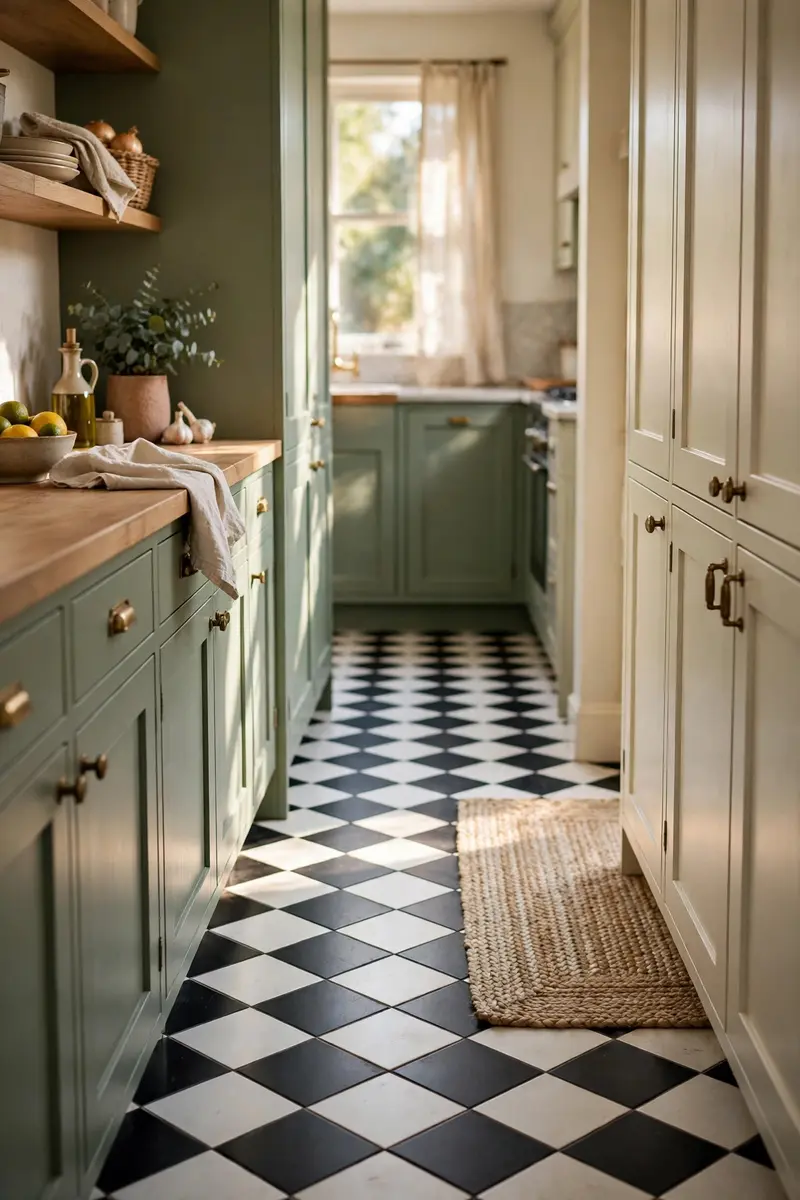
8. Black and White Checkerboard Floor with Sage Cabinets
A checkerboard floor adds retro charm and instant pattern to a sage kitchen, and black-and-white tiles tie the black accents together from the floor up. It is a classic pairing that works in farmhouse, vintage, and modern kitchens alike.
Materials and realistic cost: checkerboard vinyl or ceramic tile, $3–$10 per square foot; installation, $5–$12 per square foot if hired out.
Lay the pattern on a diagonal in a small kitchen to make the floor feel larger, or straight in a big room for a calmer grid. Seal grout well in a kitchen, and choose a grout color close to the tile tones so stains stay invisible.
Practical tip: Order 10% extra tile for cuts around cabinets and doorways, and keep a few spares for future repairs.
Variation: Swap white for cream tiles for a softer, warmer checkerboard that suits sage even better.
9. Brass Hardware to Warm Up Sage and Black
Black and sage can feel cool on their own, and brass is the perfect warmer. A few brass faucets, handles, or light fittings add a golden glow that stops the palette from feeling flat or severe.
Materials and realistic cost: brass or brass-look hardware, $5–$15 per piece; brass faucet, $150–$400.
Use brass sparingly — faucet plus a few knobs, or pendant lights plus cabinet pulls — so it reads as an accent, not a third dominant color. Unlacquered brass will patina over time, which suits a lived-in kitchen, while lacquered brass stays bright.
Practical tip: Hold brass samples next to your sage paint in daylight, since brass tones range from yellow-gold to soft champagne.
Variation: Try brushed gold instead of polished brass for a softer, more contemporary warmth.

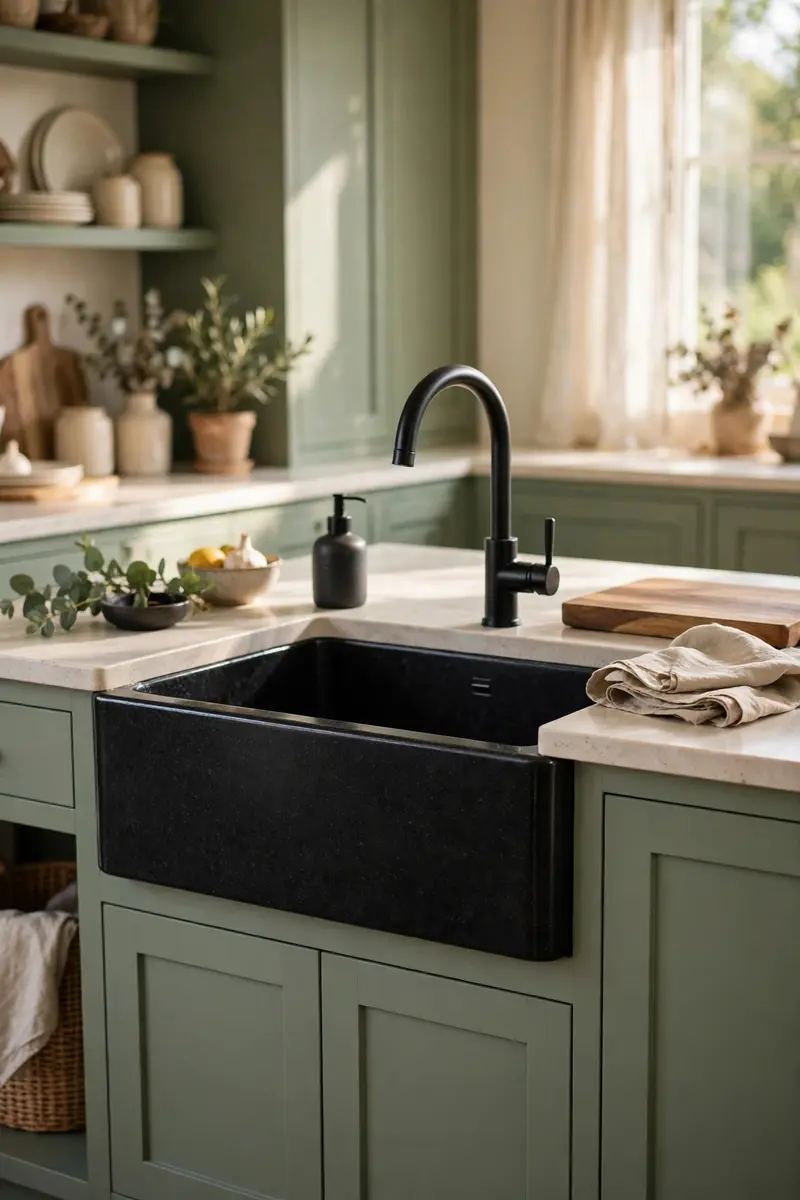
10. Sage Cabinets with a Black Farmhouse Sink
A black farmhouse sink is a bold, practical upgrade: the apron front becomes a feature, the deep bowl handles big pots, and the dark color hides stains that would show on white porcelain.
Materials and realistic cost: black granite composite or fireclay farmhouse sink, $300–$800; cabinet modification if needed, $150–$400.
Check your base cabinet width and plumbing position before ordering, since farmhouse sinks need a specific cutout. Pair the sink with a matte black or brass faucet, and keep the surrounding counters simple so the sink stays the hero.
Practical tip: Rinse and wipe a black composite sink weekly with mild soap — harsh abrasives can dull the finish over time.
Variation: Choose a black apron sink with a fluted front for a traditional farmhouse feel, or a smooth front for a modern look.
11. Moody Dark Sage Walls with Black Accents
Going darker with the sage itself creates a cocooning, evening-friendly kitchen. Deep sage walls paired with black hardware, pendants, and a black faucet feel rich and intentional, especially in a room with good natural light.
Materials and realistic cost: deep sage wall paint, $40–$80 per gallon; black fixtures as listed in other ideas.
Balance the darkness with light counters, a pale backsplash, and warm wood — a butcher-block island top or oak stools will stop the room from feeling cold. Add under-cabinet lighting so work surfaces stay bright even when the walls are dark.
Practical tip: Paint one full wall first and live with it for a weekend before painting the whole room dark.
Variation: Keep three walls pale and paint only the range wall or island wall in deep sage for a moody accent.
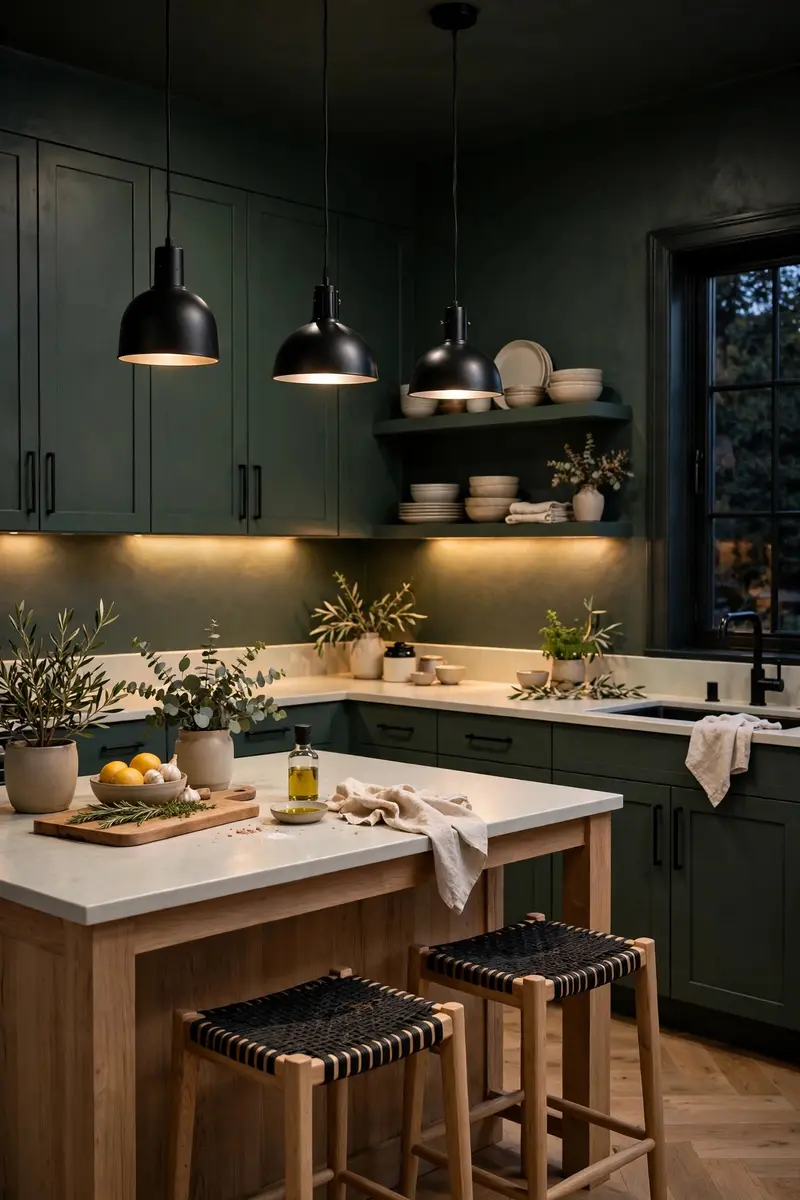
12. White Marble-Look Counters to Lighten the Pairing
When sage and black start to feel heavy, white marble-look counters are the rescue. The pale, veined surface lifts the whole room, gives the eye somewhere to rest, and makes both colors pop.
Materials and realistic cost: quartz with a marble look, $55–$95 per square foot installed; marble-look porcelain slabs, $40–$80 per square foot.
Choose a quartz with soft grey veining rather than dramatic gold veining, so it harmonizes with sage instead of fighting it. A waterfall edge on the island turns the counter into a feature in its own right.
Practical tip: Ask for a full-slab sample, not a tiny chip — veining varies a lot, and you want to love the exact pattern.
Variation: Use the same marble-look quartz as a full-height backsplash behind the range for a seamless, luxe wall.
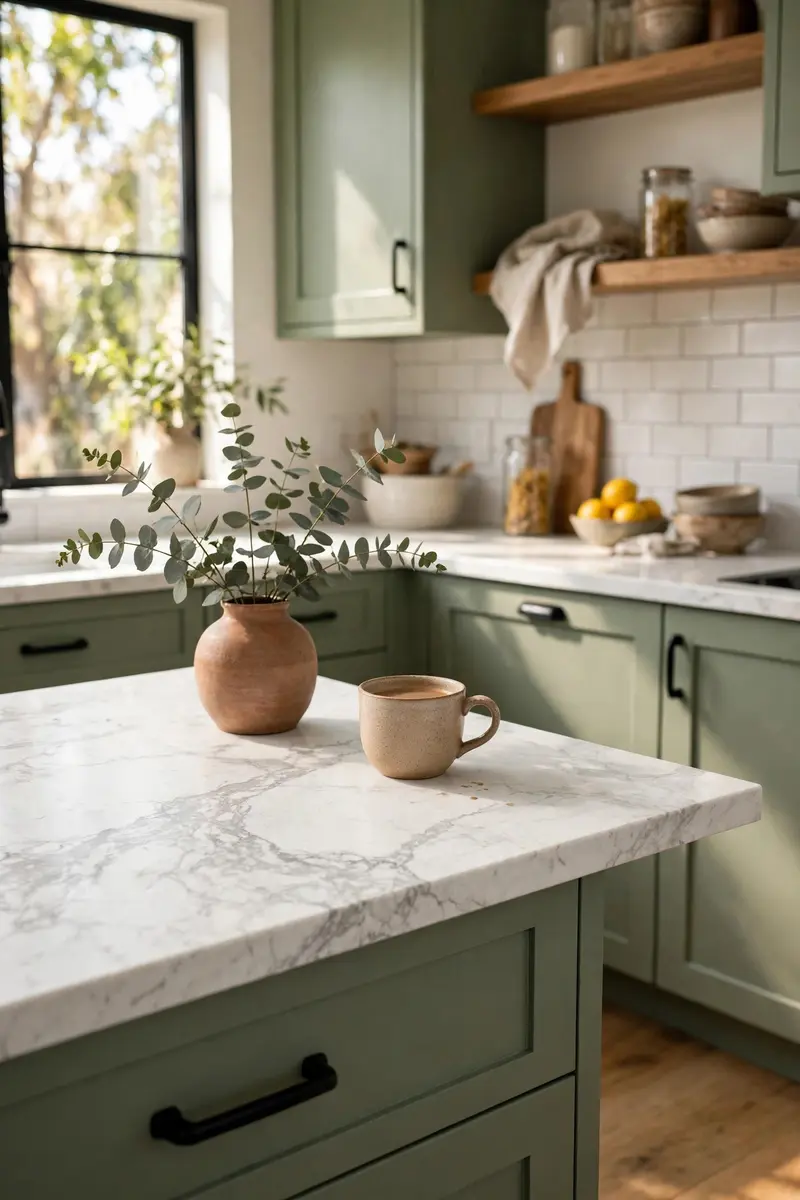
13. Black Bar Stools at a Sage Island
Bar stools are an easy, renter-friendly way to bring black into a sage kitchen. They add contrast at seating height, they are simple to swap later, and they make the island feel like a real gathering spot.
Materials and realistic cost: black metal or wood bar stools, $60–$180 each; counter-height stools for a 36-inch counter, bar-height for taller islands.
Measure your counter height and leave about 10–12 inches between the seat and the countertop for comfortable legroom. Backless stools tuck neatly under the overhang, while stools with backs are comfier for long breakfasts.
Practical tip: Leave 24–26 inches of width per stool so nobody elbows their neighbor at breakfast.
Variation: Choose black leather or faux-leather stools for warmth, or black woven rattan stools for a softer, coastal feel.
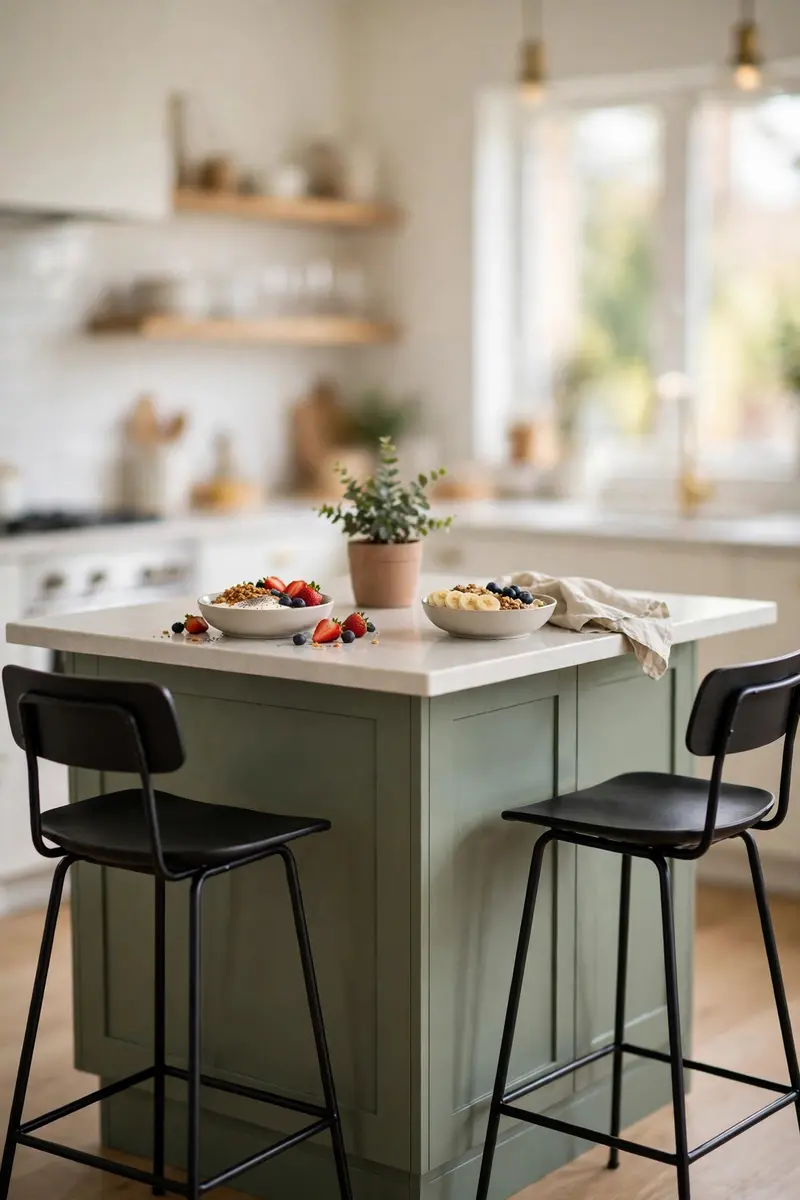
14. Sage Green and Black Kitchen Ideas for Small Kitchens
Small kitchens actually suit this palette beautifully, as long as black is used as an accent rather than a blanket. Sage on the cabinets keeps the room feeling fresh, while black hardware, a black faucet, and one black light fixture add definition without closing the space in.
Materials and realistic cost: black hardware and faucet swap, $150–$450 total; sage cabinet paint, $150–$400 DIY.
Keep upper cabinets sage or open shelving, use a light backsplash and pale counters, and let black appear in small, repeated doses — hardware, faucet, and one pendant — so the eye travels around the room. A mirror or glass-front cabinet door can also bounce light back into a tight space.
Practical tip: In a small kitchen, repeat black at least three times (hardware, faucet, light) so it looks deliberate, not accidental.
Variation: Paint only the lower cabinets sage and keep uppers white in a very small kitchen for maximum brightness.
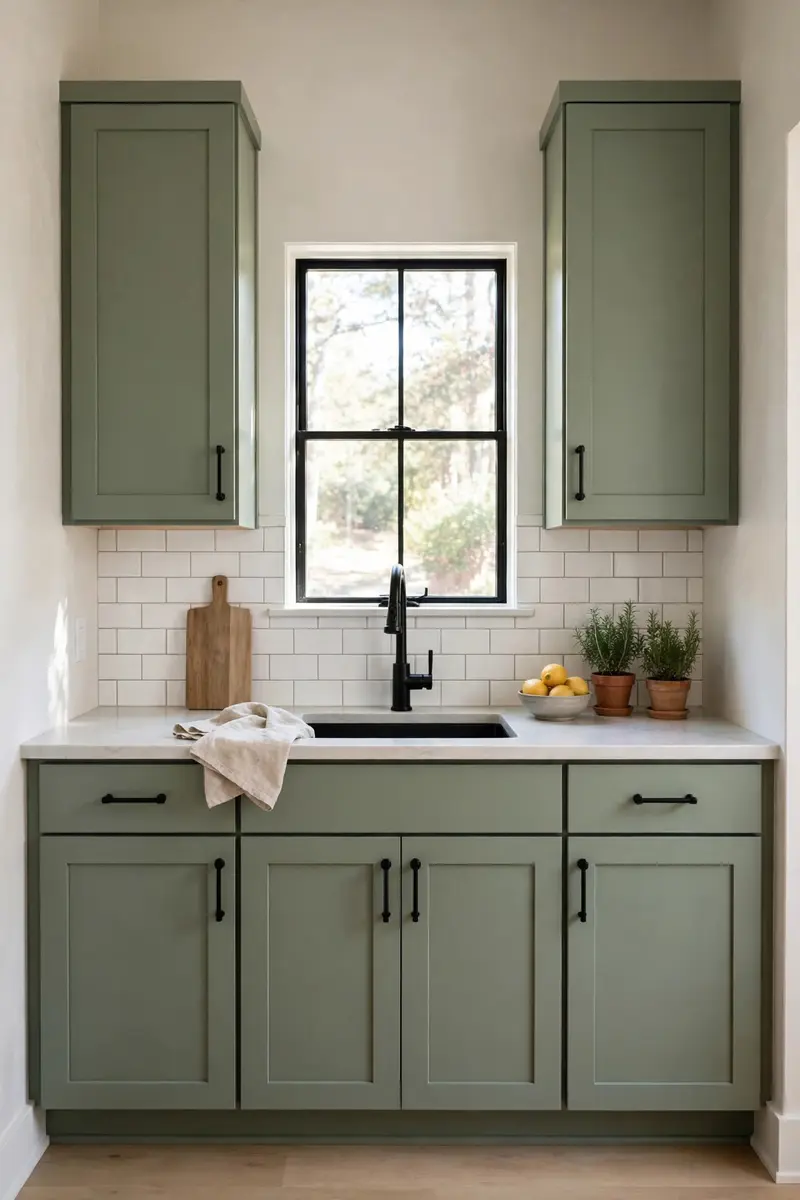
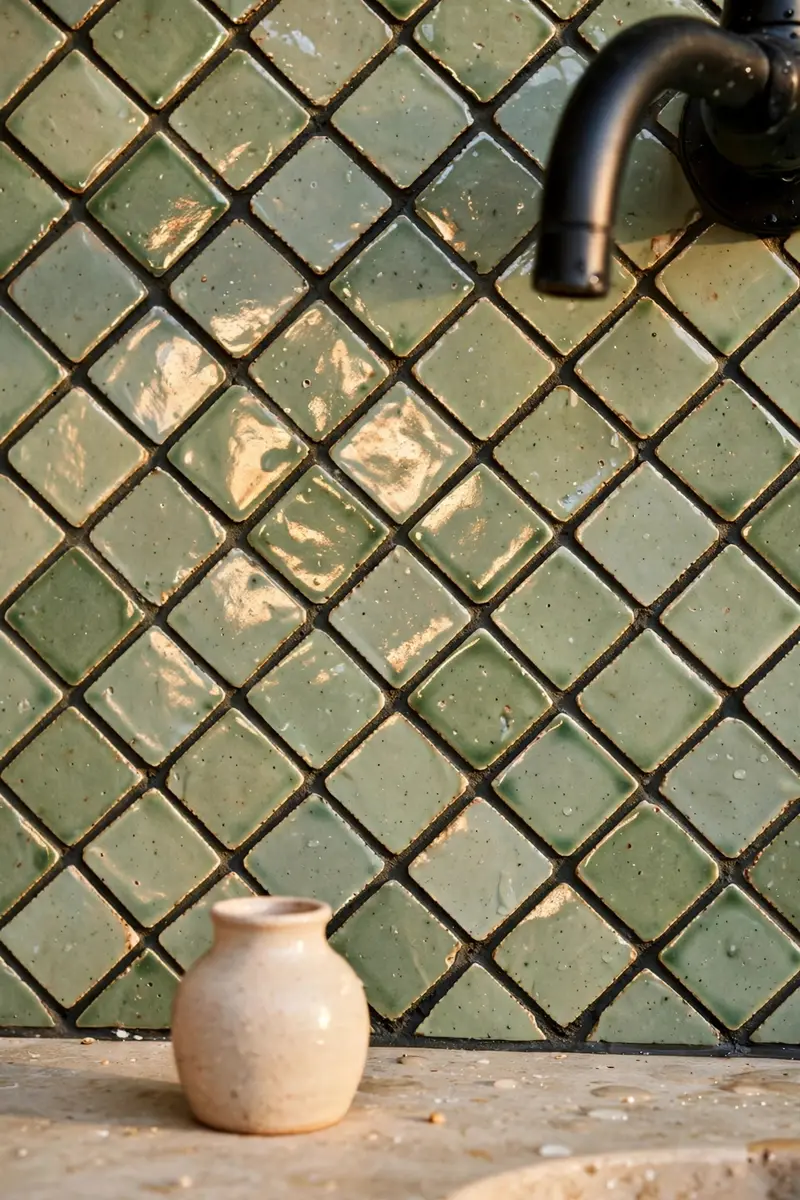
15. Sage Zellige Tile Backsplash with Black Grout
Handmade-look sage zellige tiles bring texture and a soft glow to the backsplash, and black grout outlines each tile just enough to make the pattern pop. It is a beautiful middle ground between a plain wall and a busy pattern.
Materials and realistic cost: zellige-look tile, $12–$28 per square foot; grout and sealer, $50–$100.
Dry-lay a few tiles first to shuffle light and dark pieces evenly, since handmade-look tile varies by design. Seal the tile before grouting if it is unglazed, and wipe grout haze promptly so the sage glaze stays luminous.
Practical tip: Choose a charcoal grout rather than pure black — it reads as black from a distance but is more forgiving up close.
Variation: Use sage subway tile with black grout for the same graphic effect at a lower price.
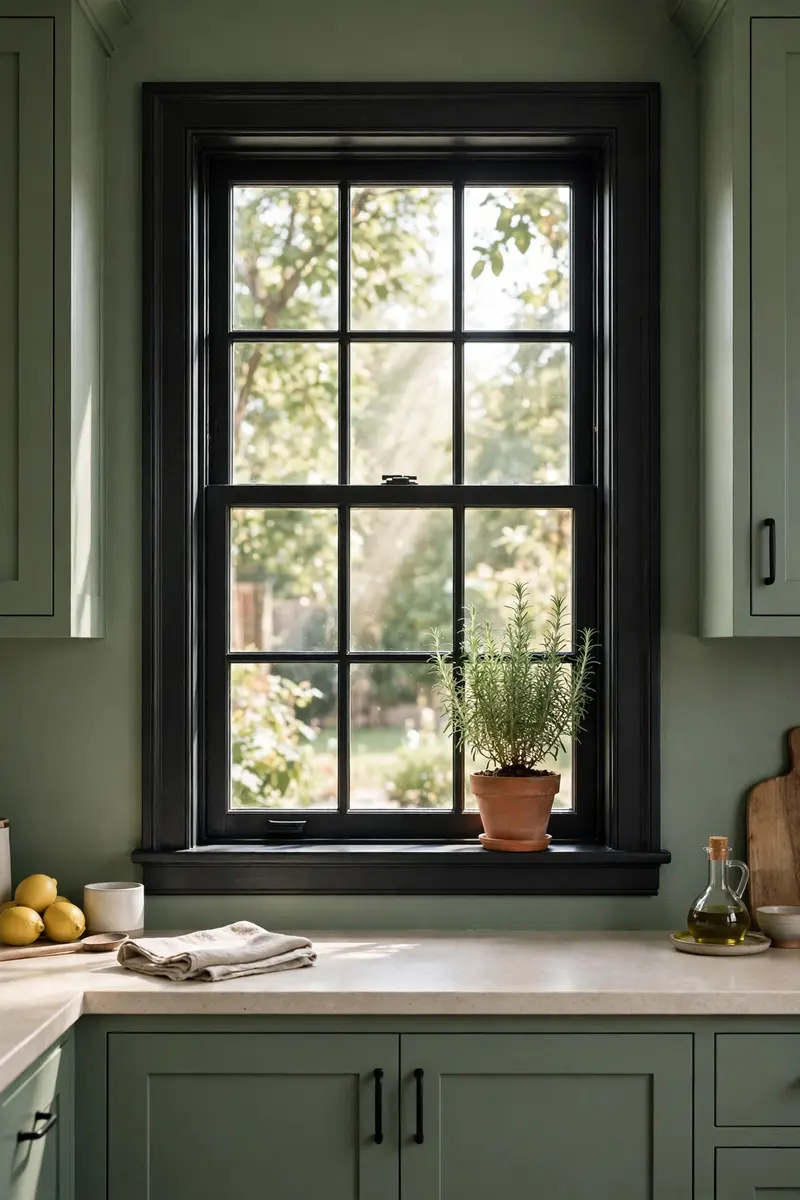
16. Black Window Frames and Trim
Painting window frames or trim black is a surprisingly powerful trick: it frames the view like a picture, sharpens pale sage walls, and ties in black hardware elsewhere in the room without any renovation.
Materials and realistic cost: trim paint, $30–$60 per quart; professional trim painting, $200–$600 for a kitchen.
Prep matters most here — clean, sand lightly, and use a durable enamel made for trim, applied in thin coats. If painting all the trim feels like too much, start with just the window frames and the door to the pantry.
Practical tip: Use a satin or semi-gloss finish on black trim so it wipes clean and does not show every fingerprint.
Variation: Try black interior doors with sage walls for the same framing effect on a larger scale.
17. Farmhouse Sage Kitchen with Black Accents
Farmhouse style loves sage, and black keeps it from turning too sweet. Think sage Shaker cabinets, a black apron sink, black hardware, a wood island top, and a few woven baskets for texture.
Materials and realistic cost: farmhouse elements vary widely; hardware and sink swap, $400–$1,000; wood island top, $200–$600.
Layer natural textures — wood, linen, woven baskets, and a ceramic crock of utensils — so the room feels collected rather than themed. Keep the black matte and the sage soft, and the farmhouse look stays timeless rather than costume-like.
Practical tip: Limit farmhouse signs and word art to one piece at most — the cabinets and materials should do the talking.
Variation: Add a black sliding barn door on the pantry for a farmhouse focal point that also saves swing space.

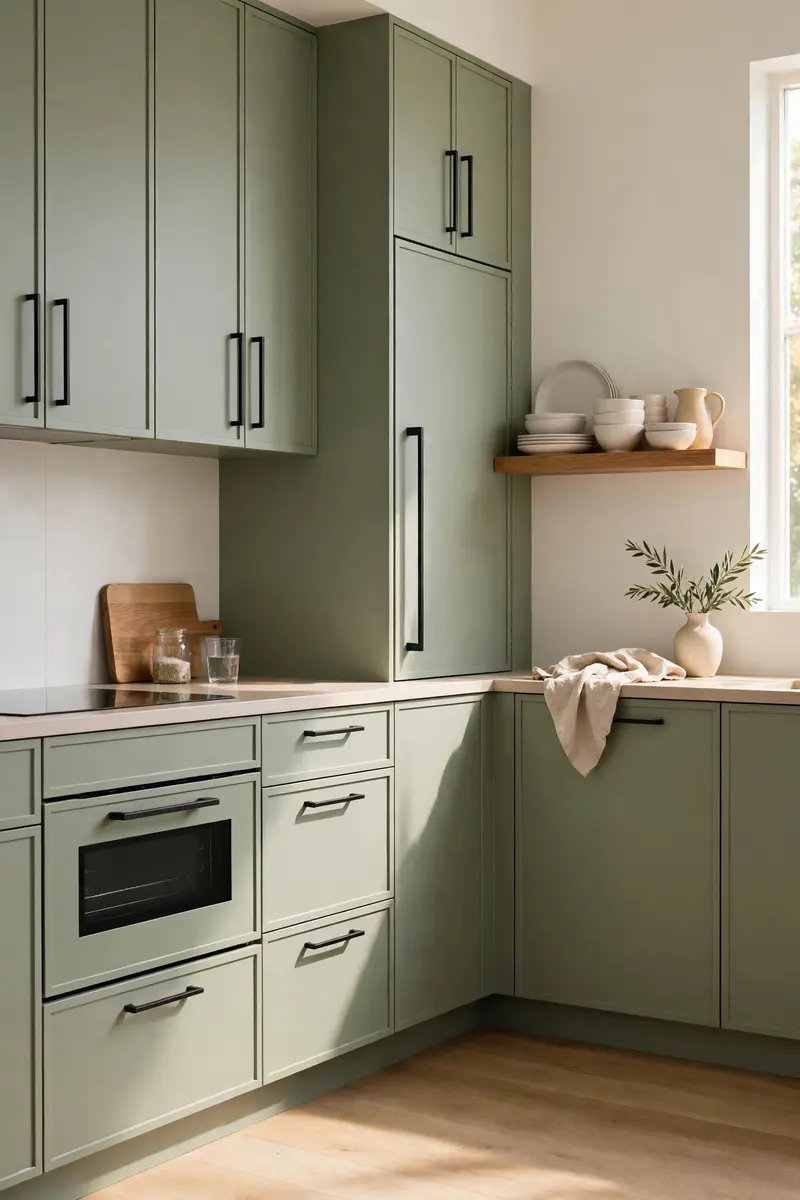
18. Modern Flat-Front Sage Cabinets with Black Handles
For a contemporary kitchen, flat-front sage cabinets with long black handles are hard to beat. The clean lines let the color do the work, and the slim black pulls add just enough graphic detail.
Materials and realistic cost: flat-front cabinet refacing or new doors, $3,000–$8,000; long black pulls, $6–$15 each.
Keep everything else minimal — handleless uppers or integrated appliances, a simple backsplash, and clutter-free counters — so the modern look stays calm. A single wood or stone accent, like oak open shelving, stops the room from feeling sterile.
Practical tip: Use the longest pulls your drawers can take — long, slim pulls look far more modern than short knobs on wide drawers.
Variation: Choose integrated black channel pulls (a recessed grip) for an ultra-minimal, handle-free look.
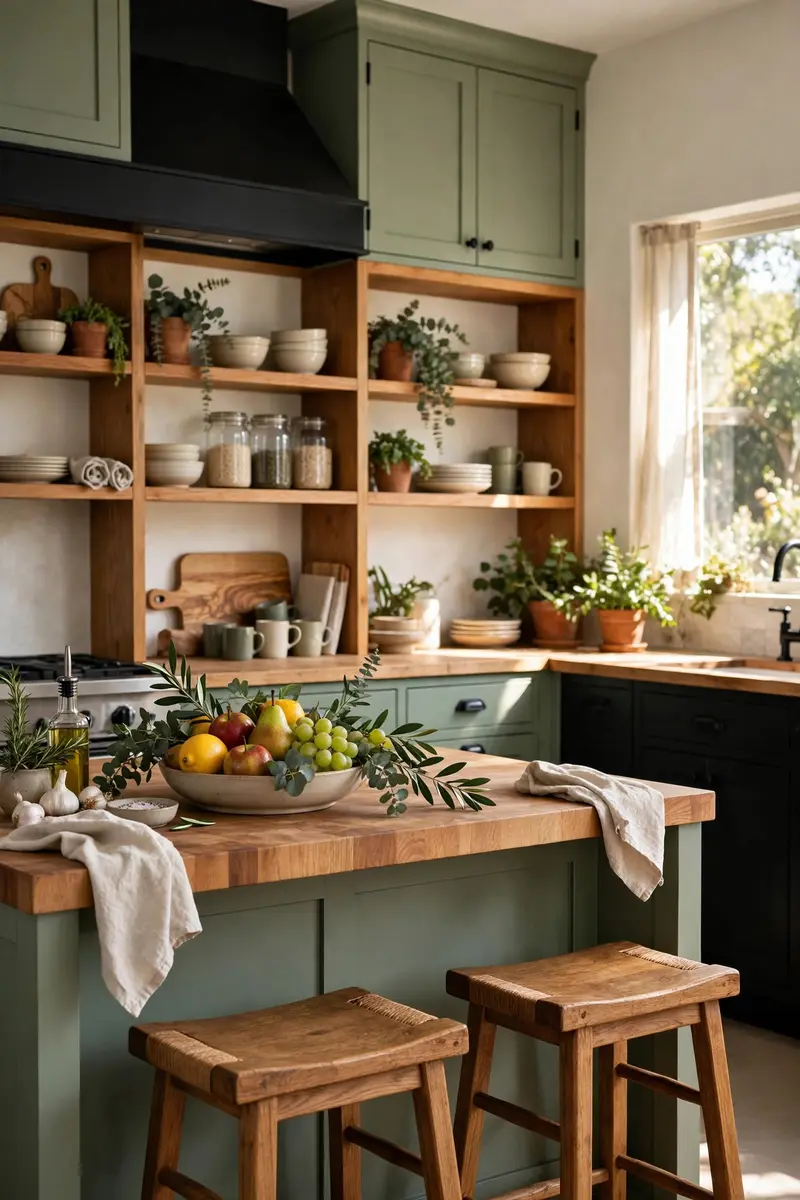
19. Sage and Black with Warm Wood Tones
Wood is the secret ingredient that makes sage and black feel like home instead of a showroom. Oak floors, a walnut island top, or open wood shelves warm up both colors and add the natural texture this palette loves.
Materials and realistic cost: oak open shelves, $40–$120 each; butcher-block island top, $200–$600; wood stools, $80–$200 each.
Pick one wood tone and repeat it — floors, shelves, and stools in the same warm family — rather than mixing three different woods. Light oak suits pale sage best, while walnut pairs beautifully with deeper sage and black counters.
Practical tip: Seal wood counters and shelves with food-safe oil or polyurethane, and re-oil butcher block every few months.
Variation: Add a wood range hood cover painted sage, with a black trim band, for a custom, furniture-like focal point.
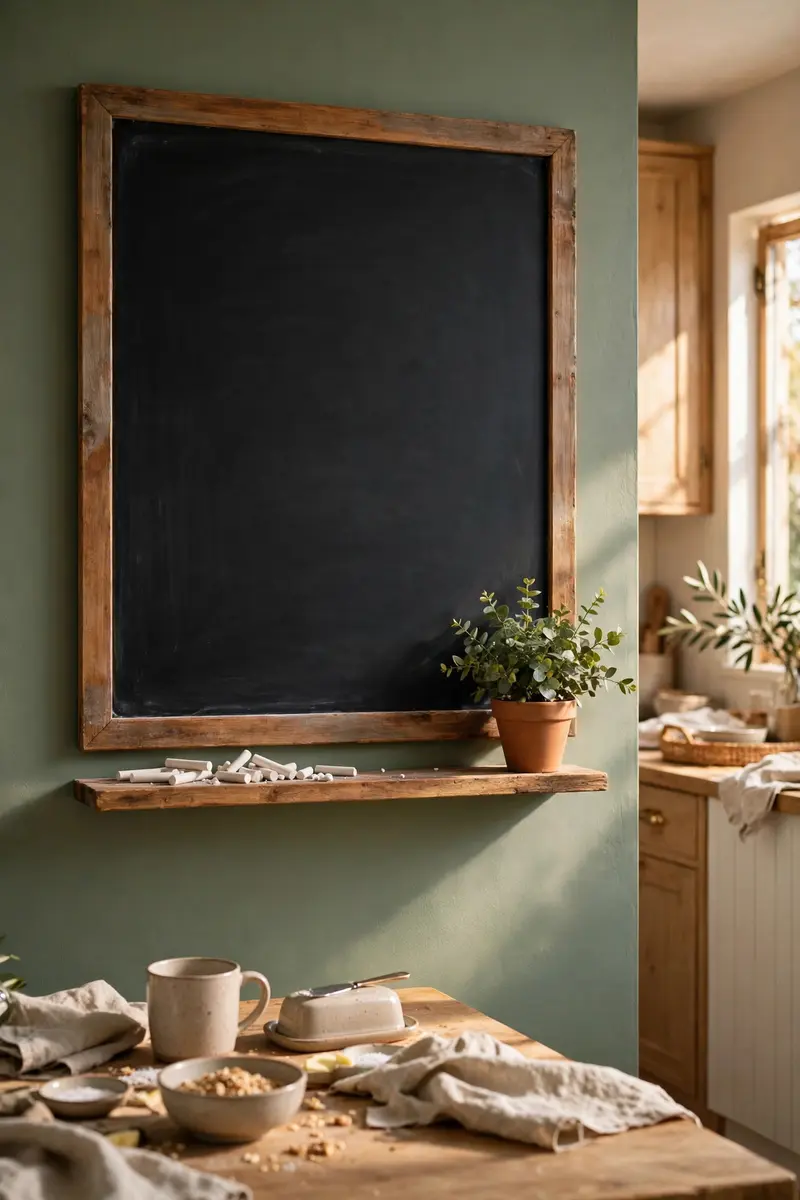
20. Black Chalkboard or Menu Wall in a Sage Kitchen
A black chalkboard wall or framed menu board is both decor and a practical family hub — shopping lists, weekly menus, and kids’ drawings all have a home, and the black panel anchors a sage wall beautifully.
Materials and realistic cost: chalkboard paint, $20–$40 per quart; framed chalkboard, $40–$120; chalk markers, $10–$20.
Paint a smooth section of wall or the side of a pantry cabinet, and frame it with simple wood trim so it looks intentional rather than improvised. Keep the rest of the wall sage and uncluttered so the black panel can breathe.
Practical tip: Condition a new chalkboard wall by rubbing chalk over the whole surface and erasing it before first use — it prevents ghosting.
Variation: Use a black magnetic board instead, so recipes and photos can be pinned up with magnets.
21. Sage Cabinets with a Black Tiled Backsplash
Flipping the usual formula — sage cabinets, black backsplash — creates a dramatic, high-contrast wall that still feels grounded because the sage softens it. Glossy black subway or square tiles catch the light and make the range wall a feature.
Materials and realistic cost: black subway or square tile, $6–$15 per square foot; grout and installation supplies, $60–$120.
Use a light or matching dark grout depending on the effect you want: dark grout makes the wall read as one sleek slab, while light grout outlines each tile for a graphic grid. Keep counters light so the dark wall does not overwhelm the room.
Practical tip: Wipe glossy black tile with a microfiber cloth and glass cleaner to keep water spots invisible.
Variation: Run the black tile only behind the range, up to the hood, and use a pale backsplash everywhere else.

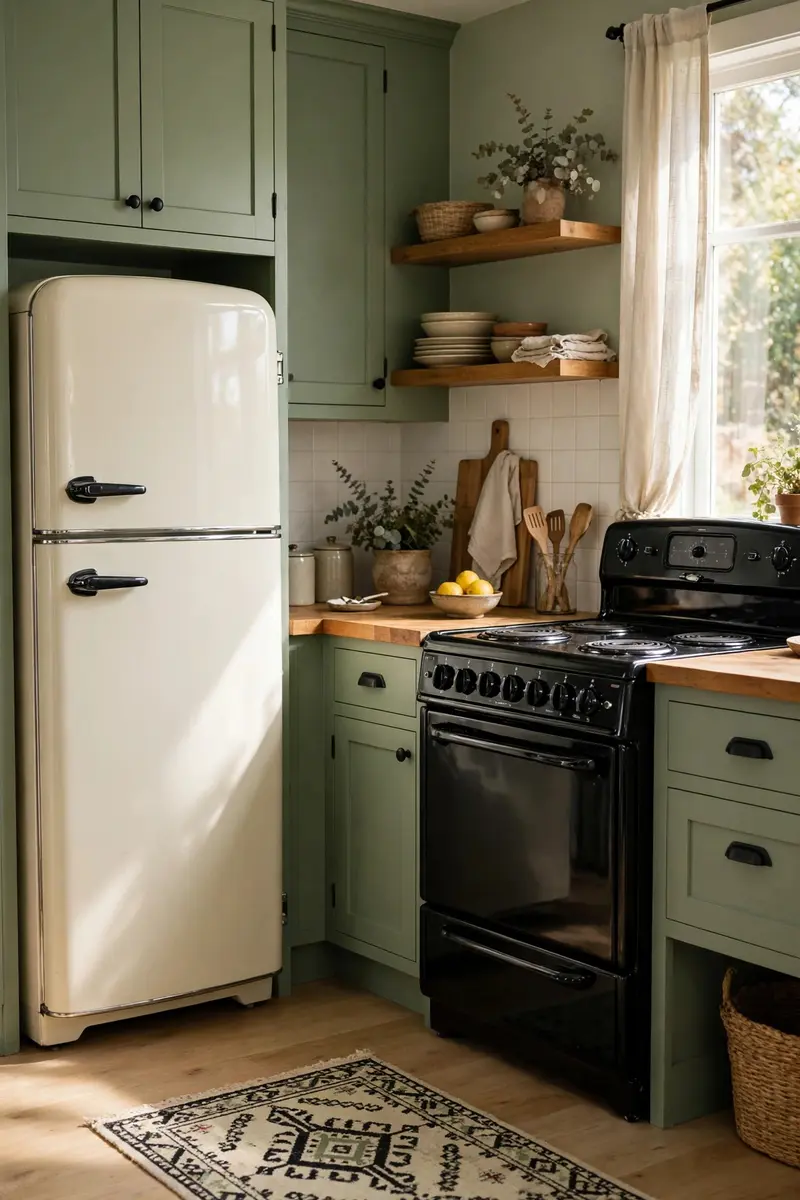
22. Vintage Touches: Sage, Black, and Retro Appliances
Retro-style appliances in cream, sage, or black bring instant personality to this palette. A vintage-look range or fridge becomes the conversation piece, while sage cabinets and black hardware tie the whole room together.
Materials and realistic cost: retro-style range, $2,000–$5,000; retro fridge, $1,500–$3,500; smaller retro appliances, $80–$250 each.
If a full retro range is out of budget, start with a retro kettle, toaster, and stand mixer in matching cream or black — they deliver most of the charm for a fraction of the price. Check energy ratings and dimensions before falling for a vintage look.
Practical tip: Measure doorways and turns before ordering a large retro fridge — vintage proportions can be surprisingly wide.
Variation: Pair sage cabinets with a black retro range and cream small appliances for a layered, collected vintage look.
23. Sage Green and Black Kitchen Ideas with Patterned Floors
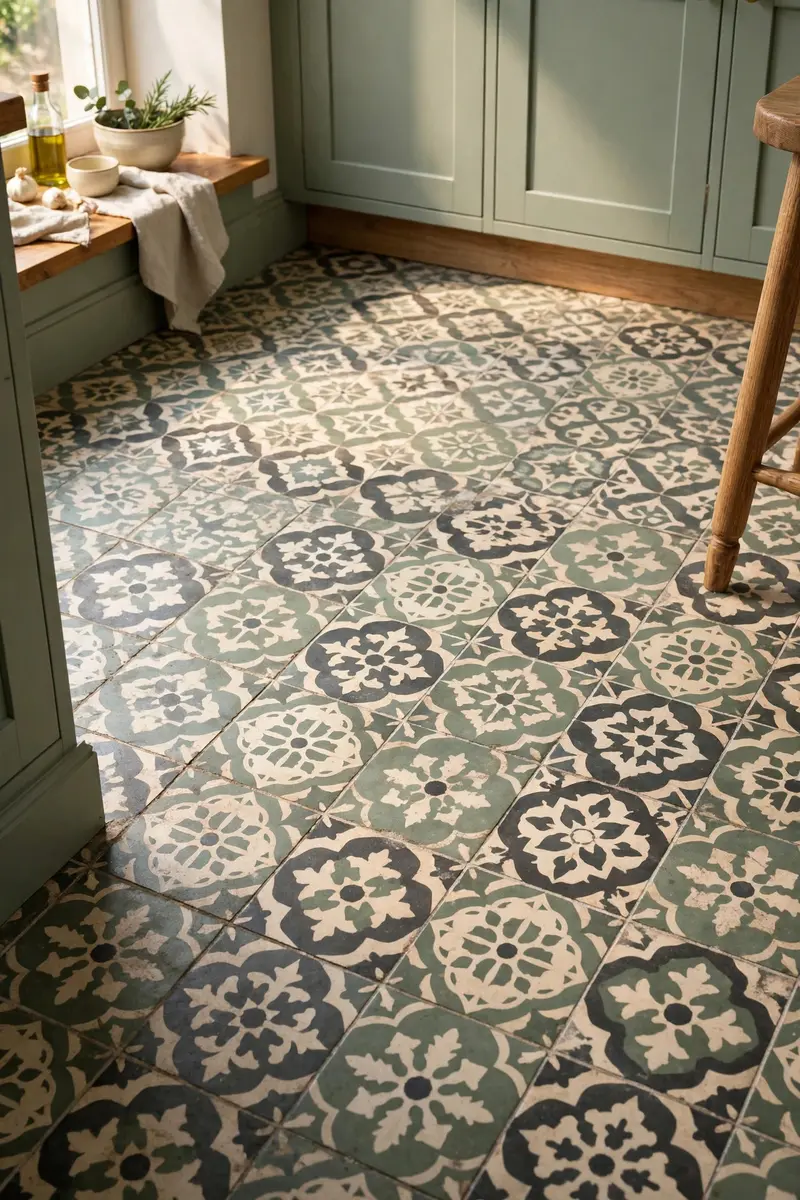
Patterned encaustic-look floor tiles add art underfoot and pull sage and black together in one surface. A soft sage-and-charcoal pattern feels handcrafted, while a bolder black-and-white pattern leans modern.
Materials and realistic cost: patterned porcelain tile, $8–$18 per square foot; installation, $6–$12 per square foot.
Keep the rest of the room relatively calm — plain cabinets, a simple backsplash — so the floor can be the pattern star. Choose a pattern scale that suits your room: larger patterns suit big kitchens, smaller repeats suit compact spaces.
Practical tip: Lay out a full repeat of the pattern on the floor with spacers before fixing any tile, so the design lands symmetrically.
Variation: Use patterned tile only in a defined zone, like the cooking area or entry, with plain tile elsewhere.
24. Black Faucet and Fixtures Throughout
Swapping every visible fixture to matte black — faucet, pot filler, cabinet hardware, and light fittings — is a weekend project with a renovation-level payoff. Consistency is what makes it look expensive.
Materials and realistic cost: matte black kitchen faucet, $120–$350; pot filler if added, $150–$400; matching soap dispenser, $30–$80.
Buy fixtures from one brand or finish family where possible, since “matte black” varies between makers. Check that your faucet suits your sink configuration (holes, height, and spray type) before ordering.
Practical tip: Wipe matte black fixtures with a soft, damp cloth only — abrasive cleaners and vinegar can damage the coating.
Variation: Keep the faucet black but add a brass soap dispenser and cabinet knobs for a subtle mixed-metal accent.

25. Open Shelving in Black with Sage Dishware
Black open shelves displaying sage, cream, and white dishware turn storage into decor. The dark shelves frame the dishes, the sage pieces echo the cabinets, and the whole wall feels styled without trying too hard.
Materials and realistic cost: black metal-and-wood shelves, $50–$150 each; dishware as you already own it.
Style with a mix of stacks, upright plates, and a plant or two, and keep everyday items within easy reach. If open shelves feel too exposed, use them for pretty pieces only and keep the rest behind cabinet doors.
Practical tip: Dust open shelves weekly with a dry microfiber cloth — kitchen grease settles faster on open storage than in cabinets.
Variation: Use black shelves on a sage-painted wall, with cream dishware and one wood board, for a softer version of the look.

26. Sage Island Seating Nook with Black Stools and Plants
Turn the end of a sage island into a cozy nook: black stools, a trailing plant, a small vase of herbs, and a linen runner. It is a low-cost styling idea that makes the kitchen feel lived-in and welcoming.
Materials and realistic cost: stools as in idea 13; plants, $10–$40 each; linen runner, $20–$50.
Place a potted herb like basil or rosemary on the island itself, so the nook is both pretty and useful while you cook. Keep the runner washable, since island seating sees spills, and choose stools that slide fully under the overhang.
Practical tip: Put the plant in a pot with drainage and a saucer — island counters stain easily from overwatering.
Variation: Add a small black-framed chalkboard menu at the end of the island for a cafe-style touch.

27. Two-Tone Walls: Sage Above, Black Wainscoting Below
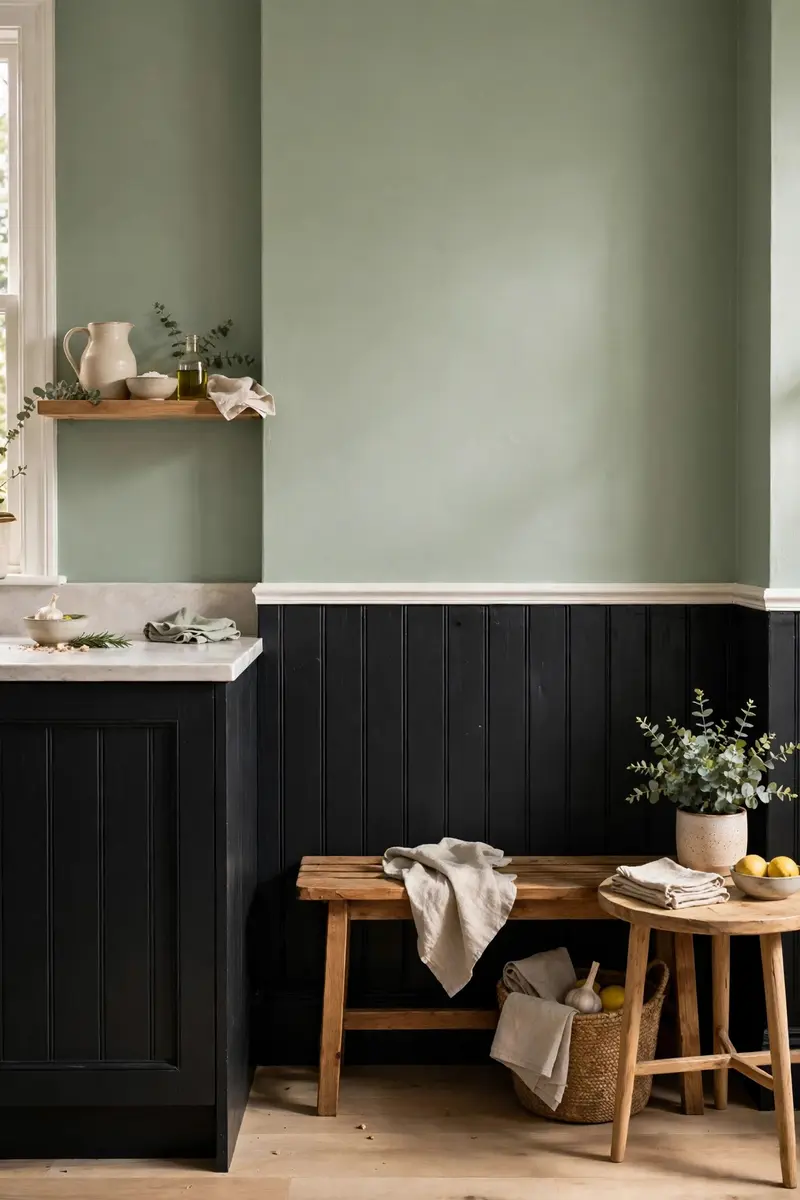
Wainscoting painted black below a chair rail, with sage walls above, gives a traditional kitchen instant architecture. The black lower wall grounds the room, the sage upper wall keeps it fresh, and the rail itself adds a crisp dividing line.
Materials and realistic cost: wainscot panels or beadboard, $3–$8 per square foot; paint, $40–$80 per gallon; chair rail trim, $1–$3 per linear foot.
Install the wainscot to about one-third of the wall height, caulk every seam, and paint it in a durable semi-gloss so it survives kicks, splashes, and chair backs. A white or wood chair rail between the colors sharpens the division.
Practical tip: Paint the wainscot before installing the chair rail, then touch up the rail joints after fitting for a seamless finish.
Variation: Use sage wainscoting with black walls above for a moodier, more dramatic version in a large, bright kitchen.
28. Sage and Black Galley Kitchen with a Statement Runner
In a galley kitchen, the floor runner is your chance to add pattern and warmth. A sage, black, and cream runner down the center ties the cabinets to the floor, softens hard surfaces underfoot, and makes a narrow room feel designed rather than just functional. For more galley-specific layout help, see our small galley kitchen ideas post, and for another take on sage cabinetry, our white and gold kitchen backsplash ideas show how a pale backsplash lifts dark accents.
Materials and realistic cost: washable kitchen runner, $40–$120; rug pad, $20–$40.
Choose a low-pile, washable runner so it survives cooking spills and does not trip anyone, and size it to leave a border of floor visible on both sides. A runner with a sage-dominant pattern and black accents will echo the cabinets without matching them exactly.
Practical tip: Shake out and wash the runner monthly, and rotate it end to end so wear stays even.
Variation: Layer a small black-and-cream patterned rug over a plain sage runner for extra texture in a wider galley.

Frequently Asked Questions
What colors go with sage green and black kitchens?
Cream, warm white, natural wood, and brass all soften sage and black beautifully. Cream and wood keep the room warm, brass adds a golden accent, and a pale backsplash stops the dark elements from feeling heavy. For a bolder look, terracotta or dusty pink accents also pair well with sage.
Does a black countertop make a small kitchen look smaller?
Not if you use it strategically. Black counters on the island or near a window, paired with pale cabinets, light backsplash, and good lighting, add contrast without closing the room in. Avoid black on every surface in a small, dark kitchen, and keep at least one large pale element, like the backsplash or uppers.
What is the best sage paint color for a kitchen?
Look for a sage with a warm, slightly grey-green undertone rather than a bright mint. Test samples in your own light, since north-facing rooms pull sage cooler and south-facing rooms warm it up. Popular starting points include soft, muted sages rather than saturated greens, and a satin or eggshell finish wipes clean best in a kitchen.
Is matte black hardware hard to keep clean?
Matte black hardware is actually forgiving, since it hides fingerprints better than polished chrome. Wipe it with a soft, damp cloth and mild soap, and avoid abrasive pads or vinegar-based cleaners, which can damage the coating over time. Buying all hardware in one finish family keeps the look consistent.
Can you mix sage green and black in a rental kitchen?
Yes, and it is one of the easiest palettes to rent with. Swap hardware, add a black faucet cover or fixtures where allowed, use black stools and a runner, and style with sage dishware, towels, and plants. Peel-and-stick sage backsplash tiles and removable wallpaper offer a bigger change without permanent paint, as shown in The Spruce’s sage green kitchen ideas guide.
Conclusion
Sage green and black is one of those rare pairings that feels both calming and confident — soft enough for everyday family life, bold enough to feel designed. Start with the smallest change that excites you, whether that is black hardware, a new faucet, or a painted island, and build from there. The best kitchens in this palette are not the most expensive ones; they are the ones where every black accent feels deliberate and every shade of sage feels warm.
Save this post to Pinterest before you start shopping, so you have all 28 ideas in one place when you are choosing paint, hardware, and counters — and come back whenever you need a fresh angle on your sage green and black kitchen.




Leave a Reply